
20 Best Calculus Books [Best Sellers Included]
Calculus crushed me the first time around. I walked into my university math class thinking I’d breeze through it because I’d been “good at math” in school. Three weeks in, I couldn’t follow the lectures. The textbook read like it was written for someone who already understood the material. I ended up buying 4 different books before I found the ones that actually worked for me.
Looking for the best calculus textbooks? That was over 16 years ago. Since then, I’ve gone through dozens of calculus books, recommended resources to hundreds of students through my site, and kept tracking which titles consistently get results. This list of the 20 best calculus books in 2026 reflects all of that. I’ve organized them into categories so you can jump straight to what you need, whether you’re a first-semester student, an AP exam prepper, or someone applying calculus to business and finance.
One thing I’ll tell you upfront: don’t buy all 20. Pick 2 or 3 that match your level and goals. I’ve seen students drown in resources instead of actually working through problems. A focused stack of the right books will always beat a shelf full of “highly rated” ones you never open.
Essential Calculus Textbooks
These are the books that cover a full university-level calculus curriculum. If your professor hasn’t assigned a textbook yet, or if the assigned one isn’t clicking, start here. These four have been used in college classrooms for decades and they’ve earned that longevity.
Pick your calculus book based on how you learn. Visual learners should start with Stewart or Thomas. If you want deep intuition, grab Morris Kline. For exam prep, The Calculus Lifesaver is unbeatable.
Calculus: Early Transcendentals by James Stewart
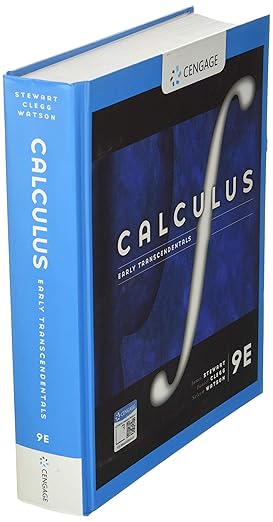
Calculus: Early Transcendentals by James Stewart
- Worldwide bestseller used in thousands of university calculus courses
- Real-world examples that connect abstract concepts to practical applications
- Built-in learning aids, practice exercises, and detailed solutions
- Covers core topics with depth and clarity
- Includes practice problems and worked solutions
- Suitable for self-study and university courses
- Written by a recognized authority in the field
- Clear explanations supported by illustrative examples
This is the book I recommend first to anyone starting calculus. James Stewart’s writing is precise without being dry, and the real-world examples actually help you see why you’re learning each concept. It’s been the go-to textbook in thousands of university courses worldwide, and for good reason. The exercises ramp up in difficulty gradually, so you don’t hit a wall in chapter 3.
Stewart passed away in 2014, but his legacy in mathematics education is hard to overstate. If your course syllabus lists “Stewart Calculus,” this is the edition you want. The early transcendentals approach introduces logarithmic and exponential functions earlier than the standard track, which I think makes the learning flow more natural. If you only buy one calculus textbook, make it this one.
Thomas’ Calculus: Early Transcendentals
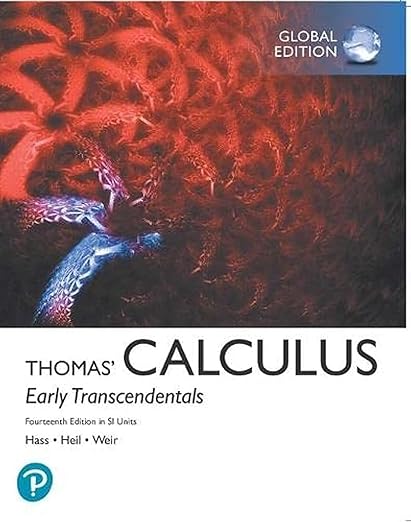
Thomas' Calculus: Early Transcendentals (14th Edition)
- Crystal clear explanations with superior figures and diagrams
- Meticulously selected exercises building technical competence
- Updated by co-authors Maurice Weir and Joel Hass for modern students
- Covers core topics with depth and clarity
- Includes practice problems and worked solutions
- Suitable for self-study and university courses
- Written by a recognized authority in the field
- Used in university courses worldwide
Thomas’ Calculus has been a staple in math departments for over half a century. The diagrams and figures in this book are some of the best I’ve seen in any calculus text. If you’re a visual learner who needs to see what’s happening geometrically before the algebra clicks, Thomas’ Calculus is your book.
The 14th edition, updated by Maurice Weir and Joel Hass, expanded the exercise sets significantly. You’ll find problems ranging from straightforward drill to genuinely challenging proofs. I’ve always thought of this as the “complete reference” calculus book. Stewart might be friendlier for beginners, but Thomas is where you go when you want depth. Many students keep this one on their shelf well into graduate school.
Calculus by Larson and Edwards
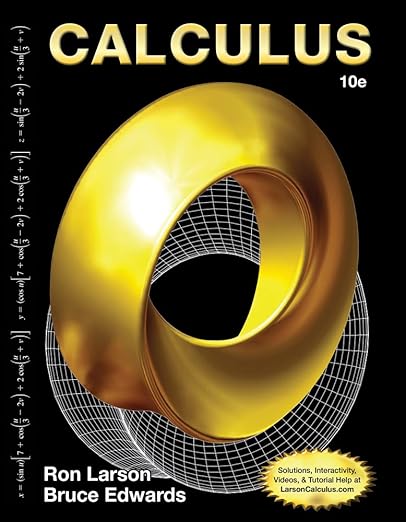
Calculus by Ron Larson and Bruce Edwards
- Proven pedagogy addressing diverse teaching and learning styles
- Detailed solutions to odd-numbered exercises on companion website
- Comprehensive exercise sets with professional presentation
- Covers core topics with depth and clarity
- Includes practice problems and worked solutions
- Suitable for self-study and university courses
- Written by a recognized authority in the field
- Used in university courses worldwide
Larson and Edwards wrote this book for students who learn by doing. The exercise sets are excellent, the explanations are clean, and the companion website with solutions to odd-numbered problems is a real time-saver when you’re studying alone. I’ve recommended this to students who told me Stewart felt too dense.
It’s not a cheap book, but it’s worth the investment if you’re taking calculus seriously. The teaching style adapts well to different learning approaches, which is probably why it’s been adopted by so many universities. If you can only afford one textbook and Stewart isn’t working for you, Larson is the alternative I’d point you to.
Calculus: An Intuitive and Physical Approach by Morris Kline
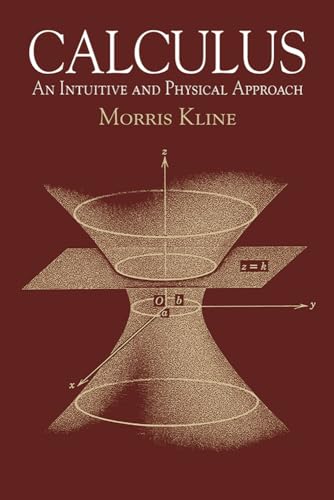
Calculus: An Intuitive and Physical Approach by Morris Kline
- Intuitive geometric approach instead of abstract formalism
- Shows the 'why' alongside the 'how' for every technique
- Real-life relevance demonstrated for each mathematical concept
- Covers core topics with depth and clarity
- Includes practice problems and worked solutions
- Suitable for self-study and university courses
- Written by a recognized authority in the field
- Used in university courses worldwide
This is the book I wish I’d found first. Morris Kline doesn’t ask you to memorize formulas. Instead, he uses geometry and physical intuition to show you what calculus actually means. He explains the “why” alongside the “how,” which is something most standard textbooks skip entirely. You’ll finish a chapter understanding the concept, not just the procedure.
Kline covers derivatives, differentiation, antidifferentiation, the chain rule, trigonometric functions, polar coordinates, and more. Every technique is tied back to a real-world application, so you never feel like you’re learning something pointless. It’s published by Dover, which means it’s significantly cheaper than the big-name textbooks. If you’re someone who asks “but why does this work?” during lectures, Kline’s book will feel like a revelation.
Best Calculus Books for Beginners
If the textbooks above feel intimidating, start here. These books assume you don’t have much background and build your understanding from the ground up. I’ve seen students go from “I hate math” to passing their calculus course with help from these titles.
The Calculus Lifesaver by Adrian Banner
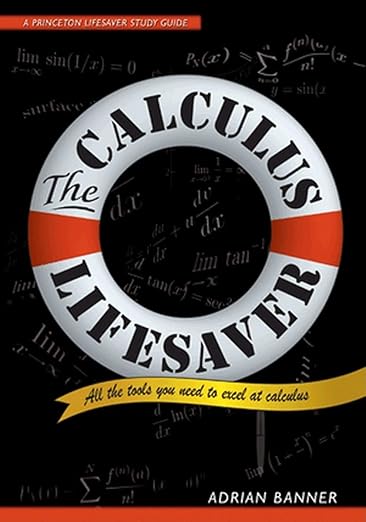
The Calculus Lifesaver: All the Tools You Need to Excel at Calculus
- Friendly, informal writing style that makes calculus approachable
- Varying difficulty examples that build problem-solving skills
- Works as a supplement or standalone single-variable calculus text
- Covers core topics with depth and clarity
- Includes practice problems and worked solutions
- Suitable for self-study and university courses
- Written by a recognized authority in the field
- Used in university courses worldwide
Adrian Banner writes the way a good tutor talks. The tone is informal, the explanations are patient, and the examples range from simple to genuinely challenging. If you’re struggling in a calculus course and your textbook isn’t helping, this book will probably save your grade. It’s designed as a supplement to any single-variable calculus course, but it’s thorough enough to work as a standalone text.
What I love about Banner’s approach is that he builds your problem-solving skills instead of just showing you formulas. Each example is worked through step by step, and the difficulty ramps up naturally. I’ve recommended this to more students than any other book on this list, and the feedback has been overwhelmingly positive. If you’re a beginner, this is your starting point.
Calculus Made Easy by Silvanus P. Thompson
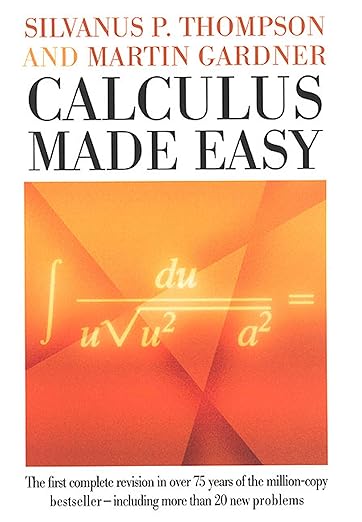
Calculus Made Easy by Silvanus P. Thompson and Martin Gardner
- First published in 1910, sold over a million copies worldwide
- Updated by Martin Gardner with new chapters and practice problems
- Transforms calculus intimidation into curiosity and delight
- Covers core topics with depth and clarity
- Includes practice problems and worked solutions
- Suitable for self-study and university courses
- Written by a recognized authority in the field
- Used in university courses worldwide
A book first published in 1910 that’s still in print and still recommended? That tells you something. Thompson’s premise was simple: once you grasp the fundamentals of differentiation and integration, everything else follows naturally. He was right. This book has sold over a million copies because it takes the fear out of calculus and replaces it with genuine understanding.
Martin Gardner’s revision added three new introductory chapters, updated the terminology, and included 20 additional practice problems. If you’re intimidated by calculus and want a book that treats you like a curious human instead of an equation-solving machine, start here. It’s especially good for students interested in the history and philosophy behind the math. Pair this with a modern textbook like Stewart’s and you’ll have both the intuition and the rigor.
Pre-Calculus for Dummies by Mary Jane Sterling
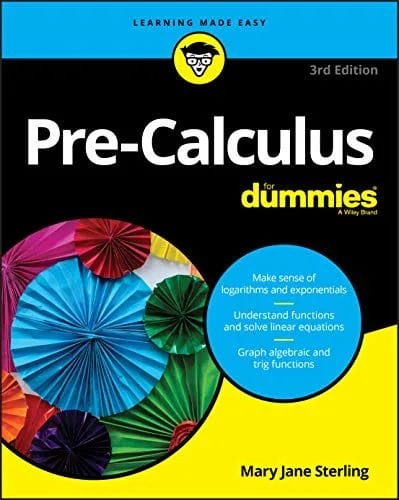
Pre-Calculus for Dummies by Mary Jane Sterling
- Builds foundations in trigonometry, algebra, and pre-calculus
- Explores series, sequences, and graphing common functions
- Practical instructions with examples to build confidence
- Covers core topics with depth and clarity
- Includes practice problems and worked solutions
- Suitable for self-study and university courses
- Written by a recognized authority in the field
- Used in university courses worldwide
Here’s an honest take: if you’re struggling with calculus, the problem might not be calculus itself. It might be your algebra and trig foundations. Pre-Calculus for Dummies fills exactly that gap. It covers trigonometry, sequences, series, and function graphing, all the prerequisites you need before calculus makes sense.
The “For Dummies” branding puts some people off, but the content is solid. Sterling breaks down differentiation and integration into digestible concepts and shows you how to approximate area using integration. If you’re a college student who barely passed algebra, don’t jump into Stewart. Start here, spend 2-3 weeks with this book, and then move to a proper calculus text. You’ll save yourself months of frustration.
Calculus in 5 Hours by Dennis Jarecke
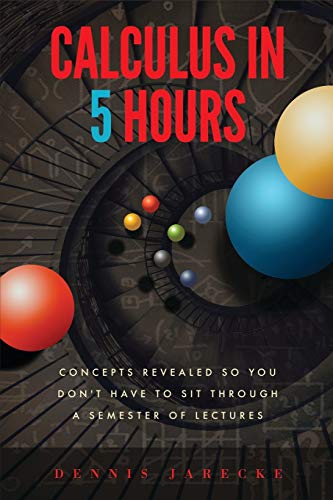
Calculus in 5 Hours: Concepts Revealed So You Don't Have to Sit Through a Semester of Lectures
- Just 124 pages covering 75% of a first-semester calculus course
- Simple examples and drawings to organize your understanding
- Perfect for quick review before exams or refreshing concepts
- Covers core topics with depth and clarity
- Includes practice problems and worked solutions
- Suitable for self-study and university courses
- Written by a recognized authority in the field
- Used in university courses worldwide
Most calculus textbooks run 800 to 1,000 pages. This one is 124. Dennis Jarecke stripped out everything that isn’t essential and focused on the core concepts that make up about 75% of a first-semester course. It’s not a replacement for a full textbook, but it’s the best “night before the exam” resource I’ve found.
I’d use this book in two situations: when you’re just starting and want a quick overview of what calculus is actually about, or when you need to refresh your knowledge fast. The simple examples and drawings help you organize your understanding without drowning in details. Don’t expect depth here. Expect clarity and speed.
The Textbook of Higher Mathematics by S.P. Thompson
The Textbook of Higher Mathematics: Learning Calculus, Integration and Differentiation
- Covers all basic calculus concepts with practical applications
- Updated table of contents with symbols and formulae reference
- Kindle version available at just $2.99, one of the cheapest e-books on calculus
- Covers core topics with depth and clarity
- Includes practice problems and worked solutions
- Suitable for self-study and university courses
- Written by a recognized authority in the field
- Used in university courses worldwide
At $2.99 for the Kindle version, this is one of the cheapest calculus resources you’ll find anywhere. It covers differentiation, integration, and the fundamental concepts you need to get started. The updated edition includes a clean table of contents and handy reference sections for symbols, formulae, and trigonometric functions.
It’s not going to replace a full textbook for a university course, but it’s a solid companion that helps you see calculus from a different angle. If you’re on a tight budget and want to supplement your course materials without spending $200 on another textbook, this is the book to grab. The physical and technical application examples give you real context for abstract concepts.
Best Recreational Books on Calculus
These aren’t textbooks. They’re books about calculus, its history, its beauty, and its surprising connections to everyday life. I think every calculus student should read at least one book from this category. Understanding why calculus exists makes learning how it works much easier.
Infinite Powers by Steven Strogatz
Infinite Powers: How Calculus Reveals the Secrets of the Universe
- Traces calculus from ancient Greece to the discovery of gravitational waves
- Shows real applications: calculating areas, generating electricity, tipping odds against HIV
- Written by Steven Strogatz, one of the most engaging math communicators alive
- Covers core topics with depth and clarity
- Includes practice problems and worked solutions
- Suitable for self-study and university courses
- Written by a recognized authority in the field
- Used in university courses worldwide
Steven Strogatz is probably the best math communicator alive right now, and this book proves it. He traces calculus from its origins in ancient Greece, where people calculated the area of a circle with nothing but sand and a stick, all the way to the modern prediction of gravitational waves. Along the way, he shows how calculus helped generate electricity, ensured rockets didn’t miss the moon, and even tipped the odds in the fight against HIV.
This isn’t a book that teaches you how to solve problems. It’s a book that makes you understand why calculus matters. I read it in two sittings and came away with a completely refreshed appreciation for the subject. At $10.99 (45% off), it’s a steal. If you’re a student who’s lost motivation, or a teacher looking for inspiring material, Infinite Powers is the book I’d hand you first.
Calculus Reordered by David M. Bressoud
Calculus Reordered: A History of the Big Ideas
- Tells the full story of how calculus evolved from Hellenistic Greece to modern day
- Challenges the standard curriculum order (limits, derivatives, integrals, series)
- Shows how astronomy and engineering drove the development of calculus
- Covers core topics with depth and clarity
- Includes practice problems and worked solutions
- Suitable for self-study and university courses
- Written by a recognized authority in the field
- Used in university courses worldwide
David Bressoud makes an argument in this book that I’ve believed for years: the way calculus is taught in most classrooms doesn’t match how it was actually developed. The standard curriculum goes limits, then differentiation, then integration, then series. Historically, it happened in a completely different order, and Bressoud argues the historical sequence makes more intuitive sense.
He traces the evolution from the Hellenistic Eastern Mediterranean through Newton and Leibniz to the 19th-century restructuring that gave us today’s curriculum. If you’ve ever felt like your calculus course jumped around without logic, this book explains why. It’s aimed at students and educators who want a deeper understanding of the subject’s intellectual history. Not light reading, but genuinely rewarding.
Change Is the Only Constant by Ben Orlin
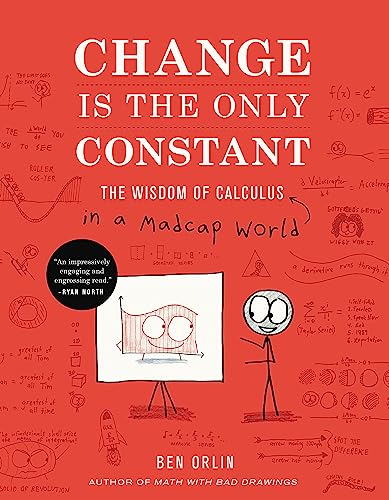
Change Is the Only Constant: The Wisdom of Calculus in a Madcap World
- 28 mathematical stories connecting calculus to literature, art, and daily life
- Witty humor and charmingly bad drawings make concepts stick
- Two sections: 'Moments' (derivatives) and 'Eternities' (integrals)
- Covers core topics with depth and clarity
- Includes practice problems and worked solutions
- Suitable for self-study and university courses
- Written by a recognized authority in the field
- Used in university courses worldwide
Ben Orlin runs the popular “Math with Bad Drawings” blog, and this book brings that same energy to calculus. Through 28 stories, he connects calculus to David Foster Wallace, Mark Twain, Sherlock Holmes, and a beloved dog named Elvis. The book is split into “Moments” (derivatives) and “Eternities” (integrals), which is a clever framing that actually helps the concepts land.
If you think math is boring, I dare you to read this and still feel the same way. The hand-drawn illustrations are intentionally terrible and somehow make the explanations clearer. It’s filled with riddles, paradoxes, and fables that make calculus feel like a story rather than a chore. This is the book I’d give to someone who says “I’m just not a math person.” At nearly 50% off right now, it’s worth grabbing even if it just sits on your nightstand for a while.
Best Self-Help Guides on Calculus
These books are built around practice. If you’ve understood the theory but keep bombing your exams, the problem is almost certainly that you haven’t solved enough problems. These four books will fix that, and they’re some of the best study tools for college students tackling calculus.
Quick Calculus by Daniel Kleppner
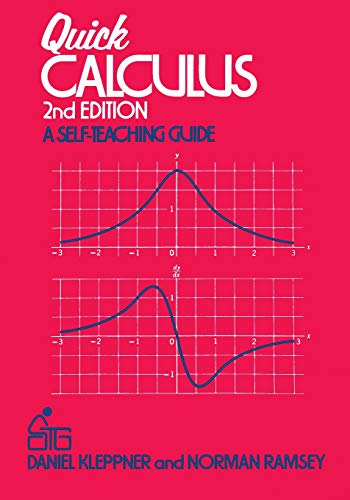
Quick Calculus: A Self-Teaching Guide (2nd Edition)
- Self-instructional format: correct answers unlock new material
- Covers differential and integral calculus fundamentals concisely
- Ideal for both students and professionals refreshing their skills
- Covers core topics with depth and clarity
- Includes practice problems and worked solutions
- Suitable for self-study and university courses
- Written by a recognized authority in the field
- Used in university courses worldwide
Daniel Kleppner built this book like a choose-your-own-adventure for math. You solve a problem. If you get it right, you move to new material. If you get it wrong, the book explains what you missed and gives you another shot. It’s a format that works well for self-study because you can’t just skip ahead without understanding what came before.
Calculus shows up everywhere, from physics and chemistry to ecology and economics. If you’re a professional who needs to brush up on calculus basics, or a student taking a self-paced course, Quick Calculus is your most efficient path. The second edition added calculator integration and more worked examples. At under $27, it’s one of the best values on this list.
Princeton Review AP Calculus BC Prep
Princeton Review AP Calculus AB Prep: Practice Tests + Content Review + Strategies
- 5 full-length practice tests with detailed answer explanations
- Targeted strategies for identifying traps and maximizing your score
- Online access to formula lists, pre-college resources, and bonus content
- Covers core topics with depth and clarity
- Includes practice problems and worked solutions
- Suitable for self-study and university courses
- Written by a recognized authority in the field
- Used in university courses worldwide
If you’re specifically preparing for the AP Calculus exam, this is the prep book to get. The Princeton Review has been in the test prep business since 1981, and their strategies for identifying exam traps are genuinely useful. The book includes 5 full-length practice tests, complete content review, and access to online resources including a comprehensive formula list.
At $2.36 (88% off the original price), this is practically free. Even if you’re not taking the AP exam, the practice tests and strategy sections are valuable for any calculus student preparing for finals. The techniques they teach for assessing your progress during prep have saved plenty of students from walking into an exam underprepared. Grab it while the price is this low.
The Humongous Book of Calculus Problems by W. Michael Kelley
The Humongous Book of Calculus Problems
- 1,000 problems with detailed, step-by-step solutions and no skipped steps
- Annotated notes explain what each problem is really asking
- Covers derivatives, integrals, limits, infinite series, Riemann sums, and epsilon-delta proofs
- Covers core topics with depth and clarity
- Includes practice problems and worked solutions
- Suitable for self-study and university courses
- Written by a recognized authority in the field
- Used in university courses worldwide
I hate when math books show a solution and skip 3 steps in the middle. W. Michael Kelley doesn’t do that. Every single one of the 1,000 problems in this book comes with a complete, step-by-step solution. No missing steps. No “it’s obvious that…” jumps. Kelley is an award-winning calculus teacher and the founder of calculus-help.com, and you can feel his teaching experience on every page.
The annotated notes alongside each problem explain what’s actually being asked, which is something students often struggle with more than the math itself. It covers everything from basic limits and derivatives to advanced topics like formal Riemann sums and epsilon-delta proofs. If you’re looking for a problem bank to grind through before your exam, this is the one. At $22.49, you’re paying about 2 cents per solved problem.
Essential Calculus Skills Practice Workbook by Chris McMullen
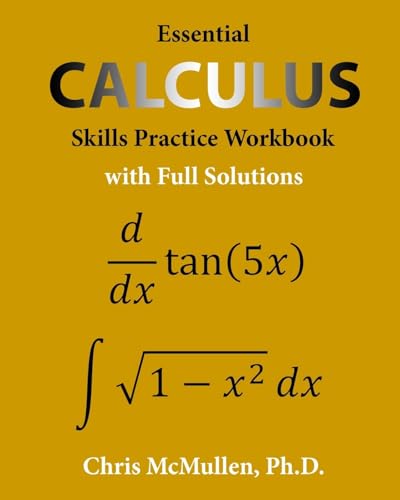
Essential Calculus Skills Practice Workbook with Full Solutions
- Focused on the most crucial skills: derivatives, chain rule, integration techniques
- Detailed solutions for every problem, written by a 20+ year physics professor
- Designed for engineering and physics students who need applied calculus skills
- Covers core topics with depth and clarity
- Includes practice problems and worked solutions
- Suitable for self-study and university courses
- Written by a recognized authority in the field
- Used in university courses worldwide
Chris McMullen has been teaching calculus to physics students for over 20 years, and this workbook reflects that practical experience. It doesn’t try to cover every topic in calculus. Instead, it zeroes in on the skills you’ll actually use: polynomial derivatives, trig functions, exponentials, logarithms, the chain rule, product rule, quotient rule, and integration techniques.
If you’re an engineering or physics student, this book is built specifically for you. The problems focus on applied calculus skills rather than abstract theory, and every single problem has a detailed solution. At $12.64, it’s cheaper than a pizza and infinitely more useful for your GPA. I’d pair this with a full textbook like Stewart’s or Thomas’ for the complete package.
Best Books on Practical Applications of Calculus
Once you’ve mastered the fundamentals, these books show you how calculus is used in the real world. Finance, biology, engineering, social sciences, you name it. Calculus isn’t just a course you survive. It’s a tool that powers serious work across multiple fields.
Introduction to Stochastic Calculus with Applications by Fima C. Klebaner
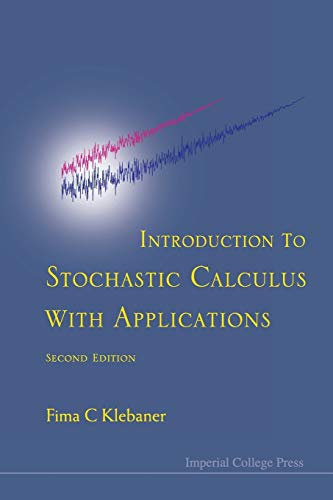
Introduction to Stochastic Calculus with Applications (2nd Edition)
- Covers stochastic calculus applications in finance, engineering, and biology
- Requires only basic calculus and probability as prerequisites
- Numerous solved examples build from simple concepts to general results
- Covers core topics with depth and clarity
- Includes practice problems and worked solutions
- Suitable for self-study and university courses
- Written by a recognized authority in the field
- Used in university courses worldwide
Stochastic calculus is the branch of mathematics that deals with random processes, and it’s the backbone of modern quantitative finance, options pricing, and risk modeling. If you’re eyeing a career in financial mathematics, this book by Fima Klebaner is the standard first text on the subject. It assumes only basic calculus and probability knowledge, which makes it accessible to upper-level undergraduates.
The approach is example-driven. Klebaner introduces concepts through worked problems and gradually builds to the general theory. He covers the most important models in finance, engineering, and biology in solid detail. At $51, it’s not cheap, but stochastic calculus textbooks rarely are. For graduate students and researchers looking to break into this field, it’s a worthwhile investment. This is also a strong pick if you’re interested in how calculus connects to statistical mechanics.
Brief Applied Calculus by Geoffrey Berresford and Andrew Rockett
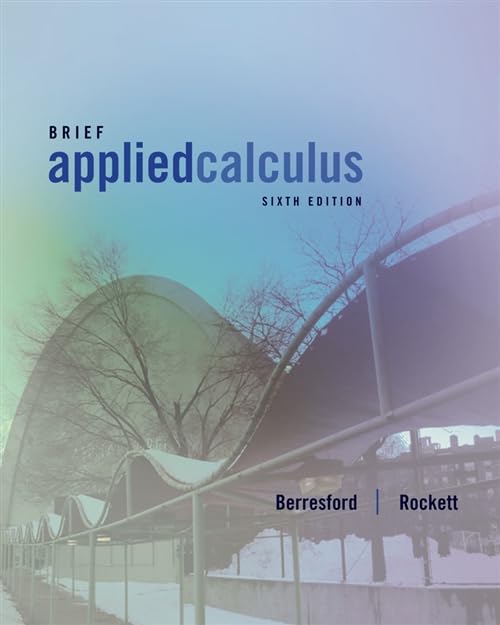
Brief Applied Calculus (6th Edition)
- Real-world applications: Dead Sea Scrolls dating, stock prices, airplane learning curves
- End-of-section exercises using real data with citations to original sources
- Graphing calculator and spreadsheet coverage with worked examples
- Covers core topics with depth and clarity
- Includes practice problems and worked solutions
- Suitable for self-study and university courses
- Written by a recognized authority in the field
- Used in university courses worldwide
Originally priced at $299.95 and now available for under $26, this is one of the best deals on this entire list. Brief Applied Calculus focuses on showing you what calculus actually does in the real world. The applications range from dating the Dead Sea Scrolls to analyzing airplane production learning curves to calculating lives saved by seat belts.
What I like about this book is that every exercise at the end of each section uses real data with citations to the original sources. You’re not solving hypothetical problems. You’re solving actual problems from business, science, and finance. The graphing calculator and spreadsheet coverage is a nice bonus for students who want to use technology alongside their manual calculations. At 91% off retail, don’t sleep on this one.
Calculus for Business and Entrepreneurs
If you’re studying business, economics, or social sciences, you don’t need the full engineering-track calculus. These two books teach you exactly the calculus you need for your field, nothing more, nothing less.
Calculus for Business, Economics, Life Sciences, and Social Sciences
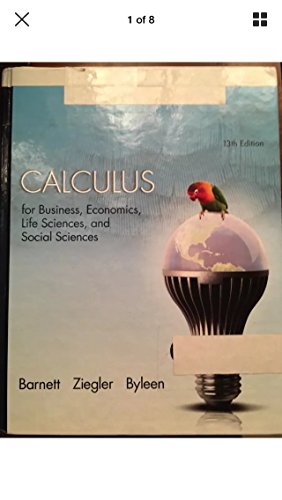
Calculus for Business, Economics, Life Sciences, and Social Sciences
- Deeper guidance than typical business calculus texts with self-study features
- Strong emphasis on prerequisite skills and real-world applications
- Latest edition with refreshed design, updated data, and new applications
- Covers core topics with depth and clarity
- Includes practice problems and worked solutions
- Suitable for self-study and university courses
- Written by a recognized authority in the field
- Used in university courses worldwide
Raymond Barnett, Michael Ziegler, and Karl Byleen wrote this specifically for non-engineering students who need calculus. If you’re a business, economics, biology, or social science major, this book covers exactly what you need without dragging you through the engineering-heavy material that’s irrelevant to your field.
At $176.85, it’s the most expensive book on this list, but it goes deeper than any other business calculus text I’ve seen. The emphasis on prerequisite skills means you won’t get stuck on algebra when you’re trying to learn calculus. The latest edition refreshed the design and updated all the application data to reflect current examples. If your program requires a business calculus course, this is likely the textbook your professor will assign, and it’s one of the few where that’s actually a good thing.
Business Calculus Demystified by Rhonda Huettenmueller
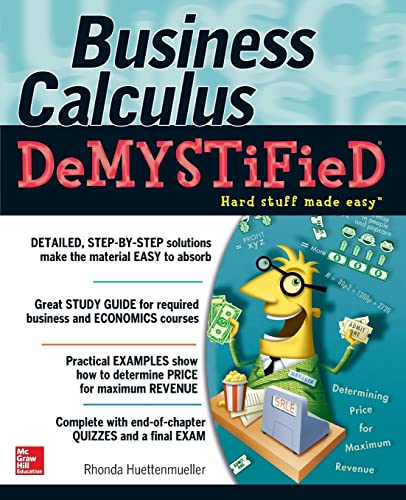
- Applies calculus directly to real-world business scenarios and problems
- Self-paced learning with multiple-choice quizzes and a final exam
- Makes differentiation and integration accessible for business professionals
- Covers core topics with depth and clarity
- Includes practice problems and worked solutions
- Suitable for self-study and university courses
- Written by a recognized authority in the field
- Used in university courses worldwide
If the Barnett textbook feels like overkill for your needs, Rhonda Huettenmueller’s book is the lighter, more affordable alternative. At $19.45, it covers the same business calculus concepts but in a self-paced format with quizzes at the end of every chapter and a full “final exam” at the back.
Huettenmueller is a bestselling math author who knows how to make differentiation and integration feel less intimidating for business students. The book is engaging without being dumbed down, and the real-world business applications keep everything grounded. If you’re a business major who needs to pass a calculus course and wants to actually understand the material rather than just memorize procedures, this is your book. I’d pick this over the Barnett text if budget is a concern.
Bonus: The Princeton Companion to Mathematics
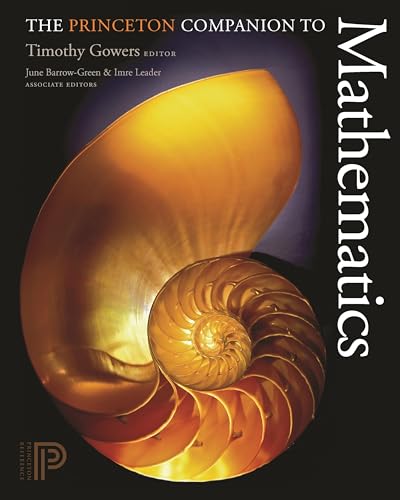
The Princeton Companion to Mathematics
- Comprehensive reference covering all major branches of mathematics
- Written by top mathematicians in accessible, engaging prose
- Perfect companion to any calculus textbook for broader mathematical context
- Covers core topics with depth and clarity
- Includes practice problems and worked solutions
- Suitable for self-study and university courses
- Written by a recognized authority in the field
- Used in university courses worldwide
If you’re serious about mathematics, pair your top 2-3 calculus picks with this book. The Princeton Companion to Mathematics covers every major branch of math in accessible prose written by top mathematicians. It puts calculus into the broader context of mathematics as a whole, which gives you a perspective that individual textbooks simply can’t provide. At 38% off, it’s a solid investment in your mathematical education.
How to Choose the Right Calculus Book
Don’t overthink this. Here’s my recommendation based on where you are right now:
- Complete beginner with weak math foundations: Start with Pre-Calculus for Dummies, then move to The Calculus Lifesaver
- First-semester calculus student: Stewart’s Calculus: Early Transcendentals as your main text, with The Humongous Book for practice
- Visual learner who needs intuition: Kline’s Calculus: An Intuitive and Physical Approach
- AP Calculus exam prep: Princeton Review AP Calculus Prep + Essential Calculus Skills Workbook
- Business or economics major: Business Calculus Demystified (budget) or Barnett’s Calculus for Business (comprehensive)
- Want to fall in love with the subject: Infinite Powers by Strogatz or Change Is the Only Constant by Orlin
- Engineering or physics track: Thomas’ Calculus for theory, Essential Calculus Skills for practice
- Graduate-level applied math: Introduction to Stochastic Calculus
My personal top 3 picks are Stewart’s Early Transcendentals (#1), Thomas’ Calculus (#2), and Larson & Edwards (#3). Combine any of these with The Princeton Companion to Mathematics and you’ll have a rock-solid foundation for years of mathematical study. You can also check out my list of must-read books for programmers if you’re in computer science, since calculus plays a big role in algorithms and machine learning.
Most of these books have Kindle versions available as well. If you’re a heavy reader or a serious student, subscribing to Kindle Unlimited can save you a lot of money on textbooks over time.
Best E-Readers for Math Textbooks
I’ve spent more money on calculus textbooks than any other subject. Stewart’s Calculus alone costs over $200 in hardcover. The Kindle edition is half that, and you can search for any theorem or formula instantly.
If you’re buying multiple calc books (and most serious students do), a Kindle Paperwhite pays for itself within the first semester. The battery lasts weeks, the screen is easy on your eyes, and you can carry every textbook without the backpack weight. For complementary tools, check my list of the best math apps and digital tools.
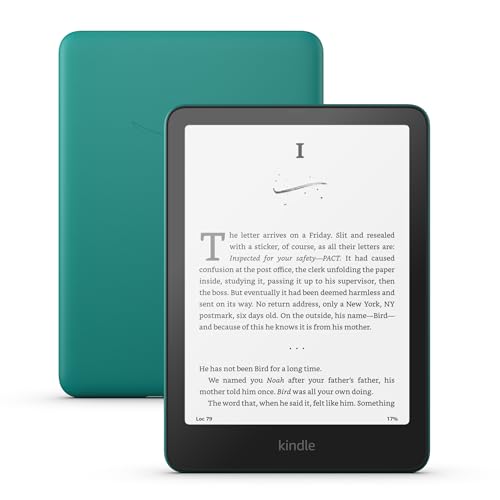
- Our fastest Kindle ever – The next-generation 7“ Paperwhite display has a higher contrast ratio and 25% faster page turns.
- Ready for travel – The ultra-thin design has a larger glare-free screen so pages stay sharp no matter where you are.
- Escape into your books – Your Kindle doesn’t have social media, notifications, or other distracting apps.
- Battery life for your longest novel – A single charge via USB-C lasts up to 12 weeks.
- Read in any light – Adjust the display from white to amber to read in bright sunlight or in the dark.
- Covers core topics with depth and clarity
- Includes practice problems and worked solutions
- Suitable for self-study and university courses
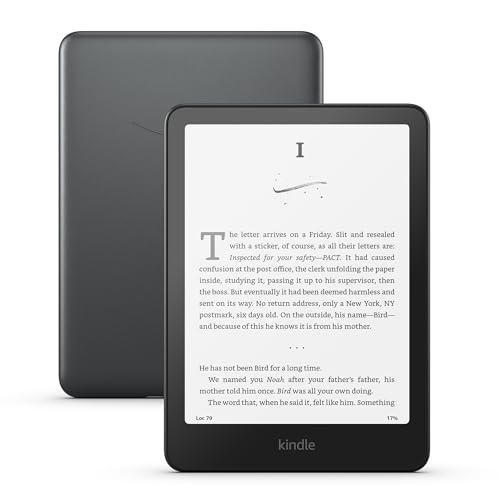
- Our fastest Kindle ever – The next-generation 7“ Paperwhite display has a higher contrast ratio with 25% faster page turns.
- Upgrade your reading experience – The Signature Edition features an auto-adjusting front light, wireless charging, and 32 GB storage.
- Ready for travel – The ultra-thin design has a larger glare-free screen so pages stay sharp no matter where you are.
- Escape into your books – Your Kindle doesn’t have social media, notifications, or other distracting apps.
- Adapts to your surroundings – The auto-adjusting front light lets you read in the brightest sunlight or late into the night.
- Covers core topics with depth and clarity
- Includes practice problems and worked solutions
- Suitable for self-study and university courses
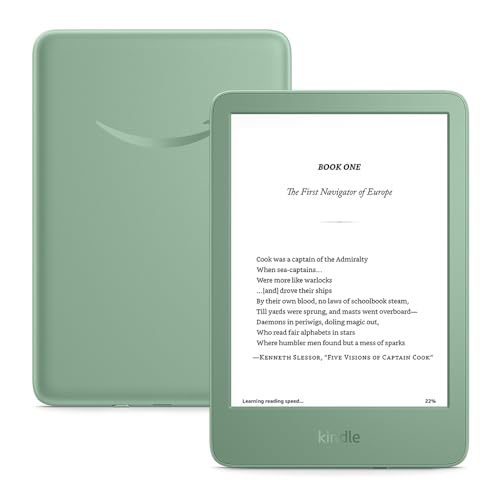
- The lightest and most compact Kindle – Now with a brighter front light at max setting, higher contrast ratio, and faster page turns for an enhanced reading experience.
- Effortless reading in any light – Read comfortably with a 6“ glare-free display, adjustable front light, now 25% brighter at max setting, and dark mode.
- Escape into your books – Tune out messages, emails, and social media with a distraction-free reading experience.
- Read for a while – Get up to 6 weeks of battery life on a single charge.
- Take your library with you – 16 GB storage holds thousands of books.
- Covers core topics with depth and clarity
- Includes practice problems and worked solutions
- Suitable for self-study and university courses
Frequently Asked Questions
What is the best calculus textbook for beginners in 2026?
For complete beginners, I recommend The Calculus Lifesaver by Adrian Banner. It’s written in an informal, approachable style and builds your problem-solving skills gradually. If your math foundations are weak, start with Pre-Calculus for Dummies first to fill in the gaps. For a full university-level textbook, Stewart’s Calculus: Early Transcendentals is the gold standard that most professors assign.
Can I learn calculus on my own without a class?
Yes, but you need the right resources. Quick Calculus by Kleppner is specifically designed for self-study, with a built-in feedback system that tests your understanding at every step. Pair it with The Humongous Book of Calculus Problems for practice, and you can absolutely learn calculus independently. The key is doing problems consistently, not just reading explanations.
Which calculus book has the most practice problems with solutions?
The Humongous Book of Calculus Problems by W. Michael Kelley has 1,000 problems, all with complete step-by-step solutions and no skipped steps. Essential Calculus Skills Practice Workbook by Chris McMullen is another strong option with fully solved problems, though it focuses specifically on the most commonly tested skills rather than covering every topic.
What’s the cheapest way to learn calculus from books?
The Textbook of Higher Mathematics is available on Kindle for just $2.99, and Essential Calculus Skills Workbook is $12.64. Calculus Made Easy by Thompson is a Dover publication and typically very affordable. The Princeton Review AP Calculus Prep is currently 88% off at $2.36. You can build a solid calculus library for under $30 if you pick the right books.
Is Stewart’s Calculus better than Thomas’ Calculus?
Both are excellent, but they serve slightly different needs. Stewart is more beginner-friendly with a smoother learning curve and better real-world examples. Thomas’ Calculus has superior diagrams and goes deeper into theory, making it better for students who want rigorous mathematical understanding. If you’re just starting calculus, go with Stewart. If you want a reference you’ll use through graduate school, Thomas is the better long-term investment.
Do I need a separate book for multivariable calculus?
The main textbooks by Stewart, Thomas, and Larson all cover multivariable calculus in their later chapters. You don’t need a separate book unless you want supplementary practice. The Humongous Book of Calculus Problems also covers multivariable topics. If you’re specifically struggling with multivariable concepts, Kline’s Intuitive and Physical Approach provides excellent geometric intuition that helps with 3D visualization.
Which calculus book is best for business and economics students?
Business Calculus Demystified by Rhonda Huettenmueller is the best value at $19.45 and covers everything a business student needs. If your program requires a comprehensive textbook, Calculus for Business, Economics, Life Sciences, and Social Sciences by Barnett is the standard, though it’s significantly more expensive at $176.85. Brief Applied Calculus by Berresford is a great middle ground at $25.97 with excellent real-world applications.
How many calculus books should I actually buy?
Two or three, maximum. You need one main textbook (Stewart, Thomas, or Larson), one practice book (Humongous Book or Essential Calculus Skills), and optionally one recreational book (Infinite Powers or Change Is the Only Constant) for motivation. Buying more than three calculus books usually means you’re procrastinating instead of actually solving problems. Pick your stack and work through it consistently.
So many of the doorstop sized books are well over $100 for the current edition. But many of the -1 or -2 editions are under $20. These slightly older versions were once the last word in calculus pedagogy. Are the changes really all that significant?
For background, I studied math at a well known Eastern university over 50 (yes!) years ago and I’m trying to, I guess, recapture my youth by relearning my forgotten knowledge.