Business Success Tips for Small Business Owners
 by
by

Business success tips usually come in 2 flavors, and both are useless. One is the poster on the wall: believe in yourself, hire great people, embrace change. The other is a list of 40 tools you should adopt this quarter. Neither explains why roughly half of new businesses are gone within 5 years, and neither tells you what the surviving half did differently.
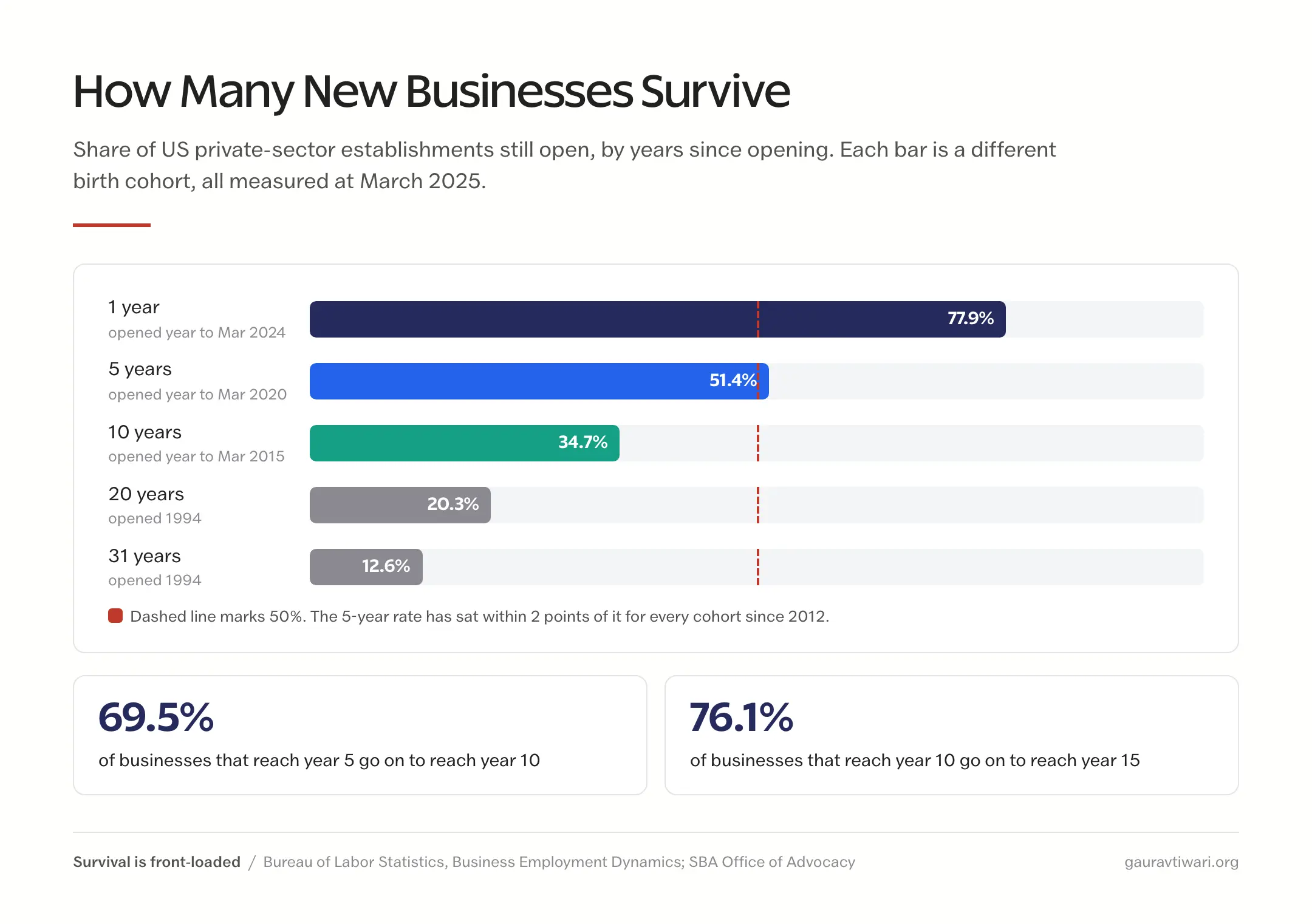
The survival data does. The Bureau of Labor Statistics tracks every new establishment by the year it opened, and the curve is the same decade after decade: about 78% make it through year 1, about 51% reach year 5, and about 35% reach year 10. The drop is steepest early. So the tips that matter are the ones that get a business through the first 5 years with cash in the account and customers who come back.
Success in the first 5 years is mostly a cash problem and a demand problem. Everything else is a luxury you earn after that.
How Long Businesses Actually Last
The Bureau of Labor Statistics has followed every new US establishment cohort since March 1994, recording how many are still open each subsequent March. It’s the longest clean series on the question, and the shape barely moves between cohorts, which is what makes it useful for planning rather than for headlines.
| Years open | Still operating | What it means for you |
|---|---|---|
| 1 year | 77.9% | The first year kills about 1 in 5, mostly on cash, not competition |
| 5 years | 51.4% | The coin-flip mark, and the one worth planning to clear |
| 10 years | 34.7% | Clear year 5 and roughly 70% of survivors reach year 10 |
| 20 years | 20.3% | 1 in 5 of the original cohort is still trading |
| 31 years | 12.6% | The longest cohort BLS has followed, opened in 1994 |
Cohorts measured as of March 2025. The row that changes behavior is the third one: survival is not a smooth decline, it’s a steep early drop followed by a long plateau. Getting to year 5 is most of the work.
On cash specifically, the most thorough study of the question is still JPMorgan Chase Institute’s analysis of 470 million transactions across 597,000 small businesses, using data from February to October 2015. The median business held 27 cash buffer days, meaning 27 days of ordinary outflows covered by cash on hand if inflows stopped. It split hard by sector: about 19 days in low-wage industries like restaurants and retail, about 31 days in professional and high-tech services.
That study is a decade old and no one has repeated it at that scale, so treat 27 days as the structural picture rather than today’s number. The structure is the point. Half of small businesses have under a month of air, which is why a weekly cash view beats an annual budget.
Count your own buffer days before you trust anyone’s median.
Know Your Runway Every Week
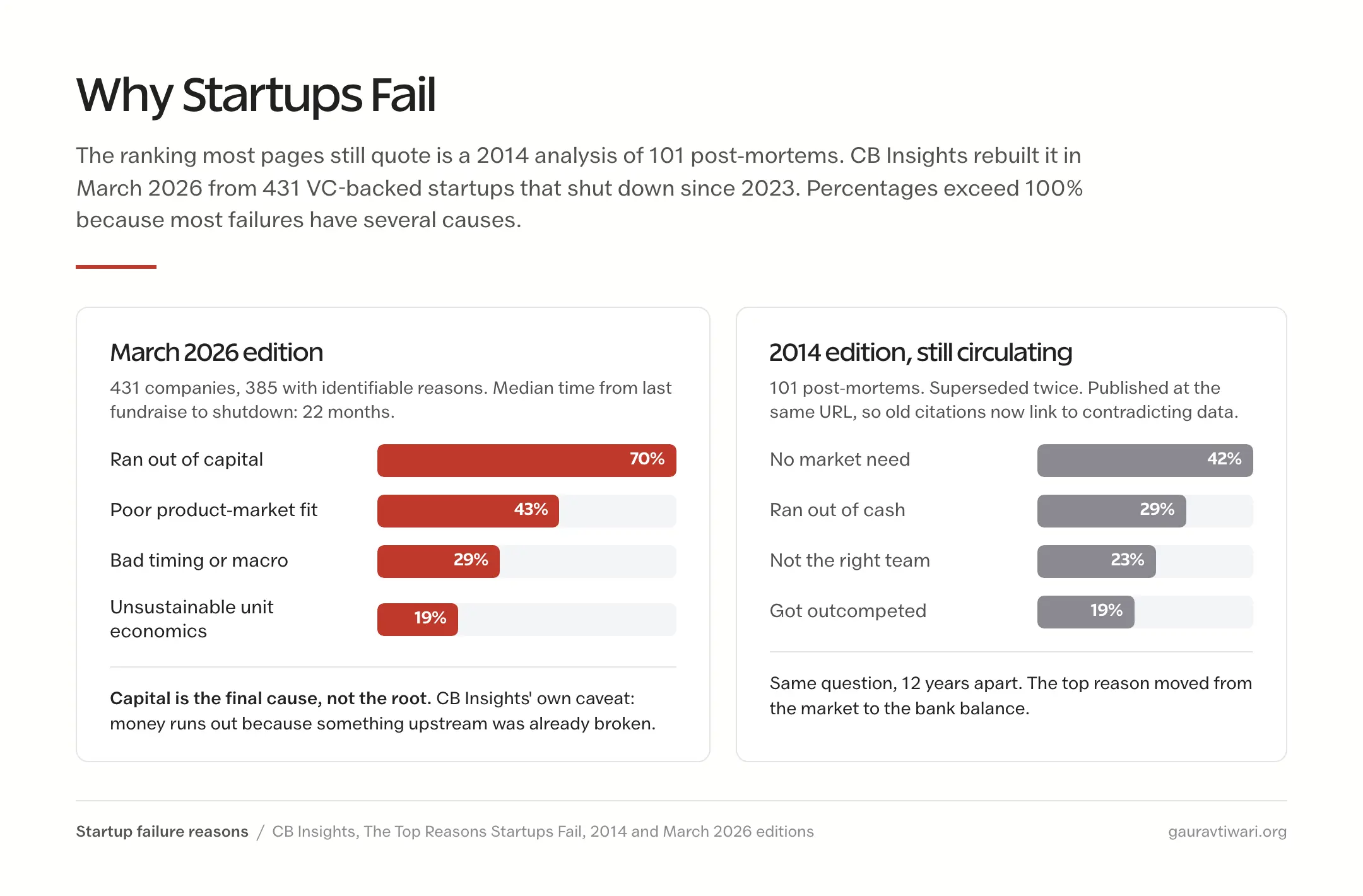
When CB Insights rebuilt its analysis of failed startups in March 2026, the top reason, at 70%, was running out of capital. Not a bad idea. Not a bad team. The money ended before the business did. The same pattern shows up in small businesses that never raised a cent, just with smaller numbers and a quieter ending.
The fix isn’t a yearly budget, which hides a problem that arrives in March. It’s a weekly cash view for the first few years. Opening cash, plus what you expect to collect this week, minus what goes out, equals closing cash. Run it 13 weeks ahead and you’ll see the bad month 2 months before it happens, which is enough time to chase invoices, delay a purchase, or cut a cost.
Most owners can’t answer “how many weeks of cash do we have” without opening a spreadsheet. The ones who last know the number the way they know their own phone number. My cash flow forecast template has the 13-week model ready to fill in, and the cash flow killers piece names the leaks that drain businesses that look profitable on paper.
Know the number.
Prove 1 Channel Before You Spread
The second reason on the CB Insights chart, poor product-market fit at 43%, is the polite way of saying not enough people wanted it at that price. Demand is proven by repeat customers, not by a launch day. A business with 1 channel that reliably produces buyers is safer than one with 6 channels that each produce a trickle, because the 1 can be funded, measured, and grown.
Pick the channel by where your buyers already look. A local service business lives or dies on Google Maps and reviews. A niche product lives on search and a handful of comparison pages. A consultant lives on referrals and 1 platform where the right people read. Fund that 1 channel until it works, and only then add the second. Spreading a small budget across everything is how you learn nothing from any of it.
If you’re doing the marketing yourself around the actual work, my 10-hour marketing plan for solopreneurs is built around exactly this 1-channel discipline.
Give the Website 1 Job
A business website has 1 job: turn the visitor into a contact, a sale, or a subscriber. Most small business sites try to be a brochure, a blog, a portfolio, and a mission statement at once, and do none of them well enough to earn the next step.
The site that works answers 3 questions above the fold: what you do, who it’s for, and what to do next. It loads in under 3 seconds on a phone, because that’s where most visitors are. And every page ends in the same 1 action, so the visitor never has to wonder. Search visibility follows from that clarity more than from any trick, and the strategies to rank your business in search all assume the site already does its 1 job.
1 page, 1 ask.
Put the Boring Systems In Early
Nobody starts a business to do bookkeeping. But the businesses that reach year 5 have a short list of unglamorous systems running in the background, and the ones that don’t usually discover the gap at the worst possible moment: a tax deadline, a lost laptop, a client dispute with no contract to point at.
- Separate money. A business account, a business card, and a ledger that reconciles. Mixing personal and business cash is the fastest way to not know whether you’re profitable.
- Contracts for everything. Scope, payment terms, what counts as done. A 1-page agreement prevents most of the disputes a 30-page one would.
- Backups you’ve restored once. A backup that’s never been tested is a hope, not a backup.
- A filing calendar. Every tax and compliance date on 1 calendar with a reminder 2 weeks before. Penalties are the most avoidable cost in business.
- Written delivery. How a customer goes from paying to receiving, step by step, so it happens the same way when you’re sick.
None of these grow revenue. All of them stop the events that end businesses that were otherwise growing.
Use AI Where It Removes Measured Work
The Census Bureau’s business survey found that 7.6% of US businesses used AI in the year to August 2025. That number surprises people who read the headlines, and it points at something useful: most of your competitors haven’t started, so the advantage is available, and most businesses that try it don’t get much from it, so the advantage isn’t automatic.
The businesses that benefit use AI on a task they already measure. Drafting the first version of 20 product descriptions that a person then edits. Summarizing support tickets into the 5 complaints that repeat. Turning a recorded sales call into a follow-up email. In each case there’s a before number, hours or cost, and an after number. Buying a subscription because everyone else has one produces a line item and nothing else. My guide to AI and automation for small business separates the uses that pay from the ones that only look modern.
Measure first, then automate.
Lead by Deciding
Leadership advice for small businesses tends to borrow from companies with 10,000 employees, where culture is a program. In a business with 4 people, culture is whatever the owner does on a bad Tuesday. The leadership that keeps a small business alive is mostly the willingness to make the unpopular call early: drop the client who pays late, stop the product line that doesn’t sell, say no to the custom request that would eat a month.
The second half is keeping the people who are good. In a small team, losing 1 strong person is losing a quarter of the company. Pay them what they’re worth before a competitor does, give them work that uses what they’re good at, and tell them the truth about the numbers. People stay where they can see the plan.
The Limits
None of this helps a business whose product nobody wants. The survival curve measures establishments that opened, and plenty of them opened on an idea the market had already rejected. Cash discipline extends the time you have to find demand. It doesn’t create demand, and if 12 months of 1-channel effort produce no repeat customers, the answer is a different offer, not a better spreadsheet.
The figures here are US data, because the US publishes the cleanest long series. The shape of the curve is similar elsewhere. The exact percentages aren’t, so if you’re in India or the UK, treat the numbers as a pattern and your own cash forecast as the fact.
What Quietly Ruins It
Treating revenue as cash. A $40,000 month with $35,000 still in unpaid invoices is a $5,000 month until the money lands, and payroll doesn’t wait for the client’s accounts team.
Growing before the delivery works. Every new customer multiplies whatever is broken in fulfillment, so a flawed process at 10 customers becomes a reputation problem at 50.
Buying tools to feel like a business. Each subscription seemed small and the total now exceeds the marketing budget. Audit them quarterly and cancel anything you can’t name a use for.
Hiring to reduce your own workload. A hire should add capacity that produces revenue or removes a measured cost. Hiring so you can stop doing the books is a $50,000 solution to a $2,000 problem.
Avoiding the numbers because they’re bad. The owners who survive a bad quarter are the ones who looked at it in week 2. The ones who looked in week 12 had fewer options left.
Final Remarks
Business success isn’t a mindset and it isn’t a stack. It’s getting to year 5 with cash, customers who return, and systems that hold when you’re not looking. The full set of numbers behind that claim is in my business statistics roundup, and they say the same thing every year: the businesses that fail mostly ran out of money while looking for demand.
The trade is that the work that keeps you alive is boring. Weekly cash, 1 channel, 1 job for the website, contracts and backups. None of it makes a good story at a dinner party.
Do the boring work first, and the interesting work gets to happen.
Tell Google you want more of this.
Add Gaurav Tiwari as a preferred sourceOne tap, and this site shows up more often in your own Top Stories, AI Overviews and AI Mode. Remove it any time.