by
by
The moment you realize you deleted the wrong folder, emptied the recycle bin, or your hard drive won’t boot, data recovery software is the only thing standing between you and panic. The good news: most deleted files are still on your drive until something overwrites them. The bad news: every second you wait and every new file you save reduces recovery chances. Pick the right data recovery software, stop using the affected drive, and run recovery fast.
I’ve used data recovery tools across dozens of disaster scenarios: accidentally formatted hard drives, SD cards that won’t mount, Recycle Bin emptied with years of work inside, ransomware encrypted folders, crashed laptops that won’t boot. Some tools recovered everything. Some recovered 80%. Some recovered nothing. The difference is usually which tool you pick and how quickly you act.
This guide covers 17 data recovery software options for Windows, Mac, and Linux in 2026, from free open-source tools (TestDisk, PhotoRec) to professional services (Ontrack, DriveSavers). Most people need the free tools or affordable commercial software like Recuva or EaseUS. The expensive ones are for catastrophic failures only. Before anything else: stop writing to the affected drive immediately.
Best Data Recovery Software at a Glance
Start with Recuva if you’re on Windows and PhotoRec if you’re not, because free comes first in my book. If I’m paying for one of these, I’m paying for EaseUS. Disk Drill is my Mac default, with iBoysoft as the specialist when APFS or encryption is involved. And if the drive is clicking, close this page and call a lab, because software cannot fix mechanics.
- Recuva: Best free data recovery software for Windows with recycle bin recovery and deep scan modes
- EaseUS Data Recovery Wizard: Best paid data recovery software with high success rate across Windows, Mac, and mobile devices
- Stellar Data Recovery: Best data recovery software for severe drive damage with RAID, encrypted drive, and formatted partition support
- Disk Drill: Best data recovery software for Mac with preview, byte-level backup, and partition recovery, sold as a one-time licence
- Wondershare Recoverit: Best data recovery software for video and photo recovery with advanced media repair tools
- TestDisk: Best free open-source partition recovery tool for fixing boot issues and rebuilding partition tables (FOSS)
- PhotoRec: Best free open-source file recovery tool specializing in photo, video, and document recovery (FOSS)
- MiniTool Power Data Recovery: Best free data recovery software with 1GB free recovery and clean interface
- Ontrack EasyRecovery: Best professional data recovery software with enterprise-grade recovery for complex failures
- Remo Recover: Best affordable data recovery software with formats specialized for photos, videos, and Outlook PST files
- iBoysoft Data Recovery: Best data recovery software for Mac with APFS and encrypted Mac drive support
- Tenorshare 4DDiG: Best data recovery software with support for iOS and Android device recovery alongside computers
- R-Studio: Best professional data recovery software for IT technicians and advanced users with forensic-level features
- Acronis Cyber Protect Home Office: Best backup software that includes data recovery and ransomware protection
- Time Machine: Best free Mac backup solution built into macOS for automatic hourly backups and file restoration
- DMDE: Best advanced data recovery tool for RAID reconstruction, partition analysis, and byte-level recovery
- Windows File History and File Recovery: Best free Windows built-in backup with Previous Versions and File History features
Data Recovery Software Comparison
Here’s how they compare on platform, free tier, licence model, and what each one is actually good at. I’ve deliberately left prices out, because every vendor here changes them constantly and a number I write today is wrong by the time you read it.
| Tool | Platform | Free Tier | License | Best For | Open Source |
|---|---|---|---|---|---|
| Recuva | Windows | Free version | Free, paid annual tier | Recycle Bin, basic recovery | No |
| EaseUS | Win, Mac | 2GB free | Subscription or lifetime | All-around recovery | No |
| Stellar | Win, Mac | 1GB preview | Annual subscription | Severe damage, RAID | No |
| Disk Drill | Mac, Win | Preview free, limited recovery | One-time licence | Mac recovery | No |
| Recoverit | Win, Mac | 100MB free | Annual subscription | Video/photo recovery | No |
| TestDisk | Win, Mac, Linux | Free forever | Free, open source | Partition recovery | Yes (GPL-2) |
| PhotoRec | Win, Mac, Linux | Free forever | Free, open source | Photo/video recovery | Yes (GPL-2) |
| MiniTool | Win, Mac | 1GB free | Annual subscription | Budget recovery | No |
| Ontrack EasyRecovery | Win, Mac | Trial scan | Annual subscription | Professional recovery | No |
| Remo Recover | Win, Mac | Trial | Annual subscription | Affordable commercial | No |
| iBoysoft | Mac, Win | Trial | Annual subscription | Mac APFS recovery | No |
| Tenorshare 4DDiG | Win, Mac, iOS, Android | Scan free | Subscription or lifetime | Mobile + computer | No |
| R-Studio | Win, Mac, Linux | Trial | Annual, one-time for pros | Technicians, RAID | No |
| Acronis | Win, Mac, mobile | Trial | Annual, tiered by cloud | Backup + recovery | No |
| Time Machine | Mac | Free (built-in) | Free, built in | Mac backup | No |
| DMDE | Win, Mac, Linux | Free edition | One-time licence | Advanced recovery | No |
| Windows File History | Windows | Free (built-in) | Free, built in | Windows backup | No |
1. Recuva
Best for: Windows users who accidentally deleted files and want a simple free tool to recover them from the Recycle Bin or storage drives.
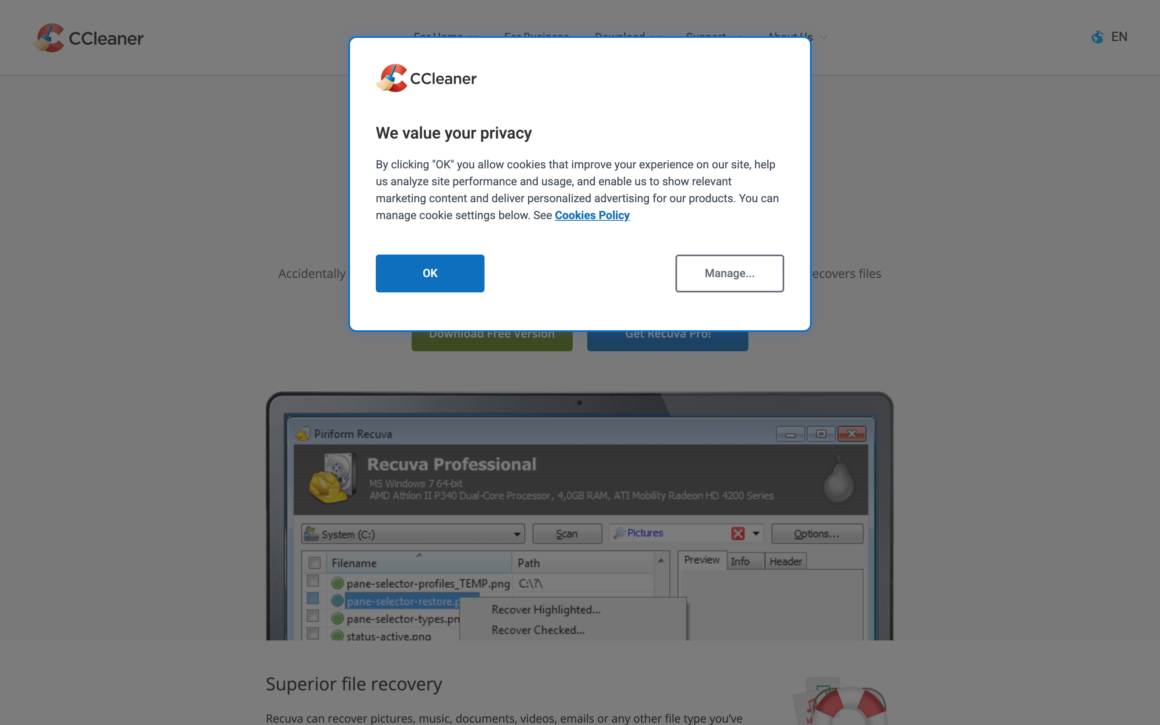
Recuva (by CCleaner creators Piriform) is the free Windows data recovery tool most people should try first. The wizard walks you through recovery step-by-step. Pick what type of file you lost (pictures, music, documents, video, emails, all), pick where it was (hard drive, SD card, recycle bin, external USB), and Recuva scans for recoverable files.
The quick scan finds recently deleted files in seconds. The deep scan takes hours but finds files that lost their file system entries. Recuva’s color-coded results show recovery probability (green = excellent, yellow = poor, red = unrecoverable) so you know what’s worth trying. The secure overwrite feature also permanently deletes files if that’s what you need.
The free version handles most home-user needs. Recuva Professional is a low-cost annual licence that adds virtual hard drive support, automatic updates, and premium support. If you’re on Windows and you just deleted something, this is where I’d start every single time. It’s free, it’s tiny, and it handles the boring cases that make up most real data loss. It runs out of road on Mac and on badly damaged drives, and that’s fine. Start here anyway.
2. EaseUS Data Recovery Wizard
Best for: Users who need reliable commercial data recovery software that handles Windows, Mac, and formatted drives with high success rates.
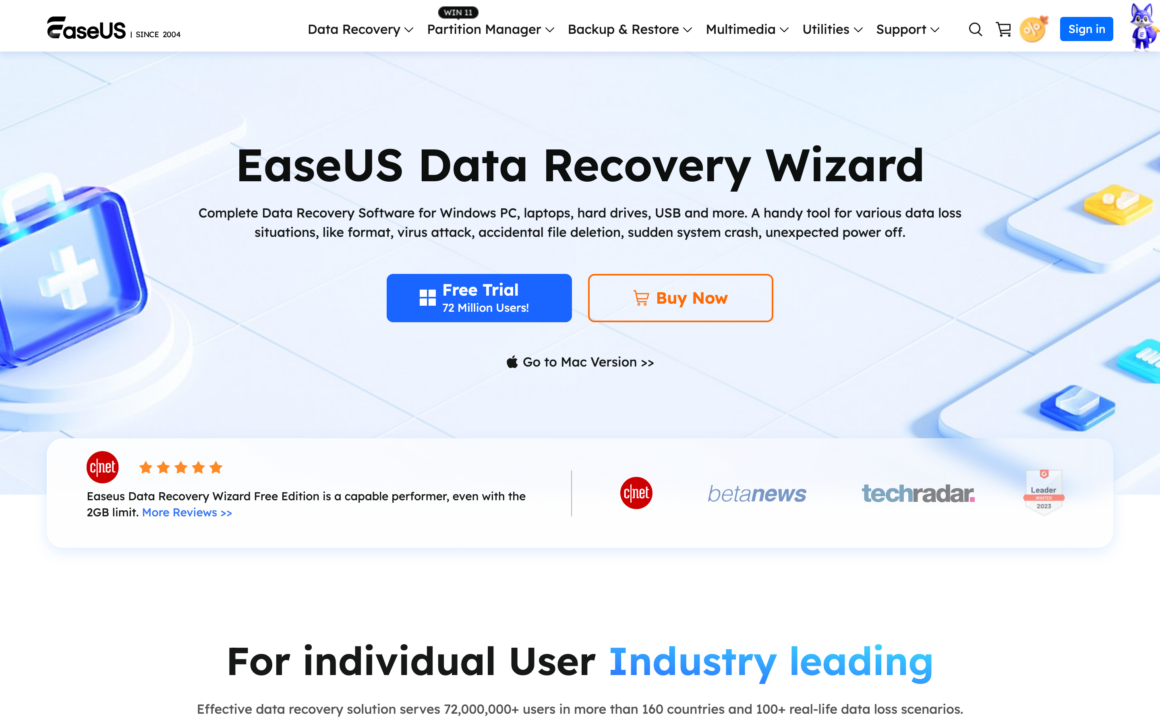
EaseUS Data Recovery Wizard is the commercial data recovery tool I recommend when Recuva fails or when recovering from formatted drives, corrupted partitions, or virus-damaged storage. The scan engine detects over 1,000 file types and handles FAT, NTFS, exFAT, APFS, HFS+, and ReFS file systems.
The interface walks you through recovery: pick the drive, scan, preview found files before restoring. The preview feature shows documents, photos, and videos before you recover them, so you know what’s actually intact. The Partition Recovery feature rebuilds lost partition tables. For OS that won’t boot, the bootable media creation lets you recover from a USB.
The free version recovers up to 2GB, which covers many small recoveries. The Pro plan is sold as a monthly or annual subscription with a lifetime option, and it unlocks unlimited recovery. Watch the monthly plan: on most of these tools a month costs a large fraction of a year, so the annual or lifetime tier is usually the only sensible choice. This is the one worth paying for. Not because it’s the most powerful thing here, but because it recovers more of what I throw at it with less fuss than anything else in its price band. If you’re only ever going to buy one recovery tool, buy this one.
3. Stellar Data Recovery
Best for: Severe data loss scenarios including RAID failures, encrypted drives, and damaged storage that lighter tools can’t handle.

Stellar Data Recovery specializes in difficult recovery scenarios. RAID 0, 5, 6 reconstruction. BitLocker encrypted drive recovery. NVMe SSD recovery. Virtual machine file recovery (VMDK, VHD, VHDX). Email recovery from PST, OST, EDB, and MBOX files. For recoveries beyond typical consumer scenarios, Stellar has features other tools lack.
The Professional plan handles most home and small business needs. Premium adds photo repair and video repair (fixing corrupted media files that won’t play, separate from recovering deleted ones). Technician plan targets IT pros handling multiple client recoveries. Stellar’s support team offers data recovery consultation if software alone can’t help.
The free version previews up to 1GB of recoverable files. Paid tiers run as annual subscriptions, stepping up through Professional, Premium, and Technician as you add RAID and advanced repair. My pick when something else has already failed. Stellar earns its keep on RAID arrays, encrypted volumes, and formatted partitions, which is exactly where the cheaper tools give up. For an ordinary deleted folder it’s overkill, and I’d feel silly paying for it.
4. Disk Drill
Best for: Mac users who want a polished interface with data protection features alongside data recovery.
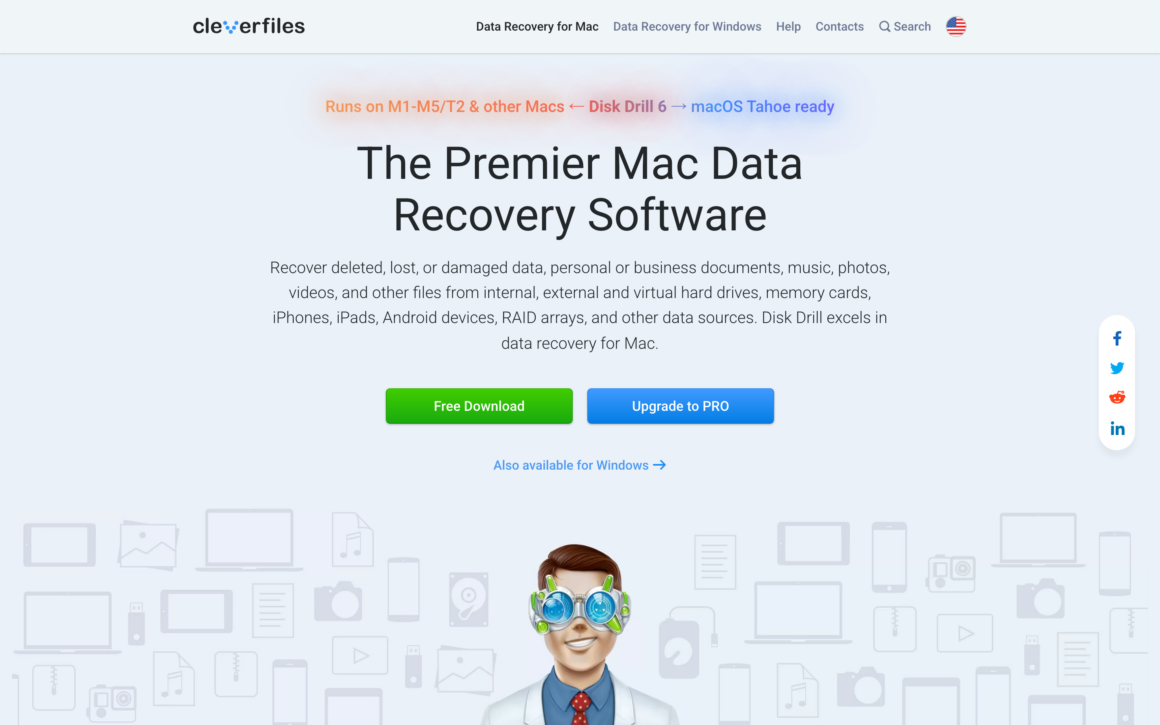
Disk Drill by CleverFiles is the Mac-first data recovery tool with the polish Mac users expect. The interface matches macOS design conventions. The scan engine handles APFS, HFS+, FAT32, NTFS, and exFAT. Beyond recovery, Disk Drill’s Recovery Vault and Guaranteed Recovery features create a safety net that makes future recoveries nearly automatic.
Recovery Vault remembers metadata of deleted files so they can be recovered even after the file system overwrites their entries. Guaranteed Recovery keeps a byte-level copy of files for a set time. The Preview feature shows recoverable files before restoring. The Clean Up feature shows files you could delete to free space, which is useful but unrelated to recovery.
The free version scans and previews what it finds. Free recovery is limited, and the limit differs by platform: on Mac, free recovery applies to files Disk Drill’s own Recovery Vault was already protecting, so treat the Mac free tier as preview-first. Disk Drill Pro is a one-time licence rather than a subscription, which is the main reason to prefer it for long-term value. The nicest thing to actually use on a Mac, and the one-time licence is why I keep recommending it. Almost everyone in this category wants to rent you software forever. Paying once for a tool you’ll open twice a decade is the sane model, and Disk Drill is one of the few offering it.
5. Wondershare Recoverit
Best for: Recovering video and photo files with built-in media repair for corrupted footage.
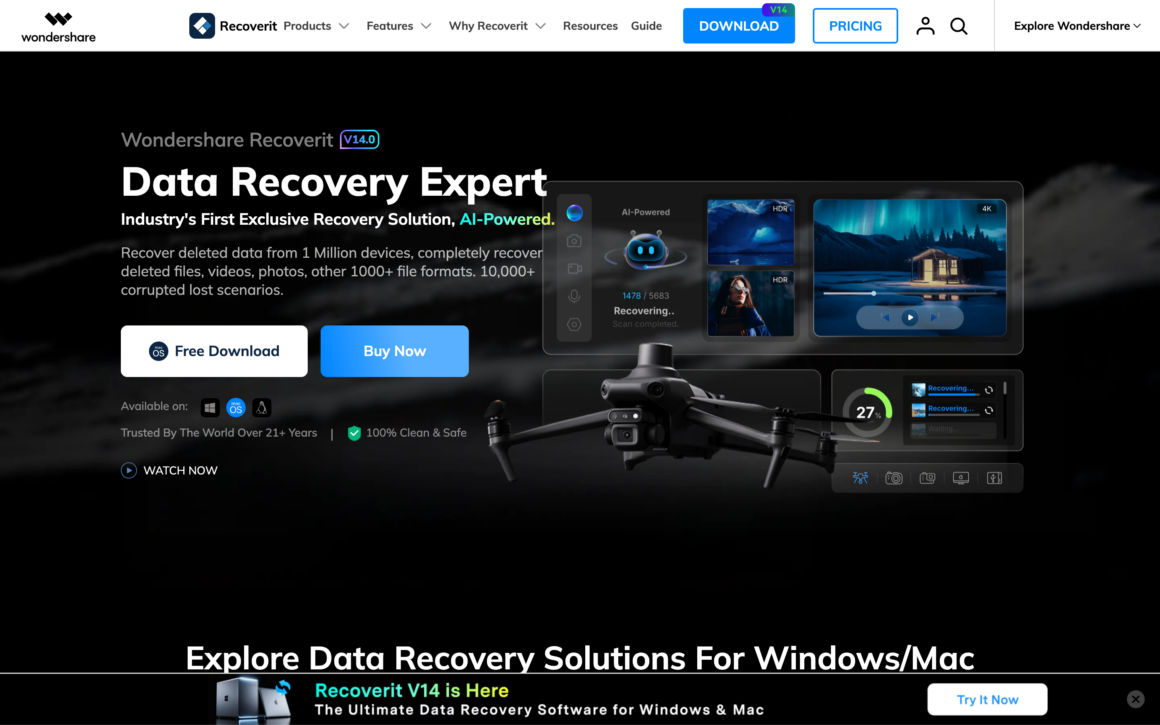
Wondershare Recoverit specializes in video and photo recovery. Beyond finding deleted files, Recoverit can repair corrupted video files that won’t play and damaged photo files with visual artifacts. For photographers, videographers, and content creators who lost media files to corruption or accidental deletion, this combination is rare among recovery tools.
The recovery scan handles 1,000+ file types including RAW camera formats (CR2, NEF, ARW, DNG) and professional video formats (ProRes, DNxHD, MOV, MP4). The Advanced Video Recovery feature specifically targets fragmented video file pieces that normal recovery would miss or merge incorrectly. The HDD Crash Recovery handles drives that won’t boot.
The free version recovers up to 100MB. Paid tiers are annual, stepping up to add video repair and then advanced features. Worth it for one job: corrupted video. The repair tooling genuinely does things general-purpose recovery software can’t. For anything else, I’d take EaseUS and keep the difference, because you’d be paying a specialist premium for a job any of these can do.
Rule one of data recovery: stop using the affected drive immediately. Every file you save, every app you open that writes temp data, and every Windows update reduces recovery success. Eject external drives if applicable. Disconnect network sync (OneDrive, Dropbox) that might overwrite cloud copies. Run recovery tools from a different drive than the affected one.
6. TestDisk
Best for: Recovering lost partitions, fixing non-booting drives, and rebuilding corrupted partition tables for free.
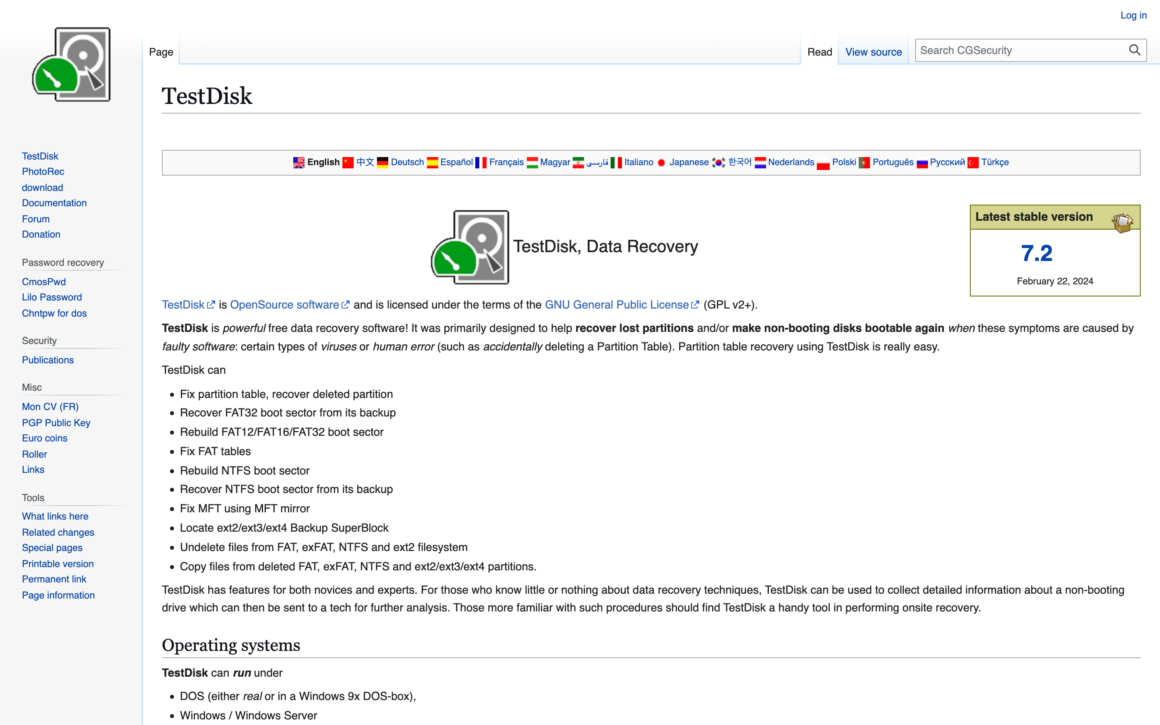
TestDisk is the free open-source partition recovery tool that IT pros reach for when a drive won’t boot. It rebuilds damaged partition tables, recovers deleted partitions, fixes boot sectors, and restores file system metadata. For catastrophic disk failures where Windows shows “drive not formatted” or a Mac refuses to mount a drive, TestDisk often brings the drive back without needing paid software.
TestDisk has a text-based interface that looks intimidating but is straightforward once you start using it. It handles FAT, exFAT, NTFS, ext2/3/4, HFS+, and most other file systems. Runs on Windows, Mac, and Linux. The documentation is thorough. The forum has 15+ years of recovery stories from users who saved drives everyone else gave up on.
Free, open-source (GPL-2.0), cross-platform. For any serious data recovery toolkit, TestDisk should be included. For users uncomfortable with command-line tools, use TestDisk for partition issues and Recuva or EaseUS for file-level recovery. The combination handles most scenarios without spending anything.
7. PhotoRec
Best for: Recovering specific file types (photos, videos, documents) from any storage device regardless of file system damage.
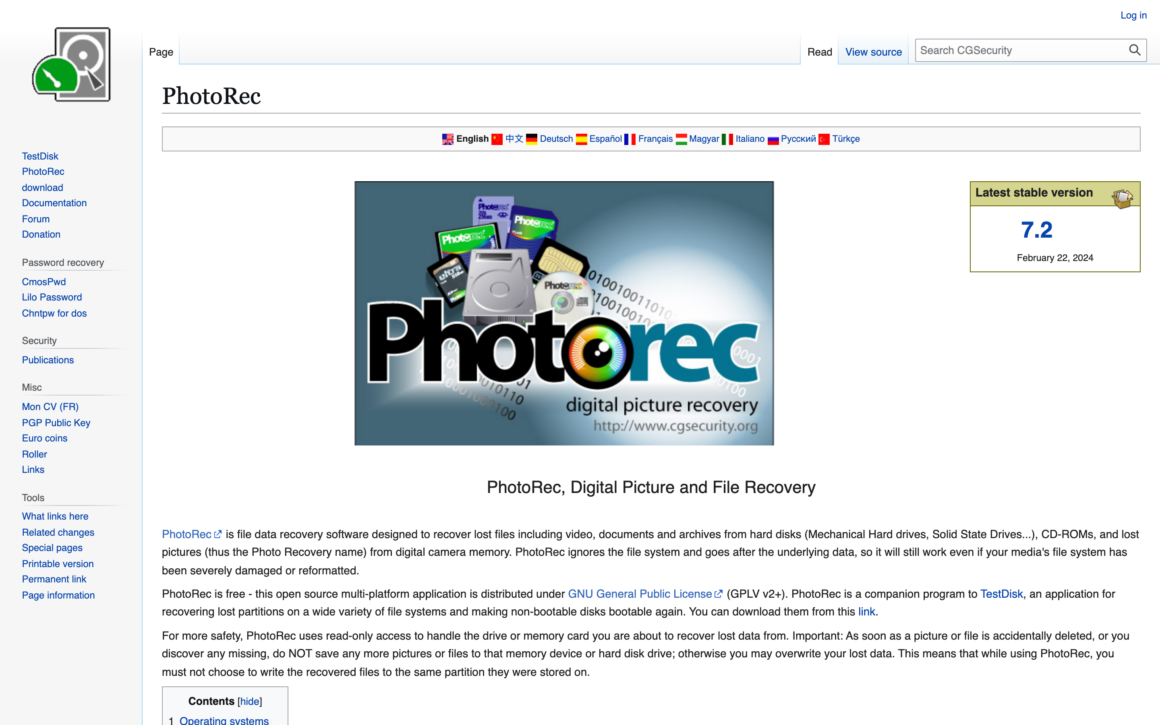
PhotoRec comes bundled with TestDisk from the same developer. While TestDisk fixes partitions, PhotoRec recovers files. It ignores file system damage entirely and scans the raw drive for file signatures. If a JPEG’s header pattern exists somewhere on the disk, PhotoRec finds it and reconstructs the file. This approach recovers files from heavily damaged drives that file-system-aware tools can’t handle.
PhotoRec supports 500+ file signatures: JPEG, RAW formats, MP4, MOV, MP3, PDF, DOCX, XLSX, and hundreds more. File names and folder structures aren’t preserved (PhotoRec bypasses the file system entirely), so you’ll rename recovered files afterward. For pure file recovery, especially from formatted drives or severely damaged media, PhotoRec’s approach works when other tools give up.
Free, open-source (GPL-2.0), cross-platform. Pair PhotoRec with TestDisk for a complete free recovery toolkit. For Mac users, QPhotoRec provides a graphical interface. For Windows users, PhotoRec GUI adds the same. The combination of TestDisk + PhotoRec + Recuva covers most home user recovery needs at zero cost.
8. MiniTool Power Data Recovery
Best for: Windows users wanting a cheaper EaseUS alternative with clean interface and reliable recovery.
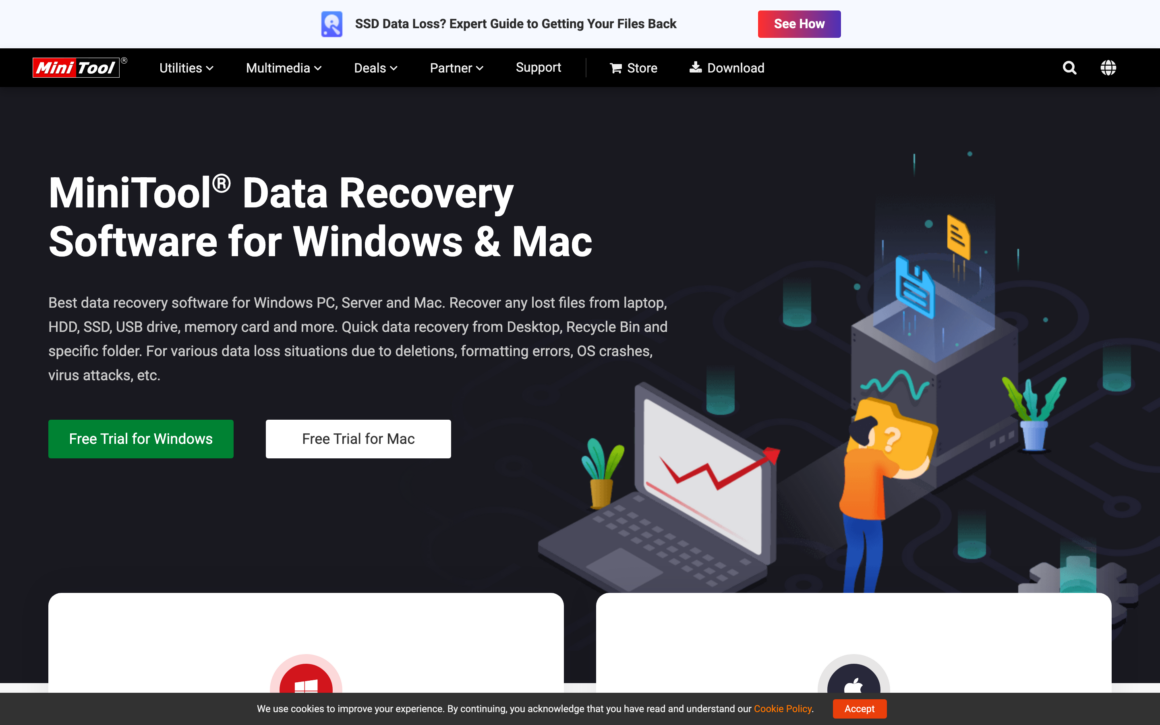
MiniTool Power Data Recovery competes directly with EaseUS at similar features and often cheaper pricing. The interface is clean and walks you through recovery step-by-step. The scan engine handles deleted files, formatted partitions, corrupted drives, and lost partitions. It supports FAT, NTFS, exFAT, and HFS+ file systems.
The Bootable Edition creates a USB that recovers files when Windows won’t boot. The Deep Scan reconstructs files from heavily damaged drives. The Filter feature narrows scan results by file type, size, or date to find what you need quickly. Preview before recovery confirms files are intact.
The free version recovers up to 1GB. The Personal plan is an annual licence, with business tiers above it. MiniTool discounts heavily and often, so check its own site before paying list price. The value pick, and where I’d point someone who winced at the EaseUS price. It does most of the same work. It just isn’t as pleasant about it, and its recovery rate on the nastier cases sits a step behind. Never pay MiniTool’s list price, because there’s almost always a discount running.
9. Ontrack EasyRecovery
Best for: Professional-level data recovery when consumer software fails and before paying for physical lab recovery.
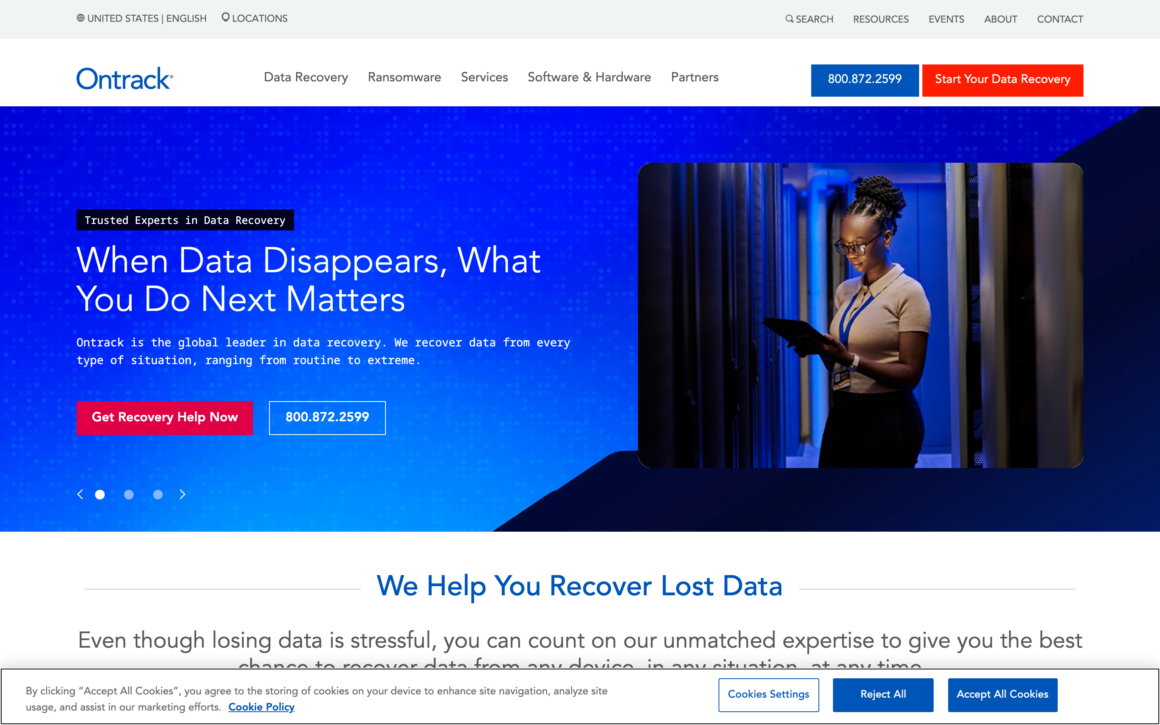
Ontrack (formerly Kroll Ontrack) is one of the oldest names in data recovery. Their EasyRecovery software uses the same engine that powers their professional lab services. When drives are severely damaged, RAID arrays fail, or enterprise storage needs recovery, Ontrack’s engineers are the experts. The EasyRecovery consumer product gives you their technology.
The Professional tier handles complex recoveries: RAID 0, 5, 6 reconstruction, Apple Core Storage, Windows Storage Spaces, virtual machine disks. The Premium and Toolkit tiers add advanced features like email recovery, clone disk, and multi-language support. For severely damaged drives that need professional-grade analysis, Ontrack’s software often succeeds where EaseUS and Recuva fail.
Ontrack sells annual licences across four tiers, and the top ones climb into professional territory. It is expensive next to EaseUS and still far cheaper than shipping a drive to a recovery lab. Hard to justify for a home user, and I’ll say that plainly. Ontrack’s value is that the same company runs a recovery lab, so if the software can’t do it, you already know who to ship the drive to. Buy it when the data is worth more than the argument about the price. Otherwise this is not your tool.
10. Remo Recover
Best for: Affordable commercial data recovery with specialized options for photos, videos, and Outlook PST files.
Remo Recover sits in the mid-range commercial data recovery market with pricing slightly below EaseUS and Stellar for comparable features. The product line includes Remo Recover (general file recovery), Remo Recover Photos (media-specific), and Remo Repair (video and photo repair tools). For users needing specialized recovery at reasonable prices, Remo fills the gap between free tools and enterprise software.
The Outlook PST Repair tool is unusual among data recovery suites. For professionals losing email data from crashed Outlook installations, this specialized tool handles what general recovery software can’t. The video repair tool fixes corrupted MOV and MP4 files similar to Wondershare Recoverit’s specialty.
The free trial scans and previews files without recovering them. Paid tiers are annual, adding partition recovery and then advanced features as you move up. Narrow reason to pick it: Outlook PST files. If you’ve lost a mailbox, Remo saves you buying a second specialist tool. If you haven’t, I don’t see a strong case for it over EaseUS or MiniTool.
11. iBoysoft Data Recovery
Best for: Mac users recovering data from APFS drives, encrypted Mac drives, and unmountable Mac volumes.
iBoysoft specializes in Mac data recovery with deep APFS support. APFS (Apple File System, used since macOS High Sierra) has unique features like snapshots, space sharing, and strong encryption that generic recovery tools struggle with. iBoysoft handles APFS specifically, including encrypted APFS containers and FileVault-protected drives (with the password).
The NTFS recovery on Mac is another specialty. Macs can read but not write NTFS drives by default. When external Windows-formatted drives become unmountable on Mac, iBoysoft recovers files where Disk Utility shows errors. The product also includes NTFS drivers separately for read-write access.
The free trial scans and previews. Paid plans are annual, with a technician tier for professionals. The Mac specialist, and I mean specialist. It pulls files off APFS volumes and encrypted drives that Disk Drill shrugs at. That’s a real, narrow superpower. If your Mac problem is ordinary, Disk Drill is the friendlier tool and I’d use that instead.
12. Tenorshare 4DDiG
Best for: Users needing data recovery across computers and mobile devices (iOS, Android) from the same company.
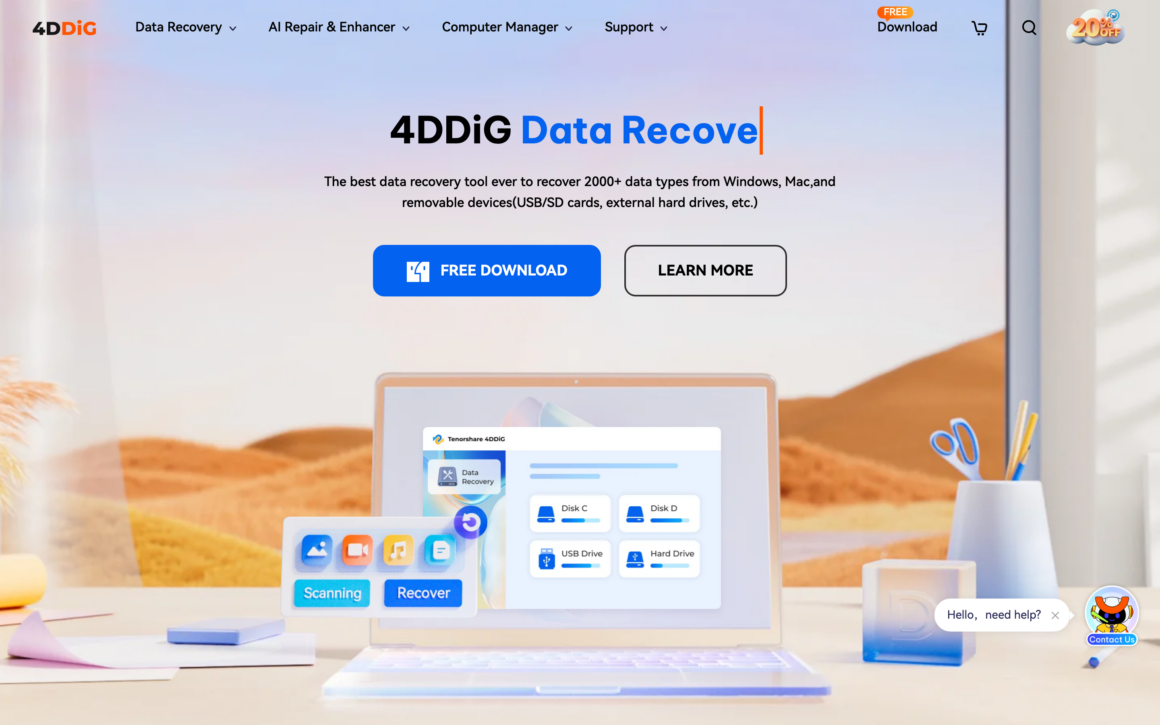
Tenorshare 4DDiG extends data recovery beyond computers to iOS and Android devices. The main 4DDiG product handles Windows and Mac recovery. Tenorshare 4DDiG for iPhone recovers data from iOS devices (including iTunes and iCloud backups). Tenorshare 4DDiG for Android handles Android phones and tablets. For users who lost data across multiple devices, one vendor covers all of them.
The computer recovery product supports 1,000+ file types, FAT, NTFS, exFAT, APFS, HFS+ file systems, and recovers from deleted files, formatted drives, lost partitions, virus attacks, and system crashes. The scan speed is faster than most competitors. The Deep Scan option takes longer but finds fragmented files.
The free trial scans only and will not recover anything. Paid access is monthly or annual with a lifetime option, and aggressive first-year discounts are common enough that you should never pay list price. One licence covering phone and computer is genuinely convenient, and that’s the entire pitch. I’d only take it if I actually needed both. Buying multi-platform coverage you’ll never use is how people end up paying subscription prices for a tool they open once.
13. R-Studio
Best for: IT technicians, forensic analysts, and advanced users who need the most comprehensive data recovery features.
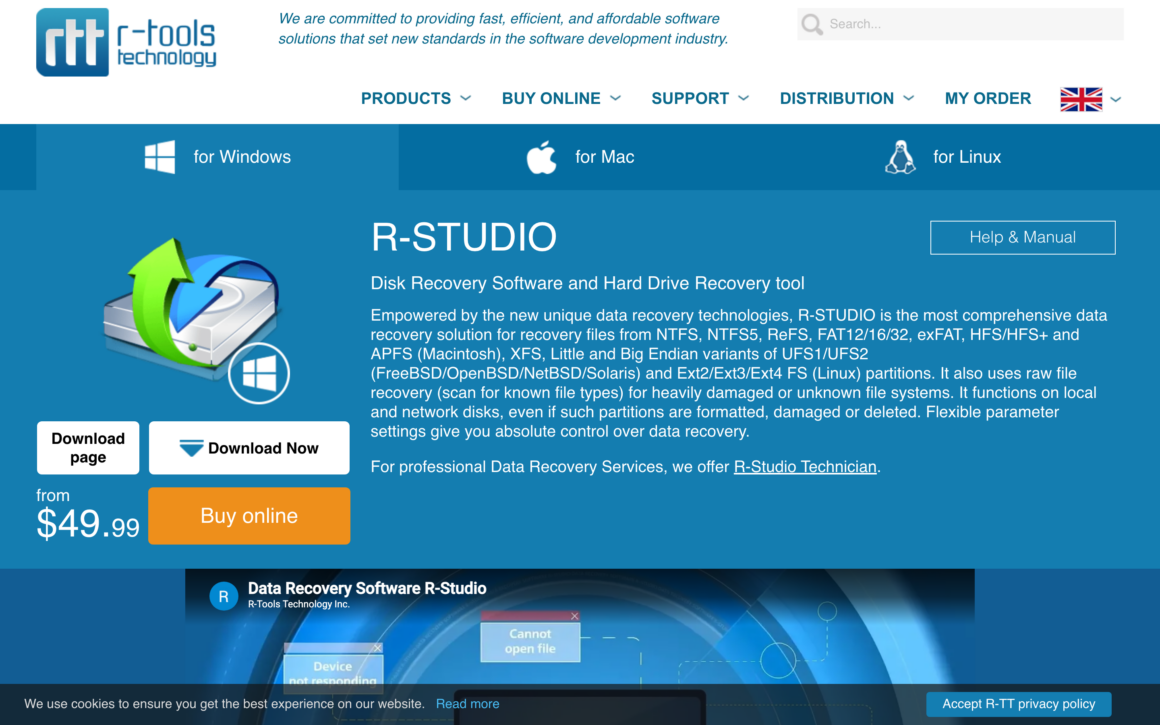
R-Studio is the professional data recovery tool IT pros use when consumer software fails. Forensic-level features including hex editor, disk imaging, RAID reconstruction for 20+ RAID types, network recovery over LAN, and advanced file system support. For recovery professionals charging clients for recovery work, R-Studio’s depth justifies the learning curve.
The product family includes R-Studio (general recovery), R-Studio for Mac (Mac-focused), R-Studio Technician (for pros), and R-Studio Emergency (boot from USB for non-booting systems). The Network Recovery feature lets you recover from a remote machine over a local network, which is useful for enterprise IT or client support.
The demo previews files up to 256KB. Paid tiers run annually through standard and professional, with a one-time technician licence for people doing this for a living. It is cheaper than Ontrack Professional for comparable capability. If you do this for a living, you already know about R-Studio. For everyone else it’s too much tool, and the interface will punish you for being a tourist. I’d only reach for it on a RAID rebuild.
14. Acronis Cyber Protect Home Office
Best for: Preventing data loss with automated backups plus data recovery as an insurance layer.
Acronis (formerly True Image) takes a different approach: backup first, recovery second. Automatic local and cloud backups mean recovery becomes a matter of restoring from backup rather than scanning damaged drives. The Cyber Protect version (rebranded from True Image) adds antivirus and ransomware protection on top of backup, creating a comprehensive data protection suite.
Full disk image backups create bootable restoration snapshots of your entire system. Incremental backups run quickly after the first full backup. The cloud storage (varies by plan: 50GB-1TB) protects against local disasters like theft, fire, or hardware failure. The Active Protection feature detects ransomware attempting to modify files and rolls them back.
Acronis sells annual plans tiered by how much cloud storage comes bundled, from none up to a terabyte. This is the purchase I actually wish more people made, because it’s the one that means never needing the rest of this page. Acronis is backup with recovery attached, not the other way round. Pair it with something like EaseUS for the day a backup didn’t exist. Pair it with a dedicated recovery tool for the times a backup didn’t exist.
15. Time Machine
Best for: Every Mac user. Apple’s free built-in backup tool is the first line of defense against data loss.
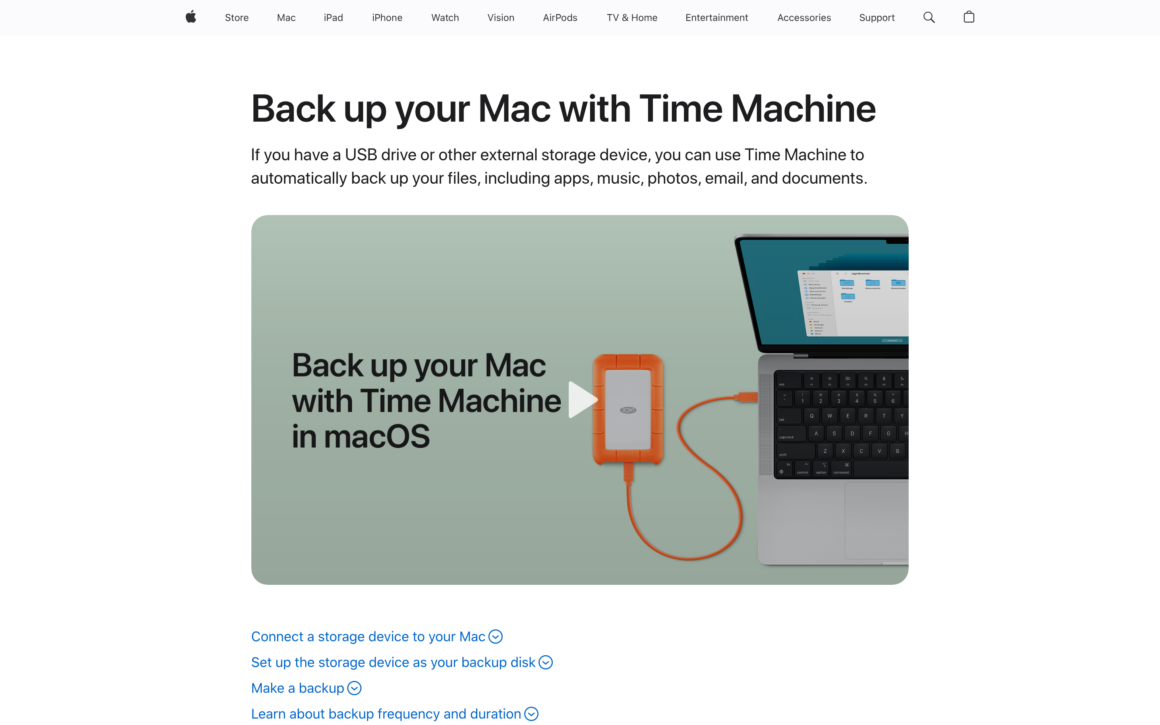
Time Machine is Apple’s built-in backup system. Plug in an external drive, Time Machine prompts to use it for backup, and your Mac automatically backs up every hour. The incremental backup strategy keeps hourly backups for the past day, daily backups for the past month, and weekly backups until the drive fills up. Restoring deleted files takes minutes via the Time Machine interface.
Time Machine backups work with any external drive (USB, Thunderbolt, NAS). Time Capsule (Apple’s dedicated Time Machine device) is discontinued but still works. Any Time Machine-compatible NAS from Synology or QNAP offers wireless automatic backup. For serious data protection, keep one local Time Machine backup plus one cloud backup (iCloud Drive, Backblaze, or similar).
Free with macOS. No configuration needed beyond picking a backup drive. The 90%+ of data recovery scenarios on a Mac with Time Machine running are solved by “open Time Machine, find the file, restore.” For Mac users not using Time Machine, start today. It’s the cheapest and most effective data loss prevention available.
16. DMDE (DM Disk Editor and Data Recovery)
Best for: Advanced users and technicians doing RAID reconstruction, partition analysis, and byte-level data recovery.
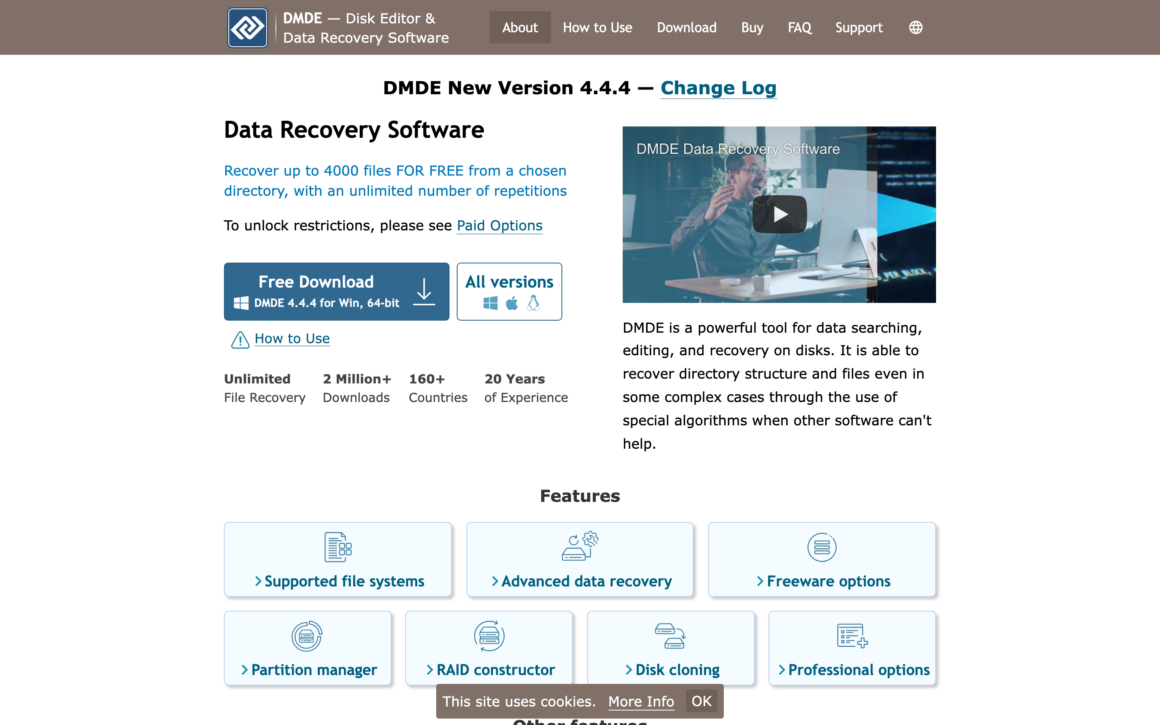
DMDE is the data recovery tool serious technicians use when everything else fails. It combines a disk editor (byte-level viewing and editing of raw drive data) with data recovery capabilities. RAID 0, 5, 6 reconstruction. Partition analysis and repair. File system recovery for FAT, NTFS, exFAT, ext2/3/4, HFS+, APFS. The interface is dense and technical, targeting users who know what they’re doing.
The Free Edition recovers up to 4,000 files per folder and 4GB per recovery (generous limits). The Express, Standard, Professional, and Technician editions scale up with features and license types. For advanced users, the one-time pricing (vs subscription) makes DMDE affordable long-term.
The Free Edition covers most personal recoveries. Paid tiers are one-time licences rather than subscriptions, stepping up through Express, Standard, and Professional, with technician licences above that. The best value on this entire page, and the hardest to recommend. DMDE does things that cost several times as much elsewhere, on a one-time licence, and it looks like software from 2004. If you’re technical, this is the smart buy. If the phrase partition table makes you uneasy, you’ll hate it.
17. Windows File History and File Recovery
Best for: Every Windows user should enable File History and Previous Versions as free built-in backup and recovery.
Windows 10 and 11 include File History (automatic backup to external drive) and Previous Versions (restore older versions of files). Both are free with Windows, disabled by default, and take 10 minutes to set up. Together they handle most “oops I deleted the wrong file” scenarios without needing any third-party software.
File History backs up your Documents, Music, Pictures, Videos, and Desktop folders to an external drive (USB or NAS) automatically. Right-click any file or folder and select Properties → Previous Versions to see backup versions from different times. Restore individual files or entire folders. The Windows File Recovery command-line tool (Microsoft’s official recovery utility) handles deeper scans when File History doesn’t help.
Free with Windows. Plug in any external drive, enable File History in Settings, and your backups run automatically. A decent external drive costs less than a single recovery-software licence. For Windows users not currently backing up at all, this is the biggest data protection improvement available at zero software cost.
The best data recovery strategy is not needing data recovery. Use the 3-2-1 backup rule: 3 copies of important data, on 2 different storage types, with 1 copy offsite, either in cloud storage or physically away from your main location. Time Machine or Windows File History covers local, Backblaze or iDrive covers cloud, and an external drive kept at work or a relative’s place covers the offsite copy. I go deeper on the software side in the backup software guide. A year of backup costs less than one recovery licence and far less than a lab. Ransomware makes that maths starker still, which is where antivirus and a few basic security habits earn their keep.
How to Recover Deleted Files: Step-by-Step
When you realize data is missing, follow this order for the best recovery chances.
Step 1: Check the Recycle Bin or Trash
Most “deleted” files sit in the Recycle Bin (Windows) or Trash (Mac) until emptied. Open it, find the files, right-click → Restore. For Windows File History users, right-click any folder → Previous Versions to find older copies. For Time Machine users, open Time Machine and browse backups by date. These built-in tools handle most recoveries without third-party software.
Step 2: Stop Using the Affected Drive
Every file you save to the same drive reduces recovery chances. Close applications that might write temp files. Disable Windows search indexing temporarily. Unplug external drives until you have recovery software ready. If your system drive is affected, shut down and boot from a different drive if possible.
Step 3: Install Recovery Software on a Different Drive
Never install recovery software on the drive you’re trying to recover from. Use a separate drive (external USB, secondary internal drive, or different computer with the affected drive connected externally). For catastrophic failures where the affected drive is your system drive, boot from a recovery USB created by EaseUS, Acronis, or DMDE.
Step 4: Run a Quick Scan First
Start with a quick scan (finds recently deleted files in minutes). If the quick scan finds your files, recover them immediately. If not, run a deep scan (takes hours but finds files that lost their file system entries). Recover files to a different drive than the one being scanned.
Step 5: Preview Before Recovery
Most commercial recovery tools preview files before you commit to recovering them. Check that the preview shows intact files (not garbled data). Previewed files that look complete are more likely to recover successfully than files showing visible corruption.
Specialized Data Recovery Tools
Beyond the 17 general-purpose recovery tools above, specialized tools handle specific recovery scenarios.
Best Photo Recovery Software
For recovering photos specifically: PhotoRec (free, FOSS) scans raw drive data for photo file signatures regardless of file system. Wondershare Recoverit specializes in video and photo recovery with media repair. Stellar Photo Recovery targets RAW camera formats. SanDisk RescuePRO recovers SanDisk SD cards specifically. CardRecovery focuses narrowly on memory cards. For phone photos, Tenorshare UltData and Dr.Fone recover from iOS and Android directly.
Best SD Card Recovery Software
For SD cards specifically: PhotoRec (free) handles SD cards like any other storage. Recuva works well on FAT/exFAT SD cards. EaseUS and Stellar handle formatted SD cards. For camera-specific recovery, Sandisk RescuePRO (free with some SanDisk cards) is reliable. The best SD card strategy is prevention: buy Class 10 UHS-I or faster cards from trusted brands (SanDisk, Samsung, Lexar), replace them every 2-3 years, and keep SD cards for single purposes (one for camera, one for phone, etc.).
Best Hard Drive Recovery Services
For physical hard drive damage, meaning clicking drives, drives that won’t spin up, or electrical failure, software cannot help and running more scans makes things worse. This is cleanroom work. The established labs are Ontrack Data Recovery, the industry leader and priced like it, DriveSavers in the US at similar rates, SalvageData as the more affordable option, and Secure Data Recovery. Expect lab quotes in the hundreds to low thousands depending on the failure, and expect a genuine lab to quote only after a diagnostic.
Best Cloud Backup Services
For preventing data loss rather than fixing it: Backblaze is the simplest unlimited-storage option and my default recommendation. iDrive routinely undercuts everyone on the first year, so compare renewal rates rather than the headline. Carbonite targets Windows users, and Dropbox or Google Drive handle sync rather than true backup, which is a different job. If you would rather pay once, the cloud storage lifetime deals roundup covers that route. Check the renewal price on any of these before committing.
Best RAID Recovery Tools
For RAID failures: R-Studio handles 20+ RAID types including standard and proprietary RAID configurations. DMDE supports RAID reconstruction with byte-level control. Ontrack EasyRecovery Professional includes RAID features. ReclaiMe specializes in RAID recovery with automatic RAID parameters detection. For enterprise RAID failures, professional services like Ontrack or DriveSavers handle what software can’t. Proper RAID implementation (with spare drives and monitoring) prevents most failures before they become catastrophic.
Best Data Recovery for Mac
Mac-specific picks: Disk Drill for Mac for the most polished interface, sold as a one-time licence. iBoysoft Data Recovery is the APFS and encrypted-volume specialist. Stellar Data Recovery for Mac and EaseUS Data Recovery Wizard for Mac both cover the general case. Time Machine is built in and free, and it is the one you should have turned on before any of this mattered.
The best data recovery software is the backup you set up last year. Everything on this page is what you reach for because you did not.
Which Data Recovery Software Should You Pick?
Match the tool to the situation you’re actually in. Here’s what I’d do in each one, in that order.
Recently deleted files (Windows): Recuva free. Check Recycle Bin first, then Windows File History if enabled.
Recently deleted files (Mac): Time Machine if enabled. Otherwise Disk Drill free tier.
Formatted hard drive or SD card: EaseUS Data Recovery Wizard. High success rate, clean interface.
Non-booting drive (won’t start Windows/Mac): TestDisk (free) to fix partitions, then Recuva or EaseUS bootable USB to recover files.
Photos or videos specifically: PhotoRec (free) for file-signature-based recovery. Wondershare Recoverit for corrupted media repair.
Mac APFS or encrypted drives: iBoysoft Data Recovery. Specializes in Mac file systems.
RAID failure: R-Studio or DMDE for DIY. Ontrack or DriveSavers for professional lab recovery.
Physical drive damage (clicking, not spinning): Stop trying software. Contact Ontrack, DriveSavers, or SalvageData for lab recovery.
Future prevention: Set up Time Machine (Mac) or Windows File History (Windows) + Backblaze for cloud backup. Cheaper than data recovery software and catches problems before they become emergencies.
Here’s the deflating part, and I’d rather say it than sell you something. Most of these tools are more alike than their marketing admits. On an ordinary deleted folder, Recuva, PhotoRec, EaseUS, and MiniTool will all give you the same files back, and the expensive ones win only on the cases that are already going badly.
So try the free tools first. Genuinely. TestDisk, PhotoRec, and Recuva cost nothing and handle most personal data loss, and I’ve watched people spend real money on a licence that recovered exactly what the free tool would have. Pay only when free has failed, and pay a lab only when the data is worth more than the invoice.
And if you take one thing away, take the unglamorous one. I’d rather you closed this page, turned on Time Machine or File History, and never needed anything on it.
Best of luck. I hope you get your files back.
Frequently Asked Questions
What is the best data recovery software?
Recuva is the best free data recovery software for Windows with good recycle bin recovery and deep scan. For commercial software, EaseUS Data Recovery Wizard has high success rates across Windows, Mac, and mobile devices. Stellar Data Recovery handles severe damage including RAID. Disk Drill is the top pick for Mac. TestDisk + PhotoRec (free, open-source) cover most recovery scenarios without spending money. The best tool depends on your specific scenario: file type, storage device, and how the data was lost.
How can I recover deleted files for free?
Start by checking the Recycle Bin (Windows) or Trash (Mac). For files emptied from Recycle Bin, download Recuva for Windows (free), PhotoRec for any platform (free, open-source), or scan with Disk Drill, though on Mac its free recovery only covers files its Recovery Vault was already protecting. Windows File History and Mac Time Machine restore from backups if enabled. The combination of TestDisk (partition recovery) + PhotoRec (file recovery) + Recuva (Windows-specific) handles most home user recoveries without paying for software. Stop using the affected drive immediately to maximize recovery success.
How does data recovery work?
When you delete a file, the operating system marks the disk space as free but doesn’t immediately overwrite the file contents. Recovery software scans the drive for file signatures and metadata to find deleted files still present on the storage. Signature-based scans (PhotoRec) find file types by their byte patterns. File-system-based scans (EaseUS, Recuva) use NTFS, FAT, or APFS structures to locate file entries. Recovery success depends on how much the drive has been written to since deletion. Every new file reduces recovery chances.
How much does data recovery cost?
Free options: Recuva, TestDisk, PhotoRec, Disk Drill free scan and preview, EaseUS free tier (2GB), MiniTool free tier (1GB). Commercial software on an annual licence: EaseUS, Stellar, MiniTool, Remo Recover, Wondershare Recoverit, Ontrack EasyRecovery. Mac-specific: Disk Drill Pro on a one-time licence, iBoysoft on an annual one. Professional lab services for physical drive damage: Ontrack, DriveSavers, SalvageData. Expect a quote only after diagnostics, and expect it in the hundreds to low thousands. For most personal data loss, a free tool or a single consumer licence recovers everything. Lab services are only needed for physical damage.
Can I recover files from a formatted drive?
Yes, if you haven’t overwritten the drive since formatting. Quick formatting (default) only rewrites the file system table, leaving actual file data intact. Full formatting overwrites the entire drive and makes recovery much harder. Immediately stop using the drive, then run EaseUS Data Recovery Wizard, Stellar Data Recovery, or TestDisk + PhotoRec. Success rates are high for quick-formatted drives (70-95%) and much lower for full-formatted drives (20-50%). The longer you wait and the more you write to the drive, the lower recovery chances become.
What is the best data recovery software for Mac?
Disk Drill for Mac, sold as a one-time licence, is the best paid Mac data recovery software with polished interface and data protection features. iBoysoft Data Recovery specializes in Mac APFS and encrypted drive recovery. Stellar Data Recovery for Mac and EaseUS Data Recovery Wizard for Mac handle general recovery. Time Machine (free, built into macOS) prevents most recovery needs by maintaining automatic backups. For Mac users, Time Machine + Disk Drill is the recommended combination.
How do I recover photos from an SD card?
Stop using the SD card immediately. Remove it from the camera or device. Connect it to a computer via SD card reader (not a camera USB cable). Run PhotoRec (free) or Wondershare Recoverit for media-specific recovery. EaseUS Data Recovery Wizard also works well on SD cards. Stellar Photo Recovery specializes in RAW camera formats. SanDisk RescuePRO (free with some SanDisk cards) handles SanDisk cards specifically. Most recently deleted photos recover successfully if the card hasn’t been reformatted or heavily written to.
What is the difference between data recovery and backup?
Backup proactively creates copies of your data before something goes wrong. Data recovery reactively extracts data from damaged storage after something goes wrong. Backup is cheaper, faster, and more reliable but requires setup before the disaster. Data recovery is more expensive, slower, and less reliable but works after the disaster. Smart strategy: use Time Machine (Mac) or Windows File History + cloud backup like Backblaze for prevention. Keep data recovery software (EaseUS, Recuva) as insurance for situations where backups missed recent changes.
Can data recovery software recover permanently deleted files?
‘Permanently deleted’ usually means emptied from Recycle Bin or Trash. These files are recoverable until the disk space is overwritten. Secure-delete tools (like Eraser or the built-in secure empty trash) overwrite the file location with random data, making recovery nearly impossible. Standard deletion just removes the file system entry while leaving data intact. For files deleted with Shift+Delete or emptied Recycle Bin, run data recovery software immediately for high recovery rates. For secure-deleted files, recovery is generally not possible without professional forensic services.
What should I do immediately after losing data?
Step 1: Don’t panic and stop using the affected drive immediately. Every file written to the drive reduces recovery chances. Step 2: Check Recycle Bin (Windows), Trash (Mac), and any cloud backup services (OneDrive, Google Drive, Dropbox) for the missing files. Step 3: If enabled, check Windows File History or Time Machine for backup versions. Step 4: Install data recovery software on a different drive than the affected one. Step 5: Run Recuva (free) or EaseUS Data Recovery Wizard to scan and recover. Step 6: For physical drive damage (clicking, not spinning), stop and contact professional lab recovery services.
Tell Google you want more of this.
Add Gaurav Tiwari as a preferred sourceOne tap, and this site shows up more often in your own Top Stories, AI Overviews and AI Mode. Remove it any time.
Disclaimer: This site is reader-supported. If you buy through some links, I may earn a small commission at no extra cost to you. I only recommend tools I trust and would use myself. Your support helps keep gauravtiwari.org free and focused on real-world advice. Thanks. - Gaurav Tiwari