
Standard Model
One of the most surprising revelations of 20th-century physics was just how many elementary particles exist in the universe. The idea of fundamental, indivisible building blocks goes all the way back to ancient Greek atomism, but it wasn’t until the 1900s that physicists began probing what actually happens inside matter at the smallest scales. What they found changed everything you thought you knew about the physical world.
Quantum physics predicts exactly 18 types of elementary particles, 17 of which have been confirmed by experiment (including the Higgs boson, detected at CERN in 2012). The remaining particle, the graviton, is still theoretical. Searching for it and testing the limits of the standard model is one of the great ongoing quests in particle physics.
The Standard Model of Particle Physics
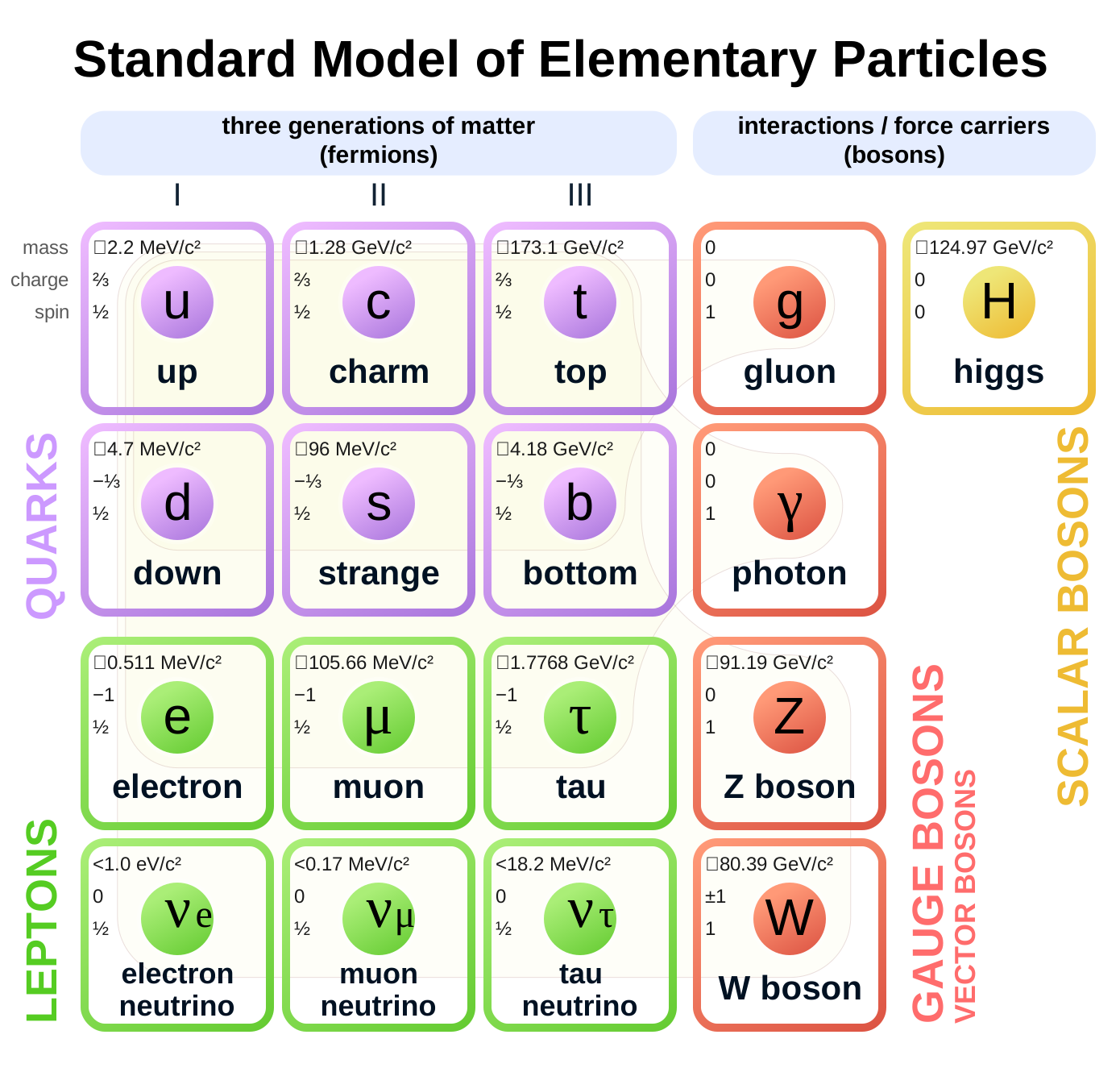
The standard model sits at the heart of modern physics. It describes three of the four fundamental forces of nature (electromagnetic, weak nuclear, and strong nuclear) along with the particles that carry those forces, called gauge bosons. You’ll notice gravity is missing from the list. That’s because physicists haven’t yet figured out how to fold gravity into the quantum framework, though many are working on it.
Think of the standard model as a periodic table for particle physics. Just as the periodic table organizes chemical elements by their properties, the standard model organizes all known elementary particles by their mass, charge, and spin. Once you understand its structure, the relationships between particles start to make intuitive sense.
The standard model accounts for 17 confirmed particles and predicts an 18th (the graviton). If you can remember that matter is made of fermions and forces are carried by bosons, you already understand the most important organizing principle in particle physics.
Groups of Particles
Particle physicists love organizing particles into groups, and for good reason. These classifications tell you how particles behave and interact. Here’s the full breakdown you need to understand.
Elementary Particles are the smallest constituents of matter and energy. As far as we can tell, they aren’t made from combinations of anything smaller. They come in two broad families:
- Fermions – These are particles with a half-integer spin (-1/2, 1/2, 3/2, etc.). Fermions make up the matter you see around you. They obey the Pauli exclusion principle, which means no two identical fermions can occupy the same quantum state. This is why matter takes up space.
- Quarks – A class of fermion that combines to form heavier particles called hadrons (like protons and neutrons). There are 6 types, organized into three generations:
- Up Quark
- Charm Quark
- Top Quark
- Down Quark
- Strange Quark
- Bottom Quark
- Leptons – A class of fermion that doesn’t feel the strong nuclear force. You’re most familiar with the electron, but there are 6 leptons total:
- Electron
- Electron Neutrino
- Muon
- Muon Neutrino
- Tau
- Tau Neutrino
- Quarks – A class of fermion that combines to form heavier particles called hadrons (like protons and neutrons). There are 6 types, organized into three generations:
- Bosons – Bosons have integer spin values (0, 1, 2, etc.) and serve as the force carriers in quantum field theory. Unlike fermions, multiple bosons can occupy the same quantum state, which is why laser light (made of photons) behaves so differently from matter.
- Photon – carries the electromagnetic force
- W Boson – carries the weak nuclear force
- Z Boson – carries the weak nuclear force
- Gluon – carries the strong nuclear force
- Higgs Boson – gives particles their mass via the Higgs field, confirmed experimentally in 2012 at CERN
- Graviton – theoretically predicted to carry gravity in a quantum theory, but not part of the Standard Model and not yet detected
Composite Particles are built from combinations of elementary particles. You encounter these every day without realizing it, because atoms themselves are composite particles.
- Hadrons – Particles made up of multiple quarks bound together by the strong force.
- Baryons (fermions) – made of three quarks
- Nucleons – protons & neutrons, the building blocks of atomic nuclei
- Hyperons – short-lived particles that contain at least one strange quark
- Mesons (bosons) – made of one quark and one antiquark
- Baryons (fermions) – made of three quarks
- Atomic Nuclei – protons and neutrons bind together through the strong force to form the atomic nucleus.
- Atoms – the basic chemical building blocks, composed of electrons orbiting a nucleus of protons and neutrons.
- Molecules – complex structures of multiple atoms bonded together. Understanding how atoms bond into molecules is the foundation of modern chemistry.
Key Properties of Elementary Particles
Numbers tell you more about particles than names ever could. The table below summarizes the mass, electric charge, and spin of every elementary particle in the standard model. You’ll notice a pattern: first-generation particles are lightest, and each successive generation gets heavier. This mass hierarchy is one of the unsolved puzzles in particle physics.
| Particle | Type | Mass (approx.) | Electric Charge | Spin |
|---|---|---|---|---|
| Up Quark | Quark | 2.2 MeV/c² | +2/3 | 1/2 |
| Down Quark | Quark | 4.7 MeV/c² | -1/3 | 1/2 |
| Charm Quark | Quark | 1,275 MeV/c² | +2/3 | 1/2 |
| Strange Quark | Quark | 95 MeV/c² | -1/3 | 1/2 |
| Top Quark | Quark | 173,000 MeV/c² | +2/3 | 1/2 |
| Bottom Quark | Quark | 4,180 MeV/c² | -1/3 | 1/2 |
| Electron | Lepton | 0.511 MeV/c² | -1 | 1/2 |
| Electron Neutrino | Lepton | < 0.0000022 MeV/c² | 0 | 1/2 |
| Muon | Lepton | 105.7 MeV/c² | -1 | 1/2 |
| Muon Neutrino | Lepton | < 0.17 MeV/c² | 0 | 1/2 |
| Tau | Lepton | 1,777 MeV/c² | -1 | 1/2 |
| Tau Neutrino | Lepton | < 15.5 MeV/c² | 0 | 1/2 |
| Photon | Gauge Boson | 0 | 0 | 1 |
| W Boson | Gauge Boson | 80,379 MeV/c² | ±1 | 1 |
| Z Boson | Gauge Boson | 91,188 MeV/c² | 0 | 1 |
| Gluon | Gauge Boson | 0 | 0 | 1 |
| Higgs Boson | Scalar Boson | 125,100 MeV/c² | 0 | 0 |
The top quark stands out immediately. At roughly 173,000 MeV/c² (about 185 times heavier than a proton), it’s the heaviest elementary particle ever discovered. It was the last quark to be found, confirmed at Fermilab’s Tevatron collider in 1995. By contrast, neutrinos are so light that physicists initially believed they were massless. The discovery that neutrinos do have mass (through a phenomenon called neutrino oscillation) earned Takaaki Kajita and Arthur B. McDonald the 2015 Nobel Prize in Physics.
A Note on Particle Classification
If you find all these names confusing, you’re in good company. Here’s a trick that might help: think of how biological classification works. A human is simultaneously a primate, a mammal, and a vertebrate. In the same way, a proton is simultaneously a baryon, a hadron, and a fermion. Each label tells you something different about the particle’s properties.
The tricky part is that particle physics names sound far more alike than biology names do. Mixing up “boson” and “baryon” is much easier than confusing “primate” and “invertebrate.” There’s no shortcut here. You just have to study each group carefully and pay attention to which name is being used in context.
Matter and Forces: Fermions and Bosons
Every elementary particle in physics is classified as either a fermion or a boson. The distinction comes down to a quantum property called spin, which is a kind of intrinsic angular momentum that particles carry even when they aren’t physically rotating. Quantum physics shows that this spin is always quantized, meaning it can only take specific values.
A fermion (named after Enrico Fermi) has half-integer spin (1/2, 3/2, etc.), while a boson (named after Satyendra Nath Bose) has integer spin (0, 1, 2, etc.). This difference in spin leads to fundamentally different behavior. Fermions obey the Pauli exclusion principle and resist being squeezed into the same state, which is why solid matter exists. Bosons have no such restriction, which is why you can pack unlimited photons into the same space.
Simple addition of spins gives you two useful rules to remember:
- Combining an odd number of fermions produces a fermion (the total spin remains a half-integer)
- Combining an even number of fermions produces a boson (the total spin becomes an integer)
This is why a proton (made of three quarks, all fermions) is itself a fermion, while a meson (made of two quarks) is a boson.
Breaking Down Matter: Quarks and Leptons
When you strip matter down to its most basic components, you find two families of particles: quarks and leptons. Both are fermions, which means all bosons in the universe are built from even combinations of these fundamental ingredients.
Quarks interact through all four fundamental forces: gravity, electromagnetism, the weak nuclear force, and the strong nuclear force. You’ll never find a quark on its own in nature. They always bind together to form composite particles called hadrons. Hadrons split into two sub-groups: mesons (which are bosons, made of one quark and one antiquark) and baryons (which are fermions, made of three quarks). Protons and neutrons are baryons, meaning they’re made of three quarks arranged so that the total spin is a half-integer.
Leptons are different. They don’t feel the strong nuclear force at all, which means they never form hadrons. There are three “flavors” of charged leptons: the electron, the muon, and the tau. Each comes paired with a nearly massless neutral partner called a neutrino. So you get the electron and electron-neutrino as one pair, the muon and muon-neutrino as another, and the tau and tau-neutrino as the third. These pairs are called “weak doublets” because they interact through the weak nuclear force.
Historical Timeline of the Standard Model
The standard model didn’t appear overnight. It took nearly a century of experimental breakthroughs and theoretical insights for physicists to assemble the complete picture. Understanding this timeline helps you appreciate why the standard model is considered one of the greatest achievements in the history of science.
1897: J.J. Thomson discovers the electron at Cambridge’s Cavendish Laboratory, proving that atoms aren’t indivisible after all. This was the first elementary particle ever identified.
1911: Ernest Rutherford’s gold foil experiment reveals that atoms have a dense, positively charged nucleus. The proton is confirmed as a distinct particle by 1919.
1932: James Chadwick discovers the neutron, completing the picture of the atomic nucleus. The same year, Carl Anderson discovers the positron (the electron’s antiparticle), confirming Paul Dirac’s 1928 prediction of antimatter.
1956: Clyde Cowan and Frederick Reines detect the neutrino for the first time using a nuclear reactor at the Savannah River Site in South Carolina. They won the Nobel Prize in 1995 for this work.
1964: Murray Gell-Mann and George Zweig independently propose the quark model, suggesting that protons and neutrons aren’t elementary but are made of smaller particles. Gell-Mann coined the name “quark” from a line in James Joyce’s Finnegans Wake.
1968-1969: Deep inelastic scattering experiments at SLAC (Stanford Linear Accelerator Center) provide the first direct evidence that quarks are real physical objects inside protons, not just mathematical abstractions.
1973: The electroweak theory, developed by Sheldon Glashow, Abdus Salam, and Steven Weinberg, merges electromagnetism with the weak nuclear force. This theoretical unification is a cornerstone of the standard model, and all three physicists shared the 1979 Nobel Prize.
1974: The charm quark is discovered simultaneously at Brookhaven National Laboratory and SLAC, an event known as the “November Revolution” in particle physics.
1983: The W and Z bosons are detected at CERN’s Super Proton Synchrotron, confirming the electroweak theory. Carlo Rubbia and Simon van der Meer earned the 1984 Nobel Prize for this discovery.
1995: The top quark, the last of the six quarks, is finally observed at Fermilab’s Tevatron collider. Its enormous mass (about 173 GeV/c²) had made it elusive for decades.
2012: CERN’s Large Hadron Collider confirms the existence of the Higgs boson at a mass of about 125 GeV/c². Peter Higgs and Francois Englert receive the 2013 Nobel Prize for their theoretical prediction nearly 50 years earlier.
Every particle in the standard model was predicted theoretically before being detected experimentally. The Higgs boson holds the record for the longest gap between prediction (1964) and confirmation (2012): 48 years.
Beyond the Standard Model
The standard model is spectacularly successful. It has predicted experimental results with extraordinary precision, sometimes matching measurements to better than 10 decimal places. But physicists know it isn’t the final word. Several big questions remain unanswered, and they point toward physics that goes beyond what the standard model can describe.
Gravity. The standard model covers three of the four fundamental forces, but it says nothing about gravity. Einstein’s general relativity describes gravity beautifully at large scales, but it breaks down at the quantum level. Reconciling these two frameworks into a single “theory of everything” is perhaps the biggest open problem in physics. String theory and loop quantum gravity are two of the leading candidates, but neither has produced testable predictions yet.
Dark matter. Astronomical observations show that visible matter accounts for only about 5% of the universe’s total mass-energy content. Roughly 27% is dark matter, a substance that interacts gravitationally but doesn’t emit, absorb, or reflect light. None of the standard model particles fit the profile. Leading candidates include WIMPs (Weakly Interacting Massive Particles) and axions, both hypothetical particles that would require extending the standard model.
Dark energy. The remaining 68% of the universe appears to be dark energy, a mysterious force driving the accelerating expansion of the cosmos. The standard model offers no explanation for it.
Neutrino masses. The original standard model assumed neutrinos were massless. Experiments on neutrino oscillation proved otherwise, but the mechanism that gives neutrinos their tiny masses remains unclear. It might involve hypothetical “sterile neutrinos” or entirely new physics.
Matter-antimatter asymmetry. The Big Bang should have produced equal amounts of matter and antimatter. Yet the observable universe is overwhelmingly made of matter. The standard model’s CP violation (a slight asymmetry in how certain particles behave versus their antiparticles) isn’t large enough to account for this. Something else must be at work.
These gaps aren’t failures of the standard model. They’re signposts pointing toward deeper physics. Experiments at CERN’s Large Hadron Collider, neutrino observatories like Japan’s Super-Kamiokande, and dark matter detectors buried deep underground continue searching for the next breakthrough. Technologies inspired by these fundamental discoveries are already reshaping applied fields like quantum computing, where understanding particle behavior at the quantum scale is essential.
What is the Standard Model of Particle Physics?
The Standard Model is the theoretical framework that describes 17 known elementary particles and three of the four fundamental forces (electromagnetic, weak nuclear, and strong nuclear). It explains how matter is built from quarks and leptons, and how forces are carried by bosons. Gravity is not included in the Standard Model.
What is the difference between a fermion and a boson?
Fermions have half-integer spin (1/2, 3/2, etc.) and make up matter. They obey the Pauli exclusion principle, meaning no two identical fermions can occupy the same quantum state. Bosons have integer spin (0, 1, 2, etc.) and act as force carriers. Multiple bosons can occupy the same state, which is why phenomena like laser light are possible.
Why can’t quarks exist on their own?
Quarks are confined by the strong nuclear force, carried by gluons. The force between quarks actually gets stronger as you try to pull them apart, a property called color confinement. If you add enough energy to separate quarks, that energy creates new quark-antiquark pairs instead, so isolated quarks are never observed in nature.
Has the Higgs boson been detected?
Yes. The Higgs boson was experimentally confirmed on July 4, 2012, at CERN’s Large Hadron Collider. Its discovery validated the Higgs mechanism, which explains how elementary particles acquire mass through their interaction with the Higgs field. Peter Higgs and Francois Englert received the Nobel Prize in Physics in 2013 for their theoretical prediction.
Why isn’t gravity included in the Standard Model?
Gravity is described by general relativity, which treats it as the curvature of spacetime rather than a force carried by particles. Attempts to create a quantum theory of gravity (which would require a particle called the graviton) have not yet succeeded. The Standard Model works extremely well for the other three forces, but a complete theory unifying all four forces remains one of the biggest unsolved problems in physics.
What are the three generations of matter in the Standard Model?
The Standard Model organizes quarks and leptons into three generations. The first generation (up quark, down quark, electron, electron-neutrino) makes up all stable matter. The second generation (charm quark, strange quark, muon, muon-neutrino) and third generation (top quark, bottom quark, tau, tau-neutrino) contain heavier, unstable particles that decay rapidly. Each successive generation is more massive than the last.
What is dark matter and how does it relate to the Standard Model?
Dark matter makes up roughly 27% of the universe’s mass-energy content. It interacts gravitationally but doesn’t emit, absorb, or reflect light. None of the particles in the Standard Model match its properties. Leading candidates include WIMPs (Weakly Interacting Massive Particles) and axions, both hypothetical particles that would require new physics beyond the Standard Model.
When was the Standard Model completed?
The theoretical framework took shape through the 1960s and 1970s, with the electroweak unification by Glashow, Salam, and Weinberg in 1973 forming a key milestone. The last predicted particle, the Higgs boson, was confirmed experimentally at CERN in 2012. The top quark (found in 1995) and the tau neutrino (confirmed in 2000 at Fermilab) were the final fermions to be detected.