by
by
Sine, cosine, and tangent are the three fundamental trigonometric ratios of a right triangle. They are defined as ratios of side lengths relative to one of the non-right angles. Master these three, plus their reciprocals (cosecant, secant, cotangent), and you have the entire toolkit for triangle solving, angle measurement, periodic motion analysis, signal processing, and most of physics. The mnemonic SOH-CAH-TOA captures the three definitions and is one of the most useful four words in mathematics.
The side labels opposite and adjacent depend on the selected angle. Switching the angle swaps those labels but leaves the hypotenuse unchanged.
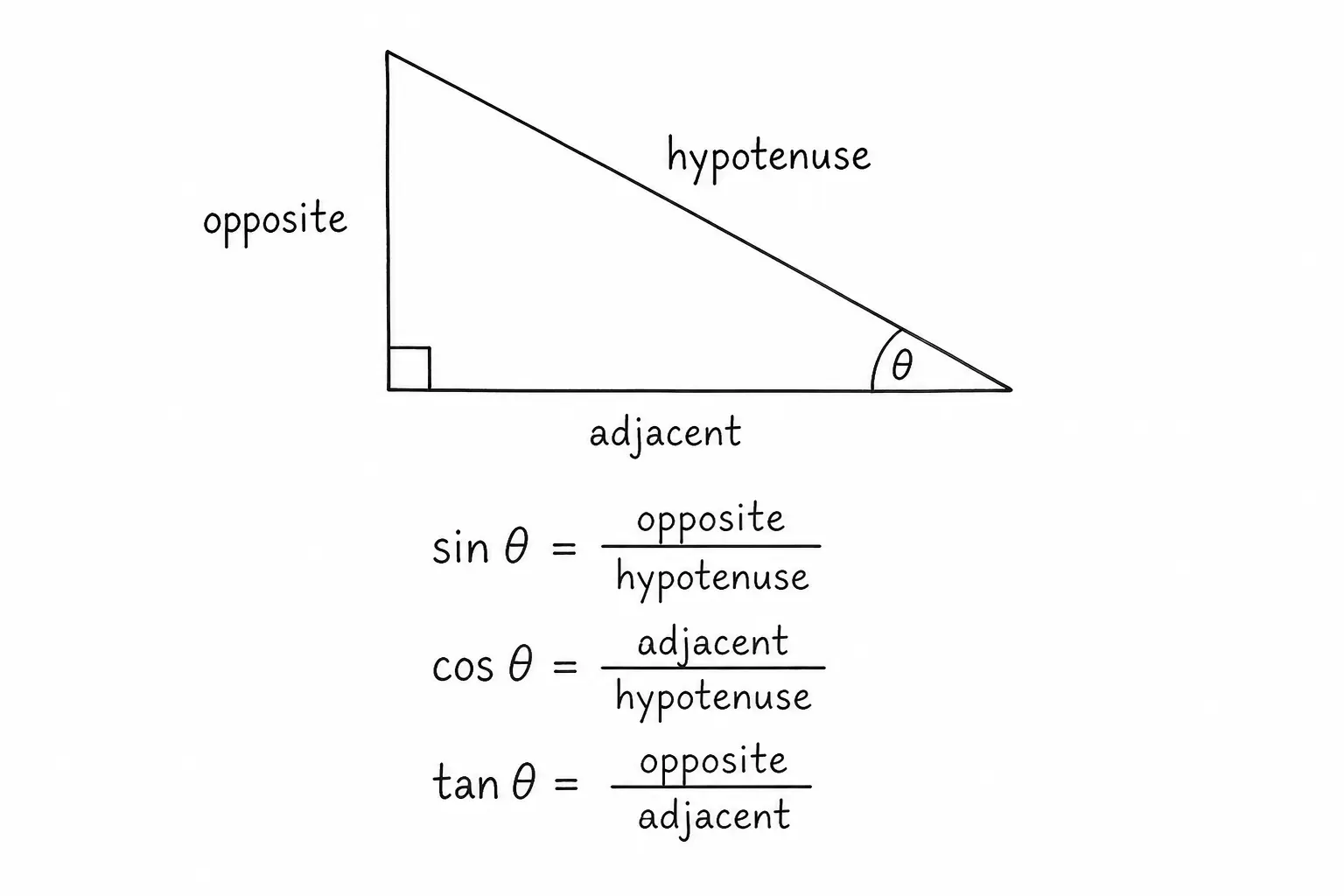
The Three Ratios, SOH-CAH-TOA
In a right triangle, pick one of the non-right angles and call it \( \theta \). Label the three sides relative to that angle:
- Opposite: the side directly across from the angle θ.
- Adjacent: the side next to the angle θ (not the hypotenuse).
- Hypotenuse: the longest side, opposite the right angle.
The three primary trigonometric ratios are then:
$$ \sin\theta = \dfrac{\text{opposite}}{\text{hypotenuse}} \qquad \cos\theta = \dfrac{\text{adjacent}}{\text{hypotenuse}} \qquad \tan\theta = \dfrac{\text{opposite}}{\text{adjacent}} $$
SOH-CAH-TOA is the mnemonic: Sine = Opposite/Hypotenuse, Cosine = Adjacent/Hypotenuse, Tangent = Opposite/Adjacent. Repeat it three times. You now have the entire foundation of trigonometry.
Worked Examples
Example 1. A right triangle has hypotenuse 10 and one of the non-right angles is 30°. Find the lengths of the other two sides.
Opposite to 30° = hypotenuse × sin(30°) = 10 × 0.5 = 5. Adjacent to 30° = hypotenuse × cos(30°) = 10 × (√3/2) ≈ 8.66.
Example 2. A 6-foot ladder leans against a wall at a 70° angle from the ground. How high up the wall does it reach?
Height on wall = hypotenuse × sin(70°) ≈ 6 × 0.940 ≈ 5.64 feet.
Example 3. The angle of elevation from a point 100 feet from a building to the top of the building is 35°. How tall is the building?
Height = adjacent × tan(35°) = 100 × 0.700 ≈ 70.0 feet.
The Special Triangles, 30-60-90 and 45-45-90
Two triangles’ trig values can be derived by hand without a calculator:
30-60-90 triangle
Sides in ratio 1 : √3 : 2. Memorize these values.
| Angle θ | sin θ | cos θ | tan θ |
|---|---|---|---|
| 30° | 1/2 | √3/2 | 1/√3 = √3/3 |
| 60° | √3/2 | 1/2 | √3 |
45-45-90 triangle
Sides in ratio 1 : 1 : √2.
| Angle θ | sin θ | cos θ | tan θ |
|---|---|---|---|
| 45° | √2/2 = 1/√2 | √2/2 = 1/√2 | 1 |
Plus the boundary cases: sin(0°) = 0, cos(0°) = 1, tan(0°) = 0; sin(90°) = 1, cos(90°) = 0, tan(90°) is undefined. These six rows cover most of the trig values you need to know by heart.
The Unit Circle Extension
The right-triangle definitions only work for angles between 0° and 90°. To extend trigonometry to all angles (including obtuse, negative, and angles larger than 360°), trigonometry uses the unit circle, a circle of radius 1 centered at the origin.
For any angle \( \theta \) measured counterclockwise from the positive x-axis, the point where the angle’s terminal ray meets the unit circle has coordinates \( (\cos\theta, \sin\theta) \). The y-coordinate is the sine; the x-coordinate is the cosine.
This extension means \( \sin \) and \( \cos \) are defined for any real angle:
- Sine ranges from -1 to +1, periodic with period 360° (or \( 2\pi \) radians).
- Cosine ranges from -1 to +1, periodic with period 360°.
- Tangent = sin/cos, undefined where \( \cos = 0 \) (at 90°, 270°, etc.), periodic with period 180°.
Radians vs Degrees
Trigonometry uses two angle measurement systems. Degrees divide a full circle into 360 equal parts, a convenient historical convention. Radians measure angles by the arc length traced on a unit circle, with a full circle equal to \( 2\pi \approx 6.28 \) radians.
Conversion: \( 180° = \pi \) radians. So \( 1° = \pi/180 \approx 0.0175 \) radians, and \( 1 \) radian \( \approx 57.3° \).
Calculus prefers radians because derivatives of trig functions in radians are clean: \( \dfrac{d}{dx} \sin x = \cos x \) only if \( x \) is in radians. In degrees you get an extra factor of \( \pi/180 \). For applied physics and engineering, use radians. For everyday geometry, degrees are fine.
Key Identities
- Pythagorean identity: \( \sin^2\theta + \cos^2\theta = 1 \). From the Pythagorean theorem applied to a unit-circle radius.
- Quotient identity: \( \tan\theta = \dfrac{\sin\theta}{\cos\theta} \).
- Reciprocal identities: \( \csc\theta = 1/\sin\theta \), \( \sec\theta = 1/\cos\theta \), \( \cot\theta = 1/\tan\theta \).
- Co-function identities: \( \sin(90° – \theta) = \cos\theta \) and \( \cos(90° – \theta) = \sin\theta \). Sine and cosine are ‘co’ functions of complementary angles.
- Even/odd: \( \cos(-\theta) = \cos\theta \) (even), \( \sin(-\theta) = -\sin\theta \) (odd), \( \tan(-\theta) = -\tan\theta \) (odd).
- Sum and difference: \( \sin(A+B) = \sin A \cos B + \cos A \sin B \) and similar for cosine.
Related study notes: Trigonometric Identities, Pythagorean Theorem, Triangle Inequality, Exponential Function.
The related OpenStax mathematics textbooks provide additional explanations and exercises for the mathematical definitions used here.
A Right-Triangle Calculation
In a right triangle with legs 5 and 12 and hypotenuse 13, choose the angle opposite the length-5 side. Its sine is 5/13, cosine 12/13 and tangent 5/12. For the other acute angle, sine becomes 12/13 and cosine 5/13.
If a 6 m ladder makes a 60° angle with level ground, its vertical reach is 6 sin 60°, about 5.20 m, and its horizontal reach is 6 cos 60° = 3 m. The ladder length is the hypotenuse. A calculator set to radians while entering 60 as degrees would answer a different question.
The points to check in this example are:
- Label the chosen angle before selecting a ratio.
- Sine and cosine of complementary acute angles exchange roles.
- The calculator angle unit should match the given angle.
Check Your Understanding
Try the questions before reading the answers.
Question 1. What is tan θ when opposite = 5 and adjacent = 12?
Answer. 5/12.
Question 2. Can the hypotenuse be smaller than a leg in a right triangle?
Answer. No.
Frequently Asked Questions
What does SOH-CAH-TOA mean?
SOH-CAH-TOA is the mnemonic for the three primary trigonometric ratios. Sine equals Opposite over Hypotenuse (SOH). Cosine equals Adjacent over Hypotenuse (CAH). Tangent equals Opposite over Adjacent (TOA). All three are defined relative to an angle theta in a right triangle.
What is the difference between sine and cosine?
For a given angle theta, sine is the ratio of the side opposite to theta divided by the hypotenuse. Cosine is the side adjacent to theta divided by the hypotenuse. The two are co-functions: sin(theta) = cos(90° – theta) and vice versa. On the unit circle, the sine of an angle is the y-coordinate of the corresponding point; the cosine is the x-coordinate.
Why do we use radians instead of degrees in calculus?
Because the derivative formulas come out clean only in radians. d/dx(sin x) = cos x is only true when x is in radians. If x were in degrees, you’d get d/dx(sin x) = (π/180) cos x with an awkward constant. Radians eliminate the conversion factor and make all the calculus identities work cleanly.
What are the values of sine, cosine, and tangent at 30°, 45°, and 60°?
These three angles have clean values worth memorizing. At 30°: sin = 1/2, cos = √3/2, tan = 1/√3. At 45°: sin = cos = √2/2, tan = 1. At 60°: sin = √3/2, cos = 1/2, tan = √3. Plus the boundary cases: sin(0°) = 0, cos(0°) = 1, sin(90°) = 1, cos(90°) = 0, tan(90°) is undefined.
What is the Pythagorean identity?
sin²θ + cos²θ = 1 for any angle θ. It follows directly from the Pythagorean theorem applied to a right triangle inscribed in a unit circle: the horizontal side has length cos θ, the vertical side has length sin θ, the hypotenuse is the radius 1. Therefore (cos θ)² + (sin θ)² = 1². It is the most-used trig identity in mathematics.
How do sine and cosine extend beyond right-triangle angles?
Through the unit circle. For any angle θ measured counterclockwise from the positive x-axis, the point where the terminal ray meets the unit circle has coordinates (cos θ, sin θ). This definition works for any angle, obtuse, negative, larger than 360°. Sine and cosine become periodic functions of period 360° (or 2π radians), oscillating between -1 and +1.
Browse more in Mathematics.