by
by
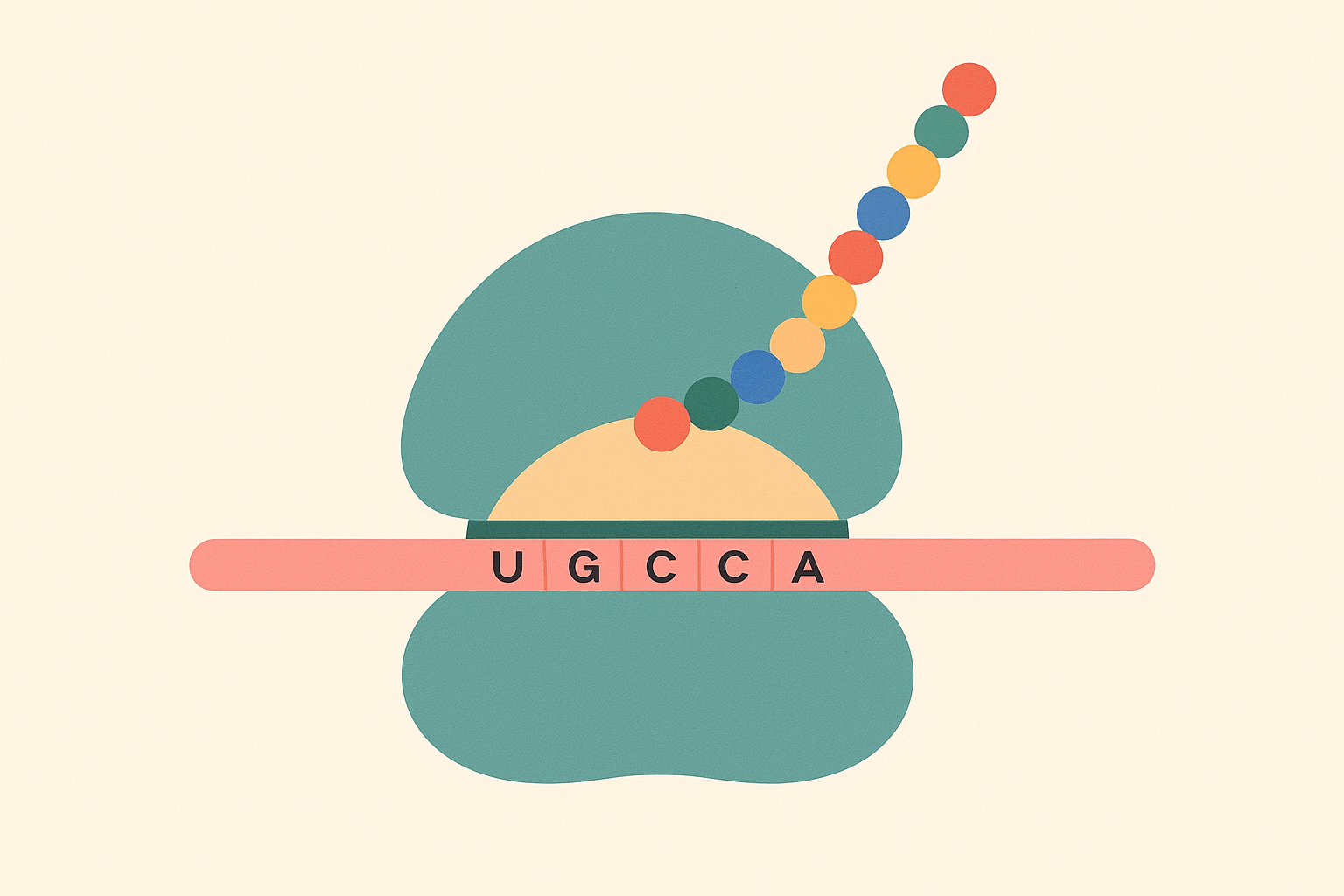
A ribosome is the molecular machine that reads messenger RNA and builds proteins from amino acids. Every functional protein in every living cell was assembled by a ribosome, one amino acid at a time. A typical bacterial cell carries about 15,000 ribosomes; a typical human cell carries millions. Ribosomes account for roughly a quarter of the dry mass of a fast-growing cell. They are the busiest, most abundant, and arguably the most important molecular machines in biology.
A ribosome translates codons into a polypeptide sequence. Its subunit sedimentation values are not additive arithmetic quantities.
What a Ribosome Is
A ribosome is a large molecular complex made of ribosomal RNA (rRNA) and ribosomal proteins. It consists of two subunits, a small one and a large one, that come together when translation begins and separate when translation ends.
- Prokaryotic ribosomes (bacteria, archaea) are 70S. The small subunit is 30S and contains 16S rRNA plus 21 proteins. The large subunit is 50S and contains 23S and 5S rRNA plus 31 proteins.
- Eukaryotic ribosomes (animals, plants, fungi) are 80S. The small subunit is 40S and contains 18S rRNA plus 33 proteins. The large subunit is 60S and contains 28S, 5.8S, and 5S rRNA plus 47 proteins.
- Organellar ribosomes vary across lineages. Mammalian mitochondrial ribosomes are 55S; chloroplast ribosomes are generally bacterial-type 70S particles. This is a major piece of evidence for the endosymbiotic origin of those organelles.
The ‘S’ in 70S and 80S refers to Svedberg units, a sedimentation rate measure. Svedberg values are not additive: they depend on a particle’s mass, shape and interactions with the solvent. The assembled bacterial ribosome sediments at 70S even though its separate subunits are designated 30S and 50S.
Where Ribosomes Live in the Cell
Eukaryotic ribosomes exist in two distinct populations.
- Free ribosomes float in the cytoplasm. They translate proteins destined for the cytoplasm, the nucleus, mitochondria, peroxisomes, or chloroplasts.
- Membrane-bound ribosomes attach to the rough endoplasmic reticulum (RER). They translate proteins destined for secretion, the cell membrane, or the endomembrane system (Golgi, lysosomes). The growing protein is threaded directly into the RER lumen as it is made.
The same ribosome can switch between these roles. The decision happens after translation begins, based on a signal sequence at the start of the growing protein.
How Translation Works
Translation is the process the ribosome performs: reading an mRNA sequence and synthesizing the corresponding protein. It runs in three stages.
Initiation
The small subunit binds to mRNA at the start codon (usually AUG). The initiator tRNA carrying methionine binds. The large subunit joins, and the ribosome is ready to read.
Elongation
This is the core loop, repeated for every amino acid added.
- Codon recognition. The next codon on the mRNA appears in the A (aminoacyl) site. A tRNA carrying the matching amino acid binds.
- Peptide bond formation. The ribosome catalyzes a peptide bond between the amino acid in the P (peptidyl) site and the new one in the A site. The peptidyl transferase reaction is the only enzymatic step, and it is performed by the rRNA itself, not by the ribosomal proteins. The ribosome is a ribozyme.
- Translocation. The ribosome shifts one codon along the mRNA. The tRNA in the A site moves to the P site; the one in the P site moves to the E (exit) site and leaves. The A site is empty again, ready for the next codon.
A single ribosome adds about 15-20 amino acids per second in prokaryotes and 5-10 per second in eukaryotes. A typical 300-amino-acid protein is synthesized in 30 to 60 seconds.
Termination
When a stop codon (UAA, UAG, or UGA) appears in the A site, no tRNA matches. Release factor proteins bind, and the completed protein is released. The ribosome subunits dissociate and are ready for another round.
Polysomes, Many Ribosomes on One mRNA
Multiple ribosomes can translate the same mRNA at the same time, lined up like trucks on a highway. The structure is called a polysome (or polyribosome). The first ribosome starts translation; before it finishes, a second ribosome binds at the start codon and begins translating behind the first. A long mRNA may carry 10-20 ribosomes simultaneously, producing 10-20 copies of the same protein in parallel.
Polysomes are how cells achieve high protein output without needing more mRNA. A single mRNA can produce thousands of protein copies before it is degraded.
Ribosomes Are a Major Antibiotic Target
Because bacterial 70S ribosomes are structurally different from eukaryotic 80S ribosomes, drugs that bind one but not the other are excellent antibiotics. Several classes work this way:
- Aminoglycosides (streptomycin, gentamicin) bind the 30S subunit and cause misreading.
- Tetracyclines block tRNA binding to the A site.
- Macrolides (erythromycin, azithromycin) bind the 50S exit tunnel and block elongation.
- Chloramphenicol inhibits peptidyl transferase activity at the 50S subunit.
- Oxazolidinones (linezolid) bind 50S and prevent initiation.
All of these affect bacterial ribosomes selectively. Mitochondrial ribosomes are sometimes affected, which is one source of antibiotic side effects.
Related study notes: Nucleic Acid, Protein, Mitochondria, Enzyme.
The OpenStax biology textbooks develop the biological processes discussed here with additional diagrams and explanations.
Codons and Termination
An illustrative mRNA reading frame starts AUG-GGC-UUU-UAA. In the standard code, it specifies methionine, glycine and phenylalanine, followed by a stop signal. The stop codon does not add a fourth amino acid.
The reading frame matters: shifting by 1 nucleotide changes how the sequence is grouped into codons. Bacterial cytosolic ribosomes are commonly 70S and eukaryotic cytosolic ribosomes 80S, while mammalian mitochondrial ribosomes are 55S. A shared bacterial ancestry does not justify assigning every organellar particle the same sedimentation value.
The points to check in this example are:
- The ribosome reads mRNA in codon groups.
- Transfer RNAs connect codon recognition with amino acids.
- Release factors participate in recognizing termination signals.
Check Your Understanding
Try the questions before reading the answers.
Question 1. How many amino acids are specified before the stop in the example?
Answer. 3.
Question 2. Do 30S and 50S subunits assemble into an 80S bacterial ribosome?
Answer. No. The assembled bacterial particle is 70S; sedimentation coefficients are not additive.
Frequently Asked Questions
What is the main function of a ribosome?
The ribosome reads messenger RNA and synthesizes proteins by linking amino acids together in the order specified by the mRNA codons. It is the central machine of protein synthesis. Without ribosomes, no living cell could produce its enzymes, structural proteins, or signaling molecules.
Are ribosomes organelles?
Technically no, because they lack a membrane. Ribosomes are large molecular complexes (or ribonucleoprotein particles), made of rRNA and proteins. The distinction matters for textbook classification but not for function, ribosomes are still considered essential cellular machinery alongside the membrane-bound organelles.
Where are ribosomes located in a cell?
Ribosomes are found in two main locations in eukaryotic cells: floating freely in the cytoplasm (where they make proteins for the cytoplasm and certain organelles) and attached to the rough endoplasmic reticulum (where they make proteins for secretion or for membranes). Prokaryotic cells have all their ribosomes in the cytoplasm.
How fast do ribosomes work?
Prokaryotic ribosomes add about 15-20 amino acids per second; eukaryotic ribosomes add about 5-10 per second. A typical 300-amino-acid protein is synthesized in 30 to 60 seconds. A single bacterial cell can produce about 70,000 protein molecules per second across all its ribosomes.
What is the difference between 70S and 80S ribosomes?
Bacterial and archaeal cytosolic ribosomes are generally 70S. Chloroplast ribosomes are commonly 70S, while mammalian mitochondrial ribosomes are 55S and organellar values vary across lineages. They are made of a 30S small subunit and a 50S large subunit. 80S ribosomes are found in the cytoplasm of eukaryotic cells (plants, animals, fungi). They are made of a 40S small subunit and a 60S large subunit. The structural difference is the basis for ribosome-targeting antibiotics, they hit 70S without affecting 80S.
Why are ribosomes called ribozymes?
Because the catalytic peptidyl-transferase activity that forms peptide bonds is performed by the ribosomal RNA, not by the ribosomal proteins. The ribosomal RNA is the actual catalyst. RNA acting as an enzyme is called a ribozyme, and the ribosome is the most consequential ribozyme in biology, it makes every protein you have.
Browse more in Biology.