
Bosons
What Are Bosons?
In particle physics, a boson is a type of particle that obeys the rules of Bose-Einstein statistics. Every boson carries a quantum spin with an integer value: 0, 1, 2, and so on. This is the key distinction from fermions, the other major family of particles, which carry half-integer spin values like 1/2 or 3/2. Bosons play a central role in the Standard Model, acting as the force carriers that hold the universe together.
Why should you care about this spin distinction? It determines everything about how particles behave in groups. Fermions (electrons, quarks, protons) are the “loners” of the particle world. They follow the Pauli Exclusion Principle, meaning no two identical fermions can occupy the same quantum state. Bosons play by completely different rules. They can pile into the same state without limit.
This stacking ability is what makes lasers possible (photons are bosons, and they happily overlap into a single coherent beam). It also gives rise to exotic states like Bose-Einstein condensates, where thousands of atoms cooled to near absolute zero collapse into a single quantum state and behave as one giant “super-atom.” This property connects directly to broader concepts in quantum computing, where bosonic behavior is exploited for information processing.
Why Bosons Matter: The Force Carriers
Bosons are often called force carriers because the gauge bosons mediate every fundamental force in nature. Think of it this way: when two electrons repel each other, they do it by exchanging photons. When a neutron decays inside a nucleus, the weak force acts through W and Z bosons. Gluons hold quarks together inside protons and neutrons. These interactions form the backbone of the four fundamental forces of nature.
Without bosons, there would be no forces, no interactions, and no structure. Fermions would just sit there doing nothing. Bosons are the messengers that make the universe dynamic.
Every force in nature is mediated by bosons. Photons carry the electromagnetic force, gluons carry the strong force, W and Z bosons carry the weak force, and the hypothetical graviton would carry gravity. Without these force-carrying particles, matter couldn’t interact at all.
The name “boson” honors the Indian physicist Satyendra Nath Bose, who in 1924 sent a paper to Albert Einstein proposing a new way to analyze photon behavior. Einstein recognized its brilliance, helped get it published, and then extended Bose’s reasoning from photons to all matter particles. The result, Bose-Einstein statistics, became one of the pillars of quantum mechanics.
The Gauge Bosons of the Standard Model
The Standard Model of particle physics identifies four gauge bosons. Each one mediates a specific fundamental force. Here is what you need to know about each.
Photon
The photon is the most familiar boson. It mediates the electromagnetic force, which governs interactions between electrically charged particles. Every time you see light, feel warmth from the sun, or use a radio, photons are at work.
Key properties of the photon:
- Mass = 0 (exactly massless)
- Electrical charge = 0
- Quantum spin = 1
- Travels at the speed of light (c)
- The photon is its own antiparticle
Because the photon is massless, the electromagnetic force has infinite range. This is why you can see stars billions of light-years away. The relationship between photons and the speed of light is a cornerstone of special relativity.
Gluon
The gluon mediates the strong nuclear force, which binds quarks together inside protons and neutrons. The strong force is, as the name suggests, the strongest of all four fundamental forces, but it operates only at extremely short ranges (about the diameter of a proton).
Key properties of the gluon:
- Mass = 0 (theoretically massless)
- Electrical charge = 0
- Quantum spin = 1
- Carries color charge (unlike the photon, which carries no electromagnetic charge itself)
- There are 8 types of gluons
Here is something remarkable about gluons: because they carry color charge, gluons interact with each other. Photons do not do this. This self-interaction is what gives the strong force its unique character, including the phenomenon of confinement, where quarks can never be isolated.
W Boson
The W boson, along with the Z boson, mediates the weak nuclear force. The weak force is responsible for radioactive beta decay, the process that powers the sun’s nuclear fusion and enables carbon dating.
The W boson is unique among gauge bosons because it carries electrical charge. It comes in two varieties: W+ (positive charge) and W- (negative charge). These two are each other’s antiparticles.
Key properties of the W boson:
- Electrical charge = +1e or -1e
- Mass = 80.385 GeV/c2 (about 86 times the proton mass)
- Quantum spin = 1
- Very short-lived: half-life of about 3 x 10-25 seconds
The W boson was experimentally observed in 1983 at CERN, earning the 1984 Nobel Prize in Physics for Simon van der Meer and Carlo Rubbia.
Z Boson
The Z boson is the electrically neutral partner of the W boson. Together, they mediate the weak nuclear force. While the W boson changes particle types (turning a neutron into a proton, for instance), the Z boson mediates neutral current interactions where particle identities stay the same.
Key properties of the Z boson:
- Electrical charge = 0 (neutral)
- Mass = 91.1876 GeV/c2 (about 97 times the proton mass)
- Quantum spin = 1
- The Z boson is its own antiparticle
- Very short-lived, same as the W boson
The Z boson was discovered alongside the W boson in 1983 at CERN. Observing neutral current interactions is especially challenging because Z bosons behave somewhat like photons but only become significant at energies comparable to the Z boson’s enormous mass. This is why their discovery required the world’s most powerful particle accelerators.
Discovery of the W and Z Bosons
The discovery of the W and Z bosons stands as one of the great triumphs of experimental particle physics. It confirmed electroweak theory, which unified electromagnetism and the weak force into a single framework.
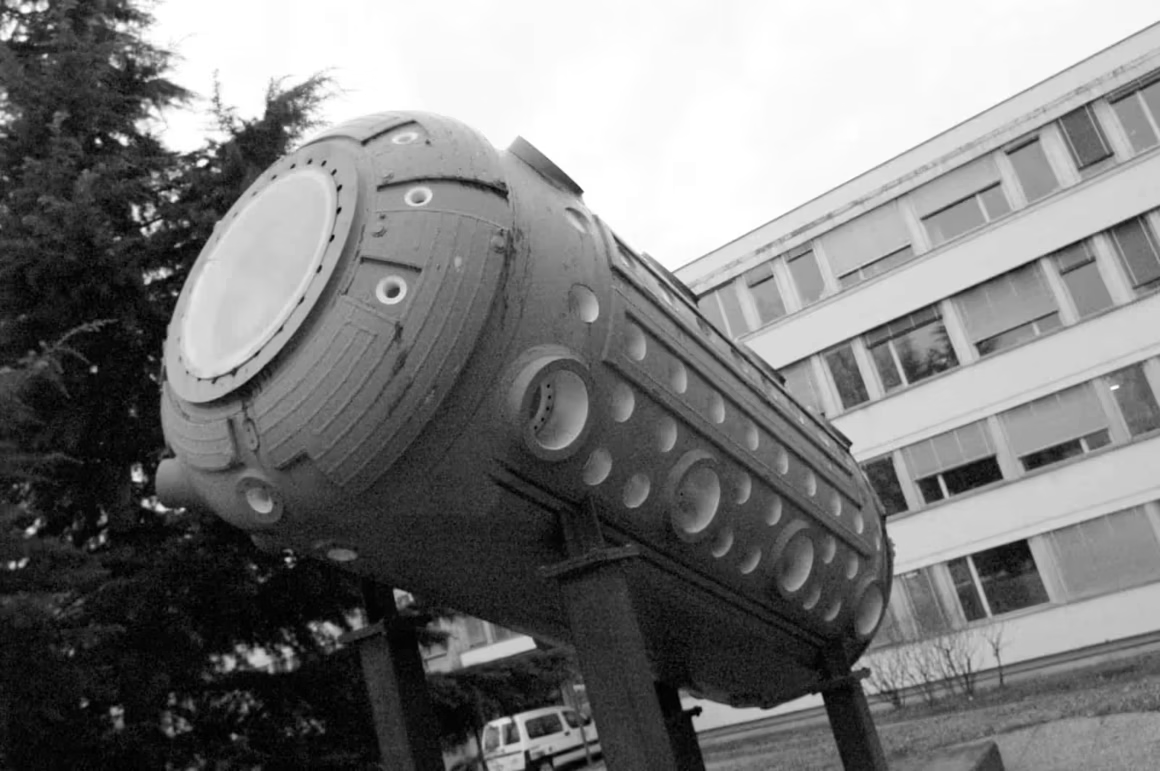
The first clue came in 1973. At CERN, the enormous Gargamelle bubble chamber photographed something unexpected: electrons suddenly starting to move, seemingly on their own. This was interpreted as a neutrino (invisible to detectors) exchanging an unseen Z boson with the electron, transferring momentum in the process. It was the first observation of neutral current interactions, exactly as electroweak theory predicted.
A decade later, in 1983, the W+, W-, and Z0 bosons were directly observed at CERN. Together with the photon, these four particles comprise the gauge bosons of the electroweak interaction. Their discovery validated decades of theoretical work and earned the Nobel Prize.
The Higgs Boson
The Higgs boson is unlike any other boson on this list. It isn’t a force carrier. Instead, it’s the quantum excitation of the Higgs field, a field that permeates all of space and gives mass to fundamental particles.
When particles interact with the Higgs field, they acquire mass. Particles that interact strongly with the field (like the W and Z bosons) are heavy. Particles that don’t interact with it at all (like the photon) remain massless. You can think of the Higgs field as a kind of invisible molasses that fills the universe.
Key properties of the Higgs boson:
- Mass = 125.25 GeV/c2 (about 133 times the proton mass)
- Electrical charge = 0
- Quantum spin = 0 (the only known fundamental scalar boson)
- No color charge
- Extremely short-lived
The Higgs boson is the only fundamental particle with spin 0, making it a scalar boson. All other confirmed bosons (photon, gluon, W, Z) have spin 1, making them vector bosons. The hypothetical graviton would have spin 2, which would make it a tensor boson.
The Higgs boson was theorized in 1964 by Peter Higgs and several other physicists. It took nearly 50 years to find it experimentally. On July 4, 2012, CERN announced the discovery of a particle consistent with the Higgs boson using the Large Hadron Collider. Peter Higgs and Francois Englert received the 2013 Nobel Prize in Physics for their theoretical prediction.
The Graviton (Hypothetical)
If the pattern of force carriers holds, gravity should also have a mediating boson: the graviton. This hypothetical particle would mediate the gravitational force, completing the set of force-carrying bosons.
Predicted properties of the graviton:
- Mass = 0 (gravity has infinite range, so the graviton must be massless)
- Electrical charge = 0
- Quantum spin = 2
Here is the catch: the graviton has never been detected. Gravity is extraordinarily weak compared to the other forces (about 1038 times weaker than the strong force). Detecting individual gravitons may be beyond the reach of any foreseeable technology. Despite this, the graviton remains an important theoretical concept, especially in attempts to create a quantum theory of gravity.
Boson Comparison Table
| Boson | Force Mediated | Spin | Mass | Charge | Status |
|---|---|---|---|---|---|
| Photon | Electromagnetic | 1 | 0 | 0 | Confirmed |
| Gluon (x8) | Strong nuclear | 1 | 0 | 0 (has color charge) | Confirmed |
| W boson | Weak nuclear | 1 | 80.385 GeV/c2 | +/-1e | Confirmed |
| Z boson | Weak nuclear | 1 | 91.188 GeV/c2 | 0 | Confirmed |
| Higgs boson | Higgs field (mass) | 0 | 125.25 GeV/c2 | 0 | Confirmed (2012) |
| Graviton | Gravity | 2 | 0 (predicted) | 0 | Hypothetical |