
The Raman Effect: Theory, Discovery, and Applications
The Raman effect was discovered on February 28, 1928, by C.V. Raman and K.S. Krishnan in Kolkata. This book covers the complete story: the science behind inelastic light scattering, the experimental discovery, the Nobel Prize, and modern applications in spectroscopy, material science, and medical diagnostics. A comprehensive resource on this fundamental physics phenomenon.
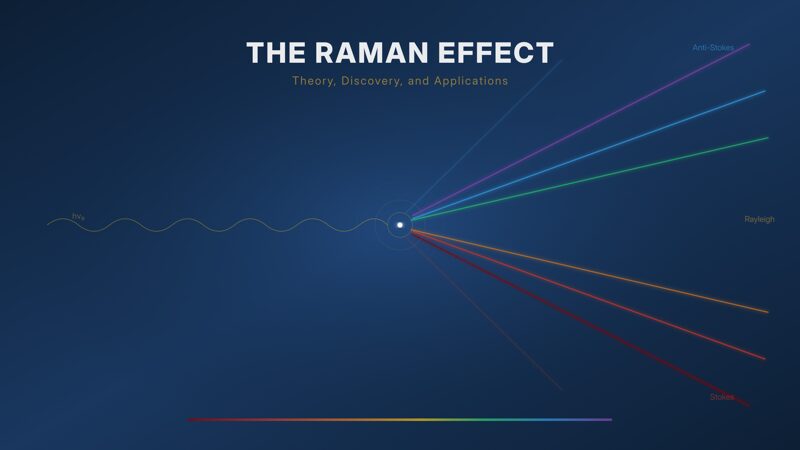
The Raman effect was discovered on February 28, 1928, by C.V. Raman and K.S. Krishnan in Kolkata. This book covers the complete story: the science, the history, and the modern applications.
The classical theory derives the Raman effect from first principles. The quantum theory covers energy level diagrams, virtual states, and selection rules.
Experimental techniques include SERS, FT-Raman, and micro-Raman spectroscopy. Applications range from medical diagnostics to carbon nanomaterials.
Key Topics
- C.V. Raman’s life and the 1928 discovery
- Classical and quantum derivations of the Raman effect
- Selection rules, polarizability tensor, and depolarization ratio
- Modern techniques: SERS, CARS, TERS, SORS
- Applications in medicine, forensics, art, and nanotechnology
- Indian contributions to physics: Bose, Saha, Chandrasekhar