
Is It Safe to Share Casino Referral Links? What You Need to Know
 by
by
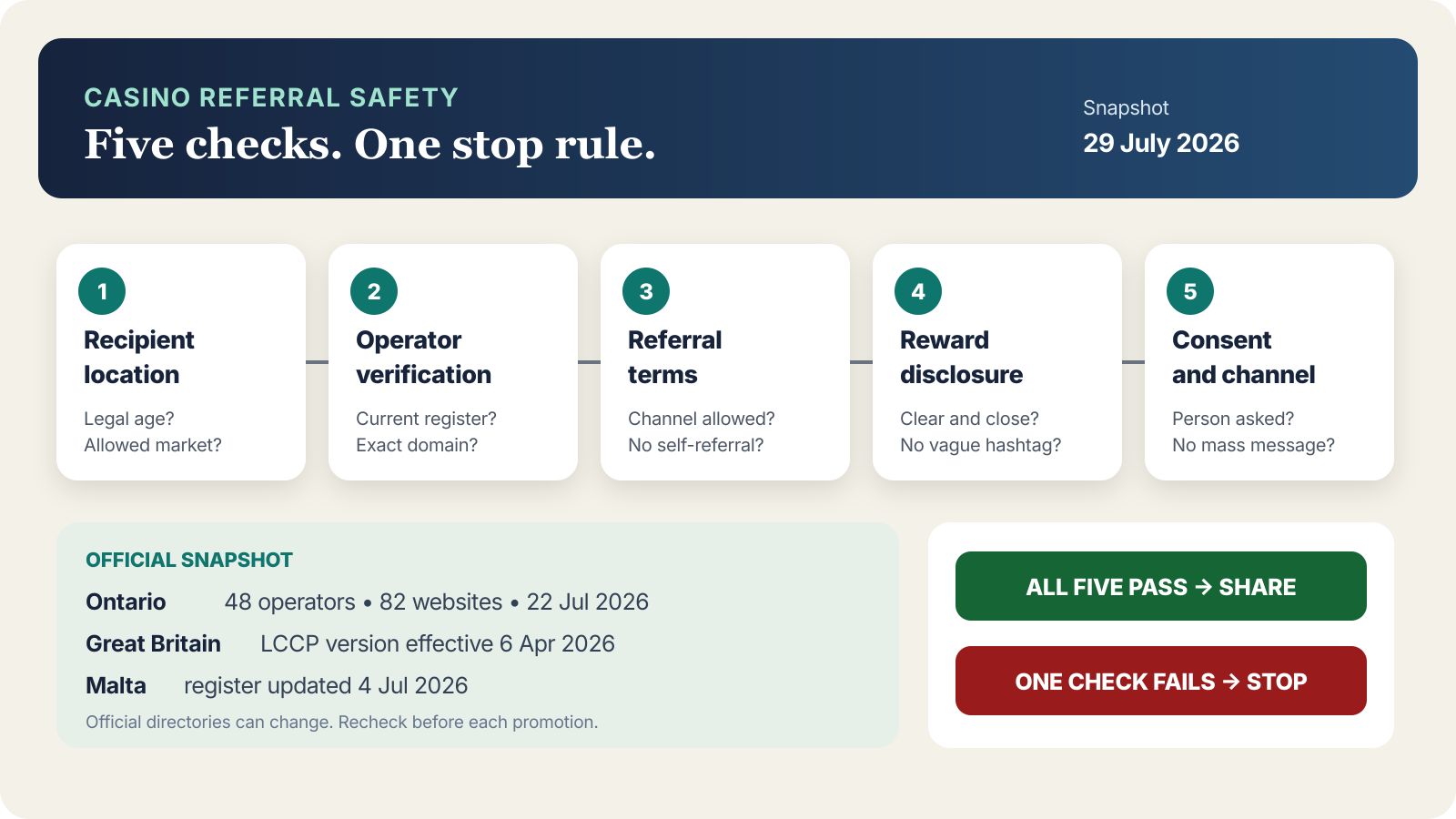
Casino referral links are not automatically safe or unsafe. The right answer depends on five checks: the recipient’s location and age, the operator’s current authorisation, the referral terms, your reward disclosure, and whether the person actually consented to receive the link.
My practical rule is deliberately strict: if one of those checks fails, do not share. A private link sent to an eligible adult who asked for it is a different activity from posting reward-driven promotions to strangers. The URL may look similar, but the legal, platform, privacy, and reputation risks are not.
The short verdict: Verify the exact domain in the official register for the recipient’s market, read the program terms, disclose any benefit you can receive, and use a consented one-to-one channel. HTTPS alone and a familiar logo are not enough.
Research snapshot, July 29, 2026: I checked current primary guidance from the U.S. Federal Trade Commission, the Great Britain Gambling Commission, iGaming Ontario, the New Jersey Division of Gaming Enforcement, and the Malta Gaming Authority. The rules differ, but the shared direction is clear: verify the operator, protect minors and vulnerable people, avoid misleading promotions, respect direct-marketing rules, and make material connections visible.
Table of Contents
What Are Casino Referral Links?

A casino referral link is a URL or code that attributes a new account or qualifying action to the person who shared it. The operator may reward the sender, the recipient, or both. That attribution function is ordinary tracking. It does not prove that the offer is fair, that the sender will be paid, or that the operator may serve the recipient’s location.
For example, a program page can explain when a casino referral bonus becomes eligible. The useful details are not the headline reward. They are the qualifying purchase, identity checks, excluded users, geographic restrictions, reward cap, expiry date, allowed sharing channels, and clawback conditions.
A referral link usually connects three records:
- Sender record: the account or code that receives attribution.
- Recipient record: the new user, location, age, identity, and eligibility checks.
- Qualifying event: the registration, purchase, deposit, play, or other action defined by the program terms.
This distinction matters because a click is not the same as an earned reward. If a program requires a purchase or continued play, the economic incentive is tied to the recipient doing more than visiting a page. That is also why the sharer should disclose the benefit instead of presenting the link as neutral advice.
Are Casino Referral Links Safe to Share?
Casino referral links can be shared with lower risk only after both the operator and the promotion pass a location-specific check. A technically valid tracking URL may be secure and verifiable and still point to an offer that is unavailable to the recipient or prohibited by the platform where it is posted.
Do not use the word “licensed” without naming the regulator and checking the exact domain. Licences have a territorial scope, and regulators maintain different registers. Approval in one market does not travel with the URL.
| Market | Dated official evidence | What to verify |
|---|---|---|
| U.S. federal advertising layer | FTC Endorsement Guides revised June 2023; guidance checked July 29, 2026 | Disclose a reward or material connection clearly. Use the FTC’s current Endorsement Guides FAQ. |
| Great Britain | LCCP version effective April 6, 2026 | Check the exact operator and domain in the Gambling Commission public register. The Gambling Commission third-party guidance makes licensees responsible for contracted third parties. |
| Ontario | 48 operators and 82 gaming websites; directory accurate July 22, 2026 | Use the iGaming Ontario operator directory. Do not infer Ontario approval from a foreign licence or from the site’s availability. |
| New Jersey | 2026 advertising best-practice document checked July 29, 2026 | Use New Jersey’s approved gaming-sites list. The New Jersey DGE Advertising Best Practices includes affiliate promotions and requires clear terms and age-appropriate placement. |
| Malta | Licensee register updated July 4, 2026 | Search the Malta Gaming Authority licensee register by URL and authorisation status. The MGA commercial-communications guidance applies social-responsibility duties to authorised persons and third parties. |
The Ontario count is useful because it shows what a verifiable market looks like: one dated directory listed 48 operators and 82 gaming websites. It is not a global total and it does not tell you whether a site is authorised in a U.S. state, Great Britain, or Malta. The correct unit of analysis is the exact operator, exact domain, exact recipient location, and current date.
Who Should Avoid Sharing (and the Real Risks)
Some people should skip casino referrals completely. A small reward is not worth becoming the person who pushes gambling at someone who did not ask for it.
- Minors or age-uncertain recipients: do not send the link. Minimum ages and product rules vary by market.
- Self-excluded or vulnerable recipients: do not send marketing to someone who has opted out or shown signs that gambling is causing harm.
- Location-uncertain recipients: stop until you can verify that the exact operator and product are available there.
- Public-spam plans: do not mass-post, buy a list, automate direct messages, or hide the reward behind a vague recommendation.
- Unverified accounts: do not expose identity documents, account numbers, QR codes, balances, or private tracking parameters in screenshots.
The risks fall into four separate layers:
| Risk layer | What can go wrong | Practical control |
|---|---|---|
| Operator terms | Reward denied, account suspended, or referral reversed | Save the current terms and use only permitted channels |
| Advertising | Undisclosed incentive or misleading bonus claim | State the benefit beside the recommendation |
| Direct marketing | Spam complaint, platform restriction, or email-law issue | Use consented contact and honour every stop request |
| Location and age | Ineligible recipient or unauthorised offer | Check the official register and eligibility before sharing |
The reward terms deserve the same scrutiny as any other promotion. See The Truth About Casino Bonuses: What Players Should Know for the difference between a headline bonus and the conditions that determine whether it has practical value.
How to Identify Safe Referral Links
A padlock is only the first technical check. HTTPS encrypts the connection between the browser and the domain. Scammers can also obtain certificates, so HTTPS does not certify the business behind the page.
- Read the domain from right to left: confirm the registrable domain, not just a familiar word in a long URL.
- Compare the exact domain with the regulator: use the register for the recipient’s market, not a review-site badge or search-result snippet.
- Inspect redirects: a legitimate campaign may track a click, but unexplained hops, misspellings, URL shorteners, or a different final domain deserve a stop.
- Open the terms without signing in: look for eligibility, qualifying actions, channel restrictions, reward limits, expiry, and reversal rules.
- Never enter credentials from a message: if something looks wrong, navigate to the verified operator independently and find the promotion there.
Location masking is not a compliance strategy. A simple rule still applies: a VPN won’t make a banned operator legal. It may also cause an operator to treat the session as suspicious or outside its terms.
How to Safely Share a Sweepstakes Casino Referral Link
Use this five-step sequence every time. The order matters because it prevents you from polishing a promotion before you know whether it should be sent at all.
- 1. Verify the person: confirm the recipient meets the product’s minimum age and is in a location the exact operator can serve.
- 2. Verify the operator: match the brand, legal entity, domain, authorisation status, and product in the current official directory.
- 3. Verify the terms: read qualifying actions, caps, expiry, prohibited channels, self-referral rules, and clawback language before writing the message.
- 4. Disclose the reward: write a plain sentence such as “I may receive a referral reward if you qualify.” Put it beside the link, not behind a profile or disclosure page.
- 5. Use consented contact: send it only to an adult who asked for the recommendation, then stop if the person declines or asks not to receive more messages.
Email deserves special care. The FTC CAN-SPAM compliance guide says a seller that offers money, discounts, awards, sweepstakes entries, or another benefit for forwarding a commercial message or generating referral traffic is likely to have compliance obligations. That is a much stronger reason to avoid blast emails than the fear that the tracking link itself contains malware.
Keep a minimal record if the reward matters:
- The date you checked the official register and program terms.
- The domain and promotion page you verified.
- The disclosure used beside the link.
- The recipient’s request or consent, without collecting unnecessary sensitive data.
- The reward status and any reversal explanation.
Do not keep identity documents, passwords, payment details, or screenshots that expose account information. The goal is to prove what you checked, not to build a private dossier on a friend.
Making the Most of Referrals
The smartest way to use casino referrals is not to maximise the number of links you send. It is to reduce the chance of a bad recommendation. One suitable referral with a clear disclosure is better than a hundred messages that create complaints, ineligible sign-ups, or pressure to gamble.
I also would not model referral rewards as dependable income. The sender does not control whether the recipient registers, passes verification, makes a qualifying action, remains eligible, or triggers a fraud review. The operator controls the terms and can change or close the program.
If you intend to publish referral content repeatedly, you are moving from a friendly recommendation toward affiliate marketing. That means disclosures, claims, audience targeting, program rules, platform policies, and recordkeeping all become operating work. My guide to the best affiliate marketing programs for beginners explains the broader model, but gambling offers deserve a higher risk threshold than ordinary software or retail links.
Responsible-sharing rule: Do not send gambling promotions to minors, self-excluded people, anyone who has asked you to stop, or anyone showing signs that gambling is causing financial or emotional harm. If the recipient needs help, point them to the self-exclusion and support options supplied by the licensed operator or their regulator. Do not use a referral reward as a reason to keep persuading them.
Are casino referral links safe to click?
A casino referral link is safer to click when the visible domain matches the operator’s current official domain, the operator appears in the relevant regulator’s register, and the page does not ask for credentials before you reach the operator. HTTPS protects the connection, but it does not prove that an operator is licensed or legal where you are.
Do I need to disclose a casino referral reward?
Yes, if the recommendation can earn you money, coins, discounts, entries, or another benefit. Put a plain disclosure beside the recommendation or link. A personalised code, profile disclosure, or vague hashtag may not make the financial relationship clear to the person receiving it.
Can I email a referral link to friends?
A one-to-one message requested by an adult is different from a reward-driven email campaign. The FTC says a seller that offers a benefit for forwarding a commercial message or generating referral traffic is likely to have CAN-SPAM obligations. Do not buy lists, mass-message strangers, or keep contacting someone who has asked you to stop.
Does a licence make a casino referral link legal everywhere?
No. A licence or registration has a territorial scope. Verify the exact operator and domain in the official register for the recipient’s location. Approval in Ontario, Great Britain, New Jersey, or Malta does not automatically authorise an offer in a different state, province, or country.
Is sharing referral links a reliable income source?
I would not treat it as reliable income. Rewards can depend on another person’s registration, purchase, play, verification, and continued eligibility. Terms can cap rewards, exclude channels, reverse suspicious referrals, or change the program. A reward is an acquisition incentive, not guaranteed earnings.
My final test is simple: can you name the regulator, verify the exact domain, show the current terms, explain your reward in one plain sentence, and confirm the adult recipient asked for the link? If yes, a private referral may be reasonable. If any answer is no, stop. All five pass means share privately; one failure means do not send it.
Tell Google you want more of this.
Add Gaurav Tiwari as a preferred sourceOne tap, and this site shows up more often in your own Top Stories, AI Overviews and AI Mode. Remove it any time.