
5 Innovative Marketing Strategies To Try For Your Next Campaign
Most marketing campaigns in 2026 are running the same playbook from 2019: social media posts, email blasts, maybe some influencer partnerships. The problem? Everyone’s doing it. Customer acquisition costs have risen 60% in the last five years, according to ProfitWell data. When every competitor runs the same strategies, none of them work as well as they used to.
AI has fundamentally changed what’s possible. Short-form video generates 2x the engagement of static posts. Community-led growth is replacing traditional top-of-funnel tactics. And the businesses growing fastest aren’t outspending their competition. They’re using strategies most companies haven’t adopted yet because they still feel “experimental.”
This guide covers 5 specific marketing approaches generating measurable results right now, with real numbers, real tools, and implementation steps you can execute this week. Whether you’re planning your first digital marketing campaign or optimizing an existing one, these strategies will give you a genuine competitive edge.
AI-Powered Content at Scale (Without Losing Quality)
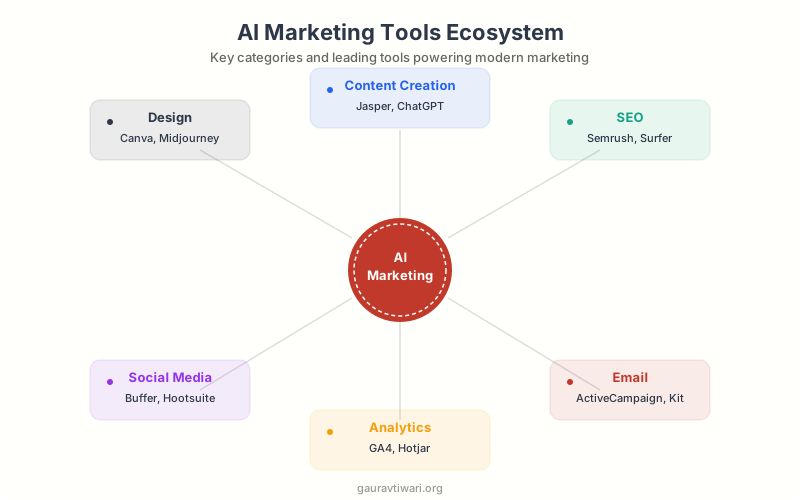
AI content tools have matured from novelty to necessity. The companies growing fastest in 2026 aren’t choosing between human and AI content. They’re combining both: AI for speed and scale, humans for strategy and voice. The result is 3-5x more content output at roughly the same cost.
How Smart Teams Use AI Content
First drafts and outlines. AI tools like Jasper, ChatGPT, and Claude generate solid first drafts in minutes. A human editor then adds brand voice, original insights, and fact-checking. This cuts content production time by 60-70% while maintaining quality.
Repurposing content across formats. One long-form blog post becomes 10 social media posts, 3 email newsletters, a YouTube script, and 5 LinkedIn carousels. AI handles the reformatting. Your team handles the strategy. This multiplies your content ROI without multiplying your workload.
Personalization at scale. AI generates personalized email subject lines, ad copy variations, and landing page copy for different segments. ActiveCampaign’s conditional content blocks show different email content to different subscriber segments automatically. HubSpot’s marketing platform uses AI to personalize website content based on visitor behavior.
SEO content optimization. Tools like Semrush’s Content Marketing Platform and Surfer SEO analyze top-ranking pages and suggest content improvements: keyword density, heading structure, content gaps, and readability. This takes the guesswork out of content marketing strategy.
Interactive Content Marketing (Quizzes, Calculators, and Tools)
Interactive content generates 2x more conversions than passive content, according to Demand Metric. It also generates 4-5x more page views and keeps visitors on your site 3x longer. The reason is simple: people engage with content that responds to them.
High-ROI Interactive Content Types
ROI calculators. A marketing ROI calculator that shows potential customers exactly how much they could save or earn by using your product. These convert at 3-5x the rate of static landing pages because they make the value proposition personal and concrete. Hubspot, Semrush, and most successful SaaS companies offer them.
Assessment quizzes. “What type of marketing strategy fits your business?” or “How mature is your content marketing?” Quizzes capture email addresses (for results delivery), segment leads automatically based on answers, and generate shareable results that drive organic traffic. Tools like Typeform, Interact, and Outgrow make these easy to build without developers.
Interactive infographics. Static infographics get shared. Interactive infographics get shared and explored. Add hover states, clickable sections, and progressive disclosure (reveal more data as users engage). They’re particularly effective for presenting digital marketing trends and complex data.
Product recommendation engines. “Which plan is right for you?” or “Find your perfect tool.” These guided selling experiences reduce decision fatigue and increase conversion rates by 20-30% for companies with multiple products or pricing tiers.
Interactive demos and product tours. Tools like Storylane, Navattic, and Tourial let you create interactive product demos that prospects can explore on their own. These have replaced the “book a demo” model for many SaaS companies, because 70% of B2B buyers prefer to self-serve before talking to sales.
Community-Led Growth (Your Most Underrated Channel)
Community-led growth (CLG) is the strategy of building a community around your brand that drives acquisition, retention, and advocacy simultaneously. It’s not “having a Facebook group.” It’s building a space where your audience connects with each other around shared interests that overlap with your product.
Why Community Works Better Than Advertising
Customer acquisition cost drops. Community members refer others organically. Notion, Figma, and HubSpot grew primarily through community and word-of-mouth, not paid advertising. Their communities create content, answer questions, and evangelize the product for free.
Retention improves dramatically. Customers who are part of a brand community have 19% higher lifetime value and churn 25% less than non-community members (CMX Research). The social connections and peer support create switching costs that no product feature can match.
Product feedback is instant. Your community tells you what to build, what’s broken, and what they wish existed. This is faster and more reliable than any formal research process. Companies like Airtable and Linear run their product roadmaps partially based on community feedback.
Building a Community That Drives Growth
Choose the right platform. Discord works for developer and creator communities. Circle and Mighty Networks work for course creators and professional communities. Slack works for B2B. Reddit and Facebook Groups work for broad consumer audiences. Don’t spread across multiple platforms. Pick one and go deep.
Start with value, not promotion. Your community should solve a problem for members, not serve as a marketing channel. Share exclusive content, host AMAs (Ask Me Anything) with industry experts, create accountability groups, and facilitate connections between members. The brand promotion happens naturally when members get genuine value.
Appoint community champions. Identify your most active and helpful members and give them special roles, early access, and recognition. These champions moderate, welcome new members, and create content on your behalf. They’re your most valuable marketing asset.
Short-Form Video Marketing (Beyond Just Posting Reels)
Short-form video is the highest-reach organic content format in 2026. TikTok, Instagram Reels, YouTube Shorts, and LinkedIn video collectively reach more people than any other content type. But most brands approach short-form video wrong: they create ads disguised as content. The algorithm (and audiences) can tell the difference.
The Content Framework That Works
Education over promotion. The 80/20 rule applies: 80% educational/entertaining content, 20% promotional. A SaaS company teaching productivity tips. A restaurant showing cooking techniques. An agency sharing marketing breakdowns. The value-first approach builds audience trust that promotional content alone never can.
Hook-value-CTA structure. Every short-form video follows this: Hook (first 1-2 seconds that stop the scroll), Value (the insight, tip, or story), CTA (follow, comment, share, or click the link). The hook is everything. “Here’s a marketing mistake that’s costing you $10K/month” works. “Welcome to our channel” doesn’t.
Repurpose everything. One 10-minute YouTube video becomes 5-8 short-form clips. One podcast episode becomes 10+ Reels. One blog post becomes a carousel and 3 video scripts. Use Canva’s video editor or tools like Opus Clip and Descript to automate the repurposing. This is how visual content teams produce volume without burning out.
Platform-native features. Each platform rewards content that uses its native tools. Instagram rewards Reels that use trending audio. YouTube Shorts rewards content from channels with regular long-form uploads. TikTok rewards duets, stitches, and responses. LinkedIn rewards text overlays and industry insights. Don’t cross-post the exact same video everywhere. Adapt it.
| Platform | Ideal Length | Best Content Type | Key Algorithm Signal |
|---|---|---|---|
| TikTok | 15-60 seconds | Trends, education, entertainment | Watch time + shares |
| Instagram Reels | 15-30 seconds | Tips, behind-the-scenes, tutorials | Saves + completion rate |
| YouTube Shorts | 30-60 seconds | Clips, tips, teasers for long-form | Click-through from Shorts to channel |
| LinkedIn Video | 30-90 seconds | Industry insights, career tips, thought leadership | Comments + dwell time |
Data-Driven Influencer and Creator Partnerships
Influencer marketing isn’t new. But the way smart brands approach it in 2026 is fundamentally different from the “pay for a sponsored post” model. The shift is toward long-term creator partnerships with performance-based compensation and authentic integration.
Micro-Influencers Outperform Mega-Influencers
Influencers with 10K-100K followers generate 60% higher engagement rates and 22% higher conversion rates than those with 1M+ followers (Influencer Marketing Hub, 2026). The reason: their audiences are more niche, more trusting, and more likely to act on recommendations. They’re also 5-10x cheaper per post.
How to find the right micro-influencers. Use tools like Semrush’s social media tools, Upfluence, or even manual Instagram/TikTok search with niche hashtags. Look for: engagement rate above 3%, audience demographics that match your target customer, content style that aligns with your brand, and genuine enthusiasm for your category (not just paid posts for anyone).
Performance-Based Creator Programs
Affiliate-style partnerships. Instead of paying a flat fee per post, offer creators a revenue share or commission on sales they drive. This aligns incentives: creators only earn when their recommendations convert, so they naturally create better, more authentic content. Platforms like Impact, PartnerStack, and ShareASale make tracking seamless.
Co-created products. Collaborate with creators to develop limited editions, exclusive content, or co-branded products. This creates genuine excitement because the creator has a real stake in the product’s success. It also generates content naturally: the creator documents the development process, launch, and results.
Long-term ambassador programs. One-off sponsored posts have diminishing returns. Long-term partnerships (3-12 months) let creators genuinely learn your product, build authentic stories around it, and create content that feels natural rather than forced. Brand ambassadors who genuinely use your product create content that converts 3-4x better than one-time sponsored posts.
Best Marketing Tools for Campaign Execution
The right tools make the difference between a strategy that sounds good on paper and one that actually executes. Here are the four marketing tools I recommend for implementing the strategies in this guide.

Experiential and Immersive Marketing
Experiential marketing creates memorable brand interactions that people talk about and share. In 2026, this extends beyond physical events to include AR experiences, interactive digital campaigns, and hybrid formats that blend physical and digital.
Augmented reality campaigns. Brands like IKEA (Place app), Sephora (Virtual Artist), and Nike (AR shoe try-on) have shown that AR drives purchasing confidence. Customers who use AR features are 40% more likely to convert because they can visualize products in their context before buying. Instagram and Snapchat both offer AR filter creation tools that any brand can use for custom experiences.
Pop-up experiences. Physical pop-ups with a digital twist. QR codes linking to exclusive content, Instagram-worthy installations that generate user-generated content, and interactive product demonstrations. The key metric isn’t foot traffic. It’s social media mentions and content generated by attendees.
Virtual and hybrid events. Webinars are commoditized. Interactive virtual events with breakout rooms, live Q&A, networking lounges, and on-demand content libraries are what differentiate. Use email marketing and social promotion to drive registrations, then repurpose event content into weeks of follow-up content.
Gamification. Add game mechanics to your marketing: points systems, challenges, leaderboards, achievement badges. Duolingo’s streak system is the most famous example. But gamification works for any business. Loyalty programs, referral challenges, and social media contests all use gamification principles to drive engagement and repeat interaction.
Measuring Campaign Success (The Metrics That Matter)
Every marketing strategy needs measurable outcomes. Track these metrics to determine whether your innovative campaigns are actually working or just looking impressive.
| Metric | What It Measures | Why It Matters |
|---|---|---|
| Customer Acquisition Cost (CAC) | Total marketing spend / new customers | Shows if your strategy is financially sustainable |
| Return on Ad Spend (ROAS) | Revenue from ads / ad spend | Direct profitability of paid campaigns |
| Marketing Qualified Leads (MQLs) | Leads meeting your qualification criteria | Pipeline quality, not just quantity |
| Content Engagement Rate | Interactions / impressions | Indicates content relevance and resonance |
| Customer Lifetime Value (CLV) | Total revenue per customer over time | Long-term campaign impact beyond first purchase |
| Net Promoter Score (NPS) | Customer willingness to recommend | Community and brand advocacy effectiveness |
Set benchmarks before launching any campaign. Measure against your own historical performance, not industry averages (which are often inflated or outdated). Review weekly during active campaigns and make data-driven adjustments. The best internet marketing strategies are the ones you continuously optimize, not the ones you set and forget.

Campaign Launch Checklist
The marketing strategies delivering the highest ROI right now aren’t the flashiest or the most expensive. They’re the ones that combine AI efficiency with human creativity, build communities instead of just audiences, and measure results instead of vanity metrics.
Which marketing strategy are you most excited to try?
Frequently Asked Questions
What’s the most effective marketing strategy for small businesses in 2026?
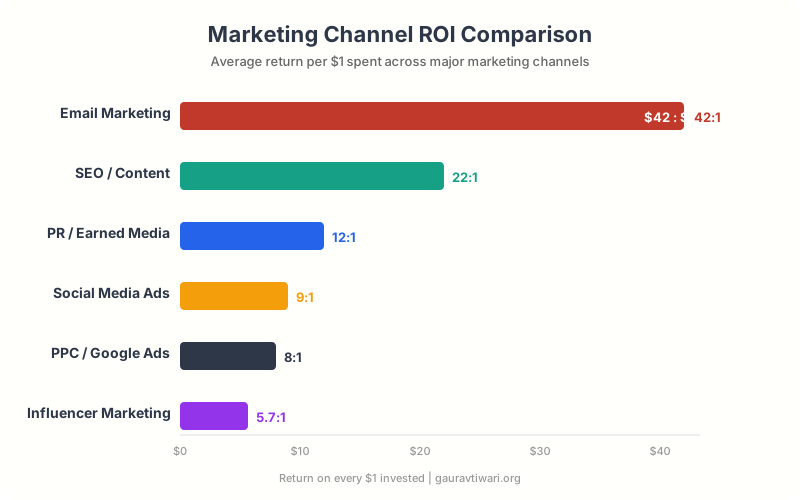
Content marketing combined with email marketing consistently delivers the highest ROI for small businesses. Email marketing returns $42 for every $1 spent on average. Pair it with SEO-driven content that generates organic traffic, and you have a sustainable growth engine that doesn’t require ongoing ad spend. Start with one blog post per week optimized for search, build an email list with a lead magnet, and nurture subscribers with a weekly newsletter.
How much should I budget for a marketing campaign?
The SBA recommends 7-8% of revenue for established businesses and 12-20% for startups or businesses in growth mode. For a specific campaign, allocate based on your customer acquisition cost target. If your target CAC is $50 and you want 100 new customers, budget at least $5,000 for the campaign. Split the budget roughly: 25% content creation, 20% paid distribution, 15% tools and tech, 15% email marketing, 15% social media, 10% influencer partnerships.
How do I measure the ROI of content marketing?
Track three metrics: organic traffic growth (Google Search Console), lead generation from content (forms, downloads, email signups attributed to blog posts), and revenue attributed to content-sourced leads. Use UTM parameters on all content links and set up goals in GA4. Content marketing ROI is typically measured over 6-12 months since SEO takes time to compound. The average ROI for content marketing is 22:1, but this takes 6+ months of consistent publishing to achieve.
Is influencer marketing worth it for B2B companies?
Yes, but the approach is different from B2C. B2B influencer marketing focuses on industry thought leaders, LinkedIn creators, podcast hosts, and niche community leaders rather than Instagram personalities. Micro-influencers with 5K-50K followers in specific professional niches (e.g., DevOps engineers, HR leaders, CFOs) often drive more qualified leads than broader influencers. The key is choosing creators whose audience matches your buyer persona, not just someone with a large following.
How often should I post on social media for marketing?
Quality beats frequency, but consistency matters. For most businesses: LinkedIn 3-5 times per week, Instagram 4-7 times per week (including Stories), TikTok 1-3 times per day for growth phase, Twitter/X 3-5 times per day, YouTube 1-2 times per week. These are ideal frequencies. If you can only manage less, focus on one platform where your audience is most active rather than spreading thin across five platforms with inconsistent posting.
What’s the difference between marketing strategy and marketing tactics?
Strategy is the overarching plan: who you’re targeting, what position you want to own in the market, and what channels you’ll use to reach them. Tactics are the specific actions: writing a blog post, running a Facebook ad, sending an email sequence. A common mistake is jumping straight to tactics without strategy. “Let’s run Google Ads” is a tactic. “We’ll target mid-market SaaS companies through educational content that establishes us as the authority on data security, distributed via search, email, and LinkedIn” is a strategy.
How do I build a marketing funnel from scratch?
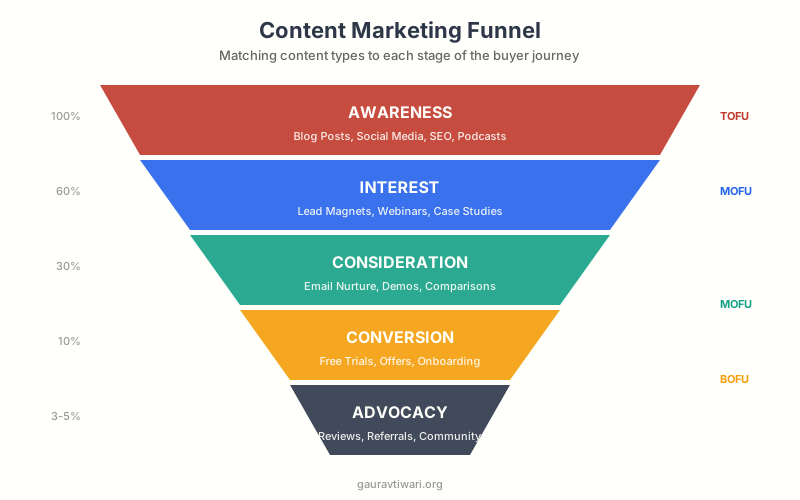
Start with three stages: awareness, consideration, and conversion. For awareness, create SEO content and social media posts that attract your target audience. For consideration, offer a lead magnet (free guide, template, or tool) in exchange for an email address. For conversion, nurture leads through an email sequence that educates, builds trust, and presents your offer. This basic funnel can be built in a weekend using a blog, an email platform like Kit or GetResponse, and a landing page. Optimize each stage based on conversion data before adding complexity.
Are traditional marketing strategies still relevant?
Some are. Email marketing (invented in the 1970s) still has the highest ROI of any digital channel. SEO is still the most cost-effective long-term traffic source. Public relations and earned media still build credibility. What’s changed is the execution. Email is now personalized and automated. SEO requires E-E-A-T signals and AI-readiness. PR now includes digital PR, podcast appearances, and creator collaborations. The principles endure. The tactics evolve. Don’t abandon strategies that work just because they’re not trendy.
The marketing landscape in 2026 rewards companies that combine AI efficiency with human creativity, build communities instead of just audiences, and create interactive experiences instead of passive content. The strategies above aren’t theoretical. They’re generating measurable results for real businesses right now.
Start with one strategy. Master it. Measure it. Then add the next. The companies that try to implement everything simultaneously end up doing nothing well. Pick the approach that aligns with your audience, resources, and goals, execute it consistently for 90 days, and let the data guide your next move. Marketing success isn’t about finding one magic tactic. It’s about building a system of strategies that compound over time.
Disclaimer: This site is reader-supported. If you buy through some links, I may earn a small commission at no extra cost to you. I only recommend tools I trust and would use myself. Your support helps keep gauravtiwari.org free and focused on real-world advice. Thanks. - Gaurav Tiwari