Is Hiring Through Freelance Platforms The Right Choice? Here’s Everything You Need To Know
 by
by

Hiring through freelance platforms can be a smart choice for scoped, reversible work. It is a poor substitute for a clear brief, a paid work sample, access controls, and someone on your side who can judge the result.
That distinction matters more in 2026. AI has made polished portfolios and fast first drafts easier to produce, while platform fees and worker-classification rules keep changing. I would not ask, “Which marketplace is cheapest?” I would ask, “Which hiring route produces an acceptable result at the lowest expected total cost?”
Should You Be Hiring Through Freelance Platforms?
Use a freelance platform when you can define the output, test the skill, limit the downside, and verify completion. Keep a role in-house or use a specialist agency when the work owns strategy, institutional knowledge, regulated decisions, or continuing privileged access.
The neutral U.S. baseline is smaller than many promotional freelancing statistics suggest. The Bureau of Labor Statistics’ latest July 2023 Contingent and Alternative Employment Arrangements release measured people’s main jobs in July 2023:
- 11.9 million people, or 7.4% of total employment, were independent contractors in their main job.
- 6.9 million people, or 4.3% of employment, held contingent jobs.
- Those are separate concepts. BLS explicitly notes that an independent contractor is not necessarily in a contingent job.
Platform research describes a faster-moving knowledge-work slice. For example, Upwork freelancing stats can help you understand marketplace activity, but the source is a marketplace with a commercial stake in freelance hiring. Use its numbers as platform evidence, not as a census of the whole labor force.
My decision rule is simple: the platform should make discovery, contracting, payment, or replacement meaningfully easier. If you already know the person, can contract safely, and do not need the marketplace workflow, the platform fee may buy very little.
| Question | Good platform fit | Poor platform fit |
|---|---|---|
| Can you define done? | A measurable deliverable and acceptance test | An open-ended responsibility or vague transformation |
| Can you test cheaply? | A paid sample or first milestone limits downside | The first meaningful test requires production-wide access |
| Can you verify quality? | Someone can review the code, design, analysis, or copy | Nobody on the buyer’s side can judge the output |
| Is failure reversible? | A backup, rollback, and replacement path exist | Failure creates legal, safety, security, or reputation harm |
How Freelance Platforms Actually Help You Hire
Good freelance marketplaces reduce transaction friction. They put search, work history, messaging, milestones, time logs, payment, and dispute processes in one place. They do not remove the buyer’s responsibility to define, test, supervise, and secure the work.
Treat the platform as hiring infrastructure, not proof of fit. Reviews are useful signals, but they can reflect easier projects, different collaborators, old work, or a service package unlike yours. A portfolio proves that an artifact exists. It does not prove who made each part, what constraints applied, or how the candidate will work inside your system.
A defensible platform funnel has five gates:
- Brief: define the deliverable, audience, constraints, source materials, exclusions, and acceptance test.
- Shortlist: compare relevant work, written reasoning, availability, and communication, not only rating and price.
- Paid sample: use a small task drawn from the real project. Do not demand unpaid speculative work.
- Milestone: make the first production step reversible, separately reviewable, and small enough to rescue.
- Access and handoff: issue named accounts, log changes, store source files, document decisions, and revoke access when the task ends.
The same logic applies when using outsourcing to drive business growth. A marketplace can widen the candidate pool, but the operating system around the person determines whether the work compounds or becomes a rescue project.
Fiverr vs Upwork vs Toptal: Fees and Best Use
The three services use different buying models, so a headline percentage is not enough. Check the checkout screen and governing terms for your account, country, payment method, and contract date.
| Platform | Published client cost | Best-fit buying pattern | Important limitation |
|---|---|---|---|
| Fiverr | Standard service fee of 5.5%; its current help page adds $3.50 to orders under $200 | A repeatable, tightly packaged deliverable with explicit quantities and revision boundaries | The service fee applies to each payment, including extras and tips |
| Upwork | Basic Client Marketplace Fee up to 7.99%; eligible U.S. bank billing can be 3%, plus a contract-initiation fee | Custom fixed-price milestones or hourly projects where work history, messaging, and payment records matter | The marketplace fee is non-refundable; moving a relationship off-platform can trigger a conversion fee |
| Toptal | $79 monthly subscription after proceeding with matching; talent rates are quoted by engagement | Specialized work where a managed matching process and trial period justify a higher-friction sales step | It is not a transparent low-budget catalog, and company screening claims still do not replace your own validation |

The source pages matter more than comparison roundups. Upwork’s current client-fee page says the Basic client fee can be as high as 7.99%, while Fiverr’s payment and billing page lists 5.5% plus $3.50 for orders under $200. Toptal’s client FAQ currently lists a $79 monthly subscription and an up-to-two-week trial that is not billed if the client is not satisfied.
If you plan to hire someone directly after meeting on Upwork, read Upwork’s conversion-fee policy. Upwork says work and payments must generally remain on-platform for the first two years unless the conversion process and applicable fee are handled. That can change the economics of a long relationship.
You can still consult Upwork vs Fiverr 2026 fee data, but use official fee pages for a purchase decision because thresholds, payment methods, refund treatment, tax, and account eligibility can change.
What Changed: How AI Reshaped Freelance Hiring in 2026
AI did not make all freelance work equally more valuable. It reduced the cost of basic execution while increasing the value of judgment, domain knowledge, integration, verification, and accountability.
The Upwork Future Workforce Index 2026 combined a March-April 2026 survey of 2,400 U.S.-based skilled knowledge workers with Upwork marketplace data. Its published findings include:
- The share of surveyed skilled knowledge workers freelancing rose from 28% to 38% in one year.
- Freelancers doing AI-related work earned 34% more per hour than those not incorporating AI.
- Complex AI work showed a 45% year-over-year earnings increase.
- Generative-AI and creative-production contract starts rose 90%, while per-contract earnings in that segment fell 13%.
- AI-augmented professional-services volume rose 72%, with earnings up 22%.
That combination is more useful than a generic “AI demand is booming” claim. It suggests a split market: routine production can expand while its unit economics weaken, but complex work that joins AI with professional judgment can command a premium. The study is produced by Upwork and includes proprietary platform classification, so it should not be generalized to every country or marketplace.
For writing, research, design, and code, stop treating tool use as the hiring test. Test whether the candidate can identify a weak source, explain a tradeoff, preserve requirements, catch an invented fact, trace a claim, and repair a flawed output. A plagiarism score or AI detector cannot prove authorship, accuracy, copyright clearance, or good judgment.
Ask candidates to show their working evidence: source list, change history, test output, design rationale, code review, citation trail, or before-and-after revision. The valuable skill is not producing a polished first answer. It is knowing what must be checked before that answer can be trusted.
The Hiring Mistake That Wastes the Most Money
The costliest mistake is choosing the lowest bid while pretending management time and failure risk are free. A low bid can be the right choice, but only after you price the work it creates on your side.
Expected project cost = bid + client platform fee + internal hours x internal hourly value + failure probability x rescue cost.
Here is a reproducible illustrative model. It is not a claim about a real contractor or a forecast. Both scenarios use Upwork’s published maximum 7.99% Basic client fee so the comparison isolates the bid, management burden, and rescue risk.
- Low bid: $2,800 bid, 35 internal hours, 45% rescue probability, and a $4,000 rescue cost.
- Stronger bid: $4,500 bid, 14 internal hours, 15% rescue probability, and the same $4,000 rescue cost.
- Excluded: taxes, contract-initiation fees, financing, delay, legal review, security incidents, and IP disputes.
| Internal time value | Low-bid expected cost | Stronger-bid expected cost | Difference |
|---|---|---|---|
| $30/hour | $5,873.72 | $5,879.55 | Low bid is $5.83 lower |
| $60/hour | $6,923.72 | $6,299.55 | Stronger bid is $624.17 lower |
| $120/hour | $9,023.72 | $7,139.55 | Stronger bid is $1,884.17 lower |
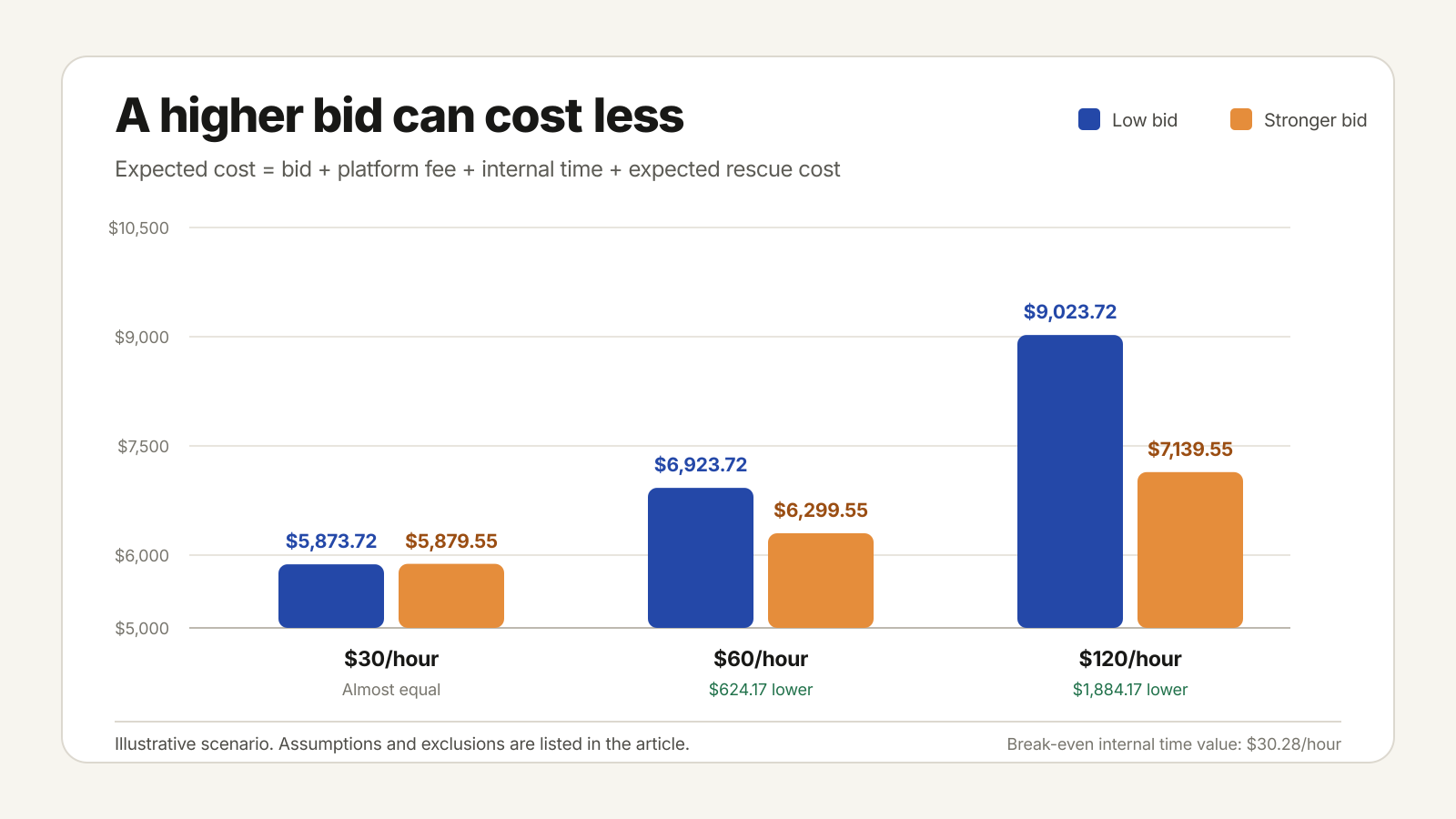
At the $60 base case, the low bid carries a $223.72 client fee, $2,100 of internal time, and $1,800 of expected rescue cost. Its expected total is $6,923.72. The stronger bid carries a $359.55 fee, $840 of internal time, and $600 of expected rescue cost. Its expected total is $6,299.55.
Now connect cost to value. If the finished project produces $9,000 of contribution before these project costs, the modeled margin is 23.07% for the low bid and 30.00% for the stronger bid. To retain a 20% target margin, the low-bid scenario needs at least $8,654.65 of delivered contribution, while the stronger-bid scenario needs $7,874.44.
Change the assumptions before using the result. If your internal time is cheap, rescue risk is low, and the output is easy to verify, the lower bid can win. If management time is expensive or failure interrupts revenue, the apparently expensive candidate can be the cheaper decision.
The Real Benefits of Freelance Hiring
The real benefit is not avoiding payroll. It is buying a specific capability for a defined period without pretending that every need must become a permanent role.
- Speed to a test: you can fund a small paid sample before running a full employee search.
- Specialist depth: a narrow migration, audit, illustration, model, or integration may need expertise only for a few weeks.
- Variable capacity: a seasonal backlog can be handled without designing a permanent role around a temporary spike.
- Geographic reach: the candidate pool can extend beyond one commuting market.
- Transaction records: milestones, messages, deliveries, and payments can be easier to reconstruct than an informal direct hire.
Those benefits become durable only when you document the work. That is the operational core of outsourcing programming work without getting burned: source belongs in your repository, credentials belong in your systems, and the handoff must work without the contractor’s private account.
Security deserves its own acceptance test. NIST SP 800-171 Rev. 3 defines least privilege as allowing only the system access necessary for assigned tasks and calls for periodic privilege review and removal. For a freelance engagement, translate that into:
- A separate named account instead of a shared administrator login.
- The minimum role and data access needed for the current milestone.
- Multi-factor authentication, activity logging, and a tested backup before production changes.
- Time-limited credentials and explicit approval before access expands.
- A closing checklist that revokes accounts, rotates exposed secrets, transfers files, and records ownership.
Who Should Skip Freelance Platforms
Skip the marketplace route when the structure of the work points to employment, a retained agency, or a trusted specialist under a more substantial agreement.
- The role is continuous and controlled: you set the schedule, methods, supervision, and day-to-day work as you would for an employee.
- The work owns institutional memory: product strategy, team leadership, customer relationships, or a core operating system needs long-term context.
- The downside is hard to reverse: medical, legal, financial, safety, privacy, or reputation decisions need stronger diligence and accountability.
- The work needs broad privileged access: a marketplace profile is not a substitute for security review, identity verification, insurance, or vendor controls.
- You cannot evaluate the deliverable: if no one can review the work, hire an independent reviewer or a firm that accepts that responsibility.
In the United States, IRS independent-contractor guidance says the facts of the relationship matter, including whether the payer controls only the result or also what will be done and how. The Department of Labor classification rulemaking page also shows that federal guidance is actively changing in 2026. State rules and other countries can differ, so a platform label does not decide whether someone is legally an independent contractor.
For a recurring creative role, compare when to hire an in-house designer versus freelancing the work out. For retained product work, the economics can also connect to reducing churn in product subscriptions: a person who understands customer history and product tradeoffs may create more value over time than a sequence of disconnected tasks.
Final Verdict
Hiring through freelance platforms is the right choice when the work is bounded, testable, reviewable, and reversible. It is the wrong choice when you are using a marketplace to avoid defining a role, supervising responsibly, securing access, or facing the true cost of failure.
Before you approve a contract, score five items from 0 to 2:
- Scope: 0 for vague, 1 for partly defined, 2 for a measurable deliverable and acceptance test.
- Verification: 0 for no reviewer, 1 for a general review, 2 for a competent reviewer and test.
- Reversibility: 0 for hard-to-repair harm, 1 for a costly rescue, 2 for a backup and clean rollback.
- Access risk: 0 for broad sensitive access, 1 for limited privileged access, 2 for least-privilege isolation.
- Continuity: 0 for a core ongoing role, 1 for a recurring project, 2 for a discrete handoff.
A score of 8 to 10 is a strong platform candidate. A score of 5 to 7 needs a smaller paid test, tighter controls, or an independent reviewer. A score below 5 should push you toward an employee, agency, or specialist relationship with stronger diligence.
Start with the smallest milestone that produces real evidence. Price your own time, write down the rescue path, and judge the candidate on decisions you can verify. That is how a freelance platform becomes useful infrastructure instead of an expensive shortcut.
Are freelance platforms worth their fees?
They can be when the platform reduces search, contracting, payment, and replacement friction by more than the fee costs. Do not compare the fee with zero. Compare total expected cost, including internal management time, failure risk, rework, taxes, and any contract-initiation or conversion charge.
Which is better for hiring: Fiverr, Upwork, or Toptal?
Fiverr suits tightly packaged deliverables, Upwork suits custom projects with milestones or hourly work, and Toptal offers a managed matching model for specialized talent. None is best for every buyer. Use the platform whose workflow fits the scope, budget, verification method, and consequence of a bad hire.
How should I budget for a freelance project?
Use this formula: bid plus client platform fee plus internal hours multiplied by the value of that time plus failure probability multiplied by rescue cost. Add applicable tax, initiation fees, legal review, security work, and delay cost. Run at least a low, base, and high case before approving the hire.
How do I check an AI-generated freelance portfolio?
Do not try to detect AI from style alone. Ask for the candidate’s role, source files, constraints, revisions, and a short walkthrough of one decision. Then use a small paid work sample based on your actual environment. Verify citations, rights, originality, and security-sensitive claims independently.
Should a freelancer receive administrator access?
Only when the task genuinely requires it, and preferably through a separate named account with the minimum permissions, multi-factor authentication, logging, and an expiry date. Back up the system first. Revoke access and rotate exposed secrets when the milestone or engagement ends.
Can a long-term freelancer legally remain an independent contractor?
Duration alone does not answer the question. In the United States, tax and labor agencies examine the real relationship, including control and economic dependence. Other countries and states use different tests. A marketplace label or contract heading does not settle classification, so obtain jurisdiction-specific advice.
Tell Google you want more of this.
Add Gaurav Tiwari as a preferred sourceOne tap, and this site shows up more often in your own Top Stories, AI Overviews and AI Mode. Remove it any time.