
Gorakhpur University Syllabus 2026-27 (DDUGU, All Subjects)

This is the most complete Gorakhpur University syllabus directory I keep online: the detailed Deen Dayal Upadhyaya Gorakhpur University (DDUGU) syllabus for every class and subject I have a copy of, kept current for the 2026–2027 session. You can download each file in one click, and I’ve flagged which PDFs follow the older annual scheme and which match the NEP 2020 rules now in force. No login, no waiting, just the documents you need before an exam or admission.
I studied at Gorakhpur University myself, so I built this page as the resource I wish I’d had: one place that explains how the new four-year system works, then hands you the syllabus PDF for Mathematics, Physics, Chemistry, Geography, History, English, Computer Applications, LLB and more. Where a department hasn’t shared a public copy, I say so and point you to the official source.
One rule before you download anything: if a document looks dated, the official, always-fresh copy lives on the university site at ddugu.ac.in. The PDFs I host are mirrors for quick access, but the university uploads the binding version, and that is the one your department follows for marks and paper count. Treat this page as your map, and the university site as the final word.
Bonus: Join my Circle (the exclusive community) to ask questions, and download DDU Gorakhpur University Notes, updated syllabi and behind-the-scenes updates.
How the 2026–2027 NEP structure works at DDUGU
DDUGU rolled out the NEP 2020 four-year undergraduate programme on a semester and credit basis starting from the 2024-25 academic session. That changed how UG papers are counted and named, so it is worth knowing before you download anything.
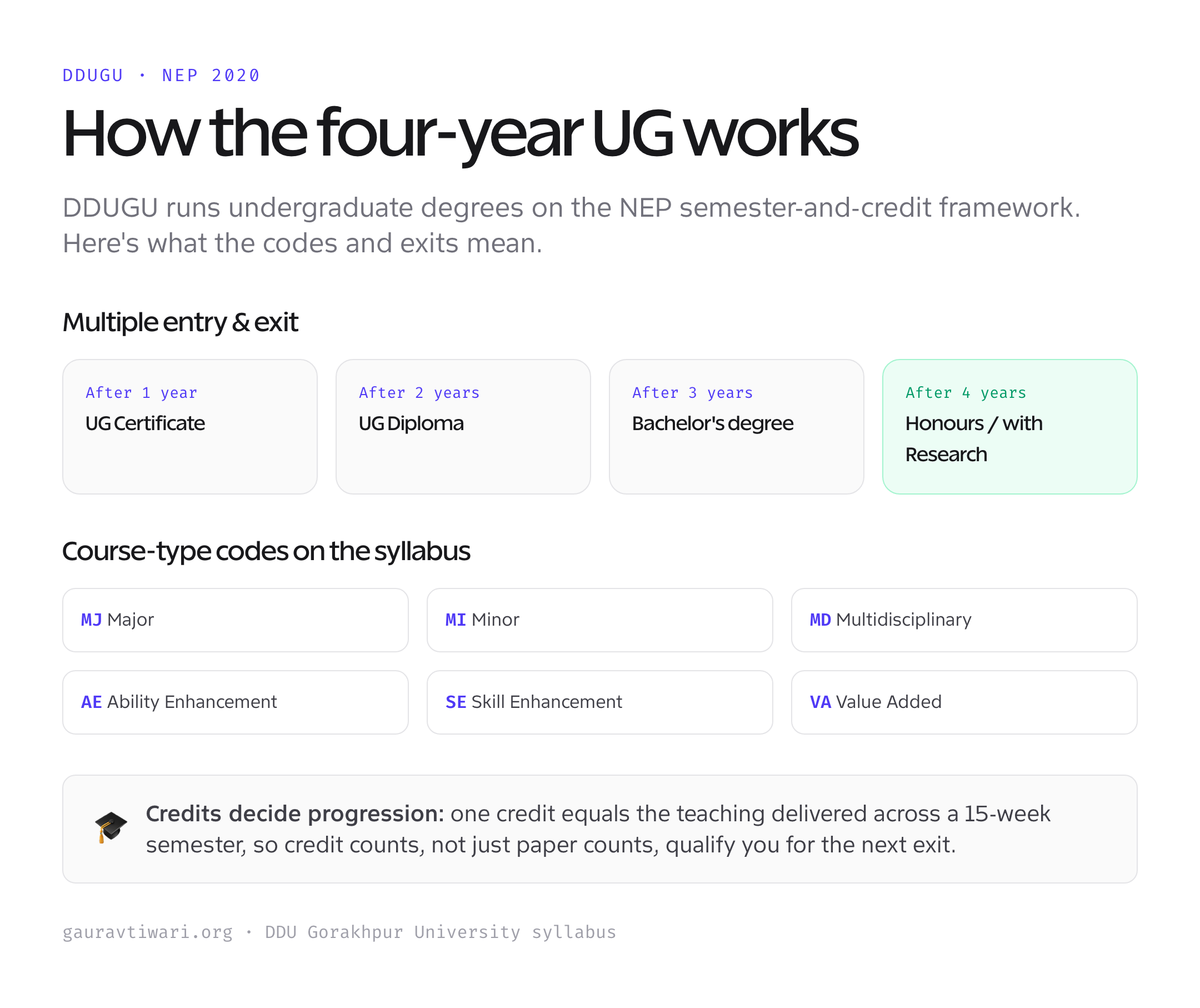
- Multiple entry and exit. One year completed earns a UG Certificate, two years a UG Diploma, three years the Bachelor’s degree, and the full four years (eight semesters) a Bachelor’s degree with Honours, or Honours with Research if you finish a research project in your major.
- Course type codes. Papers are tagged MJ (Major), MI (Minor), MD (Multidisciplinary), AE (Ability Enhancement), SE (Skill Enhancement) and VA (Value Added). When you open a NEP syllabus PDF, those codes tell you which bucket a paper falls in.
- Credits. One credit equals the instruction delivered across a 15-week semester for that paper, so credit counts, not just paper counts, decide whether you qualify for the next exit.
Official source: The university posts the binding files on its Courses, Syllabi and Time Tables page and the NEP/CBCS PDFs under ddugu.ac.in/syllabus. Admissions run through the SAMARTH admission portal. Always confirm your paper count against those before an exam.
Admission and exam calendar for 2026–2027
The syllabus only matters once you’re enrolled and sitting papers, so here’s the rhythm of a DDUGU year. Undergraduate admission for the 2026–2027 session runs through the SAMARTH portal, with forms released on ddugu.ac.in around February and the UG entrance exam typically held in May. Postgraduate and professional courses follow their own schedules, so check your department’s notice.
Under the semester system, odd-semester examinations land around November and December, and even-semester papers around April and May, with results posted on the examination portal at erp.ddugu.ac.in. Build your study calendar backwards from those windows. If you want a head start, the syllabus PDF tells you exactly how many papers and credits each semester carries, so you can plan revision before the date sheet is even out.
Dates change every session. Always confirm the current admission and exam dates on ddugu.ac.in and erp.ddugu.ac.in. The figures above describe the usual pattern, not a guarantee for any one year.
How to download and use these syllabus PDFs
Every “PDF” link below opens or downloads the file directly. On a phone, tap and choose “Download” to save it offline; on a laptop, the file opens in your browser and you can save it from there. A good reader makes a syllabus far easier to work with, so if you study from PDFs a lot, my guide to the best PDF apps for students covers annotation and highlighting tools worth installing.
When you open a NEP-era file, read it in this order: find your course-type codes (MJ, MI and so on), count the credits per semester, then map the papers to the exam windows above. That three-step read turns a dense document into a clear plan. For older annual-scheme files, focus on the paper count and marks per paper instead, since those batches don’t use credits.
NEP scheme or annual scheme: which file applies to you
The single most common confusion on this page is which version of a syllabus to follow, and the answer comes down to when you joined. If you started your undergraduate degree in or after the 2024-25 session, you’re on the NEP four-year programme with semesters, credits and the MJ/MI/MD codes explained above. If you enrolled earlier, you’re likely on the older annual scheme, where the year, paper count and marks per paper matter more than credits.
Where I host both versions, I’ve labelled them so you can pick correctly. When in doubt, the giveaway is the language inside the PDF: NEP files talk in credits and course-type codes, while annual-scheme files list papers by year with fixed marks. Postgraduate programmes like M.A./M.Sc. still use the Previous and Final structure for now, separate from the UG reform. If your file and your batch don’t match, download the other version rather than guessing, and cross-check the binding copy on ddugu.ac.in before you rely on it for an exam.
Syllabus for M.A. / M.Sc. Mathematics, Gorakhpur University
The M.A./M.Sc. (Mathematics) programme runs two years, with the 1st year called “Previous” and the 2nd “Final”. That is four semester examinations in total, exams held in December and May. In the Previous year each semester has five compulsory papers; in the Final year each semester has three compulsory papers plus two optional papers chosen from the optional groups. Every paper is three hours and 50 marks.
Note: All four PDF links above point to the same combined file. I merged the semesters into one document so you only download once. For the NEP-revised CBCS version, check the M.Sc. Mathematics file on the official DDUGU syllabus page.
Course Books for M. A. / M. Sc. Math
These are the standard texts the Mathematics department draws from for real analysis, topology, hydrodynamics and integral equations. I have used most of them myself. Prices on Amazon shift week to week, so check the live price before buying.
| Title | Buy |
|---|---|
| Elements of Real Analysis | Check Price |
| Integral Equation & Boundary Value Problem | Check Price |
| Advanced Differential Equations | Check Price |
| Mathematical Analysis | Check Price |
| A Text Book Of Real Analysis | Check Price |
| Introduction To Topology & Modern Analysis | Check Price |
| Topology (General and Algebraic) By Krishna Prakashan | Check Price |
| Topology by James R. Munkres | Check Price |
| Algebraic Topology | Check Price |
| Topology | Check Price |
| Topology: A Very Short Introduction (Very Short Introductions) | Check Price |
| Introduction to Topology: Third Edition (Dover Books on Mathematics) | Check Price |
| Principles of Topology (Dover Books on Mathematics) | Check Price |
| Riemannian Geometry: A Beginners Guide, Second Edition | Check Price |
| Hydrodynamics | Check Price |
| Elementary Hydrodynamics | Check Price |
| Hydrodynamics | Check Price |
| Fluid Dynamics: With Hydrodynamics | Check Price |
Syllabus for B.A. / B.Sc. Mathematics, Gorakhpur University
This is the undergraduate Mathematics file. The copy I host follows the older annual scheme. Under the NEP four-year framework now in force from 2024-25, Mathematics is offered as a Major or Minor with semester papers, so first-year entrants should cross-check the current credit structure on the university site.
Syllabus for B.Sc. Chemistry, Gorakhpur University
B.Sc. Chemistry at DDUGU pairs theory papers with compulsory practicals across Physical, Organic and Inorganic chemistry. Under the NEP framework, you can take Chemistry as a Major or Minor, and lab work carries its own marks you must pass separately, so don’t treat practicals as an afterthought. The file below covers the structure; confirm the current credit split on the university site if you joined in or after 2024-25.
Syllabus for B.Sc. Physics, Gorakhpur University
B.Sc. Physics runs theory papers in mechanics, electromagnetism, optics, thermodynamics and modern physics alongside a practical component. As with Chemistry, the NEP version offers Physics as a Major or Minor with semester papers and credits, while older batches follow the annual scheme. The numerical-heavy papers reward steady practice over last-minute cramming, so use the syllabus to pace yourself early.
Syllabus for B.A. / B.Sc. / M.A. Geography, Gorakhpur University
Geography at DDUGU spans undergraduate, postgraduate and research levels, with both theory and practical components, including map work and fieldwork. The eligibility and paper rules below are worth reading before you choose it as an optional, since some conditions apply based on your Intermediate subjects. Files cover B.A./B.Sc., M.A. and PhD structures.
Important notes for Undergraduate Geography Students:
- Only those candidates may offer Geography as one optional subject in B.A., who has offered Geography in Inter classes.
- Inter Science and Agriculture students are exempted from those conditions.
- No private candidates are allowed to offer Geography in B.A.
- The candidate shall have to pass in theory and practical separately obtaining 33 % marks in each.
- There shall be two theory papers of 75 marks each and one practical carrying 50 marks in B.A. /B.Sc. I and B.A. /B.Sc. II examinations, while in B.A. /B.Sc. III, there shall be 3 theory papers of 75 marks each and one practical carrying 75 marks.
Pattern of B. A./ B. Sc. Geography (Theory)
| Class | Paper | Subject | Marks |
|---|---|---|---|
| B.A. /B.Sc. I | I | Physical Geography | 75 |
| II | Human Geography | 75 | |
| Practical Geography | 50 | ||
| B.A./B.Sc. II | I | Economic Geography | 75 |
| II | Geography of India | 75 | |
| Practical Geography | 50 | ||
| B.A./B.Sc. III | I | Evolution of Geographical Thought | 75 |
| II | World Regional Geography | 75 | |
| II | Environment, Ecology and Development | 75 | |
| Practical Geography | 75 |
Syllabus for B.A. / M.A. History, Gorakhpur University
History has the most files because the department published separate Ancient, Medieval and Modern papers, plus the NEP-era four-year common minimum syllabus and the 3+1 credit distribution. If you started in or after 2024, use the 4-Year Common Minimum and the 3+1 files; older batches use the earlier UG and PG documents.
Latest B. Sc., B. A., M. Sc., M. A. Syllabus
A grab-bag of the remaining science and arts files I have on hand. A couple are marked NA because the department has not shared a public copy; for those, the official DDUGU syllabus page is your fallback.
Syllabus for LLB
The DDUGU LLB programme follows the semester system, and the file below bundles the syllabus for all semesters into one download. Law students should pay close attention to the paper-wise distribution and the prescribed bare acts, since the exam pattern leans heavily on statutory provisions and landmark case law rather than open commentary. Read the syllabus alongside the latest bare acts, and you’ll know exactly which statutes to keep on your desk through the semester.
Study tips for DDUGU semester exams
A syllabus is a map, not a method. Here’s how I’d actually use these files to score well under the semester system.
- Map every paper to its credits first. High-credit Major papers deserve the most revision time. Don’t spread effort evenly across papers that don’t weigh the same.
- Pull last years’ question papers. The syllabus tells you the topics; old papers tell you which ones examiners actually ask. Pattern-spot before you cram.
- Use the prescribed textbooks, not just guides. For Mathematics especially, the standard texts below match the paper style far better than thin exam guides. Build notes from them as you go, a habit my pick of note-taking apps for students makes easier.
- Block revision around the exam windows. With odd-semester papers near December and even-semester near May, a simple plan beats last-minute panic. A few time-management apps can keep you honest.
- Set up your space. A steady desk and a reliable laptop matter more than people admit over a long semester, see my guides to laptops for students and study desks if you’re outfitting yours.
Frequently asked questions
Where is the official DDUGU syllabus?
The binding files sit on the university’s Courses, Syllabi and Time Tables page at ddugu.ac.in, and the NEP and CBCS PDFs are stored under the ddugu.ac.in/syllabus path. The copies I host here are mirrors for quick access, but the university version is the one to trust for exams.
Is DDUGU on the three-year or four-year UG system now?
Both, depending on your batch. From the 2024-25 session DDUGU runs the NEP four-year undergraduate programme. You can exit with a UG Certificate after one year, a UG Diploma after two, the Bachelor’s degree after three, or stay the full four years for an Honours or Honours with Research degree.
How is the M.Sc. Mathematics course structured?
It runs two years split into Previous and Final, with four semester exams held in December and May. The Previous year has five compulsory papers per semester; the Final year has three compulsory plus two optional papers per semester. Each paper is three hours and 50 marks.
What do MJ, MI and AE mean on a NEP syllabus?
They are course-type codes: MJ is Major, MI is Minor, MD is Multidisciplinary, AE is Ability Enhancement, SE is Skill Enhancement and VA is Value Added. Each paper carries credits, and one credit equals the teaching delivered over a 15-week semester.
When are DDUGU admissions and entrance exams?
Undergraduate admission usually opens around February through the SAMARTH portal on ddugu.ac.in, with the UG entrance exam typically held in May. Dates shift each session, so always confirm the current schedule on the official site before applying.
Are these syllabus PDFs free to download?
Yes. Every PDF linked on this page is free and opens in one click, with no login required. They are mirrors of the university’s published files, shared so students can grab them quickly. For the binding version before an exam, always cross-check the copy on ddugu.ac.in.
Keep this page bookmarked
The Gorakhpur University syllabus changes as departments revise papers under NEP 2020, and I update this page whenever a new file lands, so bookmark it and check back before each session. Whether you need the Mathematics paper count, the Geography eligibility rules, the History credit distribution, or the LLB bundle, it should be one click away here, with the official DDUGU site as your final cross-check.
If a file you need is missing or marked NA, that usually means the department hasn’t published a public copy yet. In that case, the official syllabus page on ddugu.ac.in is your fallback, and you’re welcome to email me so I can track it down and add it. The goal of this page is simple: get every DDUGU student the right syllabus, fast, so you can spend your time studying it instead of hunting for it.
Looking for a certain resource, syllabus or PDF book? Email me at gaurav@gauravtiwari.org with your needs.