
 by
by
Good Facebook group rules do 2 jobs at once: they filter out the members you don’t want, and they give you a clean reason to act when someone crosses a line. Without written rules you are moderating on vibes, and every removal turns into an argument in your DMs.
This guide gives you copy-paste rule templates for 8 kinds of groups, plus the exact steps to add, edit and tag rules inside Facebook’s admin tools.
- Why your Facebook group needs rules
- How to add rules to a Facebook group
- How to edit Facebook group rules
- How to tag rules in posts and comments
- Basic Facebook group rules
- Copy-paste rule templates
- Enforcing the rules
Groups are still the closest thing Facebook has to a living room. The scale is easy to underestimate:
- Facebook counts more than 3 billion monthly users, and Meta’s last public Groups figure put 1.8 billion of them inside groups every month.
- More than 10 million groups compete for that attention, run by over 70 million admins and moderators.
- By Meta’s own numbers, more than half of all Facebook users belong to 5 or more active groups.
So your group is not competing with silence. It is competing with every other group your members already joined, and clear rules are one quiet reason people stay active in one community and mute another.
Why Your Facebook Group Needs Rules
Rules do 3 practical things for Facebook groups. They set expectations before someone joins, because Facebook shows your rules in the group’s About section and during the join flow. They keep the feed on the topic members actually came for. And they give every removal a reason the member can read, which turns “the admin hates me” into “rule 3, no promotions”.
That last one matters more than it looks. Moderation without written rules feels personal on both sides. Moderation against written rules is just administration.
And if the group exists to support a business, rules protect the funnel too. A tidy, on-topic group sells better than any pinned promo, and my Facebook marketing guide covers where groups fit in that bigger picture.
How to Add Rules to a Facebook Group
Facebook keeps group rules inside Admin Tools, and the whole flow takes about 2 minutes.
Step 1
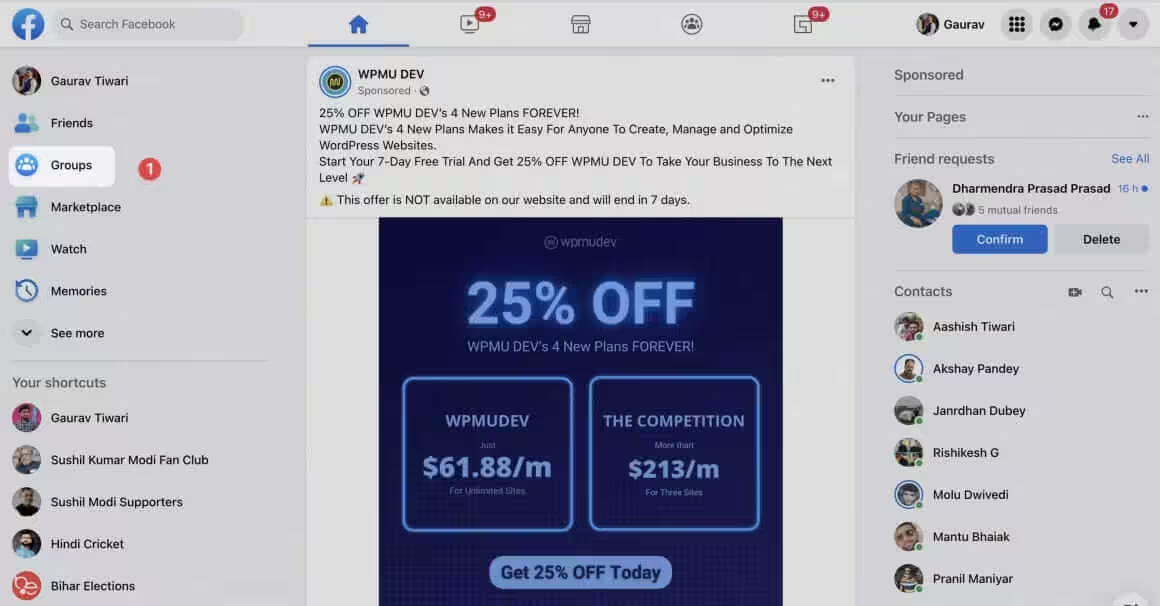
Open Facebook and click Groups in the left menu.
Step 2
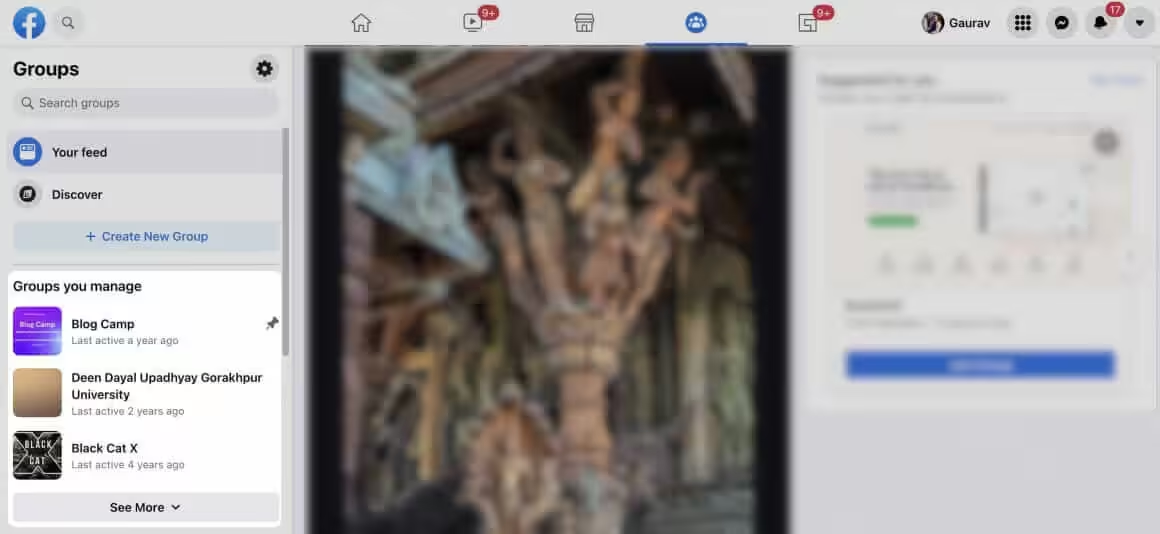
Under Groups You Manage, select the group you want to add rules to.
Step 3
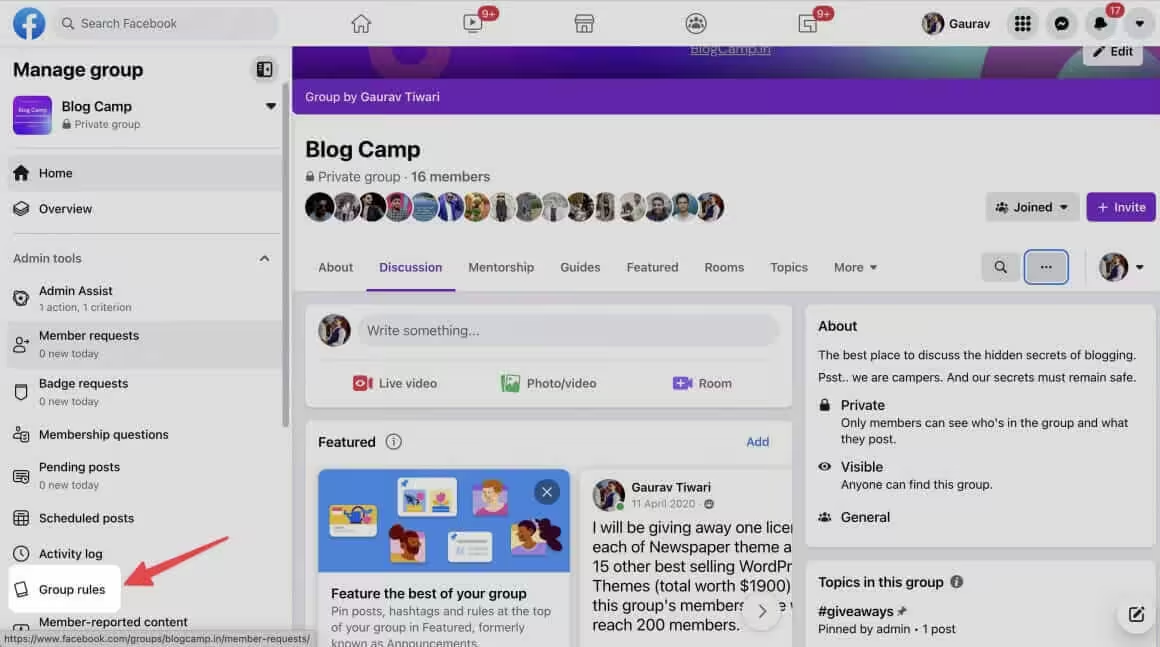
Select Group Rules under Admin Tools in the left menu.
Step 4
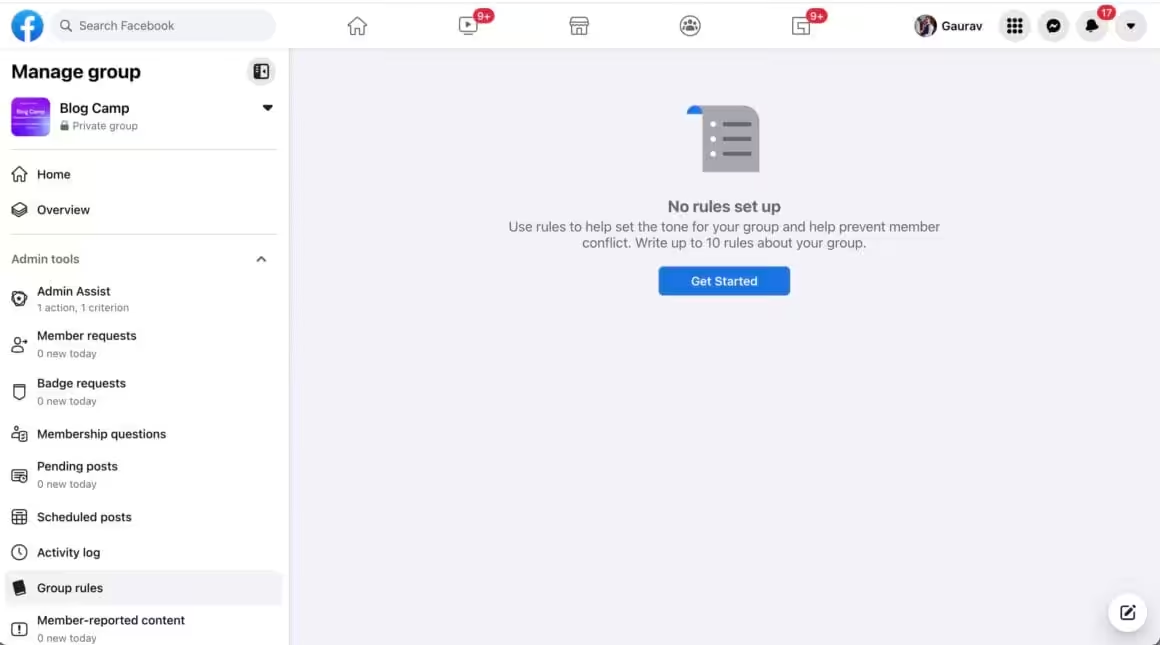
Click Get Started if the group has no rules yet, or Add if some already exist. You can reorder rules any time by dragging them up and down.
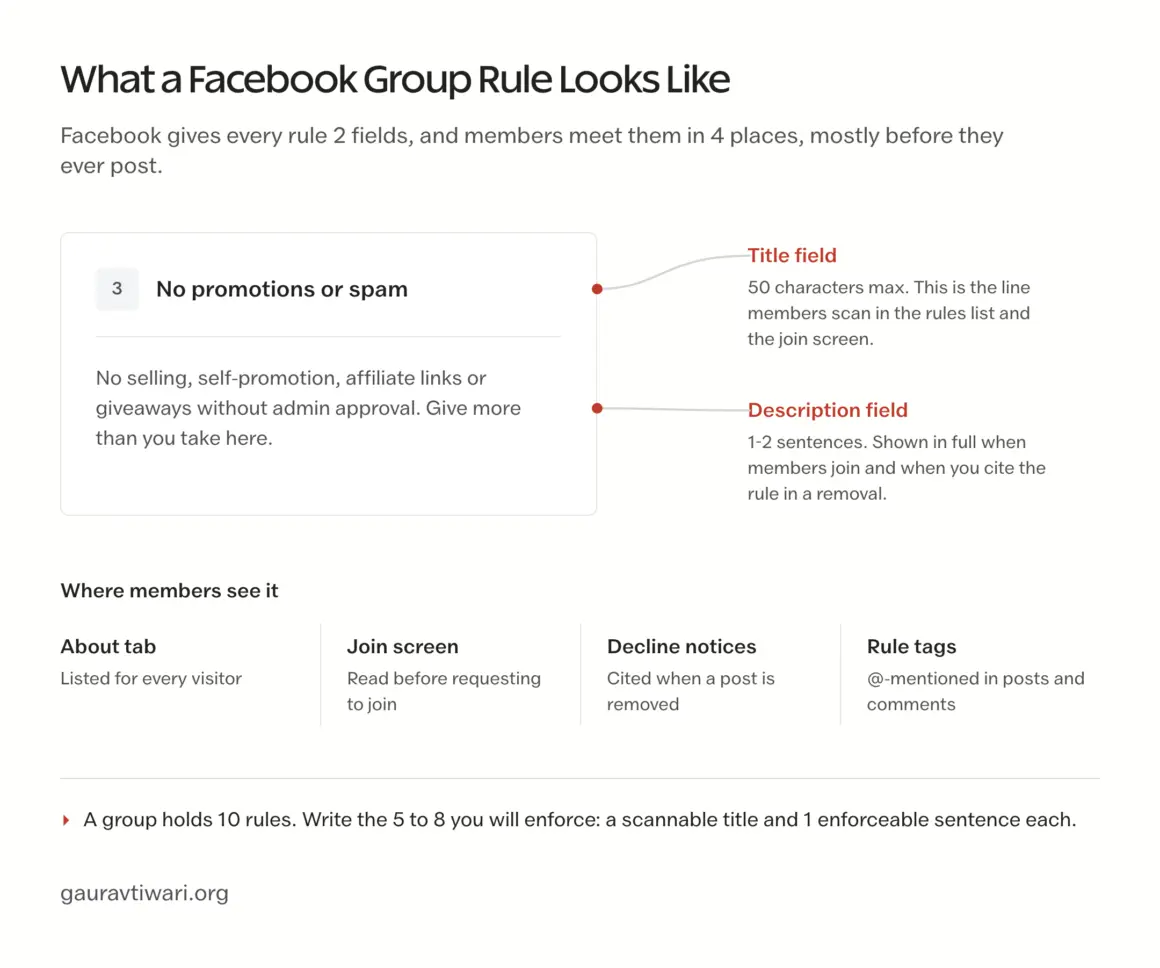
Facebook offers 4 pre-written starter rules on this screen: Be kind and courteous, No hate speech or bullying, No promotions or spam, and Respect everyone’s privacy. You can add each with a click, or write your own. A few limits worth knowing before you write:
- A group can have up to 10 rules.
- Rule titles cap at 50 characters, and short descriptions of a sentence or 2 stay readable on the join screen.
- Order is yours to set. Put the rules you enforce most at the top.
How to Edit Facebook Group Rules
Rules are not carved anywhere. As the group grows you will reword, reorder and retire them, and the path is the same as adding:
- Open Groups from the left menu and select your group.
- Select Group Rules under Admin Tools.
- Click the 3 dots next to any rule to edit or delete it, or drag it to a new position.
How to Tag Group Rules in Posts and Comments
Once the rules exist, you never have to retype them. Facebook lets admins and moderators tag a rule the way you tag a person:
- In a comment, type @ and pick the rule from the suggestions. It appears as a clickable link to the rule.
- In a post, do the same in the caption while writing it.
A tagged rule reads as policy. A typed lecture reads as a moderator picking a fight, even when the moderator is right.
Basic Facebook Group Rules
Some rules fit almost any community, whatever its topic. These 9 are the base layer I’d keep under every template in the next section.
- Be kind: no insults, ridicule or pile-ons, whether the target is a member or not.
- Be civil: no slurs or abusive language. One warning, then removal for repeats.
- Search before posting: duplicate questions bury the discussions that are still alive.
- No advertising: no products, services or self-promotion without admin approval.
- Post in the group’s language: one shared language keeps nobody locked out of the conversation.
- No spam: reposting the same content again and again earns a removal.
- Take issues to admins: complaints about the group go to admins or moderators directly, not to the feed.
- Report rule-breaking: report violations instead of fighting them in the comments.
- Think before you report: report broken rules, not opinions you dislike.
These 9 cover the floor. But a buy-and-sell group and a parenting group fail in completely different ways, which is what the templates below are tuned for.
Facebook Group Rules Templates (Copy and Paste)
Every template below matches Facebook’s rule format: a short title under the 50-character cap, plus a 1-2 sentence description that fits the join screen. Copy a whole set or individual rules, then swap the bracketed placeholders like [your group’s topic] for your own details before pasting.
And don’t fill all 10 slots just because Facebook allows them. 5 to 8 enforced rules beat 10 decorative ones. Trim hard.
Universal Starter8 rules
- Be kind and courteousDisagree with the idea, not the person. Insults, ridicule and pile-ons are removed, and repeat offenders are too.
- No hate speech or bullyingDegrading comments about race, religion, culture, sexual orientation, gender or identity mean an instant ban. No warnings.
- No promotions or spamNo selling, self-promotion, affiliate links or giveaways without admin approval. Give more than you take here.
- Respect everyone’s privacyWhat’s shared in the group stays in the group. Screenshotting a member’s post to share outside is a ban.
- Search before you postYour question has probably been asked before. Search the group first so answers stay in one place.
- Stay on topicPosts must relate to [your group’s topic]. Everything else is removed, even the funny ones.
- Post in [your language]One shared language keeps every member in the conversation. Posts in other languages are removed.
- Report, don’t argueSee a rule being broken? Report it to the admins. Don’t fight it out in the comments.
Buy and Sell7 rules
- Real photos onlyPost photos of the actual item. Stock images and pictures pulled from the internet are removed.
- Every listing needs a price‘DM for price’ counts as no price. Listings without one are removed.
- Pay for goods and servicesNever pay friends-and-family. Goods-and-services payment is your only protection if a deal goes bad.
- Proof for high-value itemsJewelry, electronics and vehicles need receipts or proof of authenticity in the listing.
- No outside linksRandom links are treated as scams and deleted. Keep the whole deal inside the thread.
- Mark sold items as soldEdit your post once the deal closes so buyers stop messaging you.
- No daily bumpingReposting the same listing within 7 days buries other sellers and gets the listing removed.
Parenting6 rules
- Experiences, not prescriptionsShare what worked for your family. For anything medical, the only answer here is ‘ask your pediatrician’.
- No selling or fundraisingThis group isn’t a marketplace. Listings, donation drives and job posts are removed.
- Respect private storiesParents share sensitive things here. Screenshotting or resharing a post outside the group is an instant ban.
- Ask, don’t judgeDifferent families parent differently. Questions are welcome; pile-ons are removed.
- No unsolicited DMsDon’t message members privately unless they’ve invited it in the thread.
- Keep politics outPolitical debates are removed, even when they touch parenting.
Fan and Entertainment6 rules
- Spoilers behind warningsStart spoiler posts with SPOILER and keep the reveal out of the first line, where the feed preview shows it.
- Stay on [your show]Memes, news and discussion about [your show] only. General entertainment posts are removed.
- Criticize the work, not peopleHate the writing all you want. Harassment of cast, crew or members means a ban.
- Vent without abuseDisappointed? Say so. Slurs, abuse and pile-ons still get removed.
- No pirated linksStreams, torrents and download links are deleted and the poster is banned.
- No real-world politicsPosts about real political figures or events are removed, even when framed as fandom.
Sports and Fitness5 rules
- No diet or dosage adviceShare routines and experiences. Meal plans, calorie targets and supplement doses belong with professionals.
- No graphic injury contentInjury talk is fine; graphic photos are not.
- Promotions need approvalSponsored posts and affiliate links without admin approval are removed.
- Coach or scroll pastForm-check posts are welcome. Mockery earns a mute.
- Every level is welcomeBeginner questions stay up. ‘Just Google it’ replies come down.
Jobs and Hiring5 rules
- One post per vacancyDuplicate postings of the same role are removed; repeat spam earns a ban.
- Full details or no postEvery listing needs the role, location or remote status, and how to apply. Salary ranges get more applicants.
- No pay-to-apply offersAny job that asks candidates for money is deleted and the poster is banned. Same for MLM recruitment.
- Keep it professionalTalk to members the way you would in an interview.
- Report suspicious listingsIf an offer smells like a scam, report it to the admins instead of calling it out publicly.
Brand and Customer Community5 rules
- Keep posts about [your brand]This space is for [your brand] questions, tips and feedback. Other promotions are removed.
- Support issues go to supportPost experiences here; send account-specific problems to [support email] so they actually get fixed.
- Honest feedback, civil toneCriticism is welcome and useful. Abuse aimed at staff or members is not.
- No fake reviewsUndisclosed paid promotion, astroturfing and review trading mean a ban.
- One thread per known issueKeep discussion of an ongoing problem in the pinned thread so answers stay findable.
Courses and Learning5 rules
- No screenshots or recordingsCourse material stays inside the group. Sharing it outside violates the course terms and ends your access.
- Submit your own workPlagiarized submissions are removed; repeat cases lose access.
- Ask questions in the openQuestions asked in the group help every student. Save DMs for private matters.
- No account sharingOne enrollment, one member. Shared logins are removed.
- Classroom language onlyKeep the tone you’d use in a classroom, even in disagreements.
The pack covers a universal starter plus buy and sell, parenting, fan, sports and fitness, jobs, brand and course groups. 2 of these deserve a footnote. A brand community doubles as a customer feedback channel, so its rules protect signal, not just civility. And if you teach through a group, or plan to move the material to a proper online course platform, the course template is what keeps your paid content from leaking in the meantime.
Enforcing Facebook Group Rules
Writing rules is the easy half. A group where rules exist but nothing happens when they break drifts back into chaos within weeks, just with extra hypocrisy on display. Facebook gives you more enforcement machinery than most admins ever open:
- When you decline a pending post or remove content, select the rule it broke. The member sees the reason instead of inventing one.
- Mute or suspend before you ban. A 24-hour mute ends most fights without losing the member.
- Admin Assist can auto-decline posts that contain links or flagged keywords, or that come from members with recent violations, so obvious spam never reaches the feed.
- Brief your moderators on the standard: same rule, same response, no matter who enforces it.
- Encourage members to report instead of engage. Reports scale; comment fights don’t.
2 habits quietly undo all of this. Enforcing rules only when you’re annoyed teaches members that rules are moods. And removing posts without citing a rule turns every removal into a private grievance the member fills with their own story.
Final Remarks
Group rules look like bureaucracy right up until the first bad week: a spam wave, a comment-section brawl, a member scraping your feed for their own page. On that day the rules are the difference between clicking “remove, rule 4” and writing paragraphs of justification to angry strangers.
So don’t think of rules as a wall around the group. They are the filter that decides who feels safe posting, and the trade is real: you will lose a few members who wanted your community as their billboard, and keep the ones who came for the conversation.
Pick a template, cut it down to what you’ll actually enforce, and put it live today. Your next 100 members will read those rules before they ever meet you.
Tell Google you want more of this.
Add Gaurav Tiwari as a preferred sourceOne tap, and this site shows up more often in your own Top Stories, AI Overviews and AI Mode. Remove it any time.