by
by
Making an ecommerce website better in 2026 is not a hunt for one magic plugin. It is a measurement problem. Find the step where qualified shoppers leave, price the fix, and compare the result with contribution margin rather than headline revenue.
My rule is simple: do not redesign a whole store because one dashboard number looks weak. Define the funnel, segment it by device and traffic source, and fix the largest verified constraint. That is how these ten improvements become decisions instead of decoration.
- 1. Choose a platform from ownership, operations, and total cost.
- 2. Instrument product, cart, checkout, purchase, and refund events.
- 3. Make search, inventory, delivery, and returns easy to verify.
- 4. Answer the buying objections on each product page.
- 5. Show total cost early and keep guest checkout obvious.
- 6. evaluate checkout work with a break-even model.
- 7. Model payment fees by order value, market, and method.
- 8. Use field data for mobile speed and responsiveness.
- 9. Treat HTTPS as one security control, not the whole program.
- 10. Run controlled tests and keep changes only when the economics work.
The widely repeated abandonment number needs context. Baymard’s cart-abandonment dataset reported a 70.22% aggregate across 50 studies, last updated September 22, 2025. It is a cross-study average, not your store’s baseline and not proof that 70.22% is recoverable.
Platform Choice: WooCommerce vs Shopify vs Everything Else
There is no universal ecommerce website platform winner. WooCommerce is usually my choice when content, ownership, portability, and custom workflows matter. A managed platform is often the better decision when a small team values predictable operations more than server control.
Start with the current economics. WooCommerce’s current pricing page says the core is free with no monthly subscription or revenue share, while listing hosting at $25 to $350 per month for most stores and extensions at $29 to $299 per year. Those are vendor ranges, not a quote.
For Shopify, check Shopify’s current pricing page for the applicable country and billing cycle. Shopify’s transaction-fee documentation explains that third-party transaction fees depend on the plan and payment setup and can sit on top of the processor’s fee. When eligible orders use Shopify Payments, the documented treatment differs. The Shopify route is sensible when speed and managed operations are worth that tradeoff.
| Decision factor | WooCommerce | Managed commerce platform |
|---|---|---|
| Ownership | Host, database, code, and exports are under your control | Exportability and APIs depend on the platform |
| Operations | You own updates, backups, monitoring, and incidents | Vendor runs the core infrastructure |
| Cost model | Hosting, development, extensions, and processing | Plan, apps, processing, and possible transaction fees |
| Customization | Deep control, with maintenance responsibility | Faster defaults, with platform boundaries |
| Best fit | Content-led or custom stores with technical capacity | Teams prioritizing speed and a managed stack |
A dropshipping store has a different risk profile from a catalog with custom fulfillment. Before choosing in 2026, export a sample of products, customers, orders, and redirects. If a platform change makes that data hard to retrieve, the cheap launch can become an expensive exit.
Essential Features Every eCommerce Site Needs
The essential ecommerce website feature is not a wishlist button. It is a complete path from product discovery to a recorded, fulfilled, supportable order. Build that path first and add features only when a measured customer problem justifies them.
- Search and filters: log zero-result queries, filter use, refinements, and search-to-purchase rate.
- Inventory truth: show availability, back-order status, and variant-level stock consistently.
- Delivery clarity: state shipping method, estimated timing, cutoff, and location limits before payment.
- Returns: put the actual window, condition, cost, exclusions, and process near the buying decision.
- Guest checkout: keep it visible and offer account creation after purchase.
- Accessibility: support keyboard use, labels, error recovery, zoom, and adequate touch targets.
- Measurement: record view_item, add_to_cart, view_cart, begin_checkout, add_payment_info, purchase, and refund.
Google’s GA4 ecommerce setup guide notes that ecommerce events require implementation and are not sent automatically in many setups. Test event names, values, currency, item arrays, refunds, and unique transaction IDs in DebugView. A broken event schema can make a healthy store look weak or hide a real checkout failure.
Define each funnel denominator in writing. For example, checkout completion equals unique purchases divided by unique begin_checkout users for the same attribution window. If one dashboard counts sessions and another counts users, do not compare their percentages.
Product Page Optimization That Actually Converts
An ecommerce website product page should reduce uncertainty. More media is not automatically better. One clear size diagram, ingredient panel, compatibility list, or demonstration can beat a gallery of six near-identical photos.
- Identity: exact product, variant, model, material, quantity, and included items.
- Fit: who it is for, who should skip it, and the constraint that decides.
- Evidence: measurements, specifications, demonstrations, and review provenance.
- Cost: item price plus foreseeable shipping, tax, subscription, or accessory requirements.
- Risk: warranty, returns, exclusions, compatibility, and support path.
- Action: a stable Add to Cart control with a clear selected variant and availability state.
The practical side of optimizing web design for conversions is sequencing. Put the decisive information beside the action, not in a tab people must discover. Track variant changes, gallery use, size-guide opens, shipping checks, add-to-cart errors, and returns by SKU. Keep the content that improves decisions, not the content that merely increases scroll depth.
Reviews need context as well. Show whether the reviewer purchased the item, which variant they used, and how moderation works. Do not turn a review count into a quality claim unless you can audit the collection and exclusion rules.
Checkout Optimization: The $18 Billion Problem
The dollar figure in this section title is not a useful planning baseline. Your recoverable value depends on your own starts, completion, contribution per order, implementation cost, and causal lift. Use public research to choose hypotheses, then use your data to fund them.
Baymard’s checkout-friction research reports 39% of surveyed abandonment respondents citing extra charges and 19% citing forced account creation. These are reported reasons from that research, not percentage points your store will automatically recover.
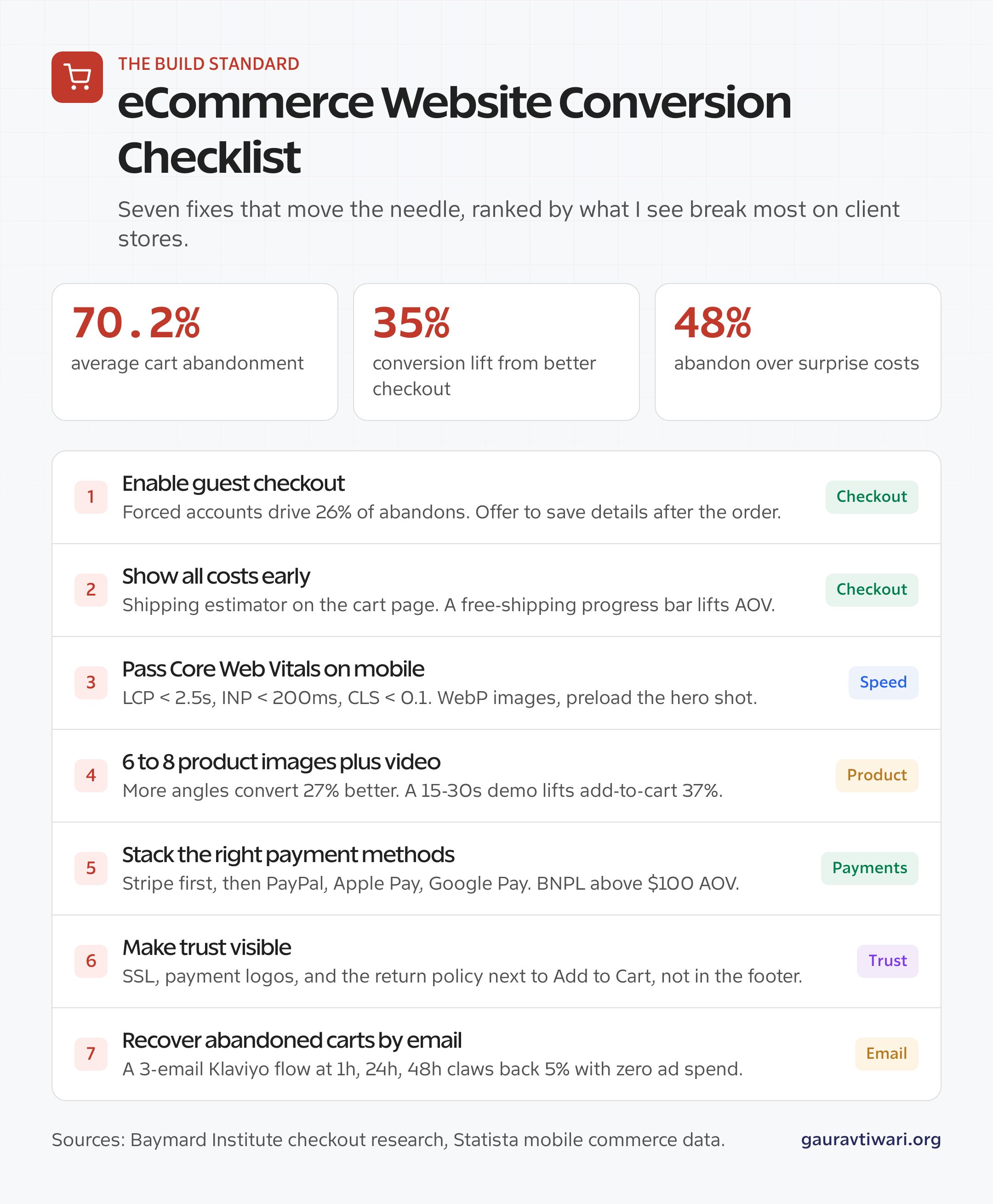
- Show the payable total early: include shipping, tax, fees, and discount effects when they can be calculated.
- Make guest checkout unmistakable: do not hide it behind the sign-in form.
- Preserve progress: keep cart and entered data through validation errors and ordinary navigation.
- Explain errors at the field: say what failed and how to correct it without erasing valid input.
- Keep the order summary visible: item, variant, quantity, delivery, discount, tax, and final total must agree.
- Measure failures: log validation, address, payment, inventory, coupon, and timeout errors separately.
Here is a reproducible 2026 decision model. The hypothetical store has 900 monthly checkout starts, 42% baseline completion, a $75 average order value, and $30 contribution per order after variable costs. The project costs $1,200, amortized over six months, plus a $149 monthly tool, for $349 in monthly modeled cost.
| Relative lift | Incremental orders | Revenue | Contribution | Net after $349 cost |
|---|---|---|---|---|
| 3% | 11.34 | $850.50 | $340.20 | -$8.80 |
| 7% | 26.46 | $1,984.50 | $793.80 | $444.80 |
| 12% | 45.36 | $3,402.00 | $1,360.80 | $1,011.80 |
Formula: incremental orders = checkout starts x baseline completion x relative lift. Monthly net = incremental orders x contribution per order – monthly tool cost – amortized implementation cost.
The modeled break-even point is a 3.08% relative lift, not a 3.08 percentage-point lift. At $20 contribution per order, the 3% case loses $122.20 monthly. At $45 contribution, it gains $161.30. That sensitivity is why revenue alone is the wrong decision metric.

This scenario is illustrative. Contribution must exclude product, fulfillment, returns, discounts, payment costs, and fraud losses. Validate the change with an experiment or a controlled before-and-after analysis with a stable definition and adequate volume.
Payment Processing: Which Providers, What They Cost
Ecommerce website payment cost is a formula, not a logo comparison. For each method, model the percentage fee, fixed fee, cross-border fee, currency conversion, dispute cost, refund treatment, failure rate, payout timing, reserves, and engineering or support burden.
As one dated US example, Stripe’s US pricing page lists 2.9% + $0.30 for a successful domestic card transaction, with an additional 1.5% for international cards and 1% when currency conversion is required. Pricing varies by country, product, method, and contract, so use the page for the account’s market.
| $75 order example | Fee formula | Illustrative fee | Share of order |
|---|---|---|---|
| Domestic US card | $75 x 2.9% + $0.30 | $2.48 | 3.30% |
| International card, no conversion | $75 x 4.4% + $0.30 | $3.60 | 4.80% |
| International card with conversion | $75 x 5.4% + $0.30 | $4.35 | 5.80% |
Do not enable every method because a vendor says it increases conversion. Segment payment failures and completed orders by country, device, method, order value, and new versus returning customer. Add a method when it solves a visible demand or failure pattern and the incremental contribution exceeds its total cost.
Also test refund and dispute handling before launch. A payment method can be cheap on authorization and expensive in support, reconciliation, delayed settlement, or fraud.
Mobile Optimization and Core Web Vitals
Mobile optimization starts with real-user field data. A fast lab run on one device is useful for diagnosis, but it does not describe the distribution of customer devices, networks, page types, and interactions.
web.dev’s threshold methodology defines the current good thresholds at the 75th percentile: LCP at or below 2.5 seconds, INP at or below 200 milliseconds, and CLS at or below 0.1. Segment mobile and desktop and inspect product, category, cart, and checkout templates separately.
- LCP: optimize the actual largest element, its resource priority, server response, and render path.
- INP: find long tasks, excessive JavaScript, and slow handlers on variant, cart, menu, and checkout interactions.
- CLS: reserve media, banner, price, error, and dynamic-content space before it changes.
- Business layer: pair field performance with add-to-cart, checkout start, purchase, and error metrics.
Google’s page-experience documentation says there is no single page-experience signal and good scores do not guarantee top rankings. Use Core Web Vitals to improve customer experience, not to chase a perfect score disconnected from sales and support.
For WordPress, FlyingPress can address parts of the delivery stack, but first diagnose why your WordPress website is slow. In 2026, a cache cannot repair an oversized product image, a third-party script that blocks the main thread, or a checkout extension that performs slow server queries.
Security: SSL, PCI Compliance, and What You Actually Need
HTTPS is mandatory for an ecommerce website, but it is not a security program. It protects data in transit. It does not prove that every script is authorized, the application is patched, administrator access is protected, backups restore correctly, or an incident will be contained.
PCI SSC’s Requirement 6.4.3 FAQ explains that Requirement 6.4.3 is intended to stop unauthorized code from executing in a payment page. PCI SSC’s payment-page script guidance summarizes 6.4.3 as script authorization, integrity, and inventory, and 11.6.1 as change and tamper detection for payment-page content and security-impacting headers.
- Reduce scope: use a well-documented hosted or embedded payment implementation when it fits the business.
- Inventory scripts: know why each payment-page script exists, who owns it, and when it changed.
- Protect access: require strong authentication, least privilege, and separate operational accounts.
- Patch deliberately: combine automatic plugin updates with staging, backups, monitoring, and rollback.
- Test restoration: a backup is only useful when a clean restore works within the required recovery time.
- Confirm obligations: ask the acquirer, processor, or qualified assessor which PCI DSS validation applies.
Do not copy a generic compliance badge into the footer and call the work finished. Record the payment flow, vendors, scripts, assets, data stores, administrators, and evidence needed for your actual implementation in 2026.
Common Mistakes That Kill eCommerce Conversions
Most advice about increasing sales for your ecommerce business starts too late. The first mistake is changing the interface without trustworthy funnel data. The second is optimizing a percentage while ignoring contribution, returns, fraud, and support cost.
- Redesigning before diagnosing: preserve a baseline and name the event you expect to change.
- Hiding total cost: expose foreseeable charges before the last payment step.
- Forcing accounts: keep guest checkout prominent and offer account creation after purchase.
- Testing many variables at once: a bundle may move the metric without showing which change mattered.
- Ignoring quality: track cancellation, returns, disputes, and support by experiment variant.
- Ending tests too early: define duration, minimum sample, primary metric, guardrails, and stopping rule before launch.
- Calling correlation causation: promotions, stock, traffic mix, holidays, and pricing can change alongside the design.
An exit-intent popup can be useful when it offers a relevant next step without blocking the purchase path. It can also create an intrusive mobile experience and train customers to wait for a discount. Measure dismissal, purchase, margin, and repeat behavior, not just email captures.
Use Klaviyo or another lifecycle platform only after consent, event quality, suppression, attribution, and deliverability are under control. An abandoned-cart flow cannot repair incorrect inventory, hidden delivery cost, or a failing payment method.
Conversion rate optimization works when each change has a hypothesis, primary metric, guardrail metrics, financial threshold, and rollback condition. Keep the improvement if the result is reliable and economically useful. Revert it when it moves a vanity metric while damaging margin, returns, accessibility, or customer support.
Frequently Asked Questions
Should I use WooCommerce or Shopify for an ecommerce website?
Choose from your operating constraints, not from a generic winner. WooCommerce gives you a free open-source core, hosting choice, and no platform revenue share, but you own maintenance. Shopify bundles hosting and operations, but plan, app, processing, and possible third-party transaction fees must be modeled for your country and payment setup.
What should I improve first on an ecommerce website?
Instrument the funnel first. Verify view_item, add_to_cart, begin_checkout, purchase, refund, and transaction ID data. Then fix the largest measured loss point. A fast product page will not repair a payment failure, and a redesigned checkout will not fix weak product demand.
What is a good ecommerce checkout completion rate?
There is no universal target. Completion varies by device, traffic source, product, price, shipping region, and how begin_checkout is defined. Compare the same event definition over time, segment it, and require a financially meaningful lift rather than copying an industry average.
How do I calculate whether a checkout tool is worth its cost?
Multiply checkout starts by baseline completion and the expected relative lift to estimate incremental orders. Multiply those orders by contribution per order, then subtract the tool and amortized implementation cost. Use contribution after variable costs, not revenue, and test several lift and margin assumptions.
Do Core Web Vitals guarantee better Google rankings?
No. Google says there is no single page-experience signal and good Core Web Vitals do not guarantee top rankings. The current good thresholds are LCP at or below 2.5 seconds, INP at or below 200 milliseconds, and CLS at or below 0.1 at the 75th percentile. Use them to improve real user experience, then measure business results.
Is HTTPS enough to secure an ecommerce checkout?
No. HTTPS protects data in transit, but it does not authorize page scripts, detect tampering, patch vulnerable software, restrict administrative access, or define incident response. Confirm your PCI DSS scope with your payment provider or assessor and maintain the controls that apply to your implementation.
The useful version of an ecommerce website improvement plan is short: measure the funnel, choose the largest controllable loss, calculate break-even, change one coherent part of the experience, and verify the result against contribution and guardrails.
If you cannot state the baseline, the expected mechanism, and the minimum worthwhile lift, you are not ready to buy another app or redesign the store. Get the measurement right first.
Tell Google you want more of this.
Add Gaurav Tiwari as a preferred sourceOne tap, and this site shows up more often in your own Top Stories, AI Overviews and AI Mode. Remove it any time.
Disclaimer: This site is reader-supported. If you buy through some links, I may earn a small commission at no extra cost to you. I only recommend tools I trust and would use myself. Your support helps keep gauravtiwari.org free and focused on real-world advice. Thanks. - Gaurav Tiwari