
Best Affordable Printers for College Students to Buy
I’ve spent more money on printer ink than I’d like to admit. Back in college, I bought a cheap inkjet that cost me three times its purchase price in cartridges over two semesters. That’s the trap most students fall into.
The printer itself isn’t the expensive part. It’s the ink. And that’s exactly why my 2026 picks focus heavily on tank-based printers that come with up to 2 years of ink right in the box. You’ll spend more upfront, but you’ll save hundreds over your college years.
Here are the best affordable printers for college students that won’t drain your wallet every time you need to print an assignment.
Quick Picks
- Best Overall: Epson EcoTank ET-2850 – Tank-based, auto-duplex, 2 years of ink included
- Best Multifunction: HP Smart Tank 7602 – Print, scan, copy, fax with ADF and 8,000 color pages included
- Best Value: Canon MegaTank G3270 – 7,700 color pages per ink set, saves up to $1,000 on ink
- Best Laser: Brother HL-L2460DW – 36 ppm, laser-sharp text, cheapest per-page cost
- Best Budget: HP DeskJet 4155e – Under $90, solid all-in-one for light printing
- Best with ADF: Canon PIXMA TR4720 – 4-in-1 with 20-sheet auto document feeder and fax
- Best Entry-Level Tank: Epson EcoTank ET-2800 – Cheapest tank printer with 4,500+ pages of ink included
Why You Actually Need a Printer in College
I know what you’re thinking. “Everything is digital now. Why do I need a printer?” Here’s the reality: you’ll need one more than you expect.
Professors still ask for printed assignments, lab reports, and project submissions. You’ll need hard copies of forms, applications, and reference letters. And running to the campus library or a print shop at midnight before a deadline? That gets old fast.
Having your own printer saves you time, money, and the stress of relying on shared campus printers that are always jammed or out of paper. Over a 4-year degree, a decent printer pays for itself many times over compared to paying per page at a print shop.
What to Look for in a Student Printer
Before you pick a printer, here’s what actually matters for college use. I’ve ranked these in order of importance.
Ink Cost Per Page
This is the single biggest factor. A $50 printer that uses $30 cartridges every month is far more expensive than a $200 tank printer that includes 2 years of ink. Do the math before you buy. Tank-based printers (EcoTank, MegaTank, Smart Tank) have the lowest cost per page by a wide margin.
Wireless Connectivity
Every printer on this list supports Wi-Fi, and that’s non-negotiable. You need to print from your laptop, phone, or tablet without messing with USB cables. Look for printers that support AirPrint (Apple) and Mopria (Android) for direct mobile printing.
Auto Duplex Printing
Automatic 2-sided printing cuts your paper usage in half. Most professors don’t care if you print double-sided, and some actually prefer it. This feature alone saves you hundreds of sheets per semester.
Size and Footprint
Dorm rooms and shared apartments are small. You don’t want a massive office printer eating up your desk space. All the printers I’ve picked are compact enough to fit on a shelf or a corner of your desk.
Scanning and Copying
An all-in-one printer that can scan and copy is worth the small premium. You’ll scan textbook pages, signed documents, ID cards, and forms more often than you’d think. If you scan multi-page documents regularly, look for a printer with an auto document feeder (ADF).
Best Affordable Printers for College Students in 2026
1. Epson EcoTank ET-2850 – Best Overall

Epson EcoTank ET-2850 Wireless Color All-in-One Supertank Printer
- Cartridge-free supertank with enough ink included to print up to 4,500 black/7,500 color pages. Save up to 90% on replacement ink vs. cartridges.
- Wireless all-in-one with print, scan, copy and auto 2-sided printing. Supports Apple AirPrint, Android printing and Epson Smart Panel app.
- Prints up to 10.5 ppm black, 5 ppm color at 4800 x 1200 dpi resolution. 1.44-inch color LCD display for easy navigation.
The Epson EcoTank ET-2850 is my top pick for college students, and it’s not even close. Here’s why: it comes with enough ink to print 4,500 black pages and 7,500 color pages. That’s roughly 2 years of printing for most students.
The upfront cost is higher than a cheap inkjet, but you won’t be buying ink cartridges every few weeks. When you do need more ink, a full set of replacement bottles costs around $40, which prints thousands more pages. Compare that to traditional cartridge printers where $40 gets you maybe 200 pages.
It prints, scans, and copies. It has auto duplex printing built in. The 1.44-inch color LCD makes it easy to navigate without a phone. And the print quality at 4800 x 1200 dpi is sharp enough for charts, graphs, and even photo assignments. If you’re buying one printer for your entire college career, this is the one.
2. HP Smart Tank 7602 – Best Multifunction

HP Smart Tank 7602 Wireless All-in-One Ink Tank Printer
- Print, copy, scan and fax with 2-sided printing, 35-page auto document feeder and borderless photo printing.
- Up to 2 years of Original HP Ink included. Get up to 8,000 color or 6,000 black pages right out of the box with mess-free refill system.
- Self-healing dual-band Wi-Fi with Ethernet networking. HP Smart app for printing, scanning and faxing from your smartphone.
If you need a printer that does everything, the HP Smart Tank 7602 is your best option. It prints, copies, scans, and even faxes. Yes, some offices and institutions still require faxed documents.
What makes this stand out is the 35-page auto document feeder. If you’re scanning research papers, multi-page forms, or study materials, you can load the pages and walk away. No feeding one sheet at a time on the flatbed scanner.
The tank system delivers up to 8,000 color pages or 6,000 black pages from the included ink. HP’s mess-free refill system is genuinely good. You just plug the bottles in and let them drain. No squeezing, no spilling ink everywhere. The self-healing dual-band Wi-Fi is a nice touch too, since dorm Wi-Fi can be unpredictable.
3. Canon MegaTank G3270 – Best Value

Canon MegaTank G3270 Wireless All-in-One Inkjet Printer
- MegaTank ink system with up to 2 years of ink included. Print up to 6,000 black and 7,700 color pages per ink set.
- Wireless print, copy and scan with 1.35-inch LCD display. Supports Canon PRINT app for easy mobile printing.
- Save up to $1,000 on ink over the life of the printer compared to traditional cartridge printers.
Canon’s MegaTank G3270 has the highest color page yield in this price range. You get up to 7,700 color pages and 6,000 black pages from the included ink. That’s enough for most students to get through 2+ years without buying replacement ink.
Canon claims you can save up to $1,000 on ink over the printer’s lifetime compared to cartridge-based models, and I don’t doubt it. The math checks out when you compare ink bottle costs ($15-20 per set) versus cartridge costs ($30-50 per set that prints a fraction of the pages).
It’s a straightforward print-scan-copy machine with a small LCD display. No auto duplex printing here, which is a tradeoff for the lower price. If you mostly print single-sided and want the best long-term ink value, this is your printer.
4. Brother HL-L2460DW – Best Laser Printer

Brother HL-L2460DW Compact Monochrome Laser Printer
- Fast monochrome laser printing at up to 36 pages per minute with automatic duplex (2-sided) printing to save paper.
- Built-in dual-band wireless (2.4GHz/5GHz), Ethernet and USB connectivity. Brother Mobile Connect app for remote printing.
- 250-sheet paper tray capacity with manual feed slot for envelopes and specialty paper. Compact design fits any desk.
If you don’t need color printing, a monochrome laser printer is the smartest investment you can make. The Brother HL-L2460DW prints at 36 pages per minute. That’s not a typo. You can print an entire 20-page report in under a minute.
Laser printers use toner instead of ink, which means the cartridge doesn’t dry out if you don’t print for weeks (a common problem with inkjets in college). The per-page cost is incredibly low, and a single toner cartridge can last for thousands of pages.
It has auto duplex, dual-band Wi-Fi, Ethernet, and USB connectivity. The 250-sheet paper tray means you won’t be refilling paper constantly. The only downside? No color, no scanner, no copier. It’s a pure printing machine. If that’s all you need, nothing beats a laser printer for reliability and speed.
5. HP DeskJet 4155e – Best Budget

HP DeskJet 4155e Wireless All-in-One Color Inkjet Printer
- Print, copy and scan in color with auto document feeder and mobile fax capability. Print speeds up to 8.5 ppm black, 5.5 ppm color.
- Dual-band Wi-Fi with self-reset for reliable wireless connectivity. USB 2.0 port included. HP Smart app for easy setup and mobile printing.
- Includes 3 months of Instant Ink with HP+ activation. Compact design perfect for dorm rooms and small desks.
I’ll be upfront: the HP DeskJet 4155e uses cartridges, not tanks. That means higher long-term ink costs. But if you’re on a tight budget right now and you don’t print heavily, it’s the cheapest way to get a decent all-in-one printer in your dorm.
It prints, copies, and scans in color. It has a small auto document feeder and even mobile fax through the HP Smart app. The dual-band Wi-Fi with self-reset is genuinely useful in a dorm where Wi-Fi drops are common. You also get 3 months of HP Instant Ink free with HP+ activation, which helps offset the cartridge cost initially.
The catch? HP’s cartridge DRM is aggressive. This printer blocks non-HP cartridges, so you can’t use cheaper third-party ink. If you print more than a few pages per week, you’ll spend more on ink than you saved on the printer. For light, occasional printing, it’s fine. For anything heavier, spend the extra $100 on a tank printer.
6. Canon PIXMA TR4720 – Best with Auto Document Feeder
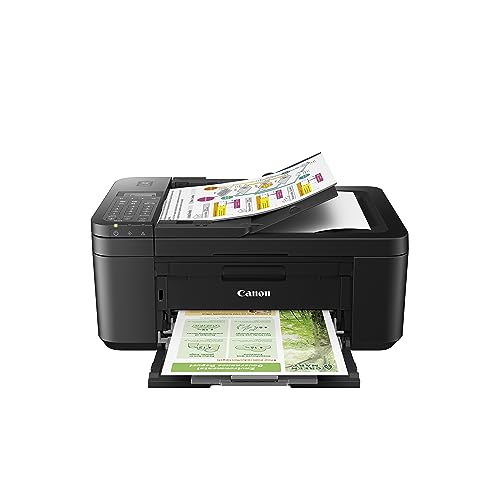
Canon PIXMA TR4720 All-in-One Wireless Printer
- True 4-in-1: print, copy, scan and fax. 20-sheet auto document feeder for multi-page scanning and copying without manual feeding.
- Auto 2-sided printing and borderless photo printing up to 8.5 x 11 inches at 4800 x 1200 dpi resolution.
- Wireless and mobile printing via Canon PRINT app. 100-sheet paper tray with easy 2-cartridge ink system. ENERGY STAR certified.
The Canon PIXMA TR4720 packs a lot into a budget printer. It’s a true 4-in-1 with print, copy, scan, and fax capabilities. The 20-sheet auto document feeder is the standout feature at this price point.
Auto duplex printing, borderless photo printing, and 4800 x 1200 dpi resolution make it surprisingly capable for a printer under $100. The 2-cartridge system (one black, one tri-color) keeps things simple, though cartridge costs will add up if you print frequently.
I’d recommend this if you need fax capability (some institutions still require it) or if you regularly scan multi-page documents. The ADF saves a ridiculous amount of time compared to placing each page on a flatbed scanner manually. For raw printing value, the tank printers above are better. But for features per dollar, the TR4720 is hard to beat.
7. Epson EcoTank ET-2800 – Best Entry-Level Tank Printer
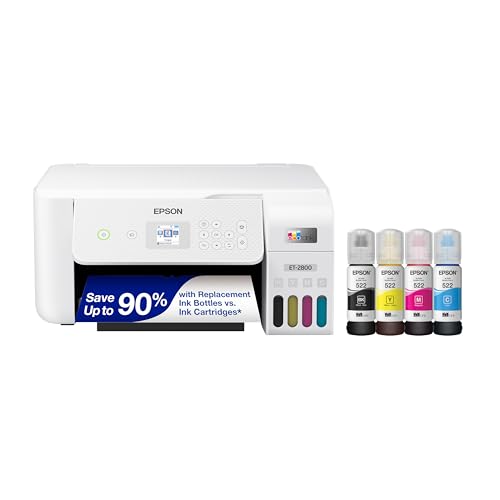
Epson EcoTank ET-2800 Wireless Color All-in-One Supertank Printer
- Cartridge-free EcoTank with up to 4,500 black/7,500 color pages of ink included. Save up to 90% on replacement ink vs. cartridges.
- Wireless all-in-one with print, scan and copy. Supports Apple AirPrint, Android printing and Epson Smart Panel app.
- Micro Piezo Heat-Free Technology for sharp text and vivid color photos. High-resolution flatbed scanner. 2-year warranty with registration.
The ET-2800 is the stripped-down sibling of the ET-2850. Same tank system, same ink savings, same print quality. You get up to 4,500 black and 7,500 color pages of ink included in the box.
What’s different? No auto duplex printing, no color LCD (it has a simple monochrome display), and slightly slower print speeds. But you save around $50 compared to the ET-2850, and you still get the core EcoTank advantage: ridiculously cheap ink that lasts forever.
If you can live without auto duplex (you can flip pages manually, it’s not that hard), this is the cheapest way to get into the tank printer ecosystem. You’ll still save hundreds compared to any cartridge printer over 4 years of college.
Ink Tank vs. Cartridge: Which Is Better for Students?
This is the most important decision you’ll make when buying a printer. Here’s the honest breakdown.
Ink tank printers (EcoTank, MegaTank, Smart Tank) cost $150-$250 upfront but include enough ink to print thousands of pages. Replacement ink bottles cost $15-40 for a full set and print thousands more pages. Over 4 years of college, you’ll spend $200-$300 total on the printer and ink combined.
Cartridge printers cost $50-$100 upfront but use ink cartridges that cost $30-$50 per set and print only 100-300 pages. If you print 100 pages per month, you’ll spend $600-$1,200 on cartridges alone over 4 years. Plus, cartridge ink dries out if you don’t print regularly, which is common in college during breaks.
The math is clear. Unless you barely print anything, a tank printer saves you money in the long run. I’d only recommend a cartridge printer if your total budget is genuinely under $100 and you print fewer than 50 pages per month.
Laser vs. Inkjet: When Does a Laser Printer Make Sense?
Laser printers have one massive advantage: toner doesn’t dry out. If you go weeks without printing (holiday breaks, summer, exam periods where you’re just studying), a laser printer picks right up where you left off. Inkjet printers can clog if you don’t print regularly.
Laser also wins on speed. The Brother HL-L2460DW prints 36 pages per minute. Even the fastest inkjet on this list does maybe 15 ppm. If you’re printing 50-page study guides or thick reports, laser is dramatically faster.
The tradeoff? No color printing (affordable color lasers start around $400+) and no scanner/copier on the model I’ve recommended. If you only print text documents, essays, and reports, go laser. If you need color for charts, presentations, or photos, go with a tank inkjet.
Frequently Asked Questions
What’s the cheapest printer to run for a college student?
Tank-based printers like the Epson EcoTank ET-2850 and Canon MegaTank G3270 have the lowest running costs. They include up to 2 years of ink in the box, and replacement ink bottles cost around $15-40 for thousands of additional pages. A monochrome laser printer like the Brother HL-L2460DW is also very cheap to run if you don’t need color.
Is it worth buying a printer for college or should I use the library?
If you print more than 20-30 pages per month, owning a printer saves money. Campus printing typically costs $0.05-$0.15 per page. A tank printer with included ink effectively costs less than $0.01 per page. Over 4 years, even moderate printing adds up to hundreds in library fees. Plus, you get the convenience of printing at midnight before a deadline.
Do I need a color printer for college?
It depends on your major. STEM students often need to print charts, graphs, and diagrams in color. Art, design, and marketing students definitely need color. If you’re in a text-heavy field like law, history, or literature, a monochrome laser printer is cheaper and faster. When in doubt, a color inkjet tank printer covers all bases.
What’s the difference between EcoTank, MegaTank, and Smart Tank?
They’re all the same concept from different brands. EcoTank is Epson’s brand, MegaTank is Canon’s, and Smart Tank is HP’s. All three use refillable ink tanks instead of cartridges, offering dramatically lower per-page costs. The differences are in specific features, print quality, and ink bottle pricing, but all three are excellent choices for students.
Can I print from my phone or tablet?
Yes, every printer on this list supports wireless mobile printing. Apple devices use AirPrint, and Android devices use Mopria Print Service or the manufacturer’s app (Epson Smart Panel, HP Smart, Canon PRINT). You can print documents, photos, and emails directly from your phone without a computer.
How long does printer ink last if I don’t print often?
This is where laser printers have a clear advantage. Toner never dries out, even after months of not printing. Inkjet ink can dry and clog print heads if you don’t print for several weeks. Tank printers handle this better than cartridge printers since there’s more ink in the system. If you go long periods without printing, consider running a test print every 2-3 weeks to keep the heads clear.
Should I avoid HP printers because of their ink subscription model?
HP’s Instant Ink subscription and cartridge DRM on their budget printers is a valid concern. Their cartridge-based models (like the DeskJet 4155e) block third-party ink. However, HP’s Smart Tank line uses refillable tanks without these restrictions. If you go with HP, choose the Smart Tank 7602 to avoid the cartridge lock-in entirely.
What’s the best printer if I only have $100 to spend?
Under $100, your best options are the Canon PIXMA TR4720 (4-in-1 with ADF) or the HP DeskJet 4155e (compact all-in-one). Both use cartridges, so ink costs will be higher long-term. If you can stretch to $150, the Epson EcoTank ET-2800 gets you into the tank ecosystem, which saves you significantly more money over time.
The Bottom Line
If I had to pick one printer for a college student right now, it’d be the Epson EcoTank ET-2850. The included ink lasts 2 years, it prints both sides automatically, and the total cost of ownership over 4 years is lower than almost any other option.
On a tighter budget? The Epson EcoTank ET-2800 gives you the same tank savings for less money. And if you only print text documents, the Brother HL-L2460DW laser printer is the most reliable, fastest option available.
Whatever you pick, avoid the trap of buying the cheapest printer and then paying through the nose for ink. Think about the total cost over your college years, not just the sticker price. Your future self will thank you.