
I’ve watched hundreds of bloggers pick their niche the wrong way. They start with what they love, build a site around it, publish for six months, and then discover nobody’s willing to pay for what they’re writing about. Or worse, they pick a niche where the money is good but they run out of things to say by month three.
Picking the wrong niche doesn’t just waste time. It kills motivation. And motivation is the only thing keeping you going during the first 12-18 months when affiliate income is basically zero.
I’ve started sites in niches that failed. I’ve also built sites in niches that generated $10,000+ per year for over a decade. The difference wasn’t luck. It was framework.
The Three-Circle Niche Framework
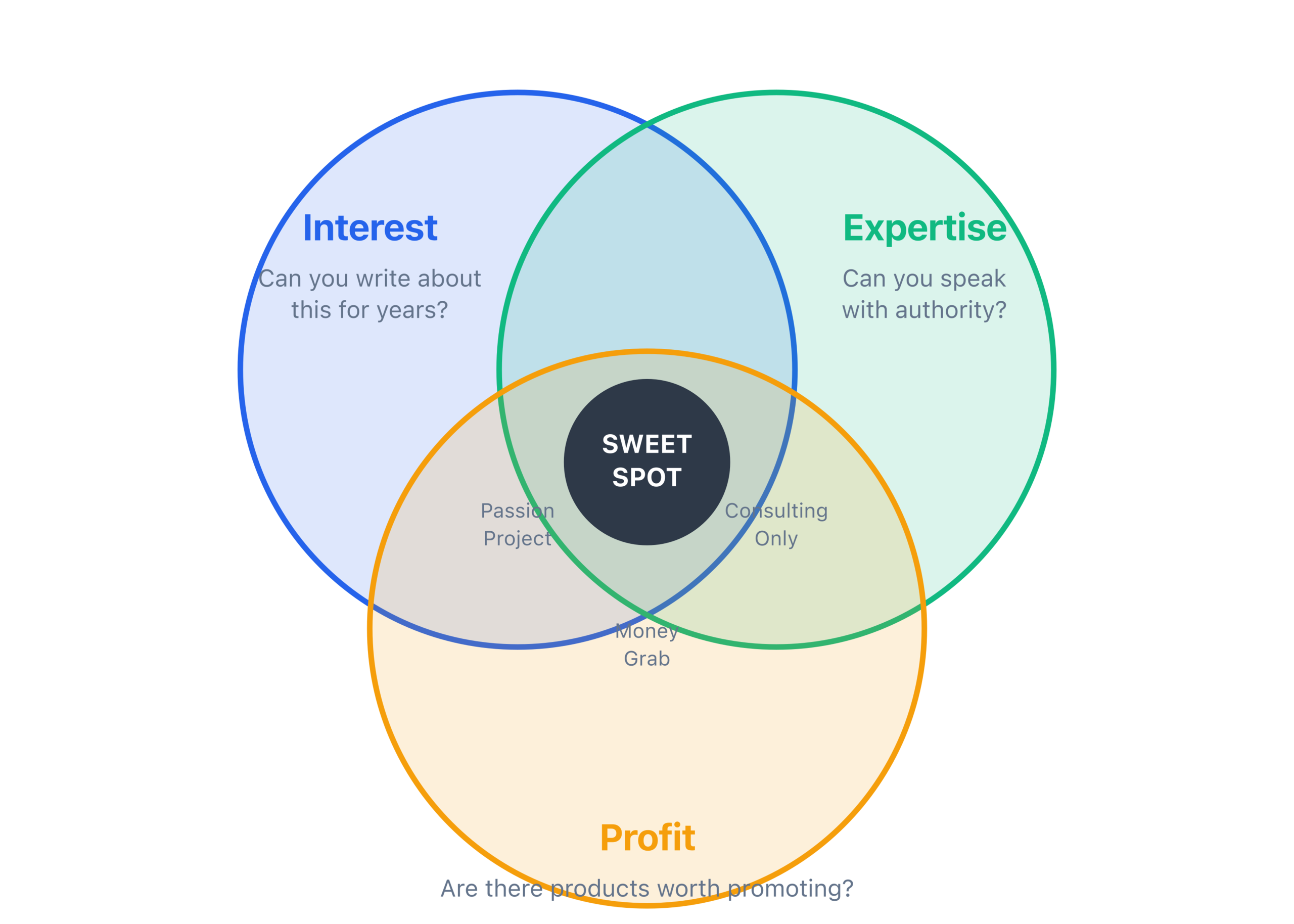
Every profitable affiliate niche sits at the intersection of three circles. Miss one, and the whole thing falls apart.
Circle 1: What You Know (or Can Learn Deeply)
This isn’t about passion. I’ll get to that in a minute. This is about competence. Can you write 100+ articles on this topic without running dry? Can you form opinions that go beyond surface-level regurgitation? Do you have real experience, or can you acquire it quickly?
I know WordPress inside and out. I’ve built 800+ client sites over 16 years. When I write about WordPress hosting, themes, or plugins, I’m drawing from actual project experience. I’ve broken sites with bad plugins. I’ve seen hosting providers fail under traffic spikes. That depth shows in the writing, and it’s what makes readers trust the recommendations enough to click and buy.
You don’t need 16 years of experience. You need enough depth to say something the other 50 articles on page one can’t say. That usually means 6-12 months of hands-on experience, or a willingness to go deep fast.
Circle 2: What People Pay For
This is where most “follow your passion” advice falls apart. People need to be spending money in your niche. Not just browsing. Not just reading. Spending.
The test is simple: are there products in this niche with price points above $50? Are there subscription services people pay for monthly? Are there affiliate programs with commission rates above 20%?
If the answer is no to all three, you’re looking at an entertainment niche, not a money niche. Entertainment niches can work with display ads and sponsorships, but they’re terrible for affiliate marketing.
WordPress passes this test easily. Hosting plans cost $5-50/month. Premium themes cost $50-200. Plugins cost $50-300/year. SaaS tools integrated with WordPress cost $20-200/month. Every one of these has affiliate programs. The money circulating in the WordPress tool market is massive.
Compare that to, say, poetry analysis. You might be passionate about it. You might know a lot. But who’s buying $100/year software for poetry analysis? Nobody. There’s no money flowing through that niche.
Circle 3: What You Can Rank For
This is the competitive filter. Even if you know the topic and people spend money on it, you still need to be able to get your content in front of them. And for affiliate marketing, that mostly means ranking in Google.
A niche like “credit cards” has enormous spend. Massive commissions. But the top 10 results for every keyword are occupied by sites with millions of backlinks and editorial teams of 50+. You’re not outranking NerdWallet or Bankrate as a solo blogger. Not in 2026. Not ever.
The sweet spot is niches where:
- There are keywords with 500-5,000 monthly searches (enough to be worth writing about)
- The current top results are from small-to-medium blogs, not mega-publishers
- Long-tail keywords exist that bigger players ignore
- You can build topical authority by covering the niche comprehensively
When I started writing about WordPress tools, the competition was manageable. There were some established sites, but the niche was wide enough that I could carve out specific corners, like WordPress hosting for beginners, or plugin comparisons for specific use cases.
The Intersection Is Everything
If you only have two circles covered, you’ll struggle.
Knowledge + Money, but can’t rank: You’ll write great content that nobody sees. This is the most frustrating position because you know your stuff and there’s money to be made, but the big players own the search results. Solution: look for sub-niches within the broader topic where competition is thinner.
Knowledge + Rankable, but no money: You’ll get traffic that doesn’t convert. I’ve seen bloggers in hobby niches pull 50,000 monthly visitors and make $200/month from affiliate links because the products they’re recommending cost $15 with 5% commissions. Solution: pivot to adjacent niches where spending is higher, or add services.
Money + Rankable, but no knowledge: You’ll rank, people will click, but your content will be shallow and your recommendations won’t carry trust. Readers can smell it when someone is faking expertise. Conversion rates tank. Solution: spend 3-6 months learning the niche deeply before going all in, or partner with someone who has the expertise.
All three circles need to overlap. When they do, that intersection is your niche.
Why “Passion” Alone Doesn’t Pay Bills
I’m going to be blunt about this because the internet is full of bad advice on the topic.
“Follow your passion and the money will follow” is a lie. I’m passionate about cricket. I’m passionate about good coffee. I could write endlessly about both. Neither one would make a viable affiliate niche for me, because the product economics don’t work.
Cricket content? The audience is massive in India, but the affiliate programs in sports content are terrible. Low commissions, low price points, and the traffic is event-driven (it spikes during tournaments and dies between them).
Coffee? Better, but the affiliate commissions on coffee equipment are thin. A $30 grinder with a 4% Amazon commission earns me $1.20 per sale. I’d need 1,000 referrals a month to make $1,200. That’s not a business. That’s a hobby that occasionally pays for lunch.
Passion matters for sustainability. You need to care enough about the topic to keep writing about it for years. But passion is a necessary condition, not a sufficient one. The sufficient condition is the intersection of all three circles.
My advice: find something you’re interested in, or at least curious about, that also has strong economics. You don’t need to be passionate about web hosting to build a profitable affiliate site about it. You need to find it interesting enough to keep learning and writing. There’s a big gap between “passionate” and “bored,” and most profitable niches live somewhere in that gap.
Evaluating Niche Profitability
Before you commit to a niche, run these numbers. I do this for every new niche I consider, and it takes about two hours of research.
Step 1: Find 10 affiliate programs in the niche
Search for “[niche] affiliate program” and make a list. Note the commission rates, cookie durations, and payment terms. If you can’t find 10 programs, the niche might be too narrow.
Step 2: Calculate average commission per sale
For each program, figure out what a typical referral earns. If the product costs $100/year and the commission is 30%, that’s $30 per sale. If it’s recurring at 20% of $49/month, that’s $9.80/month per referral. Do this for all 10 programs and find the average.
If the average commission per sale is under $20 for one-time programs, or under $10/month for recurring, the niche economics are weak. You’ll need enormous traffic to make real money.
Step 3: Check search volume for money keywords
Use a keyword tool (Ahrefs, Semrush, even free tools like Ubersuggest) and search for:
- “best [product type]”
- “[product A] vs [product B]”
- “[product] review”
- “[product] alternatives”
- “best [product type] for [use case]”
Add up the monthly search volume for the top 20 money keywords. If the total is under 10,000, the niche is too small for significant affiliate income unless the commissions are very high.
Step 4: Analyze the competition
For each money keyword, look at who’s ranking on page one. Are they:
- Huge media sites (Forbes, CNET, Wirecutter)? Hard to compete.
- Established niche sites with 5+ years of authority? Tough but possible with patience.
- Small blogs and forums? Great opportunity.
- Thin content or outdated articles? Even better.
If 7 out of 10 page-one results are from mega-publishers, pick a different niche or find a sub-niche they’re ignoring.
Step 5: Project realistic first-year revenue
Be conservative. Assume you can capture 2% of the total money keyword search volume in year one (that’s realistic for a new site). Apply a 5% CTR and 3% conversion rate to your average commission.
If the projected year-one revenue is under $2,000, ask yourself if you’re willing to invest 12 months for that return. For some people, yes. For most, that’s a signal to look for better economics.
Profitable vs Unprofitable Niches
Let me give you concrete examples from my experience and observation.
Profitable niches for affiliate marketing:
- SaaS tools (email marketing, project management, CRM): High price points, recurring commissions, 20-40% rates
- Web hosting and website builders: $65-200 per referral, massive search volume
- Online course platforms: $50-150 per sale, recurring options
- Business software (accounting, invoicing, HR): Recurring revenue, 15-30% commissions
- WordPress themes and plugins: 20-50% commissions, loyal audiences
- VPN services: 30-100% first-month commissions, huge demand
Unprofitable niches for affiliate marketing (as a primary income):
- Physical products under $30 (Amazon’s 1-4% commissions kill the math)
- Free tool alternatives (“best free [X]” attracts people who don’t want to spend money)
- News and current events (traffic is ephemeral, no product buying intent)
- Entertainment and celebrity content (massive traffic, zero purchase intent)
- Generic lifestyle content (too broad, no clear products to recommend)
Notice the pattern? Profitable affiliate niches have high-value products with strong commissions. Unprofitable ones have low-value products or audiences with no buying intent.
Micro-Niche vs Broad-Niche: When Each Wins
This is a real debate with no universal answer. I’ve done both, and they have different tradeoffs.
Micro-niche example: A site focused exclusively on email marketing tools for small businesses.
Pros: You can become the authority fast. Less content needed to cover the topic comprehensively. You rank faster because topical relevance signals are strong. Every piece of content supports every other piece.
Cons: There’s a ceiling. Once you’ve reviewed every email marketing tool and written every comparison, there’s nothing left to write. Growth stalls. And if the niche shifts (email marketing tools consolidate or pricing changes), you’re exposed.
Broad-niche example: A site covering all SaaS tools for online businesses.
Pros: No content ceiling. You can always expand into new categories. Revenue diversification across many programs. If one category slows down, others pick up the slack.
Cons: Takes longer to build authority. You’re competing with bigger sites on every keyword. Harder to create a strong brand identity. Content strategy is more complex.
My recommendation: Start micro, expand broad.
Launch with a tight niche focus, say, email marketing tools. Build authority. Get 30-50 pieces of quality content published. Start earning. Then expand into adjacent categories: CRM tools, landing page builders, marketing automation. Each expansion leverages the authority you’ve already built.
I essentially did this with WordPress. I started writing about WordPress themes and plugins, a focused sub-niche. As my site grew, I expanded into hosting, page builders, and eventually broader digital marketing tools. Each expansion built on existing trust and topical relevance.
The worst strategy? Starting broad from day one. You’ll publish 100 articles across 15 categories, rank for nothing, and burn out before any compounding kicks in.
The Final Test: Would You Read This Site?
Before committing to a niche, ask yourself one question: if you found a site covering this niche, written by someone else, would you read it? Would you bookmark it? Would you trust its recommendations?
If the answer is yes, you’ve probably found a good intersection of the three circles.
If the answer is “I guess, but I wouldn’t be excited about it,” keep looking. Because if you wouldn’t be excited to read it, you won’t be excited to write it. And that lack of energy shows in the content.
The niche I chose, WordPress and digital tools, is something I’d read even if I weren’t the one writing it. I’m genuinely curious about new tools, new approaches, and how they compare. That curiosity has kept me writing about this stuff for over 16 years.
Find your version of that.
Chapter Checklist
- I’ve identified at least 3 potential niches using the Three-Circle Framework
- For each potential niche, I’ve verified: (1) I have or can build deep knowledge, (2) people actively spend money on products in this space, (3) the competition is manageable for a new site
- I’ve researched 10+ affiliate programs for my top niche choice
- I’ve calculated the average commission per sale in my niche
- I’ve checked search volumes for at least 20 money keywords
- I’ve analyzed page-one competition for my top 5 keywords
- I’ve projected realistic first-year revenue and I’m OK with that number
- I’ve decided between micro-niche and broad-niche (recommendation: start micro)
Chapter Exercise
Complete the Three-Circle Niche Analysis for your top 3 niche ideas.
For each niche, fill in:
Niche: ___
- Knowledge Score (1-10): How much do you know? Could you write 100 articles without repeating yourself?
- Money Score (1-10): List the top 5 affiliate programs. What’s the average commission? Are there recurring options?
- Competition Score (1-10): Search for the top 5 money keywords. Who’s ranking? Could you realistically crack page one in 12 months?
- Combined Score: Multiply all three. A score above 500 is strong. Below 300, keep looking.
After scoring all three niches, pick the one with the highest combined score. That’s your starting point. Not your passion project. Not the one that sounds coolest. The one where the math works.
If none of your three niches score above 300, brainstorm five more and repeat the exercise. Don’t start building until you’ve found a niche where all three circles overlap.
Disclaimer: This site is reader-supported. If you buy through some links, I may earn a small commission at no extra cost to you. I only recommend tools I trust and would use myself. Your support helps keep gauravtiwari.org free and focused on real-world advice. Thanks. - Gaurav Tiwari