
I spent my first two years of affiliate blogging writing about whatever I felt like. Random product reviews, tips articles, opinion pieces. I was publishing 3-4 times per week, staying consistent, doing everything the “just create great content” crowd tells you to do.
My affiliate income after two years? About $200/month.
The month I started taking keyword research seriously, treating it as a strategic exercise rather than an afterthought, everything changed. Within six months, I was at $1,500/month. Within a year, $4,000/month. Same niche. Same writing quality. Same site. The only difference was writing the right content for the right search queries.
Keyword strategy isn’t about finding magic words. It’s about understanding what people type into Google when they’re ready to spend money, and making sure your content appears when they do. This chapter is the framework I use to identify, prioritize, and organize keywords for maximum affiliate revenue.
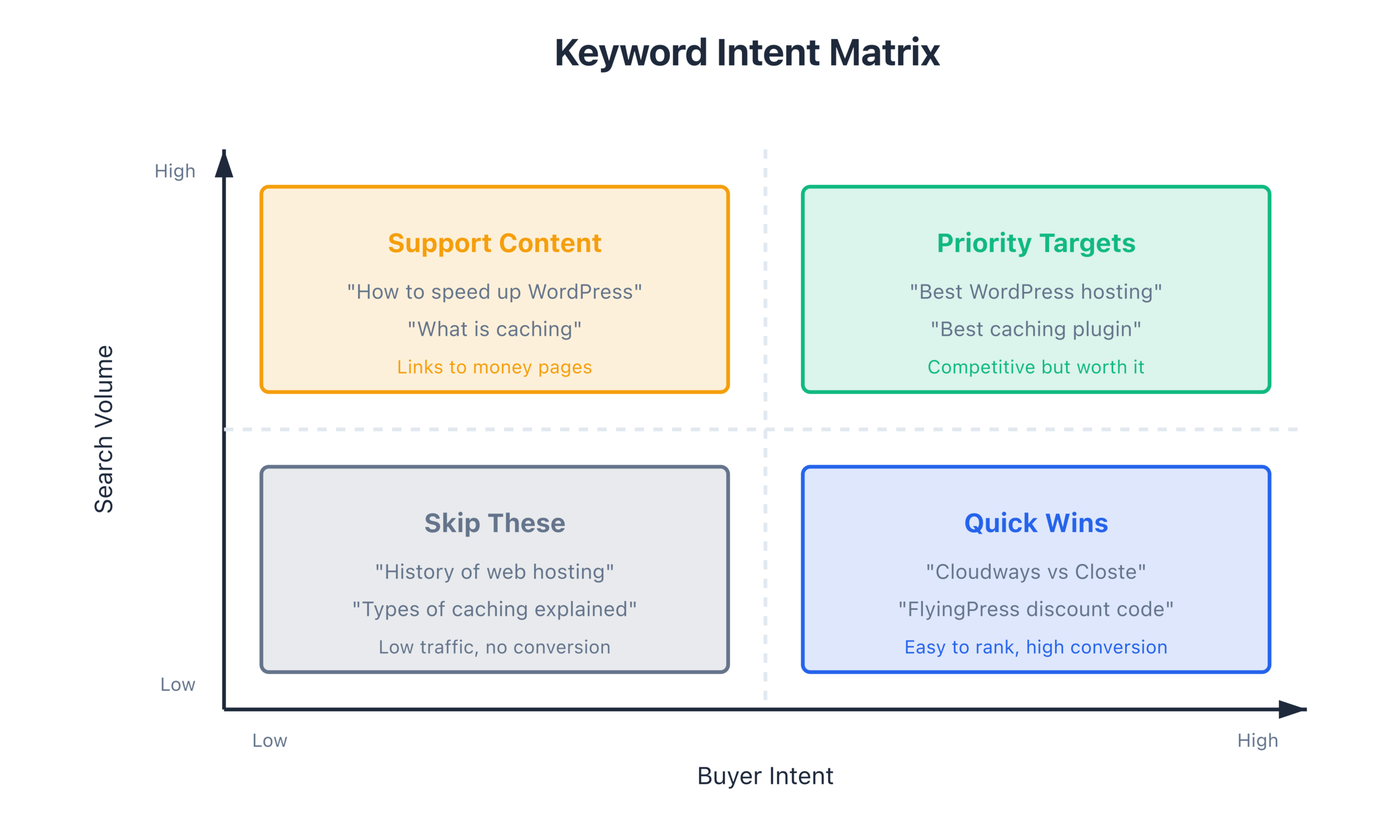
The Keyword Intent Matrix
Every search query has an intent behind it. Understanding that intent is the single most important keyword skill you’ll develop as an affiliate blogger.
I break search intent into four categories:
Informational: The searcher wants to learn something. “What is WordPress caching?” “How does CDN work?” “Difference between shared and VPS hosting.” These people aren’t buying anything right now. They’re gathering knowledge.
Commercial Investigation: The searcher is researching products but hasn’t decided yet. “Best WordPress caching plugins 2025.” “WP Rocket review.” “FlyingPress vs WP Rocket.” These people are actively evaluating options. They have purchase intent, but they need more information before committing.
Transactional: The searcher is ready to buy. “WP Rocket pricing.” “FlyingPress discount code.” “Buy FlyingPress license.” These people have made their decision and want to complete the purchase. They’re looking for the best deal or the quickest path to checkout.
Navigational: The searcher is looking for a specific website or page. “FlyingPress login.” “WP Rocket dashboard.” “Cloudways control panel.” These people already have accounts. They’re not in buying mode. Low affiliate value.
The money in affiliate marketing lives in Commercial Investigation and Transactional keywords. That’s where I spend 80% of my keyword research time. Informational keywords have their place (I’ll explain shortly), but they’re support content, not money content.
Mapping Keyword Intent to Content Types
Once you understand intent, the content type writes itself. Each intent maps cleanly to the content types we covered in earlier chapters:
- Informational keywords map to tutorials, how-to guides, and educational articles
- Commercial Investigation keywords map to reviews, comparison posts, and roundups
- Transactional keywords map to deal pages, coupon posts, and direct product links
- Navigational keywords are rarely worth targeting (the brand will always outrank you)
The connection between intent and content is the backbone of my entire content strategy:
- “What is managed WordPress hosting?” (Informational) becomes a tutorial that links to my hosting reviews
- “Best managed WordPress hosting” (Commercial) becomes a roundup with affiliate links
- “Kinsta vs WP Engine” (Commercial) becomes a head-to-head comparison
- “Kinsta pricing plans” (Transactional) becomes a pricing breakdown with a direct affiliate link
- “Kinsta discount code” (Transactional) becomes a deal/coupon page
When you map this out for your niche, you end up with a complete content plan that captures readers at every stage of their buying process. And you can strategically interlink these pieces to move readers from informational content toward commercial and transactional content.
Finding Buyer-Intent Keywords
Buyer-intent keywords are the keywords that directly lead to affiliate commissions. They’re the queries people type when they have their credit card nearby.
There are specific patterns that signal buyer intent:
“Best [product category]” keywords: “Best WordPress hosting,” “Best email marketing tool,” “Best caching plugin.” These are your primary roundup keywords. They have high search volume and strong commercial intent. Everyone searching for “best [X]” is planning to buy [X].
“[Product A] vs [Product B]” keywords: These signal a reader who’s narrowed their choices and needs help deciding. Very high conversion intent.
“[Product] review” keywords: Self-explanatory. Someone who searches for a product review is evaluating that product for purchase.
“[Product] alternative” keywords: Signals someone who’s either unhappy with a current product or researching options. Strong buying intent.
“[Product] pricing” and “[Product] cost” keywords: Very late-stage. This person is checking if they can afford it before buying.
“[Product] discount” and “[Product] coupon” keywords: The buyer has already decided. They just want a deal. Highest conversion rate of any keyword type.
“Best [product] for [use case]” keywords: “Best hosting for WooCommerce,” “Best email plugin for bloggers.” These are golden because they’re both high-intent and specific enough that you can tailor your recommendation precisely.
I keep a running spreadsheet of keyword patterns for my niche. Any time I discover a new pattern that converts, I add it to the list and then find every variation of it I can target. The patterns are more valuable than individual keywords because they’re reusable across every product category you cover.
Long-Tail vs Head Terms
Head terms are short, high-volume keywords. “WordPress hosting.” “Email marketing.” “Caching plugin.”
Long-tail keywords are longer, more specific phrases with lower volume. “Best WordPress hosting for small blogs under $10/month.” “Email marketing for Shopify stores with less than 500 subscribers.” “Fastest caching plugin for WooCommerce.”
New affiliate bloggers should focus almost exclusively on long-tail keywords. I know that sounds limiting. It’s not. It’s strategic.
Long-tail keywords have three advantages:
- Lower competition: “WordPress hosting” has thousands of pages competing for it, including major brands with massive domain authority. “Best WordPress hosting for Indian bloggers on a budget” has a fraction of the competition.
- Higher conversion rates: The more specific the search, the closer the searcher is to buying. Someone searching “best lightweight WordPress caching plugin for shared hosting” knows exactly what they need. Your recommendation needs to match their specifics, and if it does, the conversion rate is exceptional.
- Easier to match intent: Long-tail keywords tell you exactly what the reader wants. With “email marketing,” you have no idea what they’re looking for. With “best email marketing platform for WordPress with automation under $50/month,” you know their platform, their needs, and their budget. Your content can be laser-targeted.
My strategy: start with long-tail keywords for the first 50-100 articles. Build authority and backlinks. Then gradually target shorter, higher-volume keywords as your domain authority grows.
After publishing about 40 long-tail articles in the WordPress hosting niche, my site had enough authority and internal links that a broader “Best WordPress Hosting” roundup could compete. That roundup now ranks on the first page and drives more monthly revenue than the 40 supporting articles combined. But it wouldn’t rank without those supporting articles building the topical foundation.
Keyword Clustering for Topical Authority
Keyword clustering is the practice of grouping related keywords together and covering them systematically to build topical authority. Google doesn’t rank individual pages in isolation. It evaluates whether your entire site is an authority on the topic.
Here’s how I cluster keywords for an affiliate niche:
Step 1: Pick a product category. Let’s say WordPress caching plugins.
Step 2: List every keyword variation you can find. Using keyword tools, Google autocomplete, People Also Ask, and competitor analysis, build a comprehensive list:
- Best WordPress caching plugins
- WP Rocket review
- FlyingPress review
- WP Rocket vs FlyingPress
- WP Rocket vs W3 Total Cache
- FlyingPress alternatives
- WordPress caching for WooCommerce
- How to set up WP Rocket
- FlyingPress pricing
- Is WP Rocket worth it
- WordPress caching explained
- Page caching vs object caching
- WordPress caching without plugins
- LiteSpeed Cache vs WP Rocket
I could keep going. For a mature niche, you can easily find 50-100+ keyword variations around a single product category.
Step 3: Group keywords by intent and content type.
Money pages (Commercial/Transactional):
- Best WordPress caching plugins (roundup)
- [Product] review (individual reviews)
- [A] vs [B] (head-to-head comparisons)
- [Product] alternatives (alternative pages)
- [Product] pricing / discount (deal pages)
Support pages (Informational):
- How WordPress caching works (educational)
- Page caching vs object caching (educational)
- How to set up [Product] (tutorial)
- WordPress caching for WooCommerce (use-case guide)
Step 4: Plan the publishing order. Start with the support content. Build the educational foundation. Then publish the money pages. Link the support content to the money pages with strategic internal links (more on this in Chapter 9).
This is the approach that transformed my affiliate income. Instead of writing random reviews, I was building complete topic clusters that Google recognized as authoritative. When my caching plugin cluster reached 15-20 articles, Google started ranking me for keywords I wasn’t even directly targeting because the topical authority signals were strong enough.
Tools for Keyword Research
I’m going to tell you what I actually use, not what I’m paid to recommend. My keyword research stack has three layers:
Primary Tool: Semrush
I’ve used Semrush for over five years. It’s my go-to for competitor keyword analysis, keyword difficulty scores, and tracking rankings over time. The “Keyword Magic Tool” is where I start every keyword research session. I punch in a seed keyword, filter by intent type and difficulty, and export the results.
Is it expensive? Yes. $130/month for the plan I use. But it’s paid for itself hundreds of times over. If you’re serious about affiliate blogging, a professional keyword tool isn’t optional. Free tools will only get you so far.
Secondary Tool: Google Search Console
Free, and most bloggers underuse it. Search Console shows you the actual queries people use to find your site. I check it weekly to find keywords I’m ranking for on page 2-3. These are low-hanging-fruit opportunities. If I’m ranking #15 for a keyword, a focused update to that content can often push it to page 1. I’ve moved dozens of pages from page 2 to page 1 this way, and each jump typically doubles or triples the traffic to that page.
Supporting Tools:
- Google Autocomplete and “People Also Ask” for question-based long-tail keywords (free)
- Ahrefs for backlink analysis when I need a second opinion on keyword difficulty (I don’t use it for primary research, but it’s great for link-based analysis)
- AnswerThePublic for visualizing question clusters around a topic (the free tier is enough for most purposes)
- Google Trends for understanding seasonality. Some affiliate keywords spike during Black Friday, back-to-school season, or New Year. Knowing when to publish and promote seasonal content can double your revenue during peak months.
My keyword research workflow: Start in Semrush. Export a big list. Filter by intent. Check difficulty. Prioritize. Then validate with Google Search Console data if I have existing content in the same niche. The whole process for a new topic cluster takes about 2-3 hours. That research then drives 3-6 months of content creation.
Prioritizing Keywords by Difficulty, Volume, and Commercial Intent
You’ve got a list of 100+ keywords. Now what? You can’t write 100 articles at once. You need a prioritization framework.
I score every keyword on three dimensions:
Keyword Difficulty (KD): How hard is it to rank for this keyword? I use Semrush’s difficulty score as a starting point, but I also manually check the top 10 results. If the first page is dominated by sites with Domain Rating 70+ and thousands of backlinks, I skip it regardless of what the tool says. If I see a few sites with DR 30-40 ranking, there’s an opening.
- KD under 30: Target immediately (new sites can compete)
- KD 30-50: Target after 20-30 published articles in the cluster
- KD 50+: Target only when your site has established authority
Monthly Search Volume: How many people search for this keyword each month?
- Under 100: Only target if intent is highly commercial (like “[Product] discount code”)
- 100-1,000: Sweet spot for long-tail affiliate keywords
- 1,000-10,000: Medium competition, good target for established sites
- 10,000+: Head terms, requires significant authority
Commercial Value: How likely is a searcher to generate affiliate revenue? This is the multiplier that makes everything else relevant.
- High: “Best [product],” “[A] vs [B],” “[Product] review,” “[Product] pricing”
- Medium: “How to [task] with [product],” “[Product] tutorial”
- Low: “What is [concept],” “[General topic] explained”
I multiply these into a simple priority score. A keyword with low difficulty, medium volume, and high commercial intent gets immediate attention. A keyword with high difficulty, high volume, and low commercial intent goes to the back of the queue.
My top 20% of keywords, the ones with the best combination of achievable difficulty and high commercial intent, get written first. These are the articles that start generating affiliate income fastest. The supporting content (informational keywords) gets filled in around them to build the topic cluster.
One practical tip: don’t get paralyzed by analysis. I’ve seen bloggers spend weeks perfecting their keyword spreadsheet and never publish a single article. Your keyword research doesn’t need to be perfect. It needs to be directionally correct. Pick your best 10 keywords, start writing, and refine as you learn what actually ranks and converts for your specific site.
Chapter Checklist
- [ ] I understand the four types of keyword intent (Informational, Commercial, Transactional, Navigational)
- [ ] I can map keyword intent to the correct content type
- [ ] I have a list of buyer-intent keyword patterns for my niche
- [ ] I understand why new sites should focus on long-tail keywords first
- [ ] I have a keyword clustering plan for at least one product category
- [ ] I’ve set up at least one professional keyword research tool
- [ ] I’m checking Google Search Console weekly for ranking opportunities
- [ ] I have a priority scoring system for keywords (difficulty + volume + commercial intent)
- [ ] My content calendar is driven by keyword research, not random inspiration
- [ ] I’m not over-analyzing and have started publishing keyword-targeted content
Chapter Exercise
Pick one product category in your niche and build a keyword cluster from scratch:
- Seed keyword research: Use your keyword tool of choice to find 30-50 keywords related to this product category. Export the list with difficulty and volume data.
- Intent classification: Label each keyword as Informational, Commercial Investigation, Transactional, or Navigational. If you’re unsure, Google the keyword and look at what type of content ranks. That tells you Google’s interpretation of the intent.
- Content type mapping: Assign each Commercial and Transactional keyword to a content type (review, comparison, roundup, deal page, alternative page, tutorial).
- Priority scoring: For each keyword, rate it as High/Medium/Low on difficulty (inverse, so easy = high), volume, and commercial intent. Identify your top 10 keywords to target first.
- Publishing plan: Arrange the top 10 keywords in a publishing sequence. Start with the easiest, highest-intent keywords. Note which informational articles you’ll need as supporting content and where they fit in the timeline.
You now have a data-driven content plan for the next 2-3 months. Every article you write has a clear keyword target, a defined intent, and a strategic role in your topic cluster. This is the difference between random blogging and a content business.
Disclaimer: This site is reader-supported. If you buy through some links, I may earn a small commission at no extra cost to you. I only recommend tools I trust and would use myself. Your support helps keep gauravtiwari.org free and focused on real-world advice. Thanks. - Gaurav Tiwari