
Most affiliate bloggers think content strategy means “write product reviews and hope people find them.” That approach worked in 2012. It doesn’t work now. Google is smarter, readers are more skeptical, and the competition for money keywords is fierce.
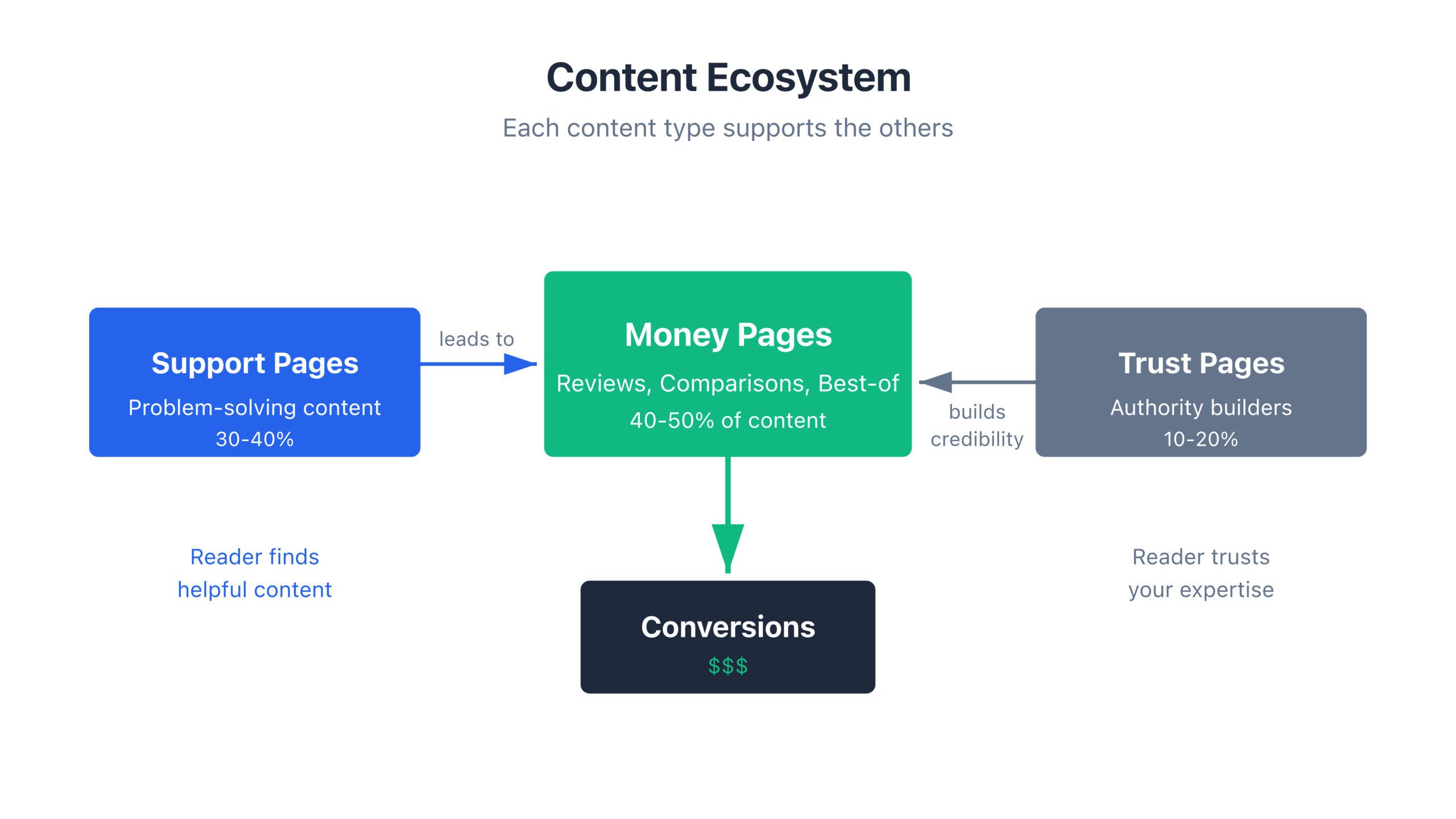
What works now is an ecosystem, a web of content where every piece serves a purpose and feeds the others. Your review doesn’t exist in isolation. It’s supported by tutorials that build trust, informational posts that capture traffic, and comparison pages that catch people at decision time.
I didn’t figure this out through some flash of insight. I figured it out by watching my highest-earning pages and asking: what makes these different? The answer, every time, was that my best money pages had a constellation of supporting content around them, driving traffic, building trust, and giving readers reasons to believe my recommendation before they ever hit the review.
The Three Content Types
Every piece of content on your affiliate site falls into one of three categories. Each serves a different function in the ecosystem.
Money Pages
These are the pages with affiliate links. Reviews, comparisons, “best of” roundups, alternatives posts. They target people who are already looking to buy something, or at least evaluating options.
Money pages convert the best because the visitor intent is commercial. Someone searching for “best email marketing tool for small business” is further along in their buying process than someone searching “what is email marketing.”
But money pages are also the hardest to rank for. Every other affiliate blogger in your niche is targeting the same keywords. And the competition is experienced, well-funded, and persistent.
This is why money pages alone aren’t a strategy. They’re the tip of the spear. Without the shaft behind them, they don’t penetrate.
Support Content
Support content is informational, educational, how-to content that’s related to your money pages but doesn’t directly promote products. It targets people earlier in their journey, before they’re ready to buy.
Examples:
- “How to grow an email list from scratch” (supports your email marketing tool reviews)
- “WordPress speed optimization guide” (supports your hosting and caching plugin reviews)
- “How to start a blog in 2026” (supports every tool review on your site)
Support content does three things. First, it captures traffic from informational keywords that are less competitive than commercial keywords. Second, it builds topical authority signals that help your money pages rank higher. Third, it contains internal links that guide readers toward your money pages when they’re ready.
I have a guide on WordPress performance that pulls in about 2,000 visitors per month. The page itself has no affiliate links. But it links to my hosting comparison, my caching plugin review, and my CDN recommendation. Those three money pages collectively earn $800-1,200/month, and about 15-20% of their traffic comes from that one support article.
Trust Content
Trust content exists to prove you’re a real person with real expertise. Case studies, behind-the-scenes posts, income reports, opinion pieces, personal experiences, even content about your process and methodology.
Trust content doesn’t drive massive traffic. It doesn’t contain affiliate links. What it does is convert visitors from “this is just another blog” to “this person knows what they’re talking about.”
I published a post in 2019 about how I built a client’s WordPress site from scratch, including the tools I used, the decisions I made, and the results after six months. That post gets maybe 200 visitors per month. But the visitors who read it spend an average of 7 minutes on the page, and they’re significantly more likely to click affiliate links on the pages they visit afterward.
Trust is the invisible multiplier in affiliate marketing. Two sites can have identical money pages, but the one with stronger trust signals will convert at 2-3x the rate. I’ve seen this consistently across my own sites and in the data from bloggers I’ve consulted with.
How Each Type Feeds the Others
The ecosystem model works because the three content types create feedback loops.
Support Content feeds Money Pages. A tutorial on “how to build a landing page” links to your review of the best landing page builders. Readers who come for the tutorial are now warmed up to the idea of using a tool, and your review is one click away.
Trust Content feeds everything. When a reader encounters your case study or experience post, they trust your other content more. They’re more likely to click affiliate links, more likely to follow your primary recommendation, and more likely to return to your site.
Money Pages feed Support Content. Someone reads your “best email marketing tools” roundup but isn’t ready to buy. They see a link to your guide on “how to build an email sequence” and click through. Now they’re deeper in your ecosystem, learning from your content, building trust, and getting closer to a purchase decision.
The internal linking structure looks like this:
- Support content links TO money pages (guides readers toward buying decisions)
- Money pages link TO support content (gives readers more education if they’re not ready to buy)
- Trust content links TO both (builds credibility that benefits every page)
- Money pages link TO other money pages (comparisons link to individual reviews, “best of” links to alternatives)
This interconnected structure is what separates affiliate blogs that earn $500/month from those that earn $5,000/month with similar traffic levels. It’s not about having more content. It’s about having content that works together.
Content Ratios: The 20/40/40 Rule
Here’s the ratio I’ve found works best, based on my own sites and the sites I’ve audited for clients.
20% Money Pages
If you have 100 posts, 20 should be money pages. Reviews, comparisons, “best of” lists, alternatives posts. These are the pages that directly earn revenue.
Why only 20%? Because money pages need supporting content to rank and convert. A site with 80% money pages looks like a thin affiliate site to both Google and readers. It lacks depth. It lacks trust. And Google’s helpful content updates have specifically targeted sites that are disproportionately commercial.
40% Support Content
These are your tutorials, how-to guides, informational posts, and educational content. They capture traffic, build topical authority, and funnel readers toward your money pages.
40% gives you enough informational content to establish authority in your niche. It creates a wide net that catches people at every stage of their journey, not just the buying stage.
40% Trust Content
Case studies, opinion pieces, process posts, comparison analyses (non-affiliate), industry commentary. Content that demonstrates expertise and builds relationships with your audience.
I know 40% sounds high for trust content. But think about it from the reader’s perspective. If they land on your site and every other post is trying to sell them something, they leave. If they land on your site and find a mix of genuinely helpful content alongside well-placed recommendations, they stay. They bookmark. They come back. They eventually buy.
A caveat: These ratios aren’t rigid rules. They’re guidelines. Some niches need more support content (complex topics where readers need education). Some niches need more trust content (high-ticket products where trust is a bigger factor). Adjust based on your niche and audience.
The one ratio I wouldn’t violate: never let money pages exceed 30% of your total content. I’ve seen sites get hit by Google’s algorithm updates for exactly this kind of imbalance.
Planning Your First 30 Pieces of Content
If you’re starting from zero, the order you publish content matters. You don’t want to start with money pages because they’ll struggle to rank without supporting content. You don’t want to start with only informational content because you’ll delay revenue unnecessarily.
Here’s the sequence I recommend for your first 30 posts.
Posts 1-5: Foundation Trust Content
- About page (who you are, why you’re qualified)
- Your experience with the niche (a story-driven post)
- Your philosophy/approach (what you believe about [niche topic])
- A case study or detailed walkthrough
- An opinion piece on a hot topic in your niche
These establish your identity. When someone finds your site, they can quickly determine if you’re a real person with real expertise.
Posts 6-15: Core Support Content
- 10 informational posts targeting medium-difficulty keywords
- Mix of how-to guides, explanations, and tutorials
- Each one should naturally link to a product category you plan to cover
- These posts start building topical authority before you publish money pages
Posts 16-20: First Money Pages
- Your primary “best of” roundup for the main product category
- Your primary product review (your #1 recommendation)
- 2-3 comparison posts (“[Product A] vs [Product B]”)
- An alternatives post for the most popular product in your niche
Posts 21-25: More Support Content
- 5 additional informational posts
- Target long-tail keywords related to your money pages
- Include internal links to your published money pages
Posts 26-30: Second Wave
- 2 more money pages for your secondary product category
- 2 more support posts
- 1 trust content piece (update on what’s working, new case study)
By post 30, you have a balanced site with 7 money pages, 15 support articles, 7 trust pieces, and an about page. That’s close to the 20/40/40 ratio. And every piece links to at least 2-3 other pieces on your site.
The Content Calendar Approach That Prevents Burnout
Burnout is the #1 killer of affiliate blogs. Not lack of traffic. Not bad products. Burnout. The blogger stops publishing, the site stagnates, rankings drop, and a year of work evaporates.
I’ve burned out twice in 16 years. Both times, it was because I was trying to publish too much content without a sustainable system.
Here’s the calendar approach I use now.
Weekly rhythm: 2 posts per week
That’s it. Two posts per week, every week, for 52 weeks. That’s 104 posts per year. More than enough to build a profitable affiliate site. And sustainable enough that you can maintain it alongside other work.
If two feels like too much, do one per week. 52 posts per year still builds a solid site. The key is consistency, not volume. I’d rather see one post per week for a full year than four posts per week for three months followed by silence.
Monthly content allocation (based on 8 posts/month):
- 2 money pages
- 3 support content posts
- 2 trust content posts
- 1 content update (refresh an existing post with new information)
That last one is important. Content updates are where a lot of your ROI lives. A 2-hour refresh of an existing post can sometimes generate more revenue impact than a brand-new post, because the existing post already has authority, backlinks, and ranking signals. You’re just making it better.
Quarterly reviews:
Every three months, I look at:
- Which posts are generating the most affiliate clicks?
- Which posts have the highest traffic but lowest CTR? (These need better affiliate integration.)
- Which money keywords am I not yet targeting?
- Which existing posts could benefit from an update?
This quarterly review takes about 2 hours and shapes the next 3 months of content planning. Without it, you’re flying blind, publishing content based on gut feeling instead of data.
The seasonal adjustment:
Some niches have seasonal patterns. Black Friday, New Year, back-to-school, tax season. Plan your money page publishing 2-3 months ahead of these peaks. A “best accounting software” roundup published in December won’t rank in time for tax season. Published in October? It has time to gain traction.
I learned this the hard way when I published a Black Friday deals post on November 20th and watched it rank on page 2 by November 30th, one day too late. Now I publish seasonal content 8-12 weeks ahead.
The Real Secret: Content Interconnection
I want to be direct about something. The 20/40/40 ratio, the publishing schedule, the content calendar, those are all structures. They’re important structures. But the real magic happens in the connections between pieces of content.
Every post you publish should link to at least 3 other posts on your site. Not forced links. Natural, contextually relevant internal links where a reader would genuinely benefit from clicking through.
When you write a tutorial on “how to set up email automation,” you link to:
- Your review of the email tool you’re demonstrating with
- Your broader “best email marketing tools” roundup for readers who want to compare options
- Your previous tutorial on “building your first email list” for readers who need to back up a step
When you write a product review, you link to:
- Your tutorials that show the product in action
- Your comparison post where this product appears
- Your alternatives post for readers who want other options
This interconnection does two things. For readers, it creates a path through your content that matches their decision-making process. For search engines, it distributes ranking signals across your pages and reinforces topical authority.
I’ve spent entire afternoons doing nothing but adding internal links to existing posts. No new content. Just connections. And I’ve seen measurable traffic and revenue increases from that work alone.
The content ecosystem isn’t about individual posts. It’s about the network.
Chapter Checklist
- I understand the three content types: Money Pages, Support Content, Trust Content
- I know how each type feeds the others in the ecosystem
- I’ve planned my content ratio (targeting approximately 20% money, 40% support, 40% trust)
- I have a list of my first 30 pieces of content, categorized by type
- I’ve set a sustainable publishing schedule I can maintain for 12+ months
- I understand the internal linking strategy that connects content types
- I’ve planned content updates for existing posts (if I already have content)
- I have a quarterly review process on my calendar
Chapter Exercise
Create your 30-post content plan.
-
Open a spreadsheet with columns for: Post Number, Title, Content Type (Money/Support/Trust), Target Keyword, Target Product (if applicable), Internal Links To (which other posts on this list it will link to), Priority (1-3)
-
Fill in all 30 posts following the sequence from this chapter: 5 trust posts first, then 10 support posts, then 5 money pages, then 5 more support posts, then 5 more mixed posts
-
For each post, identify at least 2 other posts from the list it will link to. Draw these connections. You should see a web, not isolated dots.
-
Assign realistic publication dates based on your sustainable pace. If you can write 2 posts per week, your 30 posts will take about 15 weeks. If you can write 1 per week, plan for 30 weeks.
-
Mark the 5 posts most likely to generate revenue within 6 months. These are your priority posts, the ones you spend extra time on, the ones you update first when new information is available.
Start with post #1 this week. Not next week. Not after you “plan more.” This week. The plan means nothing until the first post is published.