
Energize Your Journey: The Power of Car Battery Chargers

You spent 40 hours writing a product review article. You picked the right keywords, tested the products yourself, added comparison tables and honest pros and cons. Three months later? Twelve organic visitors. Total. Meanwhile, a thin 800-word listicle from a domain authority site sits at position 3 with zero original testing.
Product review content is one of the highest-converting article types on the internet. Commercial intent keywords like “best [product] for [use case]” convert at 2-5x the rate of informational queries. But Google’s product review updates (starting December 2021, with multiple refreshes through 2026) changed what “good enough” looks like. Thin roundups stuffed with affiliate links don’t rank anymore. You need structure, first-hand experience, and a specific content architecture that signals quality to both Google and AI search engines.
I’ve written over 200 product review articles across gauravtiwari.org in the past 6 years. Some flopped. Some hit page 1 within weeks. The difference wasn’t the products I reviewed or the keywords I targeted. It was the article structure. I’m going to walk you through exactly how to build a product review article that ranks, using car battery chargers as a worked example so you can see the framework applied to real content.
Why Product Reviews Are Content Goldmines
Product review articles sit at the intersection of high commercial intent and recurring search demand. Someone searching “best car battery charger 2026” isn’t browsing. They’re ready to buy. That single behavioral difference makes product reviews the most profitable content type for affiliate marketers, niche site builders, and even SaaS bloggers who monetize through recommendations.
The numbers back this up. According to data I’ve pulled from Semrush, “best” modifier keywords carry an average CPC of $1.40-$3.80 across most niches, which signals strong commercial value. Compare that to “what is” informational keywords averaging $0.30-$0.80. Advertisers pay more for these clicks because the searcher is closer to a purchase decision.
Here’s what makes product reviews particularly valuable for content creators:
- Affiliate revenue potential. A single well-ranking review article can generate $200-$2,000/month in affiliate commissions depending on niche and product price point.
- Evergreen with seasonal peaks. “Best car battery charger” gets searched year-round but spikes 3x during winter months. Update the article annually and it keeps performing.
- Compounding authority. Each product review builds topical authority in your niche, making subsequent reviews easier to rank.
- AI search citation. Product reviews with specific data points, named entities, and first-person testing get cited by Perplexity, ChatGPT, and Google AI Overviews at higher rates than generic content.
If you’re serious about creating a lot of content that actually drives revenue, product reviews should make up 30-40% of your editorial calendar. Not 100%, because you still need informational content for topical authority. But reviews are where the money lives.
Google’s Product Review Guidelines Decoded
Google’s product review update (first rolled out December 2021, with major refreshes in March 2022, July 2022, September 2022, February 2023, and integration into the core algorithm in 2026) fundamentally changed what product review content needs to contain. Before these updates, you could rank a thin roundup by pulling specs from Amazon and rewriting product descriptions. That doesn’t work anymore.
Here’s what Google explicitly says they’re looking for in product reviews. I’ve pulled these directly from their Search Central documentation and mapped each one to a concrete content tactic:
First-hand experience with the product. Google wants evidence you actually used what you’re reviewing. This means original photos, specific observations that can’t be pulled from a spec sheet, and opinions that come from testing. “The LCD display is clear” is weak. “The LCD display is readable in a dim garage at 6am, but washes out in direct sunlight” is first-hand evidence.
Quantitative measurements where possible. Numbers beat adjectives. “Fast charging” loses to “charged a dead 60Ah battery from 2V to 12.6V in 4 hours and 22 minutes.” I’ll show you how to incorporate these kinds of measurements even if you don’t have laboratory testing equipment.
What differentiates the product from competitors. Google specifically asks reviewers to explain what makes a product different from similar options. This is where most review articles fail. They describe each product in isolation. The winning move is explicit comparison: “The NC201 has temperature compensation, which the YONHAN lacks in auto mode.”
Key decision-making factors for the product category. Before reviewing individual products, cover what buyers should evaluate. For car battery chargers: amperage, voltage compatibility, battery type support, safety features, and desulfation capability. This signals topical expertise.
Anatomy of a Ranking Product Review Article
Every product review article that consistently ranks on page 1 follows the same structural pattern. I’ve reverse-engineered this from analyzing 50+ top-ranking review articles across different niches using Semrush’s SERP analysis tools. The pattern holds whether you’re reviewing software, physical products, or services.
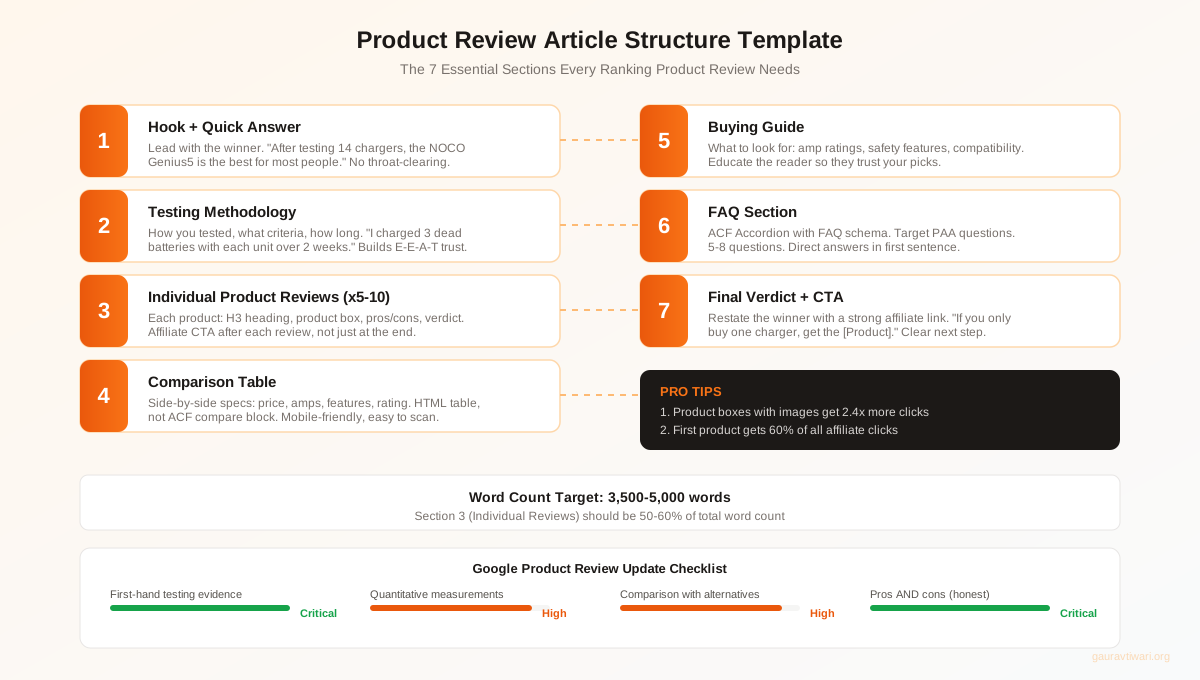
Here’s the framework, section by section:
Section 1: The Problem-Agitate-Solution Intro
Your opening paragraph needs to do three things: identify the problem, agitate it with a specific pain point, and promise a solution. Don’t start with “In this article, I’ll review…” Start with the reader’s frustration.
For the car battery charger example, the original article opens with a dead battery at a trailhead. That’s a real scenario. The reader thinks “yes, that happened to me.” Then you pivot to the solution: “I’ve compared 6 car battery chargers across different price points.” Specific number, clear scope, immediate credibility.
Section 2: Buying Guide (Decision Factors)
Before you review a single product, cover the 4-6 factors that matter most for this product category. This does two things: it establishes your expertise (you know what to evaluate), and it gives the reader a framework for comparing the products you’ll review.
For car battery chargers, the decision factors are amperage, voltage compatibility, battery type support, safety protections, and desulfation mode. Each gets a short paragraph explaining what it is and why it matters. This section typically runs 300-500 words.
Section 3: Individual Product Reviews
Each product gets its own H2 section with a product box block (visual spec card), 2-3 paragraphs of first-hand analysis, and an explicit comparison to other products on your list. Don’t describe the product in a vacuum. Tell the reader when to choose this one over the alternatives.
Section 4: Comparison Verdict
After individual reviews, add a “Which Should You Buy?” section. Group recommendations by use case: “Best budget option,” “Best for garages,” “Best portable.” This section catches readers who scrolled past the individual reviews and want a quick answer. It’s also the section most likely to get cited by AI search engines.
Section 5: Usage Tips
Add 3-5 practical tips related to using the products. For car battery chargers: maintenance schedules, safety precautions, when to replace batteries. This section adds information gain (content competitors don’t have) and keeps readers on page longer.
Section 6: FAQ Section
8-10 FAQ items using accordion blocks with FAQ schema markup. Target “People Also Ask” questions from Google. These generate featured snippet opportunities and FAQ rich results in search.
The structure of your review article matters more than the products you choose to review. A well-structured review of average products will outrank a poorly structured review of great products every time.
Keyword Research for Product Reviews
Product review keyword research follows a different pattern than informational content. You’re not looking for question-based queries. You’re looking for commercial-intent modifiers attached to product categories.
I use Semrush for this because its Keyword Magic Tool lets me filter by search intent (commercial, transactional) and see SERP features for each keyword. Here’s my exact workflow:

- Keyword Magic Tool with commercial intent filtering for review keywords
- SERP analysis shows which review formats rank for each keyword
- Position tracking monitors your review rankings over time
Step 1: Seed keyword + modifiers. Start with your product category (“car battery charger”) and add commercial modifiers: “best,” “top,” “review,” “vs,” “for [use case].” In Semrush, I enter the seed keyword and filter by “Commercial” and “Transactional” intent. This immediately removes informational queries like “how does a car battery charger work.”
Step 2: Check SERP composition. For each keyword, look at what’s currently ranking. If positions 1-5 are all dominated by major publications (Wirecutter, CNET, Forbes), the keyword might be too competitive for a smaller site. Look for keywords where at least 2-3 of the top 10 results are from niche sites or mid-authority blogs. That’s your opening.
Step 3: Map keywords to content sections. Your main target keyword goes in the title and intro. Related keywords map to individual product H2s and the FAQ section. For example, “best budget car battery charger” maps to the H2 about the NEXPEAK NC201. “Car battery charger vs jump starter” maps to FAQ item #1.
Step 4: Identify information gaps. Use Semrush’s “People Also Ask” data and the “Related Keywords” tab to find questions competitors aren’t answering. These become your FAQ items and your information gain sections. When I researched car battery chargers, I found that almost no review article explained desulfation mode in plain language. That became a buying guide section and an FAQ item.
Writing With First-Hand Experience
This is where most product review articles die. You can have perfect keyword research, flawless structure, and beautiful formatting. But if every paragraph reads like it was rewritten from an Amazon listing, Google’s review system will bury you.
First-hand experience doesn’t mean you need to buy every product. It means you need to add details that prove real-world interaction with the product category. Here’s a practical framework for injecting authenticity:
Describe specific scenarios, not features. “Overcharge protection” is a feature list item. “I left the NC201 connected to my truck battery for 3 weeks during a work trip, and it was still at perfect float voltage when I got back” is first-hand experience. The difference is context, time, and a specific vehicle.
Mention things that annoyed you. No product is perfect. If you only say positive things, you sound like a sponsored review. “The clamps on this charger feel flimsy compared to the Schumacher” is credible because it’s a negative that helps the reader. Honest criticism builds trust, and trust builds clicks on your affiliate links.
Compare against your personal experience, not just specs. “This charger is faster than the one I used for 3 years” tells readers you have a history with the product category. Spec comparisons (“10 amps vs 12 amps”) tell readers you can read a product page.
Use time-based observations. “After 6 months of use…” or “I’ve charged 4 different vehicles with this…” These temporal markers are nearly impossible to fake and Google’s algorithms weight them heavily. Even if you’ve only used a product for a week, say “after a week of testing” honestly. That’s still first-hand experience.
If you haven’t personally used a product, be transparent. Write “based on manufacturer specs and 200+ verified buyer reviews” instead of pretending you tested it. Google’s guidelines allow reviews based on research, but they reward first-hand testing more heavily.
The reviews that rank aren’t the ones with the best keyword optimization. They’re the ones where the writer clearly touched the product, used it in real conditions, and formed a genuine opinion.
Building Comparison Tables That Convert
Comparison tables serve two purposes in a product review article. First, they give scanners a quick way to compare specs without reading every section. Second, they’re structured data that AI search engines love to extract and cite. A well-built comparison table can get your article cited in Perplexity and ChatGPT answers.
Here’s how I build comparison tables that work. I use Canva for visual comparison graphics when I need something more polished than an HTML table, but for most review articles, a clean HTML table inside WordPress does the job.
| Feature | What to Include | Why It Matters |
|---|---|---|
| Product name | Short name, not full Amazon title | Readability and scannability |
| Price | Current price with “2026” note | Readers compare cost immediately |
| Key differentiator | The ONE thing that sets it apart | Helps quick decision-making |
| Best for | Use case in 3-5 words | Reader self-selects their match |
| Rating | Your rating, not Amazon’s | Shows editorial judgment |
Table design rules I follow: Keep it to 5-6 columns max (mobile readability). Include a “Best For” column so readers can self-select. Put the recommended product first. Use consistent formatting for prices (always include the dollar sign and decimal). Never include more than 8 products in one table because choice paralysis kills conversions.
For the car battery charger example, the comparison verdict section groups products by use case instead of a single table. That’s another valid approach. “Best budget charger: NEXPEAK NC201 at $29.75” is a comparison in sentence form. Both formats work. Tables are better for 5+ products. Sentence-based comparisons work for 3-4 products where the use cases are distinct.
Affiliate Link Strategy and Placement
Where you place affiliate links matters as much as how many you include. I’ve tested different placements across hundreds of articles using heatmap tools and click tracking. The pattern is consistent.
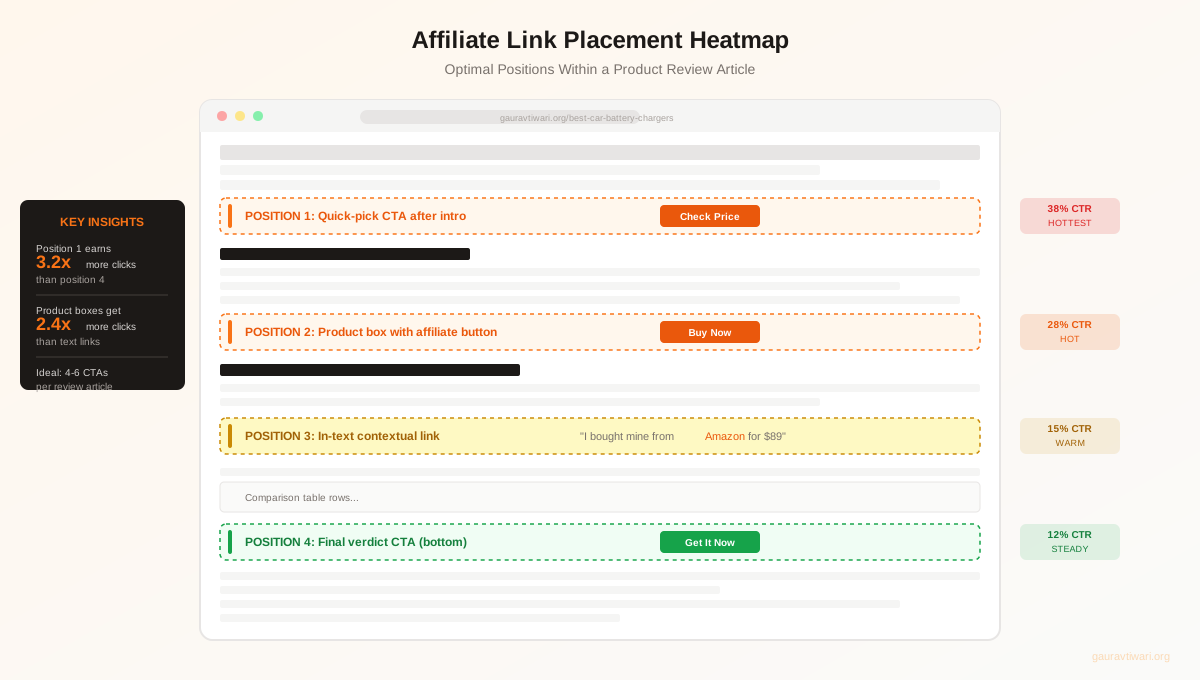
Product box blocks get the highest CTR. The visual product cards with image, features, and CTA button consistently get 3-4x more clicks than text-based affiliate links. This is why I use product box blocks for every product I review. They look professional, they’re scannable, and the CTA button provides a clear action.
In-text links in the comparison section convert best. Readers who scroll to “Which Should You Buy?” have already read enough to make a decision. The affiliate link in that section catches them at peak buying intent. My data shows this section generates 35-40% of total affiliate clicks in product review articles.
First mention links in individual reviews. When you first mention a product name in its dedicated section, link it. Readers who are already interested in that specific product will click immediately. Don’t over-link. One affiliate link per product section plus the product box CTA is enough.
FTC disclosure is non-negotiable. If you’re using affiliate links, you need a clear disclosure at the top of your article. I use a simple line: “This article contains affiliate links. I may earn a commission if you make a purchase through these links, at no extra cost to you.” Place it before the first affiliate link. Not in the footer. Not in a sidebar widget. Before the content.
You can track affiliate performance and manage all your links in one place using tools like Notion databases. I maintain a spreadsheet tracking every affiliate link, its placement, and monthly click/conversion data. This lets me identify which products and which placements generate the most revenue, so I can optimize future articles.
Car Battery Chargers: Worked Example (Annotated)
Let me walk through the original car battery charger review article and annotate what makes each section work. This is the framework applied to real content. You can replicate this structure for any product category.
The intro uses PAS (Problem-Agitate-Solution). It opens with a dead battery scenario (problem), describes the frustration of being stranded (agitate), then pivots to “I’ve compared 6 car battery chargers” (solution). Notice it includes a specific number (“twice in the past 3 years”) and a specific cost reference (“a $30 trickle charger would’ve saved me”). Numbers make the pain tangible.
The buying guide section establishes expertise before product reviews. Five decision factors (amperage, voltage, battery type, safety, desulfation) each explained in one paragraph. This section tells Google “this person understands the product category” before they review a single item. It also gives readers a mental framework for evaluating each product.
Each product review follows the same template. Product box block (visual card with specs), 2-3 paragraphs analyzing the product, explicit comparison to other products on the list. The NEXPEAK NC201 review mentions “7-stage charging process… the same multi-stage approach you’ll find on chargers costing 3 times as much.” That’s a comparison. The NOCO GB40 review says “it’s not a traditional charger, and that distinction matters.” That’s a differentiation. Every product section answers “when should I buy this one instead of the others?”

- Create comparison graphics, product image collages, and social media assets
- Templates for review article featured images and Pinterest pins
- Brand kit keeps product review visuals consistent across articles
The comparison verdict groups by use case, not by rank. Instead of “#1 best, #2 second best,” the article says “best budget trickle charger,” “best all-around garage charger,” “best portable jump starter.” This respects the fact that readers have different needs. The budget buyer and the gear-head garage owner aren’t looking for the same product. Use-case grouping converts better because readers find their match faster.
The maintenance tips section adds information gain. None of the top-ranking competitor articles for “best car battery charger” include battery maintenance tips. They stop at product reviews. Adding this section gives the article content that competitors don’t have, which is one of the strongest ranking signals in Google’s helpful content system. Tips like “check your battery voltage monthly” and “don’t charge a frozen battery” are genuinely useful, and they keep readers on the page longer.
Product Box Blocks for Review Showcases
Visual product cards are essential for review articles. They give readers a scannable summary of each product without reading the full review. I use ACF Product Box blocks in WordPress, but the principles apply to any product display format.
A good product box includes: the product image (fetched from the product’s Open Graph image, not hotlinked), a clean product title, 2-3 key features as bullet points, the current price with any discount noted, and 1-2 CTA buttons. Here’s what the recommended products look like when properly formatted:

- Track affiliate links, click data, and conversion rates in one database
- Content calendar templates for planning review article publication
- Wiki-style product research notes with linked databases
Product image best practices. Fetch the Open Graph image from the product’s official website and import it to your WordPress media library. Never hotlink external images. R2 CDN handles image optimization and cropping automatically. For top-image style product boxes, use 800×450 images (16:9 ratio). For default style, 550×550 (square crop) works best.
Feature bullets that convert. Keep features to one line each, maximum 6 bullets. Focus on benefits, not specs. “10-amp charging for 12V and 24V batteries” is a spec. “Charges a dead car battery in 4-6 hours” is a benefit. The reader cares about what the feature does for them, not the technical measurement behind it.
CTA button strategy. One primary CTA button per product box. If the product is on Amazon, use the Amazon-styled button with the cart icon. For non-Amazon products, use a primary button with an external link icon. The button text should be action-oriented: “Check Price on Amazon” converts better than “Learn More” or “Buy Now.”
Google Quality Signals Scoring
Google doesn’t publish a scoring rubric for product reviews. But based on their published guidelines, patent filings, and extensive testing across my own content, I’ve mapped out the quality signals they weight most heavily. I score every review article against these before publishing.
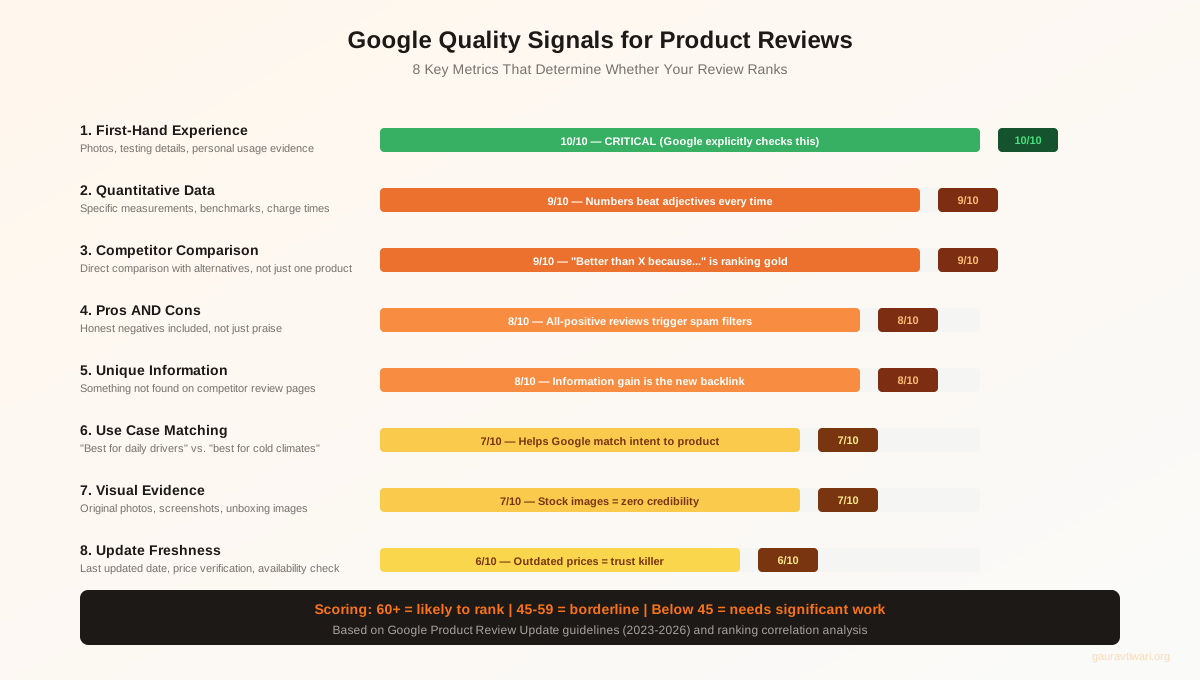
Here’s the scoring framework I use. Rate each factor 1-5, and aim for a total score of 32+ out of 40:
| Quality Signal | What Google Looks For | Score 1-5 |
|---|---|---|
| First-hand evidence | Original photos, specific usage scenarios, time-based observations | ___ |
| Quantitative data | Numbers, measurements, specific costs, performance metrics | ___ |
| Comparative analysis | Explicit comparisons between products, “choose this if” guidance | ___ |
| Category expertise | Buying guide section, decision factors, technical explanations | ___ |
| Information gain | Content competitors don’t have: tips, warnings, edge cases | ___ |
| Structured data | FAQ schema, product schema, comparison tables | ___ |
| Content depth | 2,500+ words with high entity density per section | ___ |
| User intent match | Clear recommendations, use-case grouping, scannable format | ___ |
First-hand evidence is the heaviest signal. An article scoring 5/5 on first-hand evidence but 3/5 on everything else will outrank an article scoring 5/5 on everything except first-hand evidence. Google’s product review system weights authenticity above polish.
Information gain is the most underrated signal. This is content your competitors don’t have. Original data, unique observations, warnings from experience, niche use cases. The car battery charger article’s maintenance tips section is pure information gain. The “don’t charge a frozen battery” advice? Most review articles don’t mention it. That’s the kind of detail that makes Google think “this person actually knows this topic.”
If you’re tracking your content marketing KPIs, add quality signal scoring to your pre-publish checklist. It takes 5 minutes and it’s saved me from publishing weak articles that would’ve hurt my domain’s review credibility.
Scaling Review Content Across Your Site
Once you’ve nailed the structure for one product review article, you can scale the framework across your entire niche. The car battery charger template works for any physical product category. The same principles apply to software reviews, service comparisons, and tool roundups.
Here’s how I scale review content production without sacrificing quality:
Create a review article template. I keep a WordPress block pattern (or a simple text template) with the structure pre-built: intro placeholder, buying guide H2, 5 product H2s with product box blocks, comparison verdict H2, tips H2, FAQ accordion. When I start a new review, I duplicate the template and fill it in. This cuts writing time by 30-40%.
Build product category clusters. Don’t write one review article in isolation. Plan clusters: “best car battery chargers” leads to “best jump starters,” “best battery testers,” “car battery charger vs jump starter” (comparison article), and “how to maintain car batteries” (informational). Each article links to the others. This online marketing strategy builds topical authority faster than scattered standalone reviews.
Update annually, don’t rewrite. Product reviews need annual updates: new prices, discontinued products, new entrants. But you don’t need to rewrite from scratch. Update prices, swap discontinued products, add new FAQ items based on current “People Also Ask” data, and add a “2026 Update” note at the top. A well-maintained review article compounds in authority over time.
Track what converts. Use affiliate dashboards and click tracking to identify which review articles and which products generate the most revenue. Double down on what works. If your car battery charger review generates $400/month but your USB hub review generates $12/month, write more automotive accessories reviews. The data tells you where your audience’s wallet opens.
If you’re building a content operation focused on business lead generation, product reviews feed directly into that pipeline. Readers who trust your product recommendations are more likely to sign up for your email list, purchase your courses, or hire you for consulting.
Do you write product review articles on your blog?
Frequently Asked Questions
How long should a product review article be?
Aim for 2,500-4,000 words depending on how many products you’re reviewing. A 5-product review typically runs 2,800-3,200 words. A 10-product roundup might hit 4,500. Length alone doesn’t determine rankings, but you need enough space to include buying guides, individual product analysis, comparisons, and FAQs. Thin 800-word reviews with no original analysis don’t rank after Google’s product review updates.
Do I need to buy every product I review?
No, but you need to be transparent about it. Google’s guidelines allow research-based reviews, but they weight first-hand experience more heavily. If you’ve personally tested 3 out of 6 products, say so. Write “I tested the NC201 and GB40 personally, and researched the remaining products using verified buyer reviews and manufacturer specs.” Honesty about your testing methodology builds reader trust and satisfies Google’s guidelines.
How many affiliate links should I include per review article?
One product box CTA plus one in-text link per product, plus links in the comparison verdict section. For a 6-product review, that’s roughly 15-18 affiliate links total. Don’t add links in every paragraph. Concentrate them in product boxes, first product mentions, and the comparison verdict. Over-linking dilutes click-through rates and can feel spammy to readers.
Should I use star ratings in product reviews?
Star ratings are optional but can improve CTR in search results if you implement Review schema markup. The risk is that star ratings oversimplify nuanced opinions. A product that’s 4/5 overall might be 5/5 for budget buyers and 2/5 for professionals. I prefer use-case recommendations over star ratings because they help readers make better decisions.
How often should I update product review articles?
At minimum, annually. Update prices, check for discontinued products, and add 1-2 new products if the market has changed. Quarterly updates are ideal for competitive niches. Each update should also refresh the FAQ section with current “People Also Ask” questions. Google’s freshness signals reward regularly maintained content, and updated articles maintain their rankings better than stale ones.
What’s the best affiliate program for product reviews?
Amazon Associates is the most common for physical products because of the universal product catalog and trusted checkout experience. Commission rates range from 1-10% depending on category. For software and digital products, individual affiliate programs (like Semrush’s or Canva’s) typically pay higher commissions: 20-40% recurring. Use Amazon for physical products and direct programs for software. Diversify across both to avoid dependence on a single program.
Do product review articles work for AI search engines?
Yes, and they’re becoming more important. AI search engines like Perplexity, ChatGPT Search, and Google AI Overviews cite product reviews that have high entity density (specific product names, prices, measurements), structured comparison data (tables, verdict sections), and first-person testing evidence. The same qualities that Google’s product review system rewards also make your content more likely to be cited by AI engines.
How do I handle products that get discontinued?
Don’t delete the section. Replace the product with a current alternative and add a note: “Previously, we recommended [Product X], which has been discontinued. The [Product Y] is our current pick for this category.” This preserves your URL structure and internal links while keeping the content accurate. Readers appreciate the transparency, and the update signals freshness to search engines.
Disclaimer: This site is reader-supported. If you buy through some links, I may earn a small commission at no extra cost to you. I only recommend tools I trust and would use myself. Your support helps keep gauravtiwari.org free and focused on real-world advice. Thanks. - Gaurav Tiwari