Polynomial Factoring Calculator
Factor any polynomial up to degree 4 and find its roots instantly. This polynomial factoring calculator breaks down expressions into their simplest factors with detailed step-by-step solutions.
Factor polynomials and find their roots with step-by-step solutions.
Use ^ for powers (e.g., x^2, x^3). Supported: x^4 and below.
Factored Form
Roots
Step-by-Step Factoring
Polynomial Properties
What Is Polynomial Factoring?
Polynomial factoring is the process of breaking down a polynomial expression into a product of simpler polynomials (called factors). For example, the quadratic \(x^2 – 5x + 6\) factors into \((x – 2)(x – 3)\). Factoring is a fundamental algebraic technique used in solving equations, simplifying expressions, and analyzing functions.
Methods for Factoring Polynomials
There are several standard methods for factoring polynomials, depending on their degree and structure:
- Greatest Common Factor (GCF): Factor out the largest expression common to all terms, e.g., \(6x^2 + 9x = 3x(2x + 3)\).
- Grouping: For four-term polynomials, group in pairs and factor each pair.
- Quadratic trinomials: Find two numbers that multiply to \(ac\) and add to \(b\) in \(ax^2 + bx + c\).
- Difference of squares: \(a^2 – b^2 = (a + b)(a – b)\).
- Sum/difference of cubes: \(a^3 \pm b^3 = (a \pm b)(a^2 \mp ab + b^2)\).
The Quadratic Formula
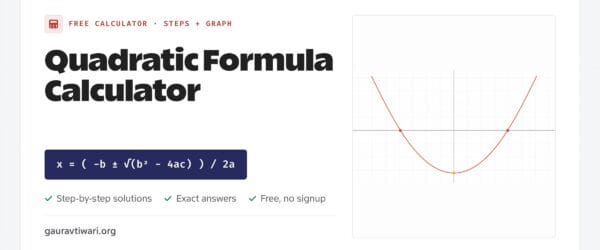
When a quadratic \(ax^2 + bx + c\) cannot be factored easily by inspection, the quadratic formula gives the roots directly:
$$x = \frac{-b \pm \sqrt{b^2 – 4ac}}{2a}$$
The discriminant \(\Delta = b^2 – 4ac\) determines the nature of the roots: two distinct real roots when \(\Delta > 0\), a repeated root when \(\Delta = 0\), or two complex conjugate roots when \(\Delta < 0\).
Factoring Higher-Degree Polynomials
For cubic and quartic polynomials, the Rational Root Theorem helps identify potential rational roots. If \(p(x) = a_n x^n + \cdots + a_0\), then any rational root \(\frac{p}{q}\) must have \(p\) dividing \(a_0\) and \(q\) dividing \(a_n\). Once a root \(r\) is found, synthetic division divides out the factor \((x – r)\), reducing the degree by one.
Polynomial Properties and Vieta’s Formulas
Vieta’s formulas relate the coefficients of a polynomial to sums and products of its roots. For a quadratic \(ax^2 + bx + c\) with roots \(r_1\) and \(r_2\):
- Sum of roots: \(r_1 + r_2 = -\frac{b}{a}\)
- Product of roots: \(r_1 \cdot r_2 = \frac{c}{a}\)
Complex Roots
When a polynomial has no real roots (negative discriminant for quadratics), the roots appear as complex conjugate pairs \(a \pm bi\). The corresponding irreducible quadratic factor is \(x^2 – 2ax + (a^2 + b^2)\). The Fundamental Theorem of Algebra guarantees that every degree-\(n\) polynomial has exactly \(n\) roots (counting multiplicity) over the complex numbers.
Real-World Applications of Factoring
Polynomial factoring appears throughout science and engineering. In physics, factoring kinematic equations helps find when a projectile reaches a certain height. In engineering, factoring the characteristic polynomial of a system determines its stability. In computer science, polynomial factoring underpins error-correcting codes and cryptographic algorithms. Economists use it to find break-even points in cost and revenue models.
Factoring rewrites a polynomial as a product of simpler expressions. The value does not change. The new form exposes roots, multiplicities, cancellations, and graph behavior that are hard to see in expanded form.
How to use this calculator
Enter terms in descending powers and include zero coefficients when the interface asks for a coefficient list. Start by removing the greatest common factor. Then check special patterns before reaching for a general root method.
The coefficient set matters. \(x^2+1\) is irreducible over the real numbers but factors as \((x-i)(x+i)\) over the complex numbers. Read the reported domain before calling a polynomial unfactorable.
- Remove the greatest common factor.
- Check difference of squares, perfect-square trinomials, sums or differences of cubes, and grouping.
- Use the rational root theorem to test likely rational zeros.
- Divide by each confirmed linear factor and continue with the lower-degree quotient.
Worked example
Factor \(x^3-6x^2+11x-6\). The rational candidates are ±1, ±2, ±3, and ±6. Substituting 1 gives zero, so \(x-1\) is a factor.
Synthetic division leaves \(x^2-5x+6\), which factors as \((x-2)(x-3)\). The complete factorization is \((x-1)(x-2)(x-3)\). Multiplying the factors back out is the fastest check.
How to read the result
Each factor \(x-r\) gives a root \(r\). An even multiplicity usually makes the graph touch the x-axis and turn; an odd multiplicity makes it cross. The leading coefficient and degree control end behavior.
Factored form is best for zeros and sign analysis. Expanded form is often better for identifying degree and coefficients. Vertex form is better for a quadratic’s turning point. No single form is best for every question.
Common mistakes to avoid
- Stopping after finding one factor and forgetting to factor the quotient.
- Losing a negative sign when taking out a common factor.
- Assuming every integer-coefficient polynomial has integer roots.
- Trusting a decimal root without substituting it back or checking the residual.
How to verify the result
Multiply the factors back together and compare every coefficient with the original polynomial. The total degree and leading coefficient must also match. For a reported root r, direct substitution should give \(P(r)=0\) apart from numerical rounding.
Multiplicity matters. A repeated root appears in more than one factor and often touches the x-axis without crossing it. Vieta’s formulas provide another check by comparing sums and products of roots with the polynomial coefficients.
Keep rational or radical factors exact when possible. Decimal roots can make an exact polynomial appear not to factor cleanly after recombination, especially for higher degrees or clustered roots.
Limits of the calculation
Degree-five and higher polynomials do not have a general solution by radicals. Numerical algorithms can still approximate roots, but the displayed factors may not be simple exact expressions.
Repeated or closely spaced roots can be numerically sensitive. Keep exact coefficients when possible and verify by multiplication or substitution.
Related calculators
Use Quadratic Formula Calculator, Polynomial Factoring Calculator, Systems of Equations Calculator when the next part of the problem needs a different method.
Useful algebra books and tools
For polynomial factoring, learn to check the greatest common factor first and multiply the factors back together at the end. The best way to make an algebra calculator useful is to pair its result with enough written practice to recognize the underlying pattern.
- Practice the method: Browse algebra textbooks and workbooks on Amazon. Choose a book with worked solutions and mixed problem sets, not only formula summaries.
- Check routine calculations: Browse scientific calculators on Amazon. Use one to verify arithmetic after you have written the algebraic steps yourself.
As an Amazon Associate, I earn from qualifying purchases.