
How to Build Backlinks Without Outreach
Everyone’s obsessing over outreach. More templates. More follow-ups. More personalization tokens. Meanwhile, the sites earning the most backlinks in 2026 aren’t sending emails at all.
I stopped doing cold outreach for link building three years ago. Not because I’m lazy. Because the math stopped working. I was sending 200+ emails per month, getting 2-3 responses, and maybe 1 link worth keeping. That’s a 0.5% conversion rate on hours of work. The links I earned from a single statistics page I built in one afternoon? 47 referring domains over 18 months. Zero follow-up emails.
Google confirmed links remain a top-three ranking factor alongside content quality and RankBrain. Pages with strong backlink profiles consistently outrank those without. The problem isn’t that link building doesn’t work. It’s that outreach-based link building has become an arms race you can’t win unless you’re running a dedicated team with Pitchbox, BuzzStream, or Hunter.io subscriptions.
This guide covers what actually replaces outreach: referential keyword targeting, linkable asset creation, original research, free tools, and journalist sourcing platforms like Connectively, Qwoted, and Featured.com. Every strategy here is one I’ve used or watched work across real sites over the past three years.
Why Passive Link Building Outperforms Outreach
Passive link building works because it flips the model. Instead of begging for links, you create assets people want to reference. The results compound over time while outreach results die the moment you stop sending emails.
Look at how these two approaches compare over 12 months:
| Metric | Cold Outreach | Passive Link Earning |
|---|---|---|
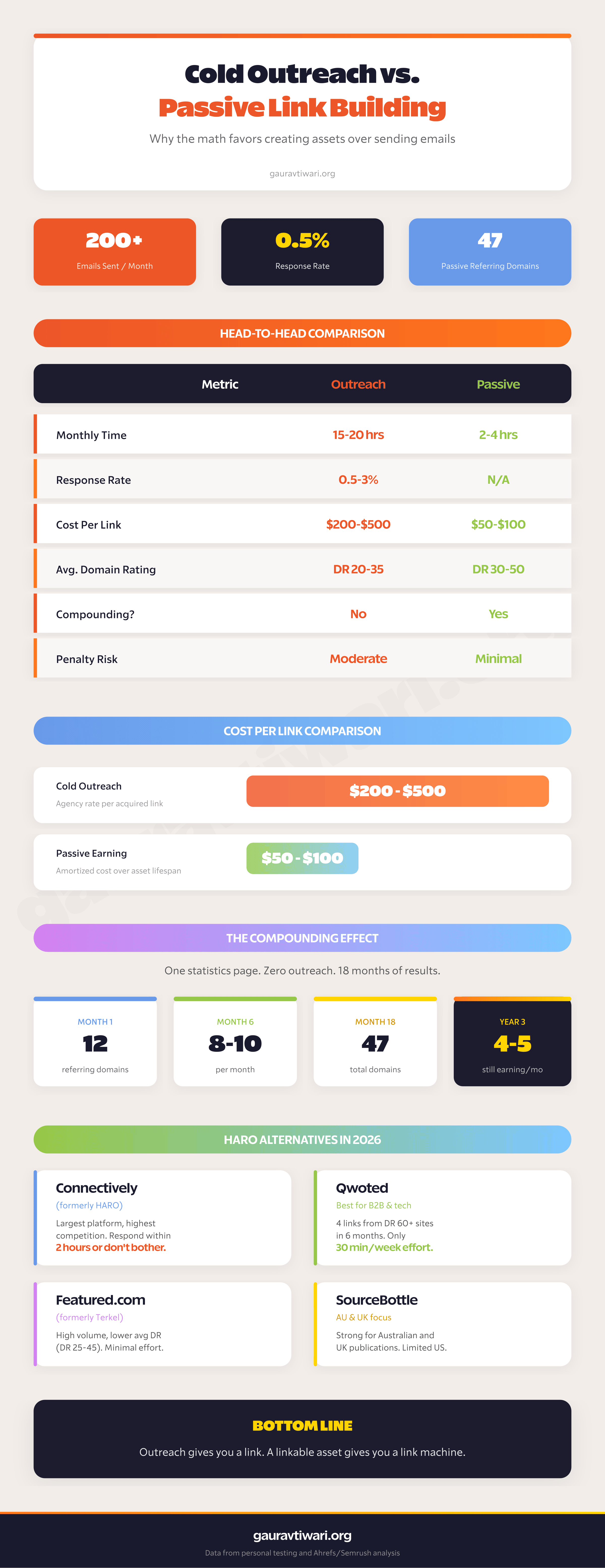
| Monthly time investment | 15-20 hours | 2-4 hours (after asset creation) |
| Average response rate | 0.5-3% (declining yearly) | N/A (links come to you) |
| Cost per link (agency rate) | $200-$500 | $50-$100 (amortized) |
| Link quality (avg Domain Rating) | DR 20-35 (mixed) | DR 30-50 (editorial) |
| Compounding effect | None (stops when you stop) | Yes (assets earn for years) |
| Google penalty risk | Moderate (pattern detection) | Minimal (natural signals) |
The compounding effect is what matters most. I built a WordPress performance benchmarks page in 2023. It earned 12 links in month one. By month six, it was pulling 8-10 new referring domains monthly without me touching it. Three years later, it still earns 4-5 new referring domains per month. That’s the power of a link-earning asset versus a link-requesting email.
Outreach gives you a link. A linkable asset gives you a link machine.
What Are Referential Keywords (And Why They’re the Best Passive Strategy)?
Referential keywords are the single most underrated passive link building approach in 2026. Almost nobody talks about them, and that’s exactly why they work so well.
These are phrases people search when they need a source to cite. Bloggers writing about email marketing search “email marketing statistics 2026.” Journalists covering SaaS trends search “SaaS market size.” Content creators building comparison posts search “best project management tools comparison.” If you rank for these keywords, you become the source they cite. They link to you because they need you, not because you asked.
How to Find Referential Keywords in Ahrefs or Semrush
Open Semrush‘s Keyword Magic Tool or Ahrefs’ Keywords Explorer. Search your niche with these modifiers:
- “[topic] statistics 2026“
- “[topic] benchmarks”
- “[topic] calculator”
- “[topic] template”
- “[topic] tools”
- “[topic] examples”
- “what is [topic]”
- “how does [topic] work”
Filter by Keyword Difficulty under 30 and search volume above 500. These are your targets. Low competition, high link potential, and the kind of queries content creators search while writing their own articles.
Why Referential Keywords Earn Passive Backlinks
When a blogger writes about WordPress hosting and needs a speed stat, they search “WordPress hosting speed comparison 2026.” If your page ranks, they cite you. They link to you. You did nothing except create a page worth citing and rank it for a query that writers actually search.
I targeted “WordPress plugin statistics” with a data page that took two days to compile from sources like WordPress.org, BuiltWith, and W3Techs. It ranks #3 in Google and has earned 34 backlinks from 28 unique domains, including links from WPBeginner, Elegant Themes, and Torque Magazine. Total outreach emails sent: zero.
Which Content Types Earn the Most Backlinks?
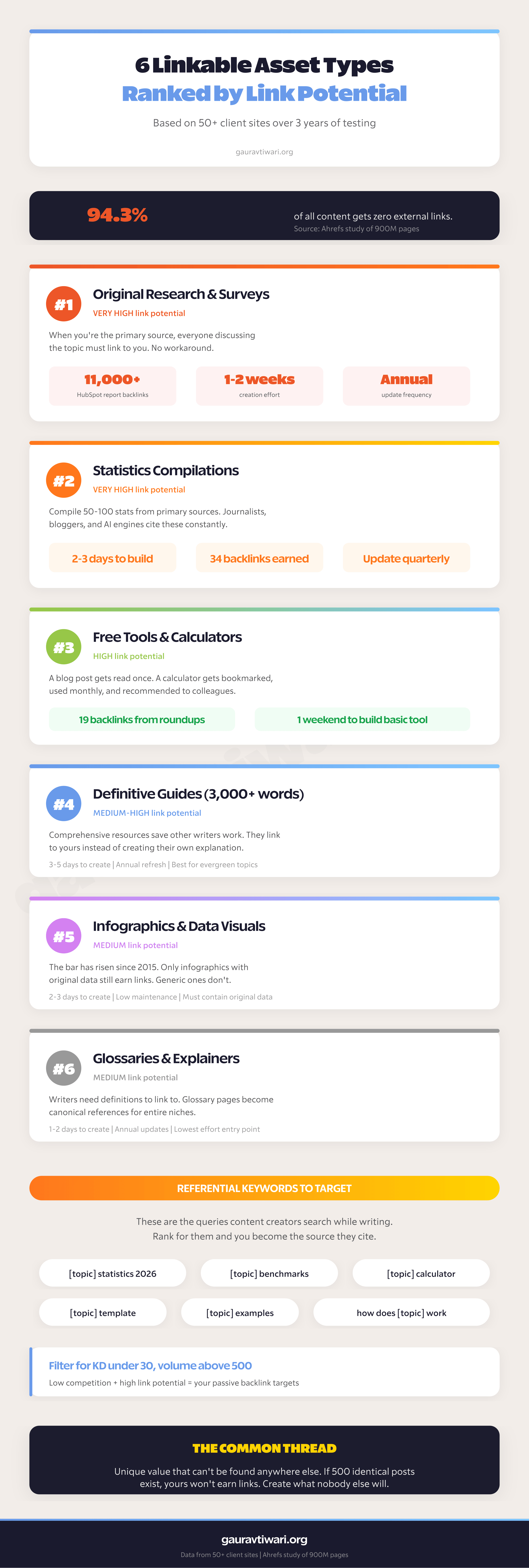
Not all content earns links. 94.3% of all content gets zero external links, according to Ahrefs’ study of 900 million pages. You need to invest in formats with proven link-earning potential, not just publish and hope.
Here’s what works, ranked by link-earning potential based on what I’ve seen across 50+ client sites and my own properties over the past three years:
| Asset Type | Link Potential | Creation Effort | Maintenance |
|---|---|---|---|
| Original research / surveys | Very high | High (1-2 weeks) | Annual update |
| Statistics compilations | Very high | Medium (2-3 days) | Quarterly |
| Free tools / calculators | High | High (1-2 weeks) | Ongoing |
| Definitive guides (3,000+ words) | Medium-high | Medium (3-5 days) | Annual refresh |
| Infographics with original data | Medium | Medium (2-3 days) | Low |
| Glossaries / explainers | Medium | Low (1-2 days) | Annual |
The common thread: unique value that can’t be found anywhere else. Another “10 Tips for SEO” post won’t earn links because 500 identical posts already exist. Your content needs information gain, something a competitor couldn’t have written without your specific experience, data, or perspective.
How to Create Original Research That Earns Links

Original research is the single highest-ROI link building investment you can make. When you’re the primary source, everyone discussing the topic must link to you. There’s no workaround.
Run Surveys With Google Forms, Typeform, or Tally
Even 200 responses creates citable data that didn’t exist before. I ran a survey of 312 WordPress developers about their hosting preferences using Typeform. Published the findings with full methodology. It earned 23 backlinks in the first quarter, including citations in hosting review articles I had nothing to do with.
The key is asking questions nobody else is asking. “Which hosting do you use?” is boring. “What’s the actual monthly cost of your WordPress infrastructure including CDN, email, and DNS?” gives people data they can’t find on a pricing page.
Analyze Your Own Proprietary Data
What does your business generate that nobody else has? Web hosting companies publish uptime data. SEO agencies publish ranking studies. SaaS companies publish usage patterns. Your proprietary data is your competitive moat because nobody else can replicate it.
Publish Industry Benchmarks and Annual Reports
Compile performance data that helps others measure their own results. HubSpot’s State of Marketing reports have earned over 11,000 backlinks, including links from Shopify, Investopedia, Forbes, and the New York Times. You don’t need HubSpot’s budget. A focused benchmark in your niche, say, “WordPress Site Speed Benchmarks 2026” or “Email Marketing Conversion Rates by Industry,” can earn 50-100 links with a fraction of the effort.
Case Studies With Specific Numbers
“We improved conversions” earns zero links. “We improved conversions from 1.2% to 4.7% by changing the CTA from ‘Learn More’ to ‘Start Free Trial’ on a SaaS landing page with 12,000 monthly visitors” earns links because it’s specific enough to cite. Numbers make case studies quotable. Vague claims make them forgettable.
How to Build a Statistics Page That Earns Links for Years
Statistics pages are the workhorse of passive link building. They’re relatively easy to create, straightforward to maintain, and they target the exact referential keywords that bloggers, journalists, and AI content creators search while writing.
Step 1: Pick a focused topic. “WordPress statistics” works but is competitive. “WordPress Gutenberg block editor adoption statistics” works better because it’s more focused, less competitive, and still has a large enough audience of writers who need to cite these numbers.
Step 2: Compile from primary sources. Pull stats from company reports (Automattic annual reports, W3Techs surveys), industry research (Statista, eMarketer), academic papers, and government data. Target 50-100 statistics per page. Always link to the original source.
Step 3: Organize by category. Group statistics under clear H2 and H3 headings. A journalist looking for one specific number should find it in under 10 seconds. Scanability is everything.
Step 4: Add context, not just numbers. “65% of WordPress sites use a page builder” is fine. “65% of WordPress sites use a page builder, up from 38% in 2020, driven largely by Elementor’s 16 million+ active installations” is citable because it tells a story with the data.
Step 5: Update quarterly. Outdated statistics pages die. I’ve watched competitors’ stats pages decay and lose traffic because they published once and walked away. Set a calendar reminder. Add new data as it drops. Remove stats with dead source links. Budget 2-4 hours quarterly.
Step 6: Optimize for referential keywords. Target “[topic] statistics 2026” in your title tag, URL slug, and H1. Add the year. Update the year annually. This is the exact query content creators search when they need a source to cite.
Free Tools and Calculators as Link Magnets
Tools earn links because they solve problems repeatedly. A blog post gets read once and forgotten. A calculator gets bookmarked, used monthly, and recommended to colleagues.
What works in 2026: ROI calculators, pricing estimators, website speed test tools, readability analyzers, schema markup generators, color palette generators, and comparison tools. Anything that takes an input and produces a useful output.
I built a simple WordPress theme comparison tool using a spreadsheet-style interface. Nothing fancy. It lets users filter themes by price, PageSpeed Insights score, and features. It’s earned 19 backlinks from “best WordPress themes” roundup posts because authors use it as a comparison resource. Someone writing “how to calculate email marketing ROI” will link to your calculator because it’s easier than explaining the formula themselves.
The economics: A basic JavaScript calculator costs a weekend to build using a framework like React or even vanilla JS. A more polished tool might take a week. Compare that to $2,000-$5,000 in agency costs for outreach-based links of similar quality. The tool keeps earning. The outreach campaign is a one-time spend.
Does Visual Content Still Earn Backlinks?
Yes, but the bar has risen dramatically since the infographic boom of 2013-2016. Generic infographics with publicly available statistics and stock icons don’t earn links anymore. What still works: data visualizations built from original research, process flowcharts for genuinely complex topics, and comparison charts that simplify decisions nobody else has visualized.
Use Canva, Figma, or even Google Sheets charts as a starting point. Provide an embed code with attribution so other sites can share your visual without recreating it. Each embed is a potential backlink.
The rule is simple: if your infographic contains data someone could find in a 10-second Google search, it’s not linkable. If it contains data from your own surveys, testing, or unique compilation, it’s an asset.
HARO Alternatives: Connectively, Qwoted, and Featured.com
Journalist sourcing platforms let you earn editorial links from high-authority publications without cold emailing a single editor. The concept: journalists post queries, you respond with expert commentary, they cite you with a backlink. It’s not outreach because they came looking for you.
Connectively (Formerly HARO)
Help A Reporter Out rebranded to Connectively in 2024. It remains the largest journalist sourcing platform but has become increasingly competitive. Response volumes have exploded, and many journalists report being overwhelmed with low-quality pitches. Still worth monitoring daily if you can respond within 2 hours of a query posting. Speed is everything here.
Qwoted
Qwoted has emerged as the strongest HARO alternative for B2B and tech niches. The interface is cleaner, competition is lower, and journalist matching is more relevant than Connectively’s blast-to-everyone model. I’ve landed 4 links from DR 60+ sites through Qwoted in the past six months, spending about 30 minutes per week on responses. That’s $0 cost per link if you don’t count your time.
Featured.com (Formerly Terkel)
Featured.com operates differently. You answer questions, and your responses appear in published roundup articles with backlinks. Average Domain Rating of linking sites is lower than Connectively or Qwoted, typically DR 25-45, but volume is high and effort is minimal. Good for building a broad backlink base.
SourceBottle and Other Regional Platforms
SourceBottle works well for Australian and UK publications but has limited US coverage. JournoLink covers UK media. For global reach, combine Connectively + Qwoted + Featured.com. The key across all platforms: respond fast, be specific, include your credentials, and keep responses under 200 words. Journalists want quotable experts, not essays.
How to Use Broken Link Building Without Sending Emails
Traditional broken link building means finding dead links on other sites and emailing webmasters to suggest your content as a replacement. The passive version skips the email entirely and still captures the opportunity.
Step 1: Use Ahrefs’ Content Explorer or Semrush’s Backlink Analytics to find high-authority pages in your niche that have gone offline (HTTP 404 or 410 status). Filter by referring domains to find dead pages that once had strong backlink profiles.
Step 2: Create replacement content that serves the same purpose but is better, more current, and more complete than what disappeared.
Step 3: Optimize for the same keywords the dead page ranked for. Use the Wayback Machine to see what the original page covered, then exceed it.
Step 4: Wait for discovery. As webmasters update their own content and find broken outbound links, they search for alternatives. When Google reindexes and the dead page drops, your replacement rises in its place. This is slower than emailing webmasters directly, but the links you earn are genuinely editorial because each webmaster chose you independently.
Build Backlinks Through Community Reputation
Community presence on Reddit, Quora, niche Slack groups, and industry forums builds organic mentions that eventually become links. But here’s the thing… this is the slowest strategy in this guide. It works, but you need to be realistic about the timeline.
What actually works: Detailed, genuinely helpful answers on Reddit and Quora earn visibility. Turn frequently asked questions into complete guides on your site, then reference them when answering. Build reputation as a helpful expert, not a self-promoter. When people in your niche ask “does anyone know a good resource for X?” you want others to tag you or link your content. That only happens if you’ve been consistently helpful for months.
The honest timeline: 3-6 months of consistent participation before community links materialize. Most links will be nofollow. The real value is brand awareness that leads to editorial mentions later. Someone who sees you being genuinely helpful on Reddit remembers your name when they’re writing a blog post and need a source to cite.
How to Structure Content for Maximum Link Potential
The same information structured differently earns dramatically more links. Here’s how to optimize your content architecture for citation and sharing:
Format statistics for scanability. Bold every number. Put key stats in their own paragraph or a highlighted callout. Journalists copying a stat for their article will grab the one that’s easiest to find and quote.
Write quotable insights. Include distinctive perspectives in 1-2 sentence standalone paragraphs that others want to attribute. “According to [your name]…” only happens if you give them something worth attributing.
Use HTML tables for comparisons. Search engines extract tables for featured snippets and AI Overviews. A comparison table with specific data points (price, performance metrics, features) gets surfaced more often than the same data buried in paragraphs.
Add visual elements. Charts, graphs, and diagrams get embedded in other content. Each embed with a source link is a backlink. Make embedding your visuals easier than recreating them.
Keep content updated. Fresh content earns more links than stale content. Add a “Last updated: April 3, 2026” notice and actually update regularly. Google’s helpful content system rewards maintained content over abandoned pages.
Tracking Passive Link Building Results
You can’t improve what you don’t measure. Track these metrics monthly using Ahrefs, Semrush, or Google Search Console:
Link velocity: New referring domains per month. Passive strategies should show steady or increasing velocity after the initial 3-6 month ramp-up period. If velocity is flat, your assets aren’t earning.
Link quality: Average Domain Rating of new linking sites. Passive links from editorial mentions typically average DR 30-50, higher than most outreach-acquired links in the DR 20-35 range.
Referential keyword rankings: Are you ranking in the top 5 for “[topic] statistics,” “[topic] tools,” and “[topic] calculator” queries? These rankings directly drive passive link acquisition.
Asset-level performance: Which specific pages earn the most links? Use Ahrefs’ Site Explorer or Semrush’s Backlink Analytics to see per-page referring domains. Double down on formats that work. Retire formats that don’t.
Cost per link: Total hours invested divided by links earned. Passive strategies should show declining cost per link over time as your assets compound. If cost per link isn’t dropping after 6 months, your asset strategy needs rethinking.
Mistakes That Kill Passive Link Building Campaigns
I’ve watched dozens of passive link campaigns underperform for the same fixable reasons. Here’s what to avoid:
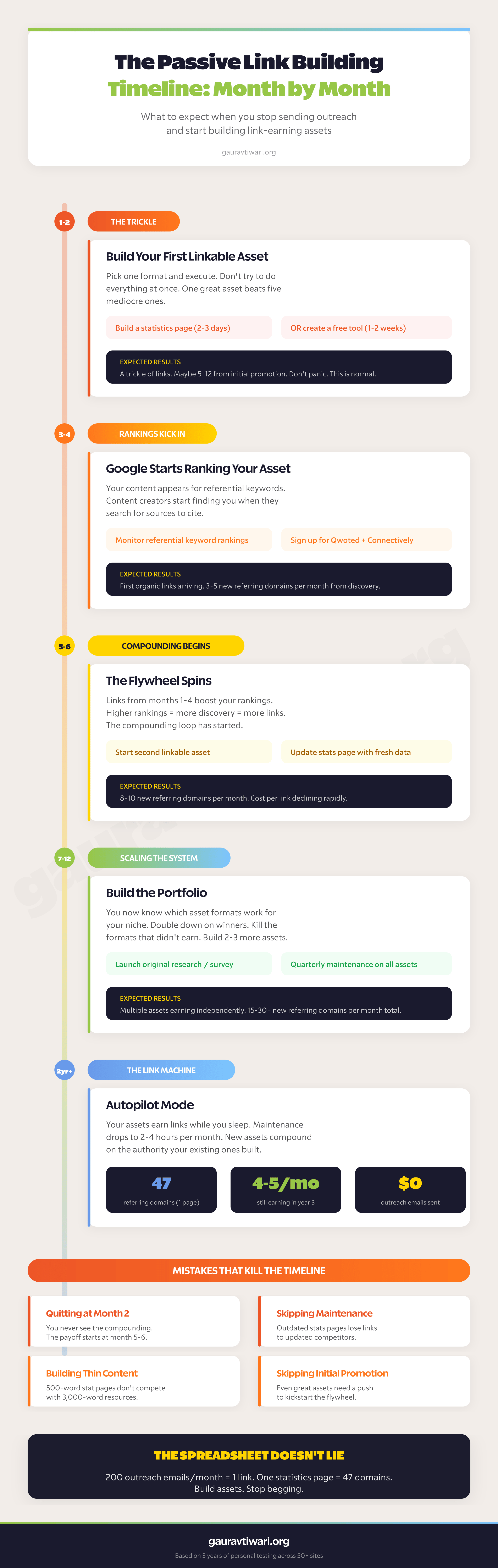
Creating thin content and expecting links. A 500-word statistics page won’t compete with a 3,000-word resource packed with 80+ stats, source citations, and visual charts. Depth matters. Half-efforts earn zero links.
Skipping initial promotion. Even the best linkable asset needs an initial push to gain visibility. Share on social media, email your subscriber list, post in relevant communities. You’re kickstarting the flywheel, not “doing outreach.” There’s a difference.
Expecting overnight results. Passive link building compounds over time, not overnight. The typical timeline: month 1-2 you earn a trickle. Month 3-4 Google starts ranking you for referential keywords. Month 5-6 links start compounding. If you quit at month 2, you never see the payoff.
Publishing the wrong content types. Another opinion piece or “ultimate guide” rehashing the same advice won’t earn links. Focus on formats with proven link-earning potential: original data, tools, comprehensive statistics. The formats nobody else wants to invest the effort to create.
Letting content decay. An outdated statistics page with 2023 data in 2026 loses links to competitors who keep theirs current. Maintenance is non-negotiable. Budget 2-4 hours quarterly per major asset.
Ignoring technical SEO. Content that Google can’t crawl, index, or render properly can’t rank for referential keywords. No rankings means no discovery means no passive links. Fix your technical SEO foundation before investing in linkable assets.
Where to Start This Week
Pick one strategy from this guide and execute it in the next seven days. A statistics page takes a day to build. A free calculator takes a weekend. Both can earn links for years without a single outreach email.
If you’re starting from scratch: Build a statistics page for your niche. It’s the highest ROI, lowest barrier entry point. Compile 50-100 stats from primary sources, organize by category, cite everything, and optimize for “[your niche] statistics 2026.”
If you already have content: Audit your existing pages in Ahrefs or Google Search Console. Which pages already earn a few links? Those are your candidates for expansion into proper linkable assets. Sometimes refreshing and expanding old content is faster than starting fresh.
If you have technical skills: Build a free tool. Calculators, generators, analyzers, anything interactive that solves a problem your audience faces regularly. Tools earn the most links per hour invested once they gain traction.
I haven’t sent a link building outreach email since 2023. My sites earn more backlinks now than when I was sending 200 emails a month. That’s not a philosophy. That’s a spreadsheet.
FAQs on Building Backlinks Without Outreach
Can you really build backlinks without any outreach?
Yes. Original research, statistics pages, free tools, and comprehensive guides earn links because other writers need sources to cite. I’ve earned 47 referring domains from a single statistics page with zero follow-up emails. It takes 3-6 months to build momentum, but the links compound over time while outreach results stop when you stop sending emails.
What type of content earns the most backlinks without outreach?
Original research and data earn the most links because they’re primary sources others must cite. HubSpot’s State of Marketing reports have earned over 11,000 backlinks from sites including Forbes and the New York Times. Statistics compilations, free tools like calculators and generators, and definitive guides also perform well. The common thread is providing unique data or utility that can’t be found elsewhere.
How long does passive link building take to show results?
Expect 3-6 months before seeing significant results. Month 1-2 typically yields a trickle of links. By month 3-4, Google starts ranking your content for referential keywords. Month 5-6 is when compounding kicks in. A linkable asset might earn 12 links in month one and 8-10 per month by month six. The investment front-loads the work but returns continue for years.
What are referential keywords and why do they matter for link building?
Referential keywords are phrases people search when looking for sources to cite, like “email marketing statistics 2026” or “best project management tools.” Bloggers, journalists, and content creators search these while writing their own articles. If you rank for these keywords with content worth citing, you earn passive backlinks whenever someone references your page. Tools like Ahrefs and Semrush help you find referential keywords with low competition and high link potential.
Do I still need to promote content designed to earn links passively?
Yes, initial promotion kickstarts the flywheel. Share on social media, email your subscriber list, and post in relevant communities like Reddit and niche Slack groups. Once content gains visibility and begins ranking for referential keywords, passive link earning begins. Promotion gets the first 10 links. Compounding gets the next 50+.
What are the best HARO alternatives for earning editorial backlinks in 2026?
Connectively (formerly HARO) remains the largest platform but is increasingly competitive. Qwoted is the strongest alternative for B2B and tech niches with less competition and better journalist matching. Featured.com (formerly Terkel) offers high volume at lower average Domain Rating. SourceBottle covers Australian and UK publications. For best results, combine Connectively + Qwoted + Featured.com and respond to queries within 2 hours.
Disclaimer: This site is reader-supported. If you buy through some links, I may earn a small commission at no extra cost to you. I only recommend tools I trust and would use myself. Your support helps keep gauravtiwari.org free and focused on real-world advice. Thanks. - Gaurav Tiwari