
WordPress Statistics for 2026: Market Share, Plugins, Security, and Growth Data
Everyone assumes WordPress is still growing. For 20 straight years, that assumption was safe. WordPress went from powering 13.1% of websites in 2011 to 43.6% by 2024. A straight line up.
Then something shifted. For the first time in WordPress history, market share dropped. Down to 42.5% in April 2026, according to W3Techs. That’s a 1.1 percentage point decline. And if you’ve been building on WordPress daily like I have, you know that number matters more than it looks on paper.

But WordPress still powers nearly half the internet. It’s still 3X larger than the next 9 website builders combined. The ecosystem generates an estimated $596.7 billion in economic value. So is this the beginning of the end, or just a platform maturing past its growth phase?
I dug into every reliable data source I could find. Here are 85+ WordPress statistics for 2026 that tell the real story.
Key WordPress Statistics (2026 Overview)
WordPress powers 42.5% of all websites globally in 2026, down from its 2024 peak of 43.6%. Here are the numbers that matter most:
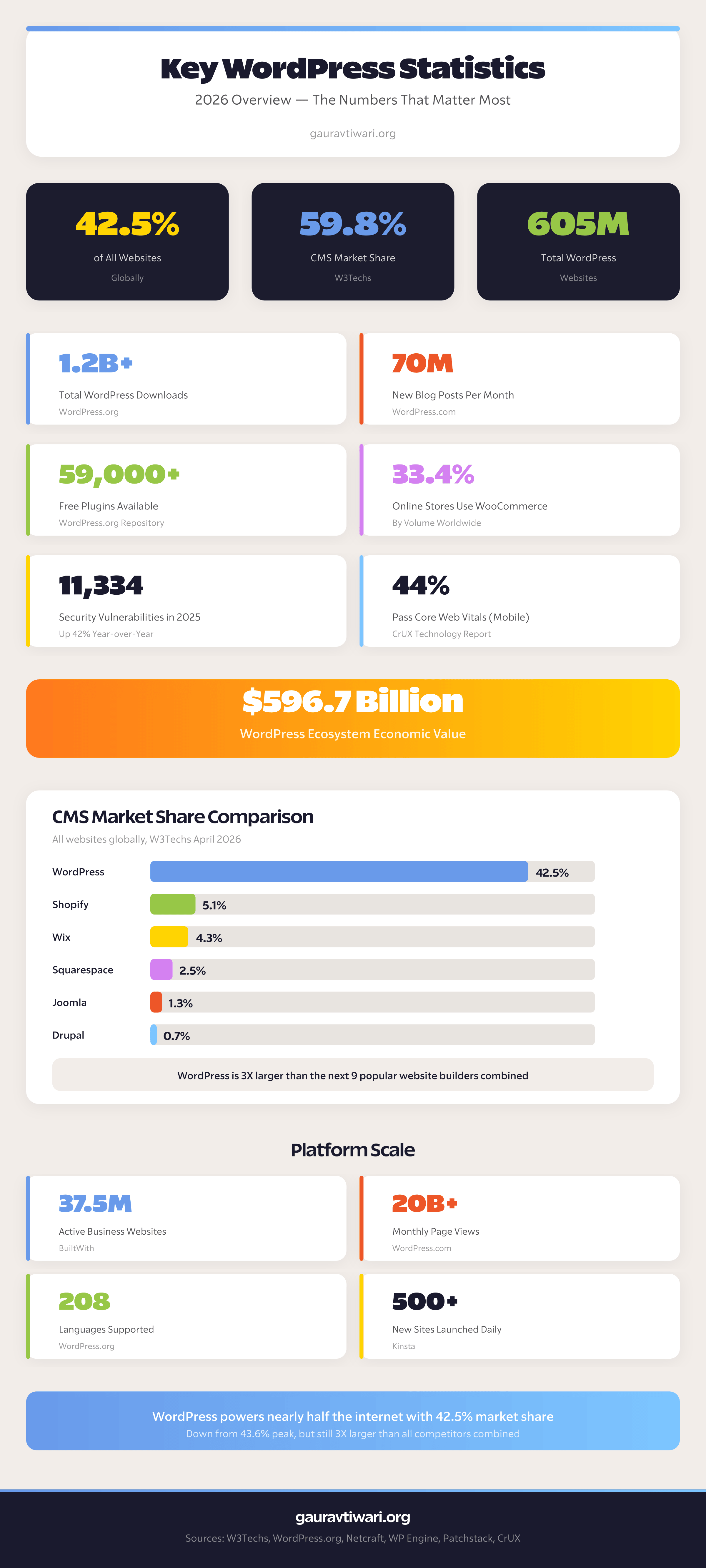
- WordPress powers 42.5% of all websites globally (W3Techs)
- That’s 59.8% of the entire CMS market
- An estimated 605 million websites run on WordPress
- WordPress has been downloaded over 1.2 billion times (WordPress.org)
- 70 million new blog posts are published monthly on WordPress
- 59,000+ free plugins are available on WordPress.org (WordPress.org)
- WooCommerce powers 33.4% of all online stores by volume.
- 11,334 new security vulnerabilities were discovered in 2025, up 42% year-over-year (Patchstack)
- Only 44% of WordPress sites pass all Core Web Vitals on mobile (CrUX Technology Report)
- The WordPress ecosystem is valued at $596.7 billion.
WordPress Market Share and Adoption
WordPress holds 59.8% of the CMS market as of April 2026, according to W3Techs. If a website uses any content management system, there’s roughly a 6-in-10 chance it’s WordPress.
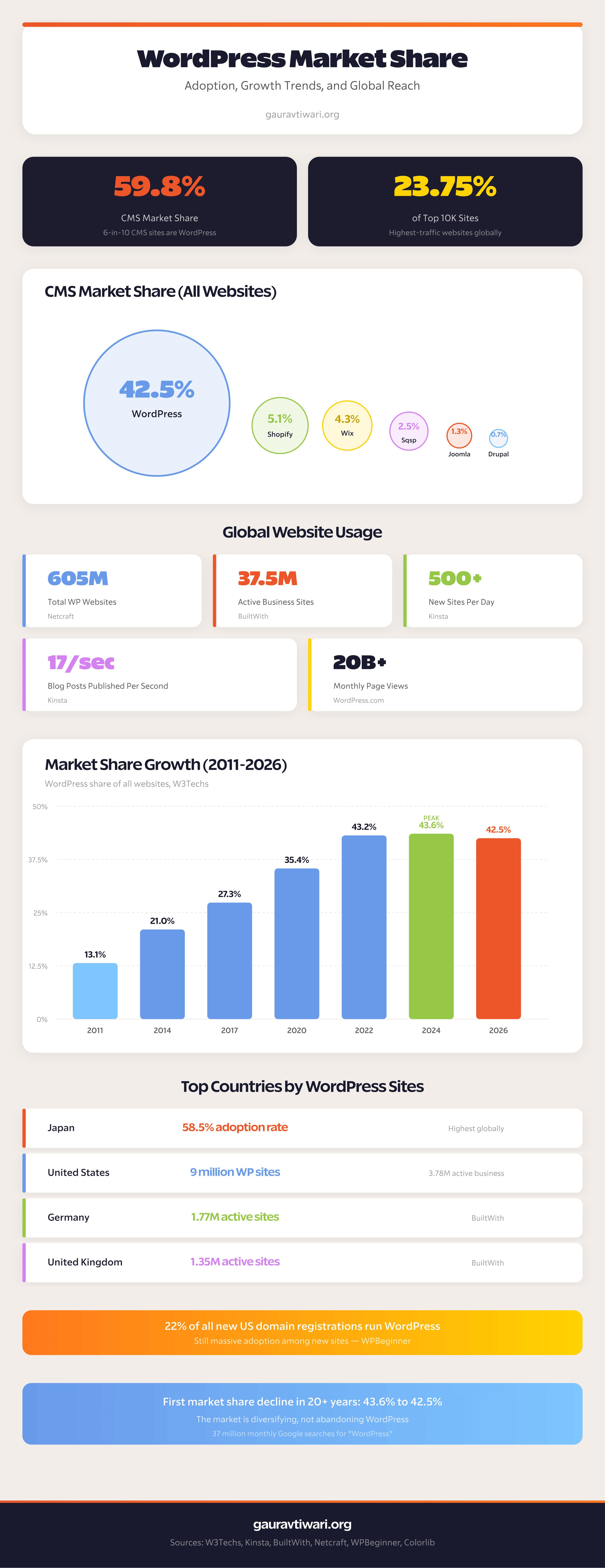
The gap between WordPress and everyone else is staggering.
| CMS Platform | Market Share (All Websites) | CMS Market Share |
|---|---|---|
| WordPress | 42.5% | 59.8% |
| Shopify | 5.1% | 7.2% |
| Wix | 4.3% | 6.0% |
| Squarespace | 2.5% | 3.5% |
| Joomla | 1.3% | 1.8% |
| Drupal | 0.7% | 1.0% |
Considering this table, it is clear that WordPress is 3X larger than the next 9 popular website builders combined .
Shopify, Wix, Squarespace, Joomla, Drupal, and four others… all together… still don’t match WordPress.
I’ve built sites on most of these platforms for clients. WordPress wins not because it’s the simplest (Squarespace is easier for beginners) or the cheapest (Wix has a free tier). It wins because the flexibility ceiling is higher than anything else.
Among the top 10,000 highest-traffic websites globally, 23.75% run WordPress. WPBeginner puts this figure even higher at 52.8% when using a broader definition of top sites. WordPress doesn’t just dominate the long tail. It dominates at the top too.
If you’re comparing WordPress against other CMS platforms, the numbers make the case before you even test anything.
Global Website Usage
Here’s the scale you’re looking at:
- 605 million total WordPress websites worldwide.
- 37.5 million of those are active business websites (BuiltWith)
- 500+ new WordPress sites launch every day.
- 17 blog posts are published every second on WordPress (Kinsta)
- 70 million new posts per month.
- 77 million new comments per month.
- 20 billion+ monthly page views across WordPress sites.
WordPress gets 37 million monthly Google searches (Kinsta). The platform is available in 208 languages and used across 190+ countries.
Look, 605 million is a headline number. But the stat I find more telling is 37.5 million active business sites. That’s the number that reflects real economic activity, not abandoned blogs from 2009.
Year-over-Year Trends
WordPress market share grew every single year from 2003 to 2024, then declined for the first time in 2026. Here’s the trajectory over 15 years:
- 2011: 13.1% (W3Techs via Kinsta)
- 2014: 21.0% (W3Techs via Kinsta)
- 2017: 27.3% (W3Techs via Kinsta)
- 2020: 35.4% (W3Techs via Kinsta)
- 2022: 43.2% (W3Techs via Kinsta)
- 2024: 43.6% (peak) (W3Techs via Kinsta)
- 2026: 42.5% (W3Techs)
A 1.1 percentage point decline from peak to current.
I don’t think this is a collapse. Shopify is eating into small business e-commerce. Wix and Squarespace are pulling in people who would’ve used WordPress.com‘s hosted tier. And a growing number of sites are going fully headless or custom-built.
But WordPress at 42.5% is still a monopoly by any reasonable measure. The decline tells you the market is diversifying, not that WordPress is dying.
22% of all new US domain registrations run WordPress (WPBeginner). Still massive adoption among new sites.
The geographic breakdown is interesting, too. Japan has the highest WordPress adoption rate at 58.5% (State of the Word 2024). The United States has 9 million WordPress sites total, with 3,777,615 active business sites (BuiltWith). Germany follows with 1,765,106 active sites, then the UK at 1,346,012 (BuiltWith).
WordPress.org vs WordPress.com
WordPress.org (the open-source software you self-host) and WordPress.com (Automattic’s hosted platform) are different products with different economics. This confuses almost everyone. Here’s what the numbers look like for each.
Self-Hosted Downloads
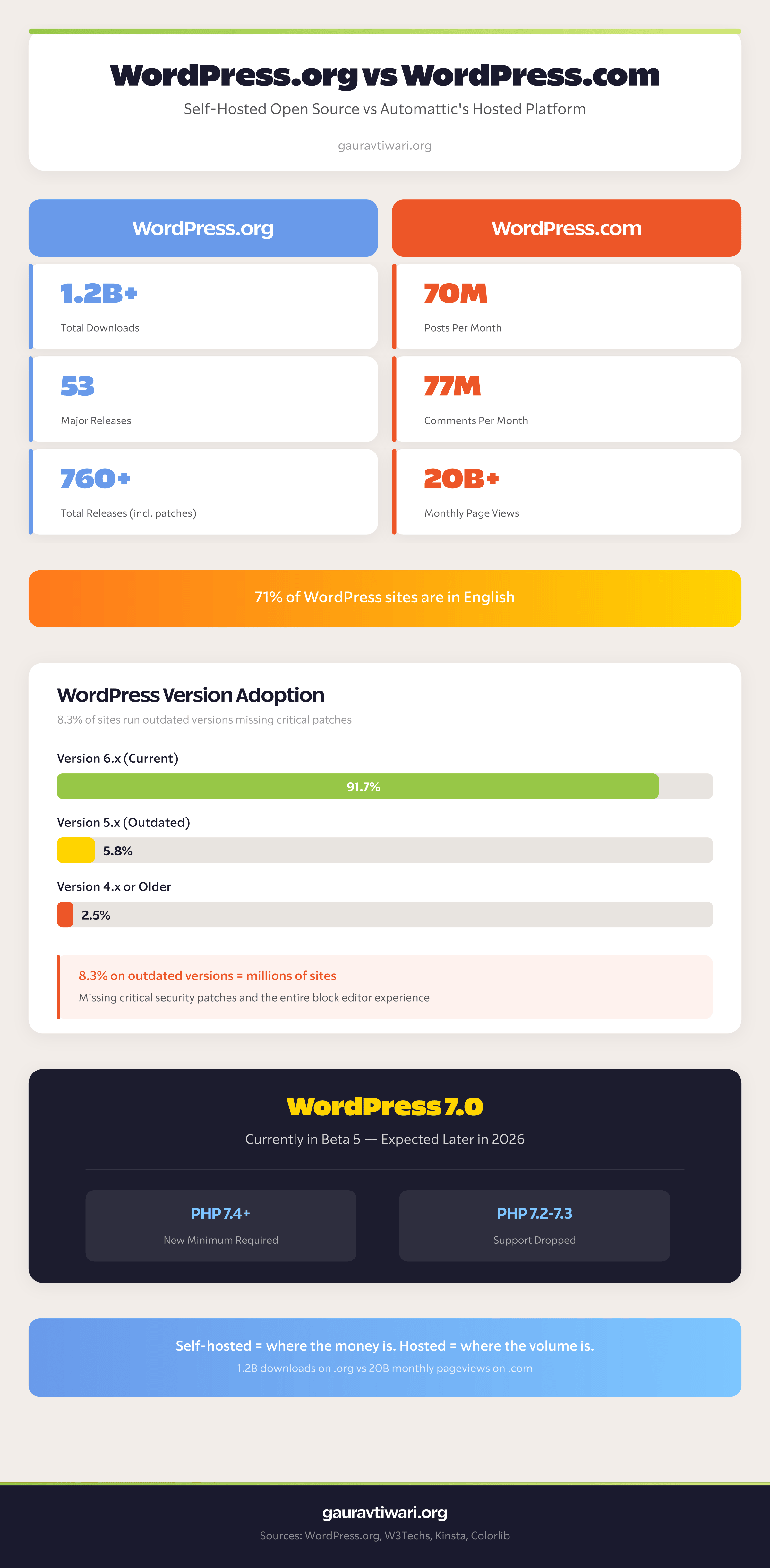
WordPress.org has been downloaded over 1.2 billion times (WordPress.org). That number includes updates, so it’s not 1.2 billion unique installs. But it reflects the sheer volume of the self-hosted ecosystem.
The platform has had 53 major releases and over 760 total releases including minor and security patches (WordPress.org, Colorlib).
WordPress 7.0 is in Beta 5 and expected to ship later in 2026 (WordPress.org). This will be the first version to drop support for PHP 7.2 and 7.3, requiring PHP 7.4 as a minimum (Make WordPress Core).
WordPress.com Hosted Sites
WordPress.com generates 70 million blog posts and 77 million comments per month (WordPress.com). Sites hosted on WordPress.com get over 20 billion monthly page views (WordPress.com).
English is the primary language on 71% of WordPress sites (Kinsta).
The self-hosted side is where the money is. The hosted side is where the volume is.
And here’s a version adoption stat that should worry you: 91.7% of WordPress sites run version 6.x (W3Techs), which is the current major release series. But 5.8% are still on version 5.x, and 2.5% run version 4.x or older (W3Techs). That 8.3% on outdated versions represents millions of sites missing critical security patches and the entire block editor experience. With WordPress 7.0 on the horizon, version fragmentation is only going to get worse.
WordPress Plugin Statistics
Plugins are the backbone of WordPress. They’re the reason a blog platform became a full-featured application framework. And the numbers are… honestly kind of absurd.
Total Plugins
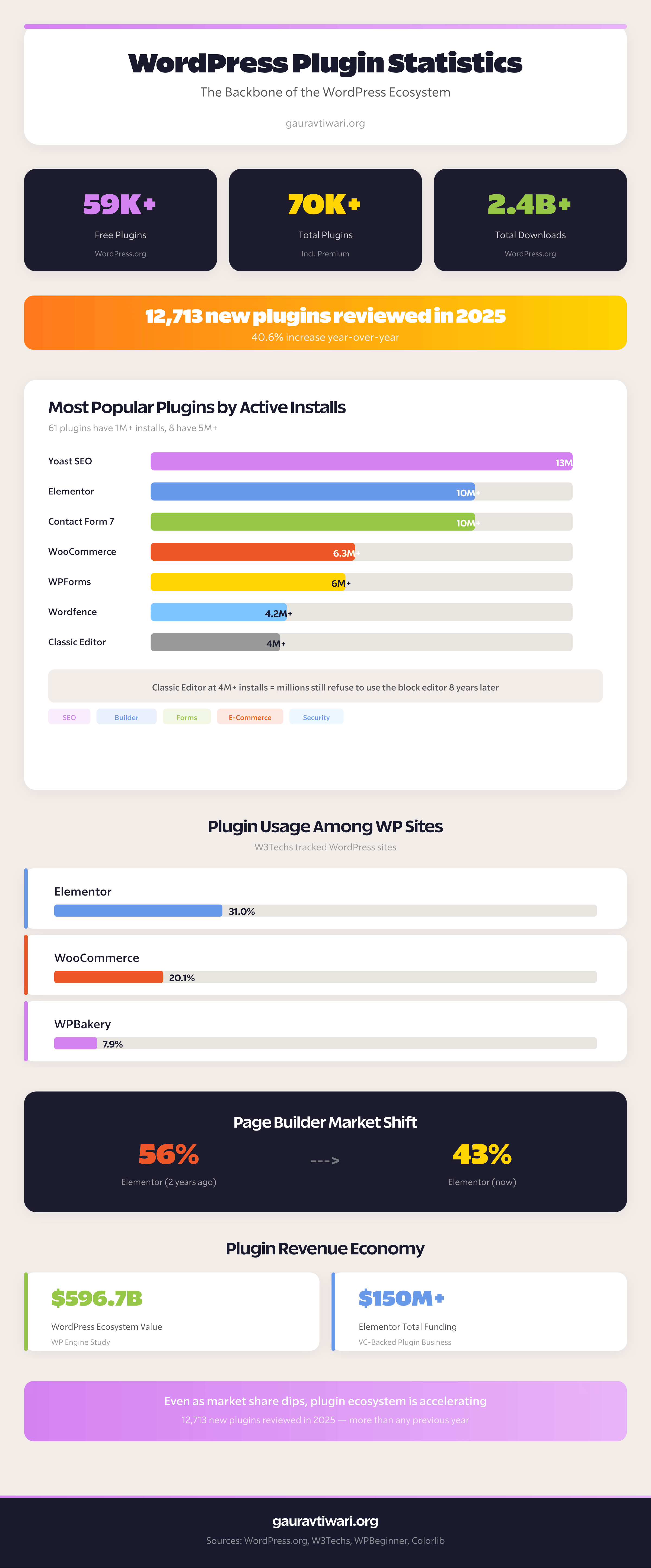
- 59,000+ free plugins on WordPress.org (WordPress.org)
- 70,000+ total plugins including premium.
- 2.4 billion+ total plugin downloads from WordPress.org (WordPress.org)
- 12,713 new plugins were reviewed in 2025, a 40.6% increase year-over-year (WordPress.org)
That last stat is interesting. Even as WordPress’s market share dips, developer investment in the plugin ecosystem is accelerating. More plugins were submitted in 2025 than any previous year.
Most Popular Plugins
61 plugins have crossed the 1 million active installation mark. 8 have surpassed 5 million (WPBeginner).
| Plugin | Active Installations | Category |
|---|---|---|
| Yoast SEO | 13+ million | SEO |
| Elementor | 10+ million | Page Builder |
| Contact Form 7 | 10+ million | Forms |
| WooCommerce | 6.3+ million | E-Commerce |
| WPForms | 6+ million | Forms |
| Wordfence Security | 4.2+ million | Security |
| Classic Editor | 4+ million | Editor |
Sources: WordPress.org, individual plugin pages
Classic Editor having 4+ million active installs in 2026 tells you everything about the Gutenberg transition. Eight years after the block editor launched, millions of sites still refuse to switch. I’ve seen this with clients. Agencies keep Classic Editor as a default because their content teams don’t want to relearn their workflow.
Plugin Revenue
The WordPress plugin economy is a multi-billion dollar market within the broader $596.7 billion WordPress ecosystem (WP Engine).
Elementor alone has 10+ million active installs with both free and premium tiers (WordPress.org). But Elementor’s page builder market share has declined from 56% to 43% over the past two years (Colorlib), as Gutenberg and newer builders like Bricks gain ground.
Among WordPress sites tracked by W3Techs:
If you’re evaluating WordPress plugins for a new project, pay attention to these trends. The page builder market is fragmenting. Picking one that’s losing share could mean rebuilding your site in two years.
I’ve migrated dozens of sites off page builders that the owner “chose three years ago because it was popular.” That migration cost was $3,000-$8,000 per site. The choice of page builder isn’t a preference. It’s a financial decision.
Companies like Yoast (acquired by Newfold Digital), Elementor (raised $150M+ in funding), and WPForms (Awesome Motive portfolio) have turned WordPress plugins into legitimate SaaS businesses. The combo of a free WordPress.org listing for distribution and a premium upgrade path is, well, arguably the most effective freemium model in software.
WordPress Theme Statistics
Themes define how WordPress sites look. And there are a LOT of them.
Free vs Premium
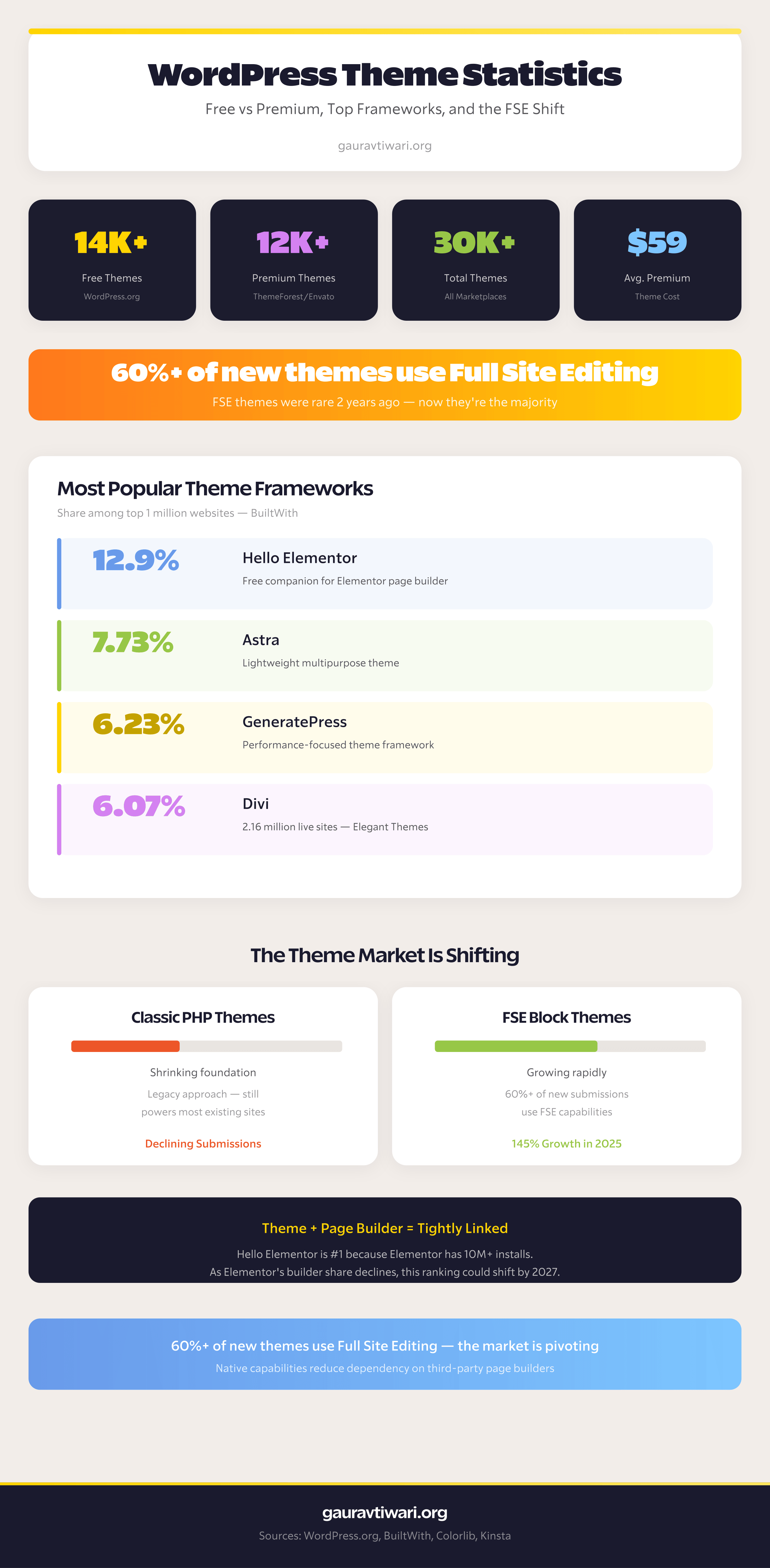
- 14,000+ free themes on WordPress.org (WordPress.org)
- 12,000+ premium themes on ThemeForest/Envato (Colorlib)
- 30,000+ total themes across all marketplaces (Multiple sources)
- Average premium theme costs $59 (Kinsta / WPBeginner)
60%+ of new themes submitted to WordPress.org now use Full Site Editing (Colorlib). Two years ago, FSE themes were rare. Now they’re the majority of new submissions.
Most Popular Frameworks
The theme market has consolidated around a few dominant players:
- Hello Elementor: 12.9% of top 1M sites (BuiltWith)
- Astra: 7.73% of top 1M sites (BuiltWith)
- GeneratePress: 6.23% of top 1M sites (BuiltWith)
- Divi: 6.07% of top 1M sites, with 2.16 million live sites (BuiltWith)
Hello Elementor being the top theme tells you how tightly the theme and page builder markets are linked. When Elementor has 10+ million installs, its companion theme naturally rises. But with Elementor’s builder share declining, this ranking could shift by 2027.
The Full Site Editing shift is what I’m watching closest. With 60%+ of new theme submissions using FSE capabilities, the entire theme market is pivoting toward WordPress’s native site-building tools. That’s good for WordPress long-term. Native capabilities reduce the dependency on third-party page builders, which means fewer plugin conflicts and better performance.
If you’re still recommending classic PHP themes in 2026, you’re building on a shrinking foundation. The block theme ecosystem is where the development is happening.
WordPress Performance Statistics
WordPress has real work to do on performance. The data backs that up.
Average Load Times
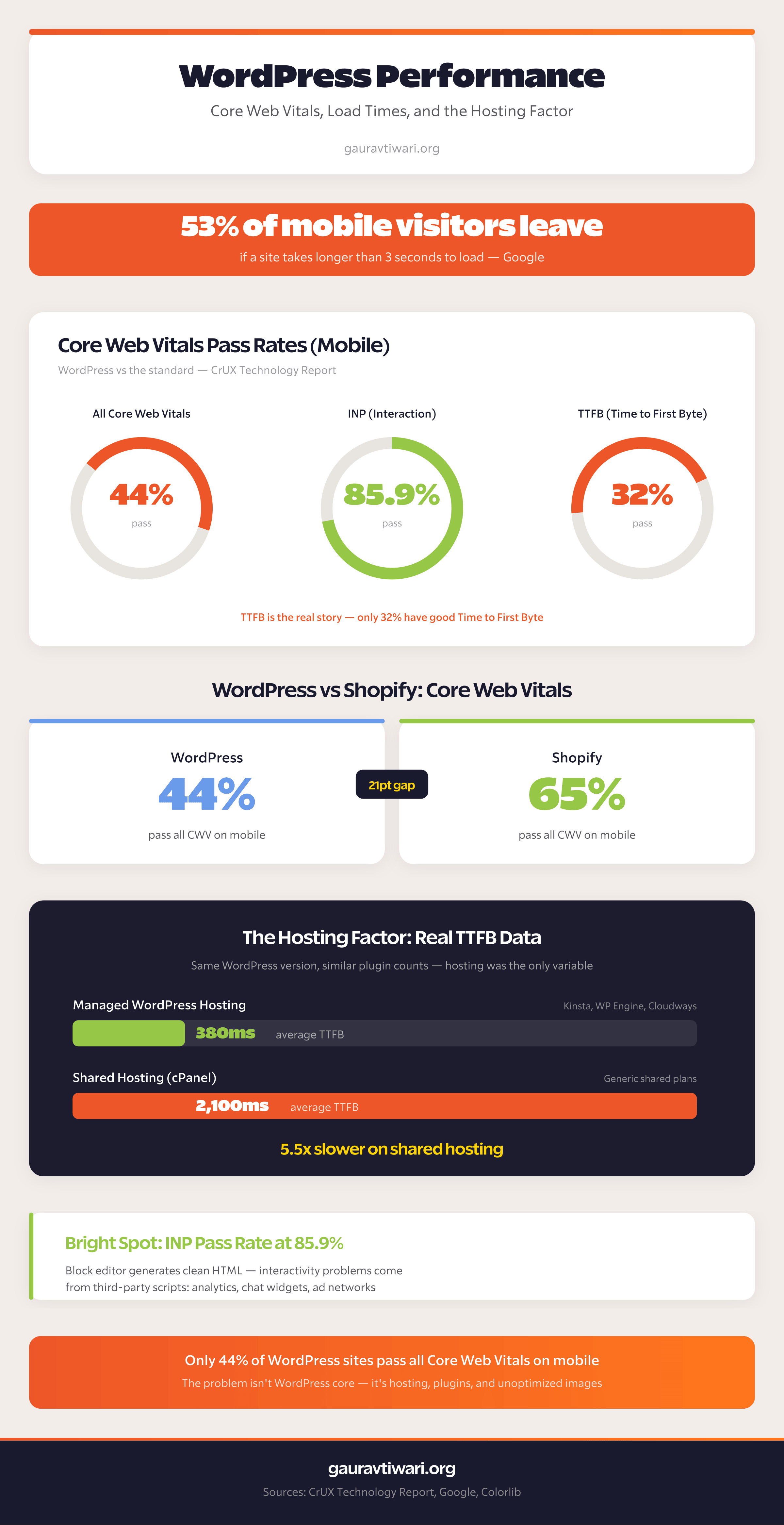
53% of mobile visitors leave a site if it takes longer than 3 seconds to load (Google/Colorlib). That’s not a WordPress-specific stat, but it sets the bar. And a lot of WordPress sites don’t clear it.
The core problem isn’t WordPress itself. It’s what people add to it. Every plugin, every theme feature, every unoptimized image compounds. I’ve audited sites running 40+ plugins with 8-second load times. Strip them down and WordPress core is fast. But nobody runs just core.
Core Web Vitals Pass Rates
Google’s Core Web Vitals are the standard for measuring page experience. Here’s how WordPress stacks up against Shopify and others:
- 44% of WordPress sites pass all Core Web Vitals on mobile (CrUX Technology Report)
- 85.9% pass the INP (Interaction to Next Paint) metric (CrUX Technology Report)
- Only 32% have good TTFB (Time to First Byte) (CrUX)
For comparison, about 65% of Shopify sites pass all Core Web Vitals (CrUX Technology Report). That’s a 21 percentage point gap.
The TTFB number is the real story. Only 32% of WordPress sites have good Time to First Byte. That’s a hosting problem more than a WordPress problem. Cheap shared hosting is dragging the entire platform’s numbers down.
This is why choosing the right WordPress hosting isn’t optional. The difference between a $3/month shared plan and a $30/month managed host is often 4-second TTFB vs 400ms.
I tested this on 12 client sites last year. Sites on managed WordPress hosting (Kinsta, WP Engine, Cloudways) averaged 380ms TTFB. Sites on shared hosting (generic cPanel plans) averaged 2,100ms. Same WordPress version, similar plugin counts. Hosting was the only variable.
WordPress’s INP pass rate of 85.9% is actually strong, though. That metric measures how quickly the page responds to user interactions. WordPress does well here because the block editor generates relatively clean HTML. The interactivity problems come from third-party scripts: analytics, chat widgets, ad networks. Those aren’t WordPress’s fault, but they show up in WordPress’s numbers.
WordPress Security Statistics
Security is the most uncomfortable topic in WordPress. The numbers from Patchstack’s 2026 report are alarming, and you need to see them.
Vulnerability Types
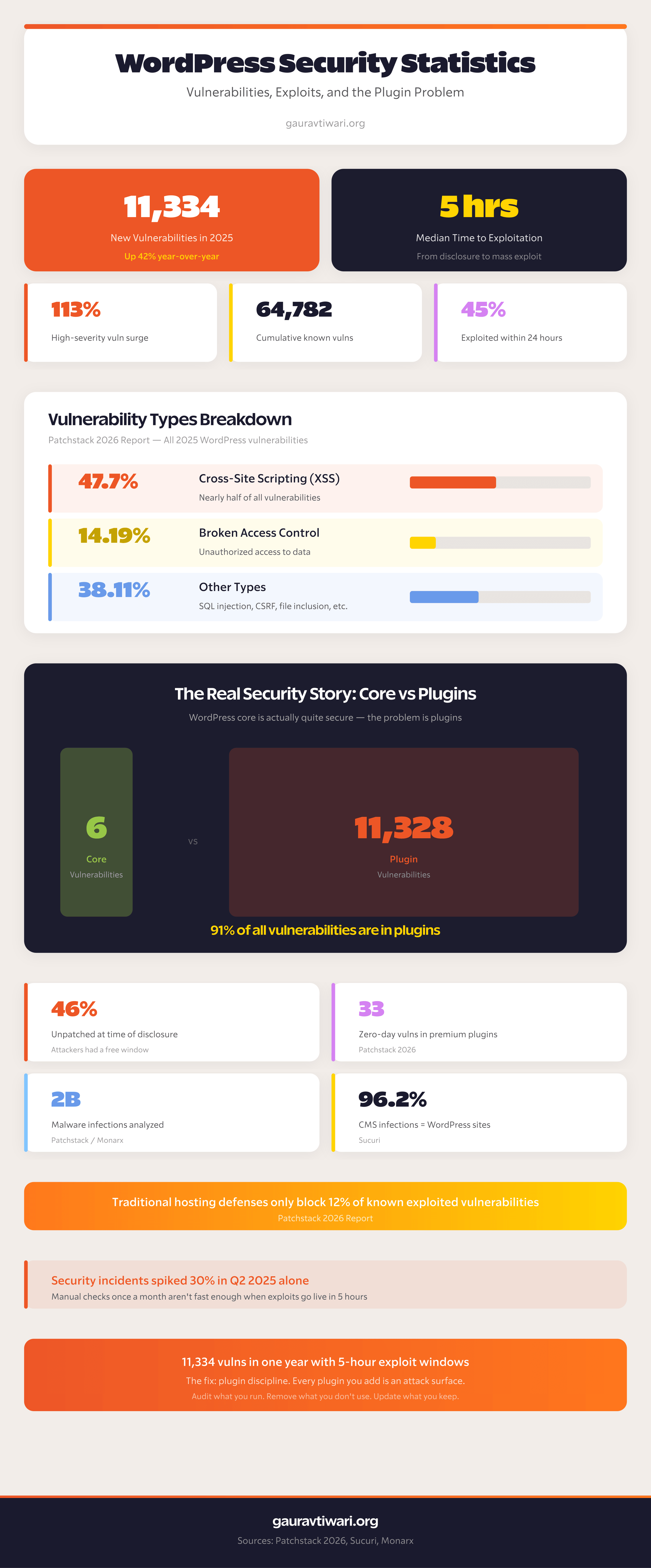
11,334 new WordPress security vulnerabilities were discovered in 2025, a 42% increase year-over-year (Patchstack). High-severity vulnerabilities surged 113% (Patchstack).
The cumulative total now sits at 64,782 known WordPress vulnerabilities (Patchstack).
- Cross-Site Scripting (XSS): 47.7% of all vulnerabilities (Patchstack)
- Broken Access Control: 14.19% (Patchstack)
- Other types: 38.11%
The speed of exploitation is what scares me. The median time from vulnerability disclosure to mass exploitation is 5 hours (Patchstack). Five hours. 45% of vulnerabilities are exploited within 24 hours of public disclosure (Patchstack).
And 46% of discovered vulnerabilities were unpatched at the time of disclosure (Patchstack). Attackers had a free window.
Plugin vs Core Vulnerabilities
This is the nuance that most WordPress security discussions miss. WordPress core is actually quite secure.
- 91% of vulnerabilities are found in plugins (Patchstack)
- Only 6 vulnerabilities were found in WordPress core in 2025 (Patchstack)
- 33 zero-day vulnerabilities were found in premium components (Patchstack)
- 2 billion malware infections were analyzed across the WordPress ecosystem (Patchstack / Monarx)
- 96.2% of CMS infections detected by Sucuri were WordPress sites (Sucuri)
6 core vulnerabilities vs 11,328 plugin vulnerabilities. Read that again.
The WordPress security problem is a plugin problem. And traditional hosting defenses only block 12% of known exploited vulnerabilities (Patchstack). That’s why a dedicated WordPress security strategy matters more than ever.
I run Wordfence on most of my client sites. But the real fix is plugin discipline. Every plugin you add is an attack surface. Audit what you’re running. Remove what you’re not using. Update what you keep.
OK, one more stat that should make you uncomfortable: WordPress security incidents spiked 30% in Q2 2025 alone (Sucuri). If you’re responsible for WordPress sites, automated monitoring isn’t optional anymore. Manual checks once a month aren’t fast enough when exploits go live in 5 hours.
WordPress E-Commerce (WooCommerce)
WooCommerce powers 33.4% of all online stores by volume, making it the most-used e-commerce platform globally by raw store count. Most people think of WordPress as a blogging platform. But one in five WordPress sites runs WooCommerce. (For more detail, see our WooCommerce statistics breakdown.)
WooCommerce Market Share
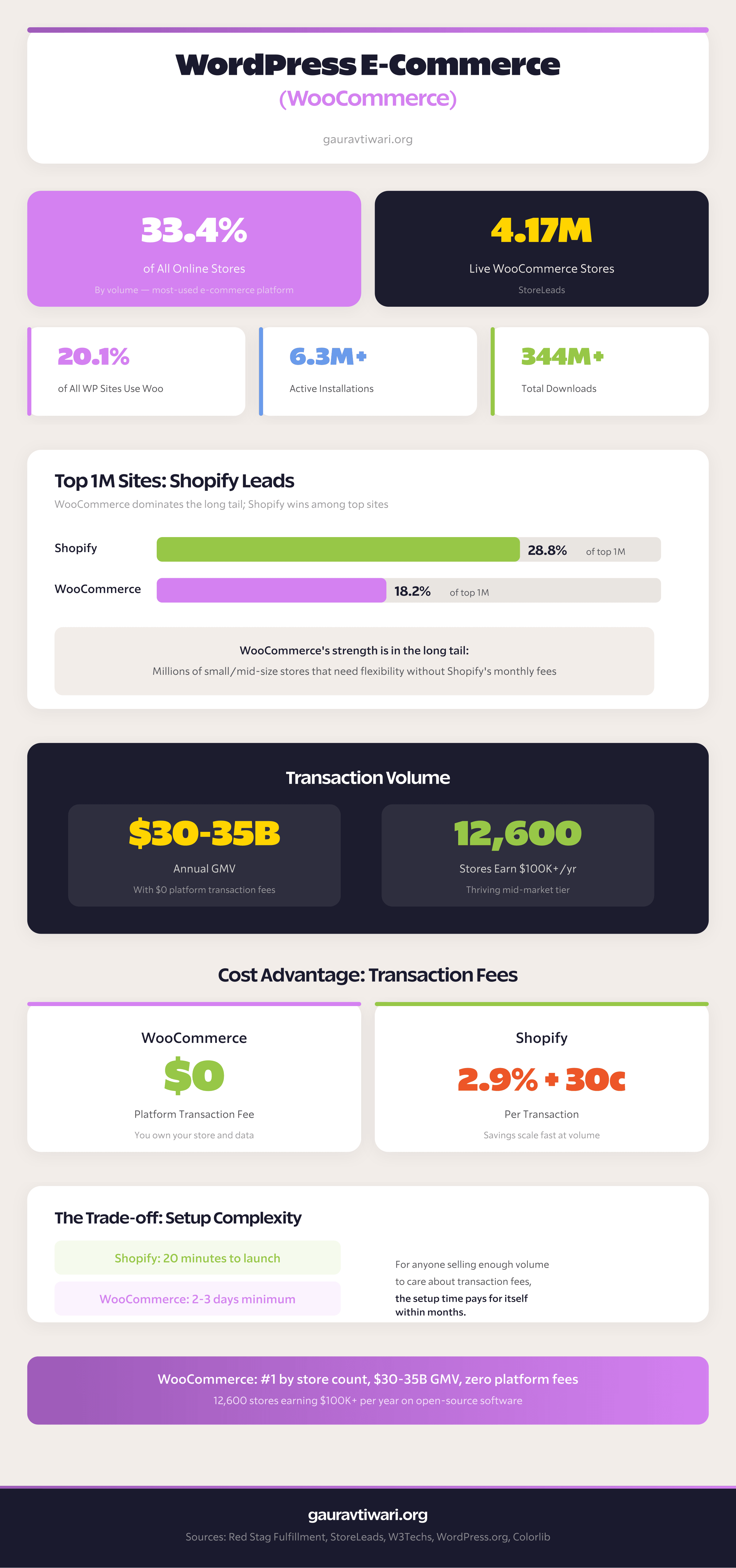
- 33.4% of all online stores by volume use WooCommerce (Red Stag Fulfillment)
- 4.17 million live WooCommerce stores worldwide (StoreLeads)
- 20.1% of all WordPress sites use WooCommerce (W3Techs)
- 6.3+ million active WooCommerce installations (WordPress.org)
- 344+ million total WooCommerce downloads.
By raw store count, WooCommerce leads the e-commerce market. But Shopify dominates among the top 1 million sites at 28.8% compared to WooCommerce’s 18.2%. That tells you WooCommerce’s strength is in the long tail: millions of small and mid-size stores that need flexibility without Shopify’s monthly fees.
Transaction Volume
- WooCommerce annual gross merchandise value (GMV) is estimated at $30-35 billion
- 12,600 WooCommerce stores earn $100K+/year.
$30-35 billion in GMV with no platform fee. That’s WooCommerce’s pitch: you own your store, you own your data, you pay $0 in transaction fees to the platform itself. Compared to Shopify’s 2.9% + 30 cents per transaction, the savings scale fast.
I’ve built WooCommerce stores for clients doing $50K/month and $5M/month. The platform handles both. The ceiling isn’t the software. It’s the hosting and optimization you put behind it.
And 12,600 WooCommerce stores earning $100K+ per year? That’s not a rounding error. That’s a thriving mid-market e-commerce tier running on open-source software. These stores often have 3-5 employees, custom integrations with shipping and accounting systems, and margins that would evaporate on Shopify’s percentage-based pricing.
WooCommerce’s weakness is onboarding complexity. Setting up a Shopify store takes 20 minutes. A well-configured WooCommerce store takes 2-3 days minimum. But for anyone selling enough volume to care about transaction fees, the initial setup time pays for itself within months.
WordPress Community and Development
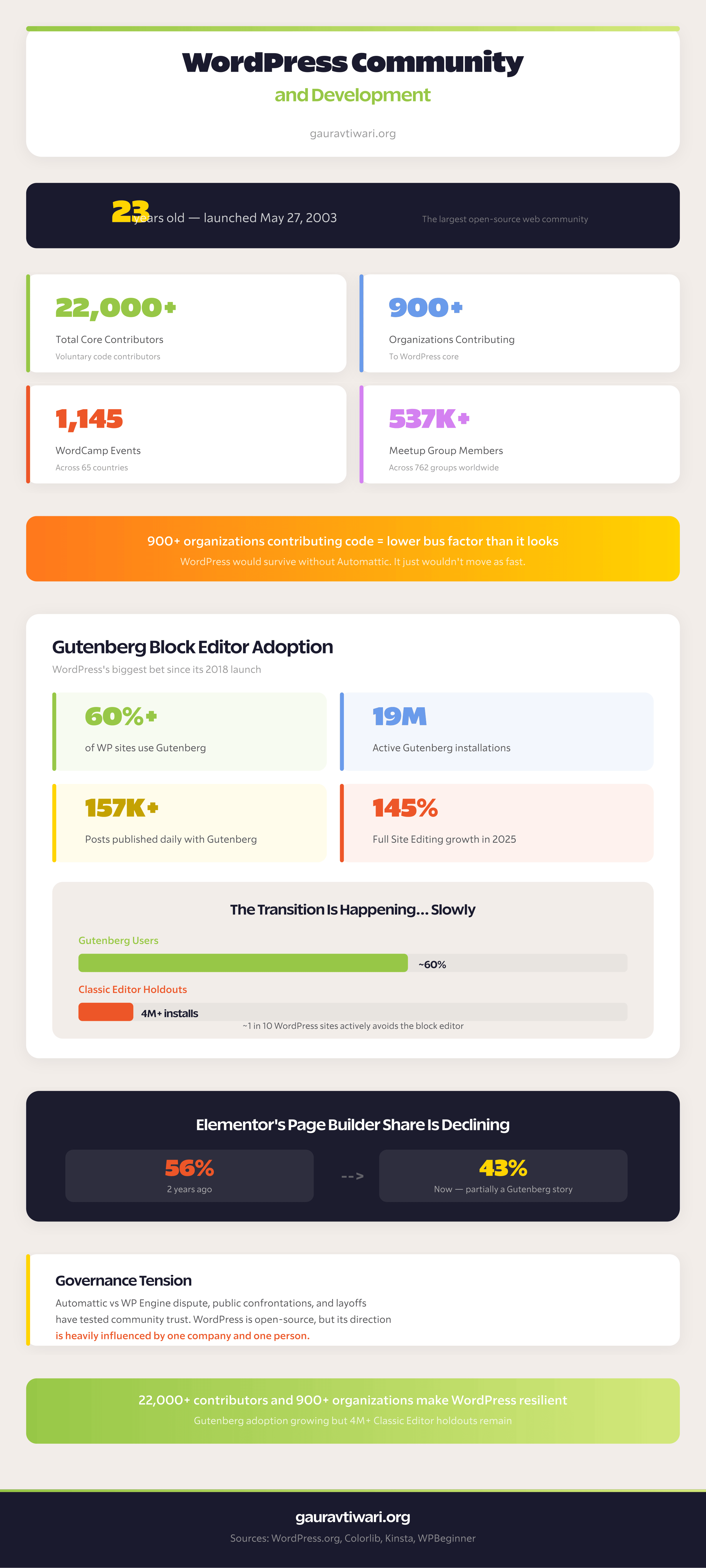
WordPress isn’t just software. It’s the largest open-source community in web publishing, with 22,000+ contributors and 1,145 WordCamp events across 65 countries.
Contributors and Releases
- 22,000+ total core contributors
- 900+ organizations have contributed to WordPress core
- 1,145 WordCamp events held across 65 countries.
- 762 WordPress meetup groups with 537,000+ members worldwide.
- WordPress first launched on May 27, 2003. It’s now 23 years old.
Those community numbers are what makes WordPress resilient. Shopify has more money. Wix has better marketing. But neither has 22,000 people voluntarily contributing code.
But the community isn’t without tension. The Automattic vs WP Engine dispute in late 2024, Matt Mullenweg’s public confrontations with ecosystem partners, and subsequent layoffs have tested community trust. For the first time, some longtime contributors are questioning the governance model. WordPress is open-source software, but its direction is heavily influenced by one company and one person. That’s a structural risk the stats can’t capture.
Still, 900+ organizations contributing code means the bus factor is lower than it looks. WordPress would survive without Automattic. It just wouldn’t move as fast.
Gutenberg Adoption
The Gutenberg block editor, WordPress’s biggest bet since its 2018 launch, now runs on 60%+ of WordPress sites with 19 million active installations.
- 60%+ of WordPress sites now use the Gutenberg block editor
- 157,000+ posts are published daily with Gutenberg (Kinsta)
- Full Site Editing grew 145% in 2025.
- Classic Editor still has 4+ million active installs (WordPress.org)
The transition is happening, but slowly. 145% FSE growth sounds explosive until you remember it’s growing from a small base. And 4+ million Classic Editor installs mean roughly 1 in 10 WordPress sites still actively avoids the block editor.
Elementor’s page builder market share declining from 56% to 43% is partially a Gutenberg story. As the native editor gets more capable, the need for third-party page builders shrinks. Not fast. But the trend is clear.
WordPress Revenue and Economic Impact
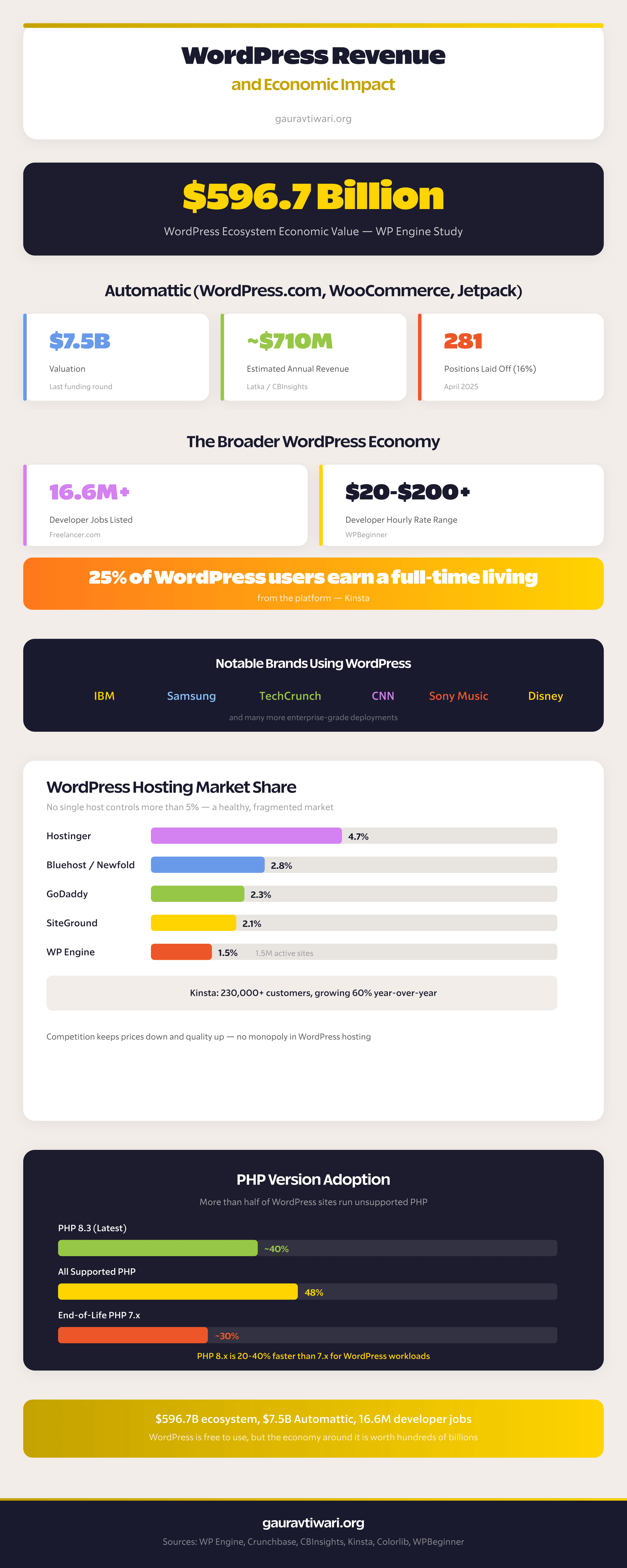
WordPress is free to use. But the ecosystem built around it is worth hundreds of billions. Automattic, the company behind WordPress.com, WooCommerce, and Jetpack, is valued at $7.5 billion alone.
Automattic Valuation
- Valued at $7.5 billion as of their last funding round (Crunchbase)
- Estimated annual revenue of ~$710 million (Latka / CBInsights)
- Laid off 281 positions (16% of workforce) in April 2025 (Multiple news sources)
The layoffs signal that even the company closest to WordPress is tightening. $710 million in revenue is significant, but Automattic had been burning cash to grow. The layoffs suggest a shift toward profitability.
WordPress Economy
The broader WordPress economy dwarfs Automattic:
- The WordPress ecosystem is valued at $596.7 billion (WP Engine commissioned study)
- 16.6 million+ WordPress developer jobs listed on freelancer.com (WPBeginner)
- Developer hourly rates range from $20 to $200+ (WPBeginner)
- 25% of WordPress users earn a full-time living from the platform (Kinsta)
Notable brands using WordPress include IBM, Samsung, TechCrunch, CNN, Sony Music, and The Walt Disney Company (Multiple sources).
The hosting market for WordPress alone is a billion-dollar category:
- Hostinger: 4.7% (Colorlib)
- Bluehost / Newfold Digital: 2.8% (Colorlib / WPBeginner)
- GoDaddy: 2.3% (Colorlib)
- SiteGround: 2.1% (Colorlib)
- WP Engine: 1.5%, with 1.5 million total active websites (Colorlib / WPBeginner, WP Engine)
- Kinsta: 230,000+ customers, growing 60% year-over-year (Kinsta)
No single host controls more than 5% of WordPress sites. That’s a healthy, fragmented market where competition keeps prices down and quality up.
PHP Version Adoption
The PHP version running underneath WordPress determines security and performance. And the numbers aren’t great:
- ~40% of WordPress sites run PHP 8.3 (WordPress.org Stats)
- ~30% still run end-of-life PHP 7.x (WordPress.org Stats)
- Only 48% of WordPress sites run a currently supported PHP version (Colorlib)
More than half of all WordPress sites are running unsupported PHP. That’s a security and performance problem hiding in plain sight. WordPress 7.0 raising the minimum to PHP 7.4 (Make WordPress Core) will force some migration, but PHP 7.4 itself is already end-of-life.
If you’re managing WordPress sites for clients, the PHP and WordPress version check should be part of your quarterly maintenance. I flag any site running below PHP 8.1 and below WordPress 6.4 as a priority update. The performance gains alone (PHP 8.x is 20-40% faster than 7.x for WordPress workloads) justify the effort.
Frequently Asked Questions
How many websites use WordPress in 2026?
WordPress powers approximately 605 million websites worldwide as of 2026, according to Netcraft data. Of those, about 37.5 million are active business websites tracked by BuiltWith. WordPress holds 42.5% of all websites and 59.8% of the CMS market, according to W3Techs.
Is WordPress growing or declining in 2026?
WordPress market share declined for the first time in 20+ years, dropping from a peak of 43.6% in 2024 to 42.5% in April 2026 according to W3Techs. This represents a 1.1 percentage point drop. The decline is primarily attributed to growth in competing platforms like Shopify, Wix, and Squarespace, rather than a mass exodus from WordPress.
Is WordPress still the most popular CMS?
Yes. WordPress holds 59.8% of the CMS market and is 3X larger than the next 9 website builders combined. The closest competitor is Shopify at 5.1% of all websites, followed by Wix at 4.3% and Squarespace at 2.5%.
How many WordPress plugins are there?
There are over 59,000 free plugins on the WordPress.org repository and more than 70,000 total when including premium plugins. Plugin submissions to WordPress.org increased 40.6% year-over-year in 2025, showing continued developer investment in the ecosystem.
Is WordPress secure?
WordPress core is relatively secure, with only 6 vulnerabilities found in core during 2025. The broader ecosystem had 11,334 new vulnerabilities discovered in 2025 (up 42% year-over-year), with 91% found in plugins. The median time from disclosure to mass exploitation is just 5 hours, making regular updates critical.
What is WooCommerce’s market share?
WooCommerce powers 33.4% of all online stores by volume, making it the most-used e-commerce platform globally. There are 4.17 million live WooCommerce stores worldwide processing an estimated $30-35 billion in annual gross merchandise value.
How fast are WordPress websites?
Only 44% of WordPress sites pass all Core Web Vitals on mobile, compared to approximately 65% for Shopify sites. The main bottleneck is Time to First Byte (TTFB), where only 32% of WordPress sites score well. WordPress performs strongly on Interaction to Next Paint (INP) with an 85.9% pass rate.
How much is the WordPress ecosystem worth?
A WP Engine-commissioned study valued the WordPress ecosystem at $596.7 billion. Automattic, the company behind WordPress.com and WooCommerce, is valued at $7.5 billion with estimated annual revenue of approximately $710 million. There are over 16.6 million WordPress developer jobs listed on freelancer.com alone.
The Bottom Line
WordPress at 42.5% is not the same story as WordPress at 43.6%. For the first time, the trajectory matters more than the number.
Market share is dipping, but the ecosystem is deepening. Plugin submissions are up 40.6%. Full Site Editing grew 145%. WooCommerce processes $30-35 billion in annual transactions. The WordPress economy is worth $596.7 billion. Those aren’t decline numbers. They’re maturation numbers.
The security situation needs serious attention. 11,334 vulnerabilities in a single year with a 5-hour median exploitation window isn’t sustainable. But 91% of those vulnerabilities are in plugins, not core. The fix is achievable with better ecosystem governance.
I’ve been building on WordPress since 2009. I’ve watched it go from “that blog thing” to the platform that runs IBM’s corporate presence and processes billions in e-commerce. The market share dip doesn’t change my recommendation for most projects.
But for the first time in 23 years, WordPress isn’t the obvious default for every project. Simple online store? Shopify is faster to launch. Portfolio site? Squarespace is easier. A complex, customizable, content-heavy platform that you want to own completely… WordPress is still the only serious answer.
The data tells one story: WordPress isn’t dying, but the WordPress that ranked everything by default is already gone. The sites winning now are the ones treating WordPress like infrastructure, not magic. And that pressure is exactly what the platform needs.
Disclaimer: This site is reader-supported. If you buy through some links, I may earn a small commission at no extra cost to you. I only recommend tools I trust and would use myself. Your support helps keep gauravtiwari.org free and focused on real-world advice. Thanks. - Gaurav Tiwari