
Why You Should Invest In Promotional Videos?
A promotional video is the fastest way to make a stranger trust your business before they ever talk to you. Not a brochure. Not a wall of text on a landing page. Sixty seconds of someone showing what you do, why it matters, and who it’s for. That’s the asset that moves the needle in 2026, and the video marketing numbers back it up hard.
Here’s the verdict up front. If you sell anything that needs explaining, a service, a product with features, software, a course, a promotional video belongs near the top of your marketing budget. Landing pages with video convert up to 80% better than text-only versions. The catch? A bad promo video can waste a week of work and still convert worse than a clean paragraph. So the decision isn’t whether to make one. It’s whether you make the right one, the right way, for the right page.
Why a Promotional Video Converts Better Than Text
A promotional video converts better because it does three jobs at once that text struggles to do alone: it shows the thing working, it carries tone and trust through a human face or voice, and it lowers the mental effort of understanding what you sell. People don’t read on the web. They skim. Video meets them where their attention already is.
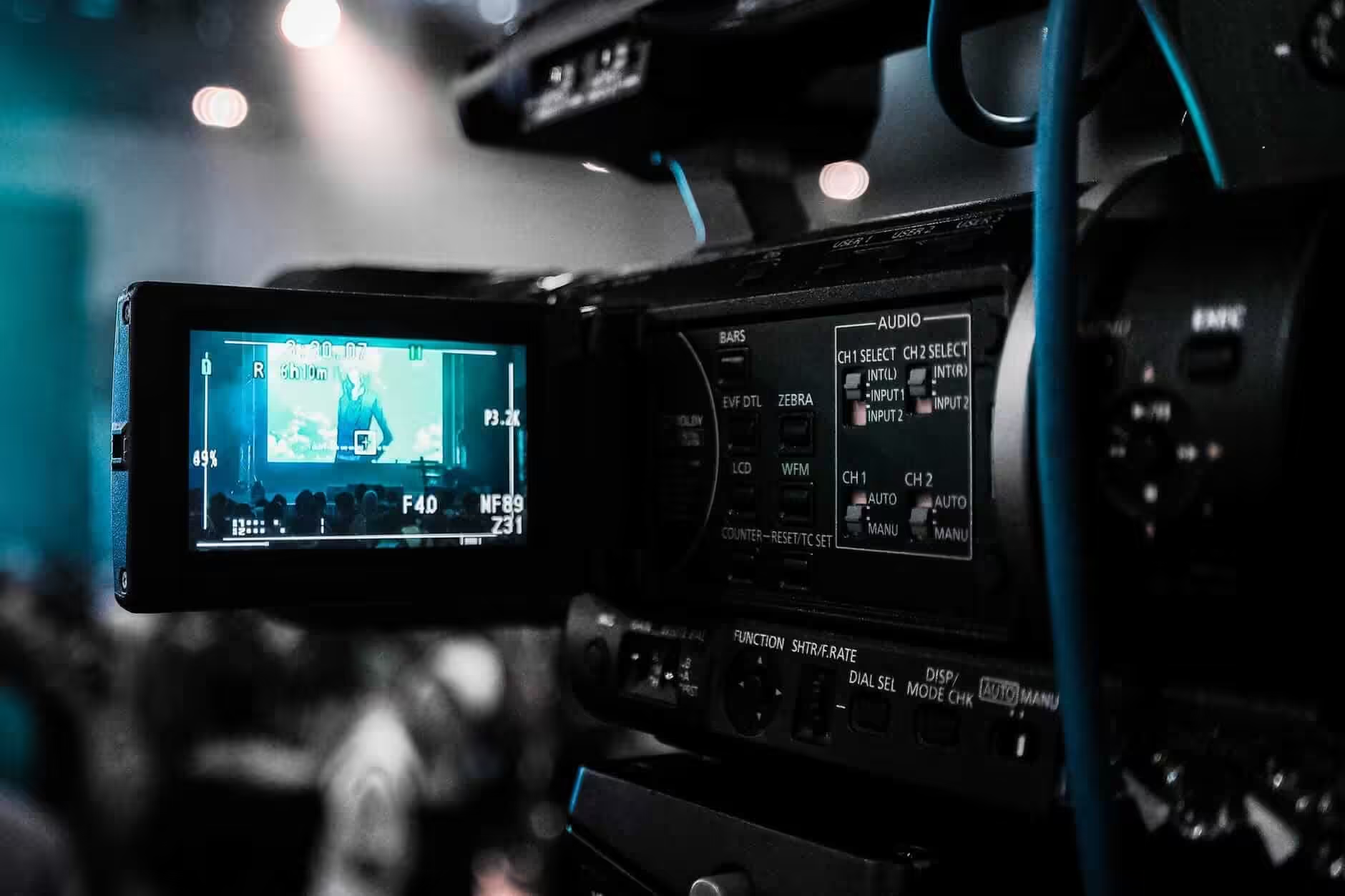
The data is blunt about it. Websites that use video average a 4.8% conversion rate versus 2.9% without, per Aberdeen Group. On product pages specifically, video drives add-to-cart lifts of up to 144% in Invesp’s analysis. And drop the word “video” into an email subject line and click-through rates jump 65% while unsubscribes fall 26%, according to Campaign Monitor. That’s not a rounding error. That’s a different business.
There’s a trust layer underneath the conversion numbers too. Around 89% of consumers say video quality affects whether they trust a brand. A clear, well-lit promo builds confidence. A grainy, rambling one quietly costs you. So this is less about whether video works and more about whether yours is good enough to count.
Proof, in plain numbers: Video landing pages convert up to 80% better than text-only (Unbounce). Sites with video average 4.8% vs 2.9% conversion (Aberdeen Group). Product videos lift add-to-cart up to 144% (Invesp). “Video” in an email subject line raises CTR 65% (Campaign Monitor). 82% of video marketers report positive ROI in 2026 (Wyzowl). Short-form video has been the top ROI format three years running.
The Types of Promo Video Worth Making
Most businesses only need two or three video types, not a whole studio catalog. The mistake I see constantly is people commissioning a glossy brand film when what their homepage actually needed was a 45-second explainer. Match the format to the job. Here’s the short list that earns its keep.
| Video type | Best for | Ideal length |
|---|---|---|
| Explainer / demo | Homepage, product page, “how it works” | 30–90 sec |
| Short-form social clip | Reels, Shorts, TikTok, ads | Under 60 sec |
| Testimonial / case study | Sales pages, building trust late in the funnel | 60–120 sec |
| Brand / about film | About page, investor decks, recruiting | 60–120 sec |
| Product walkthrough | Onboarding, support, feature launches | 2–5 min |
If you only make one, make the explainer. It carries the most weight on the page where buying decisions actually happen. The rest are supporting cast. Short-form social clips matter more every year, though. Videos under 60 seconds make up the bulk of what gets watched, and short-form has topped the ROI charts for marketers three years in a row.
Where to Actually Use Your Promotional Videos
A promo video earns its budget when it sits on a page where someone is deciding. Burying it on a blog post nobody scrolls to is how good video gets wasted. Put it where the decision happens, then reuse the same footage everywhere else.
- Homepage and product pages first. This is where the 4.8% vs 2.9% conversion gap lives.
- Email campaigns. Even a thumbnail with a play button and “video” in the subject line lifts click-through.
- Paid ads and social feeds as native short-form clips, cut from the same shoot.
- Trade shows, demos, and sales decks, where a 60-second loop does the explaining for you.
- Onboarding and support, where a walkthrough cuts your ticket volume.
The strategy that compounds is shooting once and slicing many. One solid explainer becomes a homepage hero, three social cuts, an email asset, and an ad. That’s also where a strong content distribution plan turns one video into ten placements instead of one.
DIY vs Hire a Production Company vs AI Video
You’ve got three roads now, and for the first time AI is a real third option, not a toy. Hire a production company when the video is your flagship and budget allows. Go DIY when you’re testing or shooting volume. Reach for AI tools when you need speed, scale, or a draft to test before you commit real money.
A full-service production company handles concept, storyboarding, shooting, editing, voiceover, and music. You get polish and you save your own time, which is the real cost most owners forget to count. That’s the right call for a hero brand film or a launch you only get to do once.
For everything else, modern tools have collapsed the cost. Canva’s video editor handles clean explainers and social cuts without a learning curve, and tools like InVideo let you generate a draft from a text prompt in minutes. I lean on these for fast social clips and A/B test drafts, then hand the winner to a pro if it deserves the polish. WeVideo is a solid middle option for team-based editing in the browser.
What changed in 2026: AI cut the floor out from under video costs. Traditional production runs about $4,500 per minute; AI-assisted production lands near $400 per minute, roughly a 91% drop. The average time to produce a 60-second marketing video fell from 13 days to 27 minutes. Around 78% of marketing teams now use AI-generated video in at least one campaign a quarter, and short-form makes up 67% of all AI-generated clips. The honest tradeoff: AI is unbeatable for drafts, social volume, and localization, but a flagship brand film still wins with a human crew.
What a Promotional Video Actually Costs
The cost of a promotional video in 2026 ranges from almost nothing to five figures, and the spread is wider than it’s ever been. A DIY clip made in Canva or InVideo can cost the price of a monthly subscription. A professionally produced corporate video still runs in the thousands once you add crew, scripting, and editing.
Here’s the rough map. AI-assisted production sits around $400 per minute. Freelancer or small-studio work tends to land in the $1,000 to $5,000 range for a polished 60-to-90-second piece. Full agency production for a flagship brand film climbs from there. The smart move for most small businesses is to start cheap and AI-assisted, prove the format converts on your own page, then reinvest the winnings into a better version. Don’t spend $8,000 to learn whether video works for you. Spend $40 first.
What Makes a Good Promo Video (and When It’s a Waste)
A good promotional video answers one question fast: what’s in it for me, the viewer? It hooks in the first three seconds, shows the product or outcome instead of describing it, keeps to one core message, and ends with a clear next step. Length is ruthless. If it can be 45 seconds, it shouldn’t be 90.
Now the part most articles skip. A promo video is a waste of money when:
- You haven’t nailed your message yet. Video just amplifies a confused pitch into an expensive confused pitch.
- It lives on a page nobody visits. Traffic first, then video.
- You’re spending agency money to test an unproven format. Test cheap, then scale.
- It’s all polish and no point, a brand film that says nothing a customer cares about.
- You can’t support it. A video that loads slow and tanks your page speed costs more conversions than it earns.
If your message is still fuzzy, fix that first. A tight content marketing strategy tells you what to say before you spend a rupee on saying it on camera.
How to Measure Video ROI
Measure video ROI by the action it drives, not the views it collects. View count is a vanity number. The metrics that tell you whether a promotional video earned its budget are conversion rate on the page that hosts it, engagement (watch time and completion), and click-through on the call to action that follows.
The cleanest test is an A/B test: run the page with video against the same page without it and watch the conversion gap. This used to be expensive because you needed multiple video versions. Now AI-powered A/B variants cost a fraction of producing several traditional cuts, so there’s no excuse not to test. Track the numbers for 30 days, keep the winner, and kill what doesn’t move the needle. If you want the video to pull its weight beyond your own site, pair it with proven YouTube marketing tactics and a plan to boost awareness of your product across channels.
So, should you invest in promotional videos? Yes, but invest like a tester, not a gambler. Start with a cheap AI-assisted explainer on your highest-intent page. Measure the conversion lift over a month. When the numbers prove out, and with 82% of marketers reporting positive ROI in 2026, they usually do, that’s when you spend real money on the polished version. Video isn’t optional anymore. Doing it blind is.
Disclaimer: This site is reader-supported. If you buy through some links, I may earn a small commission at no extra cost to you. I only recommend tools I trust and would use myself. Your support helps keep gauravtiwari.org free and focused on real-world advice. Thanks. - Gaurav Tiwari