
Website and Blog Copywriting: The Ultimate Guide to Engaging and Converting Readers in 2026
Did you know that websites with well-optimized content are 10x more likely to rank higher on Google and convert visitors? That’s huge and that makes website and blog copywriting essential for every business.
In this guide, we’ll explore the essential strategies and tips to help you write compelling, SEO-friendly copy that turns visitors into loyal customers. Whether you’re a business owner or a content marketer, you’ll find actionable insights to level up your copywriting game. I’ve also added a section on using AI writing tools effectively, because that’s the biggest shift in copywriting since I started writing for the web.
What Is Website and Blog Copywriting?
Alright, let’s talk about website and blog copywriting.
It’s one of those things people hear about all the time, but it’s not always clear what it actually is.
I’ll admit, when I first started writing for the web, I thought it was just about slapping some words on a page and calling it a day. Big mistake! Over time, I learned there’s a lot more to it.
In the simplest terms, it’s the art of writing text for websites and blogs in a way that not only informs or entertains but also motivates people to take action. The kind of action depends on your goal. It could be getting someone to buy something, sign up for a newsletter, click on a link, or even just stick around long enough to read more.
I remember when I wrote my first blog post for a client. I thought, “I’ll just write a cool piece about their products, and people will love it.” Spoiler alert: they didn’t. That’s when I realized copywriting wasn’t just about what I was saying, but how I was saying it. People skim when they read online, so if your message isn’t clear right off the bat, they’re gone faster than you can blink.
Website Copywriting vs Blog Copywriting
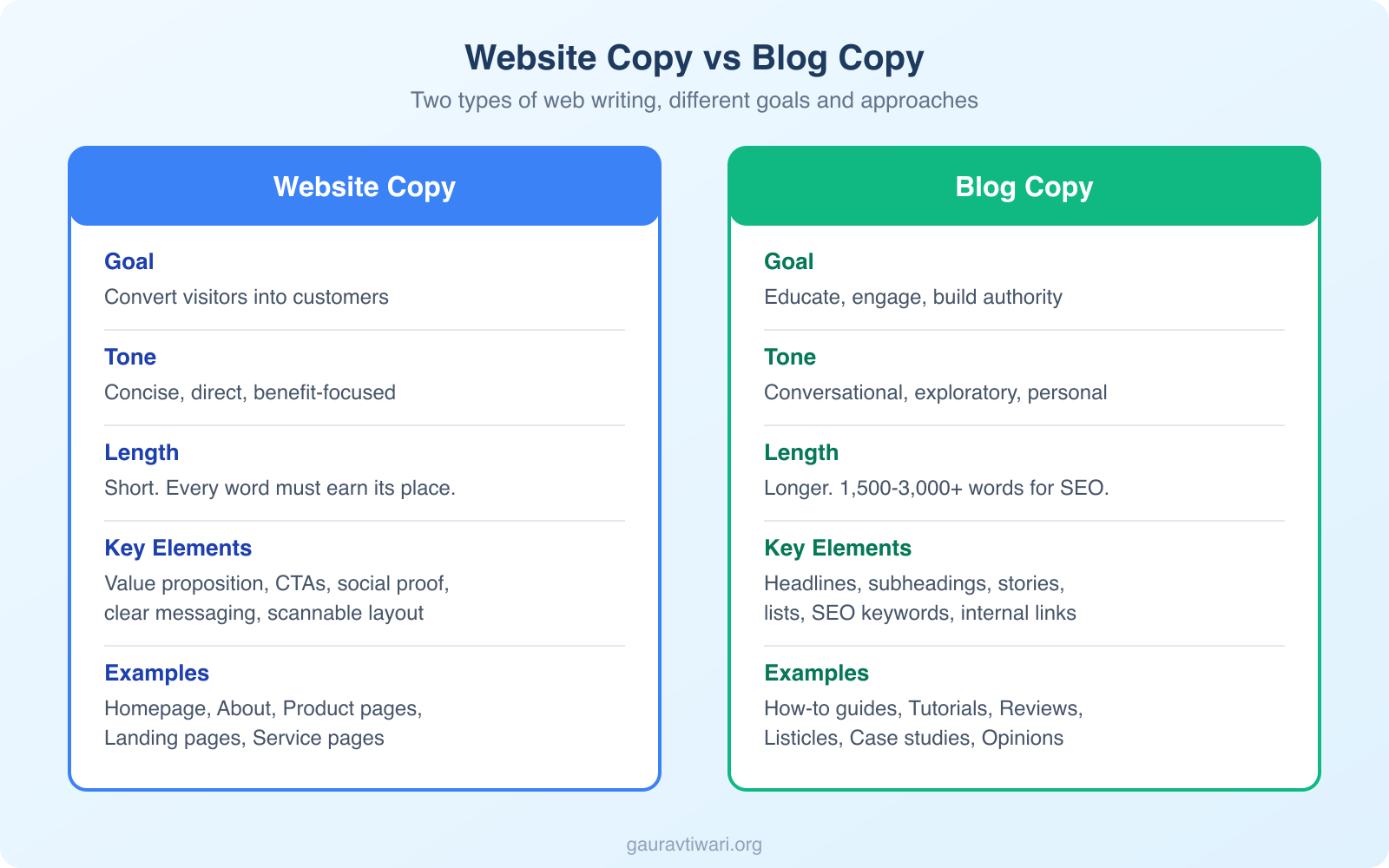
Website copy is a bit different from blog copy, though they share some DNA.
When you’re writing website copy, like for an “About Us” page or product description, you’ve got to be straight to the point but still engaging. It’s like that delicate balance between being concise and conversational. I always picture myself explaining something to a friend.
Blog copy, on the other hand, can be more laid-back and exploratory. Blogs are where you can really dive deep into a topic, share stories, and go on the occasional tangent. For example, if I’m writing a blog about SEO tips, I might share an experience about the time I spent hours optimizing a page for a keyword, only to realize the keyword I picked was one barely anyone searches for.
Lesson learned: keyword research is non-negotiable. You MUST do it.
Copywriting for Both Humans and Search Engines
This is important: copywriting for blogs or websites isn’t just for humans; it’s for search engines, too. Whoever tells you “don’t write for search engines” is wrong. You’ve got to sprinkle in those keywords, but not in a way that sounds robotic or forced.
I had to figure this out the hard way after reading one of my posts back and realizing I had crammed “best email marketing software” into every other sentence. Ugh, cringe!
Good copywriting resonates. It feels like a conversation rather than a sales pitch. And that’s where a lot of people go wrong. I’ve seen some super-sleek, fancy websites with copy that’s so stiff and formal, you feel like you’re reading a legal document. People want authenticity, whether they’re reading about the best new hiking boots or learning how to improve their business’s website.
If you’re thinking about jumping into copywriting yourself, my advice is to start small and experiment. See what gets clicks, what keeps people reading, and, most importantly, what makes you excited to write. Because if you’re not enjoying it, that’s going to come through in your copy.
The Essentials of Effective Website Copy
When it comes to effective website copy, it’s really all about finding that perfect balance between being informative and engaging while still keeping things simple enough that people don’t get lost or bored. Trust me, I’ve messed it up more times than I’d like to admit.
So, what makes website copy effective? First off, you’ve got to get straight to the point. I know it sounds obvious, but you’d be surprised how easy it is to start rambling about your product’s 25 amazing features before actually telling someone why they should care. The key is focusing on the value proposition. What’s in it for the visitor?
If you’re writing for, say, a coffee shop, don’t just tell me that you roast your beans in-house. Tell me how that makes my morning cup of coffee taste better than anything else I’ve tried.
One thing I’ve learned the hard way is the importance of clear messaging. Your visitors aren’t going to spend time figuring out what you’re trying to say. It needs to be obvious from the get-go. Forget jargon, forget complicated words. Write like you’re talking to a friend. If your website copy sounds like a robot wrote it, people are going to bounce right off your site. And guess what? That’s not good for your SEO either.
Which brings me to another point: readability matters. Using headers, bullet points, and short paragraphs makes your copy much easier to digest. Think of it like this: you want someone to be able to quickly glance at your page and know exactly what you offer.
Another big one: calls to action (CTAs). You could have the most beautiful, engaging copy in the world, but if you’re not telling people what to do next, you’re missing out. Your CTAs should stand out and be clear, but not in a pushy, annoying way. Something like “Find Your Perfect Plan” or “Start Your Free Trial” works better than a generic “Buy Now” because it’s softer but still gets the point across.
And don’t forget about SEO. It’s not just about stuffing in as many keywords as you can. It’s about using semantic keywords naturally throughout your copy. If your website is about eco-friendly cleaning products, don’t just repeat “eco-friendly” over and over. Talk about “green cleaning,” “natural home cleaning solutions,” or “sustainable cleaning methods.” It helps search engines understand what your page is about without making your copy sound like it was written by an algorithm.
One of my favorite tricks to boost SEO without making it obvious is optimizing your meta descriptions, URLs, and headers. These are prime real estate for keywords, and they often get overlooked. I generally rewrite the meta description for clients as soon as I join them, and their rankings improve within weeks. Small changes, huge difference.
The Art of Writing Compelling Blog Posts
Writing a compelling blog post isn’t as easy as people think. Sure, anyone can write a blog, but getting people to actually read and engage with it? That’s the tricky part.
When I first started blogging in 2008, I was just happy to get anything published. I’d put my thoughts down and hit “publish” without giving much thought to how it would resonate with my audience. Needless to say, it didn’t exactly take off until late 2010. The truth is, there’s an art to writing blog posts that grab attention, hold it, and ultimately provide value.
First things first: headlines. If your headline doesn’t catch someone’s eye, it doesn’t matter how brilliant your post is. Nobody’s going to click on it. Crafting the perfect headline can be just as tough as writing the post itself. It’s got to be snappy, give a clear idea of what the post is about, and create enough intrigue that people feel compelled to click. Check out my post on headline writing tips for more on this.
Once you’ve got a great headline, the next step is writing an introduction that hooks your reader. I used to make the mistake of starting with a long-winded backstory. The reality is, you’ve only got a few seconds to grab someone’s attention. Dive right into the meat of your post or pose an interesting question. Something like, “Ever wonder why your blog posts aren’t getting any traffic?” gets people curious enough to keep reading.
The body of your blog post is where I see a lot of bloggers struggle. The best blog posts are well-organized and broken up with subheadings, bullet points, or numbered lists. People love lists. It makes your content easier to digest. Plus, with most readers skimming through articles, having clear sections helps them navigate your post quickly.
Here’s something I learned the hard way: writing for your audience is key. It’s easy to get caught up in writing about what interests you, but if you’re not addressing your readers’ pain points, they’ll quickly lose interest. For more on making your blog posts work harder, check my guide on optimizing blog posts for SEO.
One mistake I used to make was focusing too much on being informative and not enough on being engaging. People come to blogs to learn, but they also want to be entertained. Inject some personality into your writing! Don’t be afraid to share personal anecdotes, even if they’re a little embarrassing. People love reading about real experiences.
Finally, always end with a strong conclusion. Summarize your main points and always include a call to action. This whole process is part art, part science. It’s about finding the right balance between offering value, optimizing for SEO, and keeping your readers engaged with your unique voice.
How to Write for Your Target Audience
Writing for your target audience is hands down one of the most important things you can learn as a content creator, but I’ll be honest, it took me a while to get the hang of it.
I used to think, “Hey, I’ll just write what I think is interesting, and people will naturally want to read it.” But that’s not how it works. If you’re not speaking directly to the people you want to reach, your content might as well be shouting into the void.
I remember one of my early projects where I wrote a blog for a startup selling online teaching apps for teachers and coaching centers. I thought I was killing it with a super detailed breakdown of each product’s technical benefits. The thing is, my audiences weren’t technical experts. They were busy and desperate people looking for quick and easy ways to take their teaching online. They didn’t care about the deep technical stuff; they wanted to know how using these products would save them time and make their lives easier.
I learned a big lesson that day: it’s not about what you want to write, it’s about what they need to hear.
So, how do you figure out what your audience really wants? First, you’ve got to get to know them. And I don’t just mean in a vague, demographic way like “Women, 25-35, interested in fitness.” I mean understanding their challenges, goals, and pain points on a deeper level.
One of the best ways to get inside your audience’s head is by engaging with them directly. If you have a blog with an active comment section or a social media following, you’ve got a goldmine of insights right there. Read the comments, respond to questions, and take note of what people are asking for.
Here’s an example: I wrote an article on WordPress SEO, and after publishing it, I kept getting emails from readers about specific plugins they should use. I hadn’t covered plugins in much detail in the original post. But since it was clearly something people wanted, I ended up creating a whole separate guide on the best WordPress SEO plugins, and it became one of my most-converting articles. Listening to your audience works.
Another trick that’s helped me is creating audience personas. Just sketch out a few typical readers of your blog or website. What do they care about? What problems are they trying to solve? Having those personas in mind helps me focus the content on real needs rather than just generic advice.
One mistake I see a lot is trying to please everyone. Your audience is going to be diverse, but you can’t write for all of them at once. A few years ago, I tried writing blog posts that would appeal to everyone. The result? It was a mess. It’s much more effective to focus on one persona or segment of your audience at a time, even if that means you’re writing separate posts for beginners and experts. Clarity beats trying to cover all bases.
Finally, when you’re writing for your audience, don’t be afraid to use their language. If your readers tend to be more casual, don’t hit them with formal corporate jargon. Conversely, if you’re writing for a more professional audience, make sure your tone reflects that. A big part of why people stick around on blogs or websites is because they feel like the writer “gets them.”
AI Writing Tools: When They Help and When They Hurt
I can’t write a guide on copywriting in 2026 without addressing the elephant in the room: AI writing tools. ChatGPT, Claude, Gemini, Jasper, and dozens of other tools have fundamentally changed how content gets created. The question isn’t whether to use them. The question is how to use them without destroying your copy.
I use AI tools in my workflow every day. But I don’t use them the way most people think. I don’t type “write me a 2,000-word blog post about email marketing” and publish whatever comes out. That approach produces generic, soulless content that reads like every other AI-generated article on the internet. Google can detect this pattern, and so can your readers.
Where AI writing tools actually help
- First drafts and outlines. AI is excellent at generating a structural skeleton for your content. I’ll feed it my topic, angle, and key points, and ask for an outline. Then I rewrite every section in my own voice.
- Research summaries. When I need to understand a complex topic quickly, AI can synthesize information from multiple angles. It’s faster than reading 15 articles, though I always verify the facts independently.
- Headline variations. I’ll write my headline, then ask AI to give me 10 alternatives. Usually 2-3 of those spark ideas for a better version than what I started with.
- Meta descriptions and social copy. Rephrasing the same message for different formats (meta descriptions, social posts, email subject lines) is tedious work that AI handles well.
- Proofreading and clarity checks. AI catches awkward phrasing, passive voice overuse, and unclear sentences that I might miss after staring at my own writing for hours.
Where AI writing fails
- Original opinions and takes. AI can’t have a genuine opinion. It can mimic one, but readers sense the difference. When I say “I tested this on 12 sites and the results were mixed,” that carries weight because it’s true. AI-generated opinions are just statistical averages of what other people have written.
- Personal stories and anecdotes. The stories I share about client projects, early mistakes, and hard-won lessons are what make my content different from everyone else’s. AI can generate fake anecdotes, but they feel hollow.
- Nuanced recommendations. AI tends to hedge everything. “It depends on your situation.” “Both tools are great options.” Real copywriting requires you to pick a side. I recommend Rank Math over Yoast for SEO plugins. That’s a real opinion based on years of testing, not a safe, AI-generated both-sides take.
- Brand voice consistency. AI writes in a generic, slightly formal, cautious tone by default. It can mimic a voice, but maintaining that voice across 50+ articles requires a human who actually has that voice.
The best approach: use AI as a research assistant and first-draft generator, then rewrite everything in your own voice. Your editing pass should add personal experiences, specific numbers, opinionated recommendations, and the conversational tone that makes your content sound like you. If you skip the editing pass, you’re publishing commodity content.
My AI-assisted writing workflow
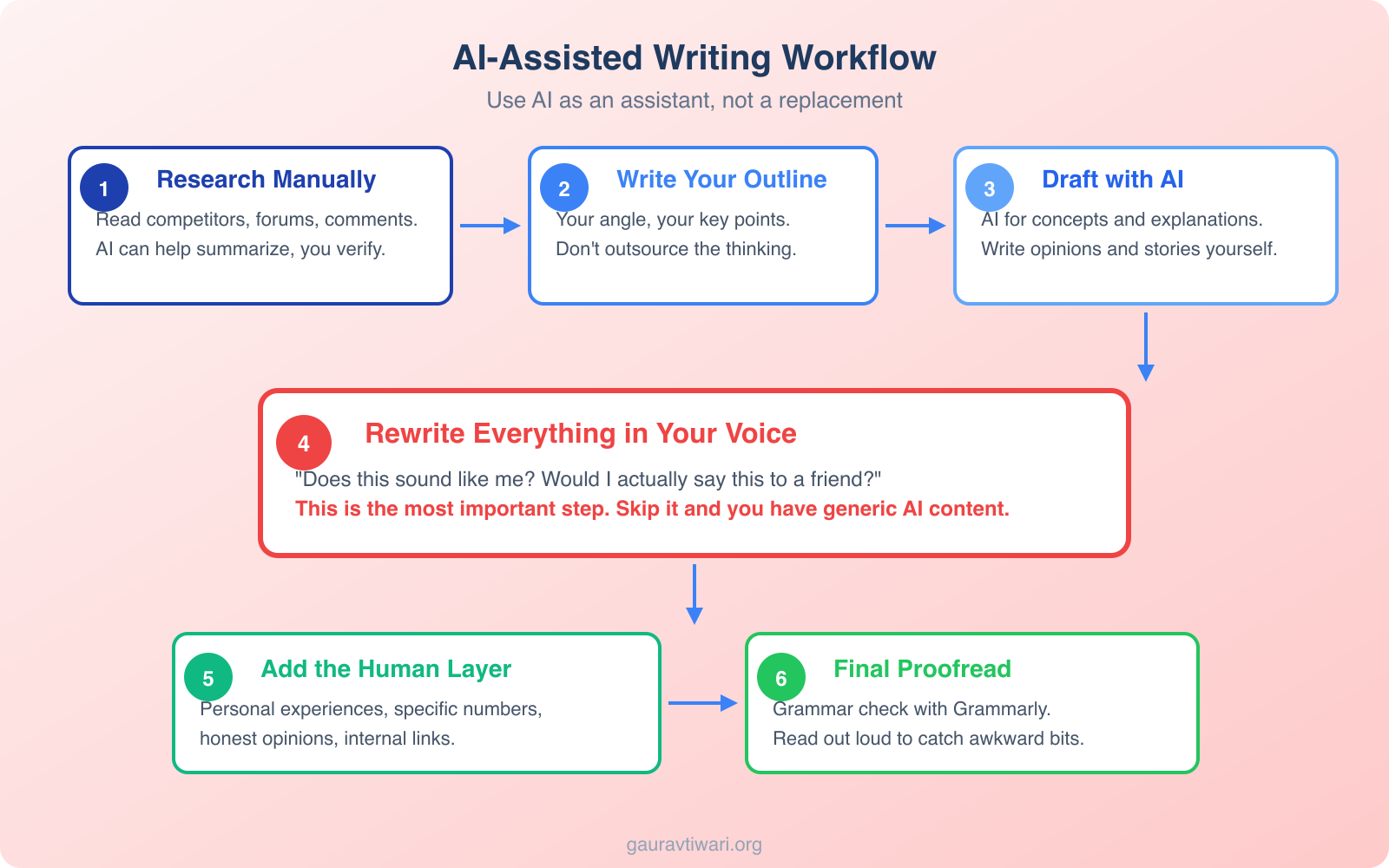
Here’s the exact process I follow for every piece of content I publish:
- Research manually. Read competitor articles, check forums, look at what questions people are asking. AI can help summarize, but the insights come from actually reading.
- Write the outline myself. I know my angle, my audience, and my key points. The outline reflects my thinking, not AI’s default structure.
- Draft with AI assistance. For sections where I need to explain a concept, I’ll use AI to generate a first pass. For sections that require opinions or stories, I write those from scratch.
- Rewrite everything. This is the most important step. I go through every paragraph and ask: “Does this sound like me? Would I actually say this to a friend?” If not, I rewrite it.
- Add the human layer. Personal experiences, specific numbers, tool recommendations, internal links, and my honest takes on what works and what doesn’t.
- Final proofread. I use Grammarly for grammar checks and read the piece out loud to catch anything that sounds unnatural.
The result is content that’s faster to produce than writing entirely from scratch, but still sounds authentically human. That’s the sweet spot. If you want to learn more about the best AI writing tools and how they compare, I’ve covered that in detail separately.
Copywriting for Conversions
Let’s talk about the golden ticket for most people in copywriting: conversions. Writing copy that converts is basically the holy grail of digital marketing, but it’s not as simple as slapping a “Buy Now” button on your page and hoping for the best.
When I first got into conversion-focused copywriting, I had this naive idea that all you needed was persuasive sentences and, boom, people would take action. But getting someone to convert, whether it’s making a purchase, signing up for a newsletter, or downloading an ebook, is a bit like trying to convince a friend to join you on a 5 a.m. hike. You can’t just tell them it’s a good idea; you’ve got to show them why they’ll love it.
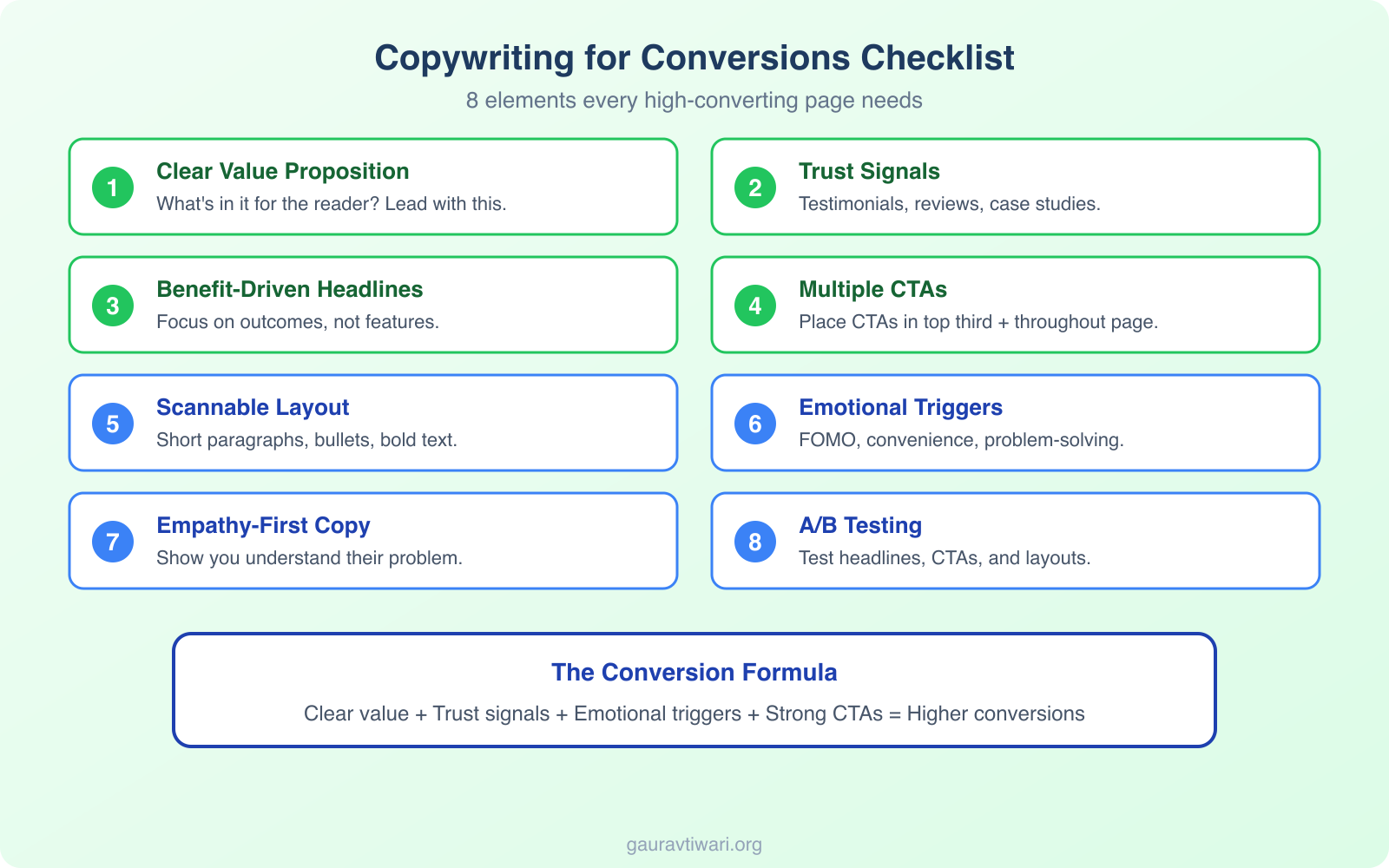
The first thing I’ve learned is that you’ve got to build trust. People aren’t going to take action if they don’t feel like they can trust you. Trust comes from the tone of your copy, the clarity of your messaging, and how well you understand your audience.
A real game-changer for me was using social proof. Testimonials, case studies, reviews, anything that shows you’ve delivered results for others. One of the first times I incorporated testimonials into a landing page, the conversion rate almost doubled. People are way more likely to trust a stranger’s experience than they are to believe a company’s own claims.
The layout of your copy matters too. People don’t have the patience to wade through text walls, especially when skimming for key details. Breaking things up with short paragraphs, bullet points, and bolded sections helps a ton. The more skimmable your content, the more likely it is that someone will stick around long enough to actually convert.
One time, I made the mistake of putting all the good stuff, features, benefits, and CTAs, toward the end of a page, thinking I was building up to this grand finale. Here’s the thing: people aren’t always going to read that far. You’ve got to lead with the most important information and make sure your CTAs are front and center. Ever since I started placing a CTA in multiple places throughout the page, especially in the top third, I’ve seen way better results.
Another big lesson: empathy plays a huge role in conversions. When you write from a place of understanding, showing your audience that you get their struggles, they’re way more likely to convert. If you’re selling a productivity tool, don’t just list features. Talk about how frustrating it is to juggle tasks and how your product can make that chaos a thing of the past.
Testing your copy is crucial too. Sometimes, the smallest tweak can make a world of difference. I once spent hours crafting what I thought was the perfect sales page, only to see it barely convert. After running some A/B tests, I realized that changing the headline to focus more on the problem (instead of the features) increased conversions significantly. Don’t assume you’ve nailed it on the first go.
And let’s talk about emotional triggers. People like to think they make decisions logically, but emotions almost always play a bigger role. Whether it’s fear of missing out, the desire for convenience, or the need to solve a pressing problem, tapping into the emotions behind why someone would want to convert can be super effective.
Common Copywriting Mistakes and How to Avoid Them
Copywriting might seem simple, but it’s way too easy to mess it up. And the worst part is, most of these mistakes are things you don’t even realize you’re making. Let’s go through the most common copywriting blunders I’ve made, and how to avoid them.
1. Overstuffing keywords
The rookie mistake we’ve all made at least once. When I first started out, I thought the more times I crammed my target keyword into a piece of copy, the better it would rank. So I’d write something like: “If you’re looking for the best SEO tools, here’s a list of the best SEO tools that will help you find the best SEO tools on the market.”
Painful to read, right? And Google hates it too. Use keywords naturally and sparingly. Focus on writing for humans first, search engines second. Use semantic keywords (related phrases) to help Google understand your content without overloading it.
2. Focusing too much on features
When I first started writing sales copy, I got caught up in listing all the cool features of a product. “It’s got a 10-hour battery life, 128GB storage, and weighs just 340 grams!” The thing is, most readers don’t care about features; they care about benefits.
Always translate features into benefits. Instead of “128GB storage,” say something like, “Enough storage space to hold all your favorite apps, photos, and music without slowing down your device.” Focus on how your product or service makes life better for the reader.
3. Writing too much (or too little)
There’s no perfect length for copy, it depends on the medium and the audience. But I’ve definitely been guilty of rambling on for way too long. I used to think that the more I wrote, the more value I was giving. Not true. On the flip side, I’ve also been too brief, failing to explain things thoroughly.
Focus on quality over quantity. Every sentence should serve a purpose. If something feels repetitive or irrelevant, cut it out. Write just enough to fully explain your point, then stop.
4. Failing to match user intent
There have been times when I’ve written what I thought was a killer blog post, only to find out it wasn’t converting or ranking well. The problem? I wasn’t matching the user’s intent. If someone’s searching for “best budget laptops,” they’re looking for product recommendations, not a detailed explanation of how laptops work.
Before you write, think about what the reader is looking for. Are they looking for information? A solution to a problem? A product? If you’re writing for SEO, check out the top-ranking pages for your target keyword. They’ll give you a good sense of what the reader expects.
5. Ignoring the power of the CTA
One of my early mistakes was assuming that people would just know what to do next. I’d write a solid blog post but then leave my readers hanging without a clear call to action. You’ve got to spell it out for them! Do you want them to buy something? Sign up for a newsletter? Share the post? Tell them exactly what to do next.
Every piece of copy you write should have a clear goal. Use actionable, benefit-driven language. Instead of “Click here,” try “Get your free trial now” or “Start saving today.”
6. Wrong tone for the audience
I once wrote a super casual, chatty piece for a professional, corporate client. Let’s just say, it didn’t go over well. On the flip side, I’ve written stiff, overly formal copy for a younger, more laid-back audience. Know your audience. Are they formal or casual? Do they prefer professional, no-nonsense language, or are they cool with a little humor?
7. Not proofreading thoroughly
Let’s be real: typos happen. But there’s a difference between the occasional slip-up and sending out copy that looks like it was typed with your eyes closed. I’ve made my fair share of embarrassing mistakes. It doesn’t matter how good your message is; if it’s riddled with errors, it’s going to distract your readers and make you look unprofessional.
Always, always proofread. Use a tool like Grammarly to catch errors. Step away from your copy for a while before coming back with fresh eyes. And if you can, get someone else to read it too.
8. Publishing AI-generated copy without editing
This is the newest mistake on this list, and it’s becoming the most common. I see it everywhere now: blog posts that are clearly AI-generated with zero human editing. They’re grammatically correct but completely generic. No personal voice, no specific examples, no real opinions. Just walls of competent but forgettable text.
Google has gotten much better at identifying and devaluing AI-generated content that doesn’t add unique value. Your readers can spot it too. If you use AI tools (and you should), treat their output as a rough draft, not a finished product. Every paragraph needs your voice, your experiences, and your specific point of view before it’s ready to publish.
Frequently Asked Questions
What’s the ideal length for website copy?
There’s no universal ideal length. Homepage copy should be concise and scannable, typically 500-1,000 words. Landing pages work best at 1,000-2,500 words because you need space to build a case for conversion. Blog posts perform best between 1,500-3,000 words for SEO purposes. The real answer: write exactly as much as you need to fully address the topic and nothing more. Every sentence should serve a purpose.
Can AI tools replace human copywriters?
No, but they can make human copywriters significantly more productive. AI tools are excellent for generating first drafts, brainstorming headline variations, writing meta descriptions, and catching grammatical errors. However, they can’t replicate genuine personal experience, nuanced opinions, brand voice consistency, or the kind of emotional resonance that comes from truly understanding your audience. The best approach is using AI as a writing assistant while keeping a human in the loop for voice, strategy, and quality control.
How do I write SEO-friendly copy without sounding robotic?
Focus on writing naturally first, then optimize. Use your target keyword in the title, first paragraph, and 2-3 subheadings. Throughout the body, use semantic keywords (related phrases and synonyms) instead of repeating the same keyword. Write as if you’re explaining something to a friend, and your keywords will naturally appear in context. Tools like Rank Math help you track keyword usage without over-optimizing. The key: if it sounds awkward when you read it out loud, rewrite it.
What’s the difference between copywriting and content writing?
Copywriting is persuasion-focused. Its primary goal is to get the reader to take a specific action: buy, sign up, click, or subscribe. Content writing is value-focused. Its primary goal is to inform, educate, or entertain. Blog posts, guides, and tutorials are content writing. Sales pages, product descriptions, and ad copy are copywriting. In practice, the best web content blends both. A blog post that educates but doesn’t include a call to action is a missed opportunity. A sales page that pushes too hard without providing value feels like spam.
How often should I update my website copy?
Review your key pages (homepage, service pages, about page) at least twice a year. Blog posts should be updated whenever the information becomes outdated or when you see ranking positions dropping. For time-sensitive content (tool recommendations, pricing comparisons, best-of lists), quarterly updates are ideal. Fresh content signals to Google that your site is actively maintained, and updated articles often see ranking improvements within weeks of being refreshed.
Resources and Inspirations
In preparation for this article, I had help. I used my existing experience but was also guided by valuable insights from the following books and websites:
Books
- “Everybody Writes” by Ann Handley – A fantastic guide to creating engaging, relatable, and high-quality content for the web. Get it on Amazon.com or Amazon.in
- “Made to Stick” by Chip Heath and Dan Heath – This book helped me understand how to make ideas “sticky” and memorable, a key aspect of good copywriting. Get it on Amazon.com or Amazon.in
- “Building a StoryBrand” by Donald Miller – A great resource on clarifying your message and writing for conversions by framing your audience as the hero of the story. Get it on Amazon.com or Amazon.in
- “The Copywriter’s Handbook” by Robert W. Bly – An oldie but a goodie that offers timeless tips on effective copywriting, especially when it comes to persuasive writing. Get it on Amazon.com or Amazon.in
- “Very Good Copy” by Eddie Shleyner – Packed with micro-courses and articles on copywriting, offering actionable insights and bite-sized lessons. Get it on Amazon.com or Amazon.in
Websites
- Copyblogger – A great resource for content creators looking to improve their copywriting and content marketing skills.
- Backlinko – Brian Dean’s Backlinko (now Semrush‘s) is a must-read for anyone looking to master SEO and content optimization.
- Ahrefs Blog – A go-to resource for SEO best practices and how they tie into effective content writing.
- gauravtiwari.org – My treasure trove of articles and guides on SEO, website optimization, and content creation.
The art of effective copywriting really comes down to understanding who you’re writing for and making sure every word serves a purpose. Keep your copy readable, include compelling CTAs, and sprinkle in some SEO magic. Whether you’re using AI tools to speed up your workflow or writing everything from scratch, the principles don’t change: be clear, be human, be useful. That’s what gets read, and that’s what converts.
Disclaimer: This site is reader-supported. If you buy through some links, I may earn a small commission at no extra cost to you. I only recommend tools I trust and would use myself. Your support helps keep gauravtiwari.org free and focused on real-world advice. Thanks. - Gaurav Tiwari