
Poincare and Einstein: Who Really Discovered Relativity?
The standard narrative is clean: Einstein published “On the Electrodynamics of Moving Bodies” in 1905, and special relativity was born. One man, one paper, one revolution.
The actual history is messier. By June 1905, Henri Poincare had already identified the Lorentz group, proved the invariance of the spacetime interval \( x^2 + y^2 + z^2 – c^2t^2 \), derived relativistic velocity addition, proposed a covariant theory of gravitation, and stated the principle of relativity in language nearly identical to Einstein’s first postulate. He had the mathematics. All of it.
And yet… he didn’t discover relativity. Not quite. The gap between “nearly all the pieces” and “a new theory of space and time” turns out to be the most instructive gap in the history of modern physics.
The Crisis That Forced the Question
Between April and July 1887, Albert Michelson and Edward Morley conducted what became the most consequential null result in 19th-century physics. Their interferometer was designed to detect Earth’s motion through the luminiferous ether by measuring differences in the speed of light along perpendicular directions. If the ether existed as a fixed medium for light propagation, a measurable “ether wind” should produce a phase shift in the interference pattern.
Nothing. No shift. The speed of light appeared identical in all directions regardless of Earth’s orbital velocity of roughly 30 km/s.
This was not a small problem. The entire edifice of 19th-century electrodynamics rested on the ether hypothesis. Maxwell’s equations described electromagnetic waves propagating through this medium. Remove the ether, and you had to explain what light was waving in.
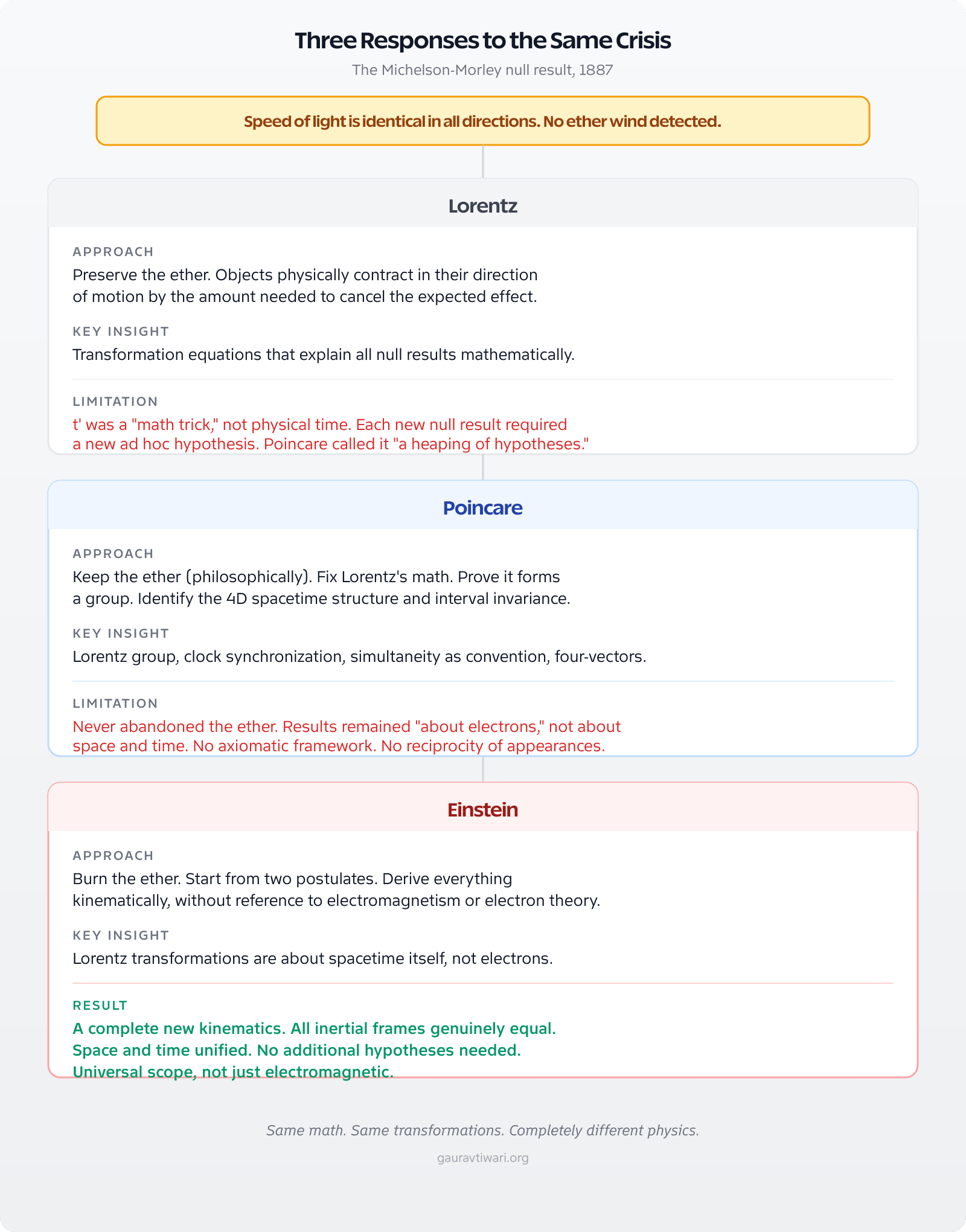
Three physicists responded to this crisis. Each response reveals something different about the relationship between mathematical formalism and physical understanding.
Lorentz: Saving the Ether by Deforming Matter
Hendrik Lorentz’s approach was conservative and ingenious. If experiments couldn’t detect the ether, perhaps objects physically contracted in their direction of motion through it, by precisely the amount needed to cancel the expected effect. George FitzGerald had proposed the same idea independently in 1889.
By 1904, Lorentz had developed this into a full mathematical framework. His paper “Electromagnetic phenomena in a system moving with any velocity smaller than that of light” introduced transformation equations between coordinates in the ether rest frame and a moving frame:
$$ x’ = \gamma(x – vt), \quad t’ = \gamma\left(t – \frac{vx}{c^2}\right), \quad \gamma = \frac{1}{\sqrt{1 – v^2/c^2}} $$
The mathematics was nearly correct. But Lorentz treated the primed coordinates as mathematical fictions. The quantity \( t’ \) was “local time,” a computational tool, not what a moving clock actually reads. The ether frame remained the physically real one. Length contraction was a dynamical effect of motion through the ether, not a kinematic consequence of spacetime structure.
Lorentz was patching holes. Each new null result required a new hypothesis to explain why the ether remained undetectable. Poincare saw this clearly and criticized it as “a heaping of hypotheses.”
Poincare: The Mathematician Who Saw Everything Except the Point
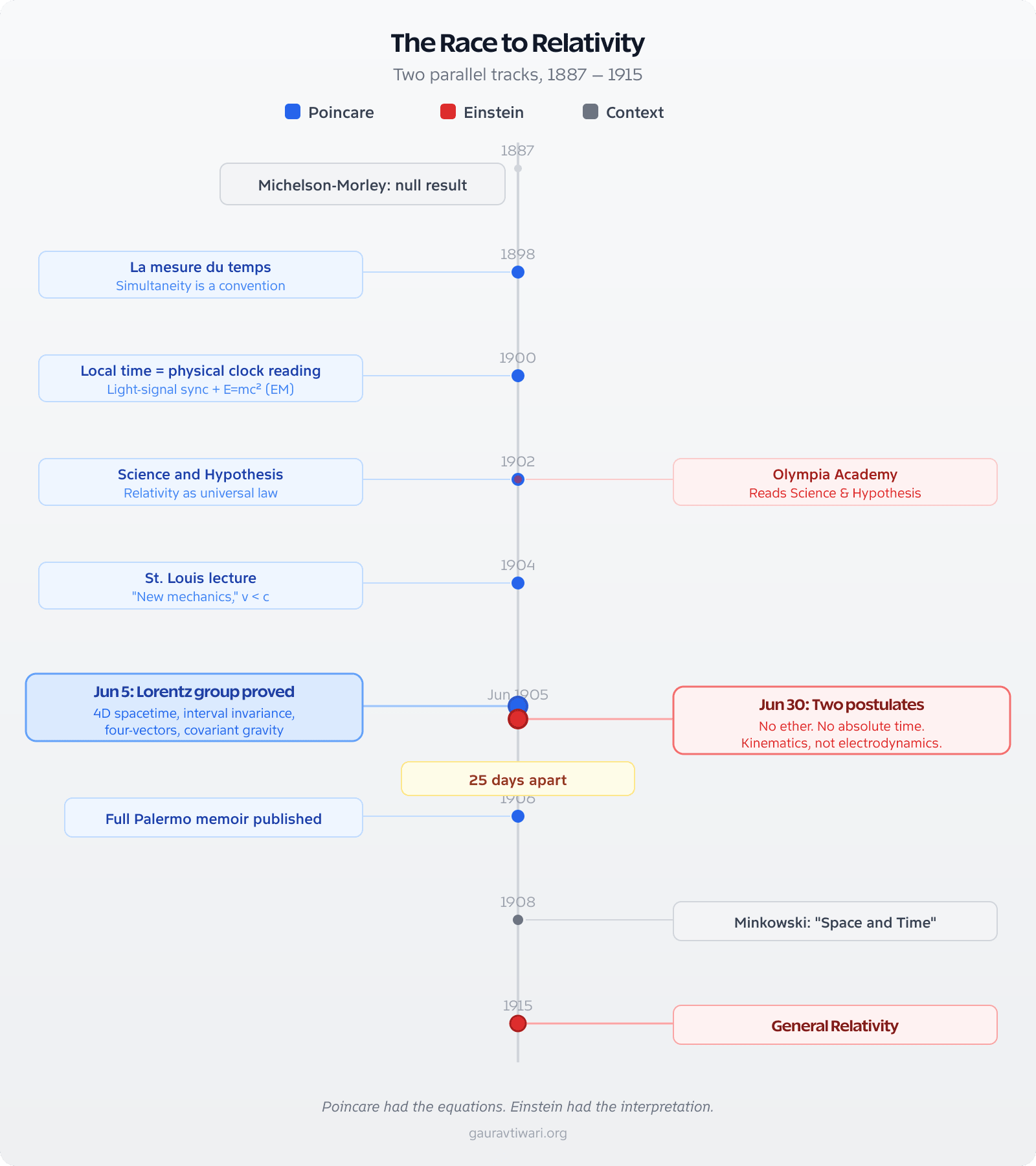
Poincare’s engagement with this problem spanned a decade and produced work of extraordinary mathematical depth. Tracing the timeline reveals how close he came.
1898: The Conventionality of Simultaneity
In “La mesure du temps,” Poincare argued that simultaneity between spatially separated events has no absolute meaning. It is always established by convention, typically using light signals. He wrote that “all these affirmations have by themselves no meaning. They can have one only as the result of a convention.” This is a profound epistemological insight and it anticipates Einstein’s operational definition of simultaneity by seven years.
1900: The Physical Meaning of Local Time
This is where it gets remarkable. At the Lorentz Festschrift, Poincare gave a physical interpretation of Lorentz’s “local time” that Lorentz himself had treated as pure mathematical convenience. Poincare described a thought experiment: two observers A and B, moving through the ether, synchronize their clocks by exchanging light signals and correcting for transmission time. The time they measure is precisely Lorentz’s \( t’ \).
This is structurally identical to the synchronization procedure in Einstein’s 1905 paper. Peter Galison’s research shows Poincare arrived at this through his work at the Bureau des Longitudes on coordinating clocks across the French empire via telegraph. Einstein, working at the Bern patent office, came to the same operational definition through patent applications for electromagnetic clock-coordination systems. Different institutional contexts, same physics.
In a separate 1900 paper, Poincare also derived \( E = mc^2 \) in a limited, electromagnetic context, five years before Einstein’s general formulation.
1902: Science and Hypothesis
Poincare’s widely read philosophical text argued that the relativity principle, the idea that no experiment can reveal absolute motion, was likely a universal law of nature. This book was studied closely by Einstein and his friends in the Olympia Academy in Bern during the years immediately preceding the 1905 paper.
1904: The St. Louis Lecture
At the International Congress of Arts and Science, Poincare stated what may be the clearest pre-Einstein formulation of the relativity principle:
The principle of relativity, according to which the laws of physical phenomena must be the same for a stationary observer as for one carried along in a uniform motion of translation, so that we have no means, and can have none, of determining whether or not we are being carried along in such a motion.
This is not a hedged statement. He elevated the relativity principle to the same status as energy conservation. He proposed a “new mechanics” in which no velocity can exceed the speed of light. He was, in every measurable way, circling the same territory Einstein would claim the following year.
June 5, 1905: Sur la dynamique de l’electron
Three weeks before Einstein submitted his paper. Poincare’s note to the Academie des Sciences corrected errors in Lorentz’s 1904 paper, gave the transformations their final symmetric form, and proved they form a mathematical group, a property Lorentz had missed entirely. He named it the “Lorentz group.”
The extended memoir, submitted in July 1905 and published in 1906 in the Rendiconti del Circolo Matematico di Palermo, went further. Poincare:
- Proved the Lorentz transformations form a group (composition, identity, inverse)
- Demonstrated the invariance of the spacetime interval \( x^2 + y^2 + z^2 – c^2t^2 \)
- Introduced a four-dimensional representation of spacetime using \( ict \) as the fourth coordinate, predating Minkowski’s 1908 formalization
- Developed four-vectors
- Derived relativistic velocity addition
- Proposed the first Lorentz-covariant law of gravitation propagating at the speed of light
- Applied the principle of least action to relativistic dynamics
The mathematics of special relativity was, at this point, largely complete in Poincare’s hands. As the historian Olivier Darrigol put it: “Most of the components of Einstein’s paper appeared in others’ anterior works on the electrodynamics of moving bodies.”
Einstein: The Physicist Who Saw What the Mathematics Meant
Einstein’s paper, received by Annalen der Physik on June 30, 1905, contained no bibliography. No references to Lorentz’s 1904 paper. No mention of Poincare. It started from scratch.
Two postulates. That’s all.
First postulate: The laws of physics take the same form in all inertial frames of reference.
Second postulate: The speed of light in vacuum is constant and independent of the motion of the source.
From these two statements alone, plus the assumptions of spatial homogeneity and isotropy, Einstein derived the Lorentz transformations, time dilation, length contraction, relativistic velocity addition, the relativistic Doppler effect, and aberration formulas. Everything Poincare and Lorentz had built over a decade of intricate electromagnetic theory, Einstein produced in a few pages from first principles about the nature of space and time.
Einstein later wrote in 1953: “The new feature of it was the realization of the fact that the bearing of the Lorentz transformation transcended its connection with Maxwell’s equations and was concerned with the nature of space and time in general.”
That single sentence captures the entire difference.
The Precise Gap Between Poincare and Einstein
The differences are not mathematical. They are conceptual, and they are fundamental.
The ether. Poincare never abandoned it. He retained the ether as the privileged frame where “true” time exists, even as he proved that no experiment could detect it. Einstein’s opening sentence declared the ether “superfluous.” For Einstein, all inertial frames are genuinely equivalent. For Poincare, one frame remains philosophically privileged even if experimentally invisible.
The foundation. Poincare’s work remained embedded in the electrodynamics of Lorentz. He was correcting and extending a theory of the electron. Einstein derived the same results kinematically, from axioms about space and time measurement, without any reference to electromagnetism. This meant Einstein’s results applied to all of physics, not just to electrons moving through fields.
Simultaneity. Poincare argued for the conventionality of simultaneity. It’s a choice. Einstein argued that once the choice is made via light signals, the result is what simultaneity means. There’s no hidden “true” simultaneity behind the convention. And crucially, as Darrigol noted, Poincare “did not require reciprocity of the appearances.” If observer A measures B’s clock as running slow, Einstein insisted B must equally measure A’s clock as running slow. That physical reciprocity is the heart of relativity. Poincare didn’t demand it.
Length contraction. Poincare treated Lorentz-FitzGerald contraction as an independent third hypothesis requiring separate justification. Einstein derived it as a consequence of his two postulates. Abraham Pais, in his definitive Einstein biography Subtle is the Lord, wrote that Poincare “failed, because… he treated length contraction as a third independent hypothesis.”
The axiomatic method. Einstein organized everything into a deductive system: state postulates, derive consequences. Poincare’s philosophical temperament toward conventionalism may have actually inhibited this. If the relativity principle is a “convention” rather than a law of nature, it can’t serve as an axiom you build a theory on.
What Each Contributed: A Comparison
| Contribution | Lorentz | Poincare | Einstein |
|---|---|---|---|
| Lorentz transformations (exact form) | 1904 | 1905 (corrected) | 1905 (derived from postulates) |
| Group structure of transformations | No | 1905 (named the Lorentz group) | Not explicit |
| Relativity principle (general) | No | 1895-1904 | 1905 |
| Clock synchronization via light signals | No | 1898-1900 | 1905 |
| Physical meaning of local time | No (math tool only) | Partial (1900) | Yes (1905) |
| Ether abandoned | No | No | Yes |
| Axiomatic derivation from 2 postulates | No | No | Yes |
| Kinematic (not electrodynamic) foundation | No | No | Yes |
| Spacetime interval invariance | No | 1906 (explicit) | Implicit 1905 |
| Four-dimensional formalism | No | 1906 | No (Minkowski 1908) |
| Mass-energy equivalence | No | Limited EM context (1900) | General (1905) |
| Covariant gravitation theory | No | 1906 | 1915 (general relativity) |
The Poincare Group: Legacy in Modern Physics
The deepest irony of this story is that Poincare’s mathematical contribution, the one Einstein didn’t make, turned out to be among the most important structures in all of theoretical physics.

The Poincare group is the full isometry group of Minkowski spacetime. It combines Lorentz transformations (rotations and boosts) with spacetime translations into a 10-dimensional non-abelian Lie group, formally the semidirect product \( \mathbb{R}^{1,3} \rtimes O(1,3) \). Its ten generators, via Noether’s theorem, yield the fundamental conservation laws:
- 4 spacetime translations → conservation of energy and momentum
- 3 spatial rotations → conservation of angular momentum
- 3 Lorentz boosts → conservation of center-of-mass velocity
In 1939, Eugene Wigner showed that every elementary particle corresponds to an irreducible representation of the Poincare group. The two Casimir invariants, \( m^2 \) (mass squared) and \( s(s+1) \) (spin), are precisely the quantum numbers that classify every particle in the Standard Model. An electron is not just “a particle with mass 0.511 MeV and spin 1/2.” It is a specific representation of the Poincare group. That’s the definition.
Every relativistic quantum field theory, quantum electrodynamics, quantum chromodynamics, the electroweak theory, the full Standard Model, is built on Poincare invariance as the foundational symmetry constraint. Minkowski’s 1908 geometric picture of spacetime, the one that became standard, drew directly on Poincare’s 1906 identification of the spacetime interval and four-dimensional representation.
The name Poincare attaches to the mathematical structure. The name Einstein attaches to the physical interpretation. Both are correct attributions.
What This Tells Us About Discovery
Marie-Antoinette Tonnelat, the French physicist, summarized it directly: “Poincare’s thinking disagrees with that of Einstein. The crisis of relativity is, in Poincare’s view, a purely experimental and probably only passing issue.” In 1904, Poincare wrote: “We shall only hand over the matter to the experimenters… and tranquilly continue our work as if the principles were still uncontested.”
Einstein’s response to the same crisis was to declare it permanent and resolve it by burning the ether.
Darrigol’s final assessment: “Lorentz, Poincare and Einstein all contributed to the emergence of the theory of relativity, Poincare and Einstein offered two different versions of the theory, and Einstein gave form to what today is considered the best one.” Galison, somewhat wearily: “Did Einstein really discover relativity? Did Poincare already have it? These old questions have grown as tedious as they are fruitless.”
But the questions aren’t fruitless for anyone trying to understand how physics actually progresses. The Poincare-Einstein story demonstrates that mathematical formalism and physical understanding are not the same thing. You can have every equation and still miss the theory. You can prove the group structure, derive the invariants, write down the four-vectors, and still not see that space and time themselves have changed.
Poincare built the mathematical edifice. Einstein moved into it, knocked out the walls labeled “ether” and “absolute time,” and declared it a new building entirely. The mathematics didn’t change. The physics changed completely.
That gap, between having the formalism and grasping what the formalism means, is where the deepest scientific revolutions live.
Further Reading
- Abraham Pais, Subtle is the Lord: The Science and the Life of Albert Einstein (1982) — the definitive scientific biography
- Peter Galison, Einstein’s Clocks, Poincare’s Maps: Empires of Time (2003) — institutional and technological context
- Olivier Darrigol, “The Genesis of the Theory of Relativity” (2006) — the most balanced modern historical analysis
- Best General Relativity Books for Beginners — for the mathematical foundations
- Understanding the Poincare Conjecture — Poincare’s other enduring contribution to mathematics
- Symmetry in Physical Laws — the role of symmetry groups in modern physics
- Best Physics Textbooks for College Students
- Special Theory of Relativity: Study Notes