
Top 10 On-Demand Service Apps That Will Encourage You To Develop Your Own
You tap a button and a driver shows up in three minutes. Tap another and someone’s cleaning your apartment by noon. A decade ago, that sounded futuristic. Now it’s Tuesday.
The on-demand economy hit $335 billion globally in 2024 and isn’t slowing down. From food delivery in Mumbai to ride-hailing in Lagos to home repairs in Berlin, on-demand service apps have reshaped how people access everything from transportation to healthcare. If you’re building a startup, studying the market, or just curious about what’s working across different regions, these are the apps setting the pace in 2026.
What Makes On-Demand Service Apps Work
Every successful on-demand service app solves the same core problem: it connects people who need something done with people who can do it, faster than traditional methods. The model works because it removes friction. No phone calls to schedule, no waiting for business hours, no uncertainty about pricing.
The best on-demand platforms share three traits. First, they nail real-time matching, pairing supply with demand within seconds. Second, they handle payments, reviews, and dispute resolution so both sides trust the transaction. Third, they use location data and algorithms to optimize the entire experience, from estimated arrival times to dynamic pricing during peak hours.
What’s changed recently is the geographic spread. On-demand apps used to be a Silicon Valley story. Now the biggest growth is happening in India, Southeast Asia, Latin America, and parts of Africa. Each region has its own dominant players, and they’ve adapted the model to local infrastructure, payment methods, and consumer behavior in ways that US-based apps never could.
The on-demand economy isn’t just about convenience anymore. In markets like India and Southeast Asia, these apps have become critical infrastructure, providing employment to millions and enabling small businesses to reach customers they couldn’t access before.
Top On-Demand Service Apps in 2026
This list covers the most impactful on-demand service apps across food delivery, ride-hailing, home services, grocery delivery, and multi-service super apps. I’ve organized them by category with coverage across the US, EU, India, and global markets.
Food Delivery Apps
Food delivery remains the largest on-demand category globally. These three apps dominate their respective markets.
1. DoorDash (US, Canada, Australia, Japan)
DoorDash controls roughly 67% of the US food delivery market as of late 2024. Founded in 2013 by Stanford students Tony Xu, Stanley Tang, Andy Fang, and Evan Moore, the company went public in December 2020 and now operates in over 30 countries after acquiring Wolt (the leading European delivery platform) for $8.1 billion in 2022.
What sets DoorDash apart is the DashPass subscription ($9.99/month) that eliminates delivery fees on orders over $12. For frequent users, it pays for itself within two to three orders. The platform also expanded beyond restaurants into convenience stores, grocery, pet supplies, and alcohol delivery through its DashMart dark stores.
DoorDash’s logistics network handles over 2 billion orders annually. Their driver (Dasher) model lets anyone with a car, bike, or even on foot deliver in dense urban areas. The company reported $8.6 billion in revenue for 2024, making it the undisputed leader in North American food delivery.
Region: US (dominant), Canada, Australia, Japan, Germany, and 25+ countries via Wolt
Revenue model: Commission from restaurants (15-30%), delivery fees, DashPass subscriptions
Why it works: Massive restaurant selection, reliable delivery times averaging 30-35 minutes, and a subscription model that locks in repeat customers
2. Deliveroo (UK, EU, Middle East)
Deliveroo is the go-to food delivery app across the UK, Ireland, France, Italy, Belgium, UAE, Kuwait, Qatar, and Hong Kong. Founded in London in 2013 by Will Shu (a former Morgan Stanley banker who couldn’t find good delivery food in his neighborhood), the company went public on the London Stock Exchange in 2021.
Deliveroo’s competitive edge is Editions, their dark kitchen program. They build shared kitchen spaces where multiple restaurant brands operate delivery-only locations. This lets popular restaurants expand into new neighborhoods without the cost of a full storefront. For consumers, it means better food selection in areas that traditionally had limited options.
The Deliveroo Plus subscription (from £3.49/month in the UK) offers free delivery on orders over £25. The platform also supports grocery delivery through partnerships with major supermarkets including Waitrose, Sainsbury’s, Carrefour, and Co-op.
Region: UK (dominant), France, Italy, Belgium, Ireland, UAE, Kuwait, Qatar, Hong Kong
Revenue model: Restaurant commissions, delivery fees, Deliveroo Plus subscriptions, advertising
Why it works: Strong brand loyalty in the UK, dark kitchen innovation, and strategic focus on premium restaurant partnerships rather than just volume
3. Swiggy (India)
Swiggy is India’s largest on-demand food delivery platform, operating in 580+ cities with over 200,000 restaurant partners. Founded in 2014 in Bengaluru by Sriharsha Majety, Nandan Reddy, and Rahul Jaimini, the company went public on the Bombay Stock Exchange (BSE) and National Stock Exchange (NSE) in November 2024 with a valuation of approximately $11.3 billion.
Swiggy expanded well beyond food. Swiggy Instamart handles 10-minute grocery delivery across 40+ cities. Swiggy Genie works as a pick-up-and-drop service for sending packages across town. Swiggy Dineout offers restaurant table reservations with discounts. This multi-vertical approach mirrors the super-app strategy that’s proven successful across Asia.
Swiggy’s delivery fleet of over 300,000 active partners is one of the largest gig workforces in India. The company competes directly with Zomato (also publicly listed) in a market where food delivery is growing at 25-30% annually. Swiggy One membership (starting at INR 99/month) offers free delivery, extra discounts, and priority support.
Region: India (580+ cities)
Revenue model: Restaurant commissions, delivery fees, Swiggy One subscriptions, Instamart margins, advertising
Why it works: Deep local market understanding, multi-vertical approach, and a delivery network that reaches beyond metros into tier-2 and tier-3 Indian cities
Ride-Hailing and Transportation Apps
Ride-hailing was the original on-demand category. These platforms have since expanded into food delivery, package logistics, and financial services.
4. Uber (Global)
Uber operates in 72 countries and over 10,000 cities, making it the most geographically widespread on-demand app ever built. Founded in 2009 by Travis Kalanick and Garrett Camp in San Francisco, Uber essentially created the modern ride-hailing category. The company hit $43.9 billion in revenue in 2024 and recorded its first full-year operating profit in 2023.
Uber’s ecosystem now includes Uber Rides, Uber Eats (food delivery), Uber Freight (trucking logistics), Uber Health (non-emergency medical transportation), and Uber for Business (corporate travel management). Uber Eats alone generated over $12 billion in bookings in 2024. The platform processes 28 million trips daily across all services.
In the EU, Uber operates under stricter regulatory frameworks. The UK Supreme Court ruled Uber drivers are “workers” (not independent contractors) in 2021, leading to minimum wage guarantees and holiday pay. Similar regulations are being implemented across the EU under the Platform Workers Directive passed in 2024. In India, Uber competes with Ola in the ride-hailing space and with Swiggy/Zomato in food delivery.
Region: 72 countries globally, dominant in the US, strong presence in Europe, India, Latin America, Middle East
Revenue model: Ride commissions (25-30%), Uber Eats commissions, Uber One subscriptions ($9.99/month), Uber Freight fees
Why it works: Unmatched global scale, multi-service ecosystem, and the network effect of having the largest driver pool in most markets
5. Bolt (EU and Africa)
Bolt is Uber’s biggest competitor in Europe and Africa. Founded in 2013 in Tallinn, Estonia by Markus Villig (who was 19 at the time), Bolt operates in 45+ countries with over 200 million customers. The company is valued at $8.4 billion and has been profitable in its ride-hailing segment since 2023.
Bolt’s competitive advantage is pricing. They take a smaller commission from drivers (15-20% vs Uber’s 25-30%), which means lower fares for riders and better earnings for drivers. This pricing strategy has made Bolt the preferred choice in price-sensitive European markets like Poland, Romania, Czech Republic, and the Baltics, as well as across Africa where Bolt operates in Nigeria, South Africa, Kenya, Ghana, and Tanzania.
Beyond rides, Bolt offers Bolt Food (delivery), Bolt Market (groceries in 15 minutes), Bolt Drive (car sharing), and Bolt Scooters (e-scooter rentals). They’ve also launched Bolt Business for corporate accounts. In several EU markets, Bolt Food has overtaken Uber Eats in market share.
Region: 45+ countries across Europe (dominant in Eastern Europe and Baltics) and Africa
Revenue model: Ride commissions (15-20%), food delivery fees, scooter rental fees, car-sharing margins
Why it works: Lower prices than Uber through smaller commissions, aggressive expansion in underserved European and African markets, and a multi-service approach that keeps users within the ecosystem
Home Services and Handyman Apps
Home services represent a massive on-demand opportunity. Getting a plumber, electrician, or cleaner used to mean calling around, waiting for callbacks, and hoping they’d show up. These apps fixed that.
6. Urban Company (India, UAE, Saudi Arabia, Australia)
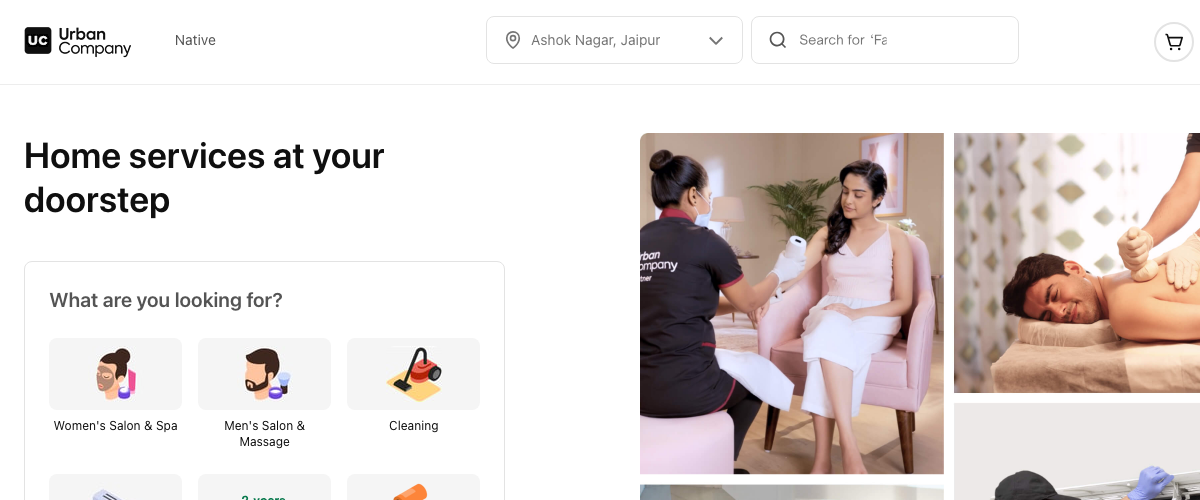
Urban Company (formerly UrbanClap) is the world’s largest on-demand home services marketplace. Founded in 2014 in Gurgaon, India by Abhiraj Bhal, Varun Khaitan, and Raghav Chandra, the company serves over 40 million customers across India, UAE, Saudi Arabia, Singapore, and Australia. They completed their IPO filing in early 2025.
What makes Urban Company different from a simple aggregator is their training and quality control. Every service professional goes through skill verification, background checks, and standardized training. They provide equipment and supplies, ensuring consistent service quality regardless of which professional shows up. This approach solves the trust problem that kills most home services marketplaces.
The service catalog is extensive: salon and spa at home, appliance repair, deep cleaning, pest control, painting, plumbing, electrical work, carpentry, and even fitness training. In India, Urban Company has become the default app for home services, the way Uber became the default for rides. Pricing is transparent and standardized, which was revolutionary in a market where haggling and variable pricing were the norm.
Region: India (40+ cities, dominant), UAE, Saudi Arabia, Singapore, Australia
Revenue model: Commission from service providers (15-25%), lead generation fees, UC Plus subscriptions
Why it works: Standardized training and quality control in a market plagued by inconsistency, transparent pricing, and an app experience that’s genuinely easier than finding a local plumber through WhatsApp groups
7. TaskRabbit (US, UK, Canada, EU)
TaskRabbit connects you with skilled “Taskers” who handle everything from furniture assembly (they’re IKEA’s official assembly partner) to moving help, cleaning, handyman work, yard maintenance, and personal assistance. Founded in 2008 in Boston by Leah Busque, the company was acquired by IKEA’s parent company Ingka Group in 2017.
The IKEA integration is a masterstroke. When you buy a Billy bookcase or Malm dresser, TaskRabbit’s assembly service is offered directly at checkout. This gives TaskRabbit a steady stream of customers who already trust the IKEA brand. The integration extends to IKEA stores in the US, UK, Canada, France, Germany, Italy, Spain, Portugal, and the Netherlands.
TaskRabbit operates on a marketplace model where Taskers set their own hourly rates. You browse profiles with reviews, skills, and pricing, then book directly. Average Tasker earnings range from $25-45/hour depending on the task and market. The platform handles payments, insurance, and dispute resolution.
Region: US (64 cities), UK, Canada, France, Germany, Italy, Spain, Portugal, Netherlands
Revenue model: Service fees (15% from Taskers + trust and support fee from clients), IKEA partnership revenue
Why it works: The IKEA partnership provides reliable demand, the marketplace model lets skilled workers earn well, and the review system builds trust for tasks you’d normally only give to someone you know
8. Thumbtack (US)
Thumbtack takes a different approach from TaskRabbit. Instead of small tasks, Thumbtack connects homeowners with licensed professionals for larger projects: home remodeling, plumbing, electrical work, roofing, painting, landscaping, wedding planning, and personal training. The platform serves 1,100+ service categories across all 50 US states.
Founded in 2008 by Marco Zappacosta and Jonathan Swanson, Thumbtack has raised over $700 million in funding and was valued at $3.2 billion. The company processes millions of projects annually with an average project value significantly higher than task-based platforms.
Thumbtack’s business model is lead-based. Professionals pay for leads (customer inquiries) rather than commissions on completed work. This means you can get multiple quotes from verified pros, compare reviews and pricing, and choose who to hire. For professionals, the cost per lead ranges from $5-200+ depending on the service category and market.
Region: US (nationwide, all 50 states)
Revenue model: Lead fees from professionals, Thumbtack Guarantee (insurance) upsells
Why it works: Higher-value projects with licensed professionals, the quoting system lets consumers comparison shop, and the review system holds contractors accountable in an industry notorious for unreliable service
Grocery and Quick Commerce Apps
Quick commerce (delivery in 10-30 minutes) is the fastest-growing segment of the on-demand economy. These apps are changing how people buy everyday essentials.
9. Instacart (US, Canada)
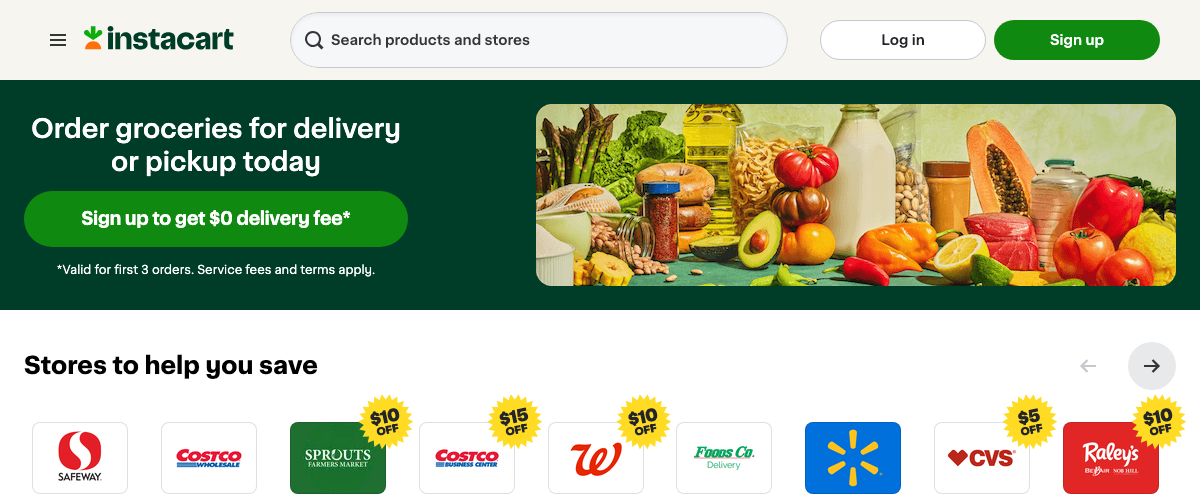
Instacart dominates North American grocery delivery with partnerships across 1,500+ retail banners including Costco, Kroger, Walmart (in some regions), Publix, Aldi, Sprouts, and Sam’s Club. Founded in 2012 by Apoorva Mehta (former Amazon engineer), Instacart went public in September 2023 on the Nasdaq.
The platform uses personal shoppers who pick your groceries in-store, communicate substitutions in real-time, and deliver to your door. Instacart+ membership ($99/year or $9.99/month) offers free delivery on orders over $35, reduced service fees, and credit back on pickup orders. The company reported $3.3 billion in revenue for 2024.
Instacart has pivoted from pure delivery into retail technology. Caper Carts (smart shopping carts with built-in scales and scanners), Connected Stores (sensor-based inventory management), and their advertising platform (Instacart Ads) now generate significant revenue. Retailers use Instacart’s technology even in their own stores, not just for delivery.
Region: US (nationwide), Canada
Revenue model: Delivery/service fees, Instacart+ subscriptions, advertising platform, retail technology licensing (Caper Carts, Connected Stores)
Why it works: Partnerships with virtually every major grocery chain, real-time communication with shoppers about substitutions, and the expanding tech platform that makes Instacart valuable to retailers beyond just delivery
10. Getir (Turkey, EU)
Getir pioneered ultrafast grocery delivery, promising delivery in 10-15 minutes from dark stores (small fulfillment centers positioned in residential neighborhoods). Founded in 2015 in Istanbul by Nazim Salur, Serkan Borancili, and Tuncay Tutek, Getir proved the model in Turkey before expanding aggressively across Europe.
The quick commerce model works differently from Instacart. Instead of shopping at existing stores, Getir operates its own micro-fulfillment centers stocked with 1,500-2,000 of the most commonly ordered items. Couriers on bikes or mopeds deliver within minutes. The trade-off is smaller selection but dramatically faster delivery.
After rapid expansion and contraction (Getir pulled out of the US, UK, and several EU markets during the 2023 cost-cutting wave), the company refocused on its core markets: Turkey (where it’s deeply profitable) and select European cities. The quick commerce shakeout eliminated weaker competitors like Gorillas (acquired by Getir) and Flink, leaving a more sustainable market.
Region: Turkey (dominant), Germany, select EU markets
Revenue model: Product margins (markup on items), delivery fees, minimum order requirements
Why it works: The 10-minute delivery promise is addictive once you’ve tried it, the dark store model enables better inventory control and fresher products, and the unit economics have improved significantly after the industry consolidation
If you’re building an on-demand service app, study how these companies handle their toughest challenge: supply-side economics. Getting enough drivers, service providers, or delivery partners to ensure fast response times is harder than acquiring customers. Bolt solved this with lower commissions. Urban Company solved it with training and equipment. TaskRabbit solved it with the IKEA partnership.
Super Apps (Multi-Service Platforms)
Super apps bundle multiple on-demand services into a single platform. This model is dominant in Asia and Latin America, where consumers prefer one app that handles rides, food, payments, and more.
11. Grab (Southeast Asia)
Grab is Southeast Asia’s everything app. Ride-hailing, food delivery, grocery delivery, package delivery, digital payments (GrabPay), insurance, investments, and lending, all inside one app. Founded in 2012 in Malaysia by Anthony Tan and Tan Hooi Ling, Grab went public on the Nasdaq in December 2021 via SPAC at a $40 billion valuation.
Grab operates in 8 countries: Singapore, Malaysia, Indonesia, Thailand, Vietnam, Philippines, Cambodia, and Myanmar. The company processes over $20 billion in gross merchandise value annually. GrabPay has become one of the most widely used digital wallets in the region, accepted at millions of online and offline merchants.
The super-app strategy creates powerful lock-in. A user who rides with Grab, orders food through GrabFood, pays with GrabPay, and gets groceries through GrabMart generates data across multiple touchpoints. This data powers personalized offers, credit scoring for GrabFin (their financial services arm), and increasingly accurate demand prediction.
Region: Singapore, Malaysia, Indonesia, Thailand, Vietnam, Philippines, Cambodia, Myanmar
Revenue model: Ride commissions, food delivery fees, GrabPay transaction fees, financial services margins, advertising
Why it works: The super-app model creates ecosystem lock-in, GrabPay makes the financial services layer sticky, and deep localization (Grab adapts to each country’s payment preferences, language, and regulations) keeps regional competitors at bay
12. Rappi (Latin America)
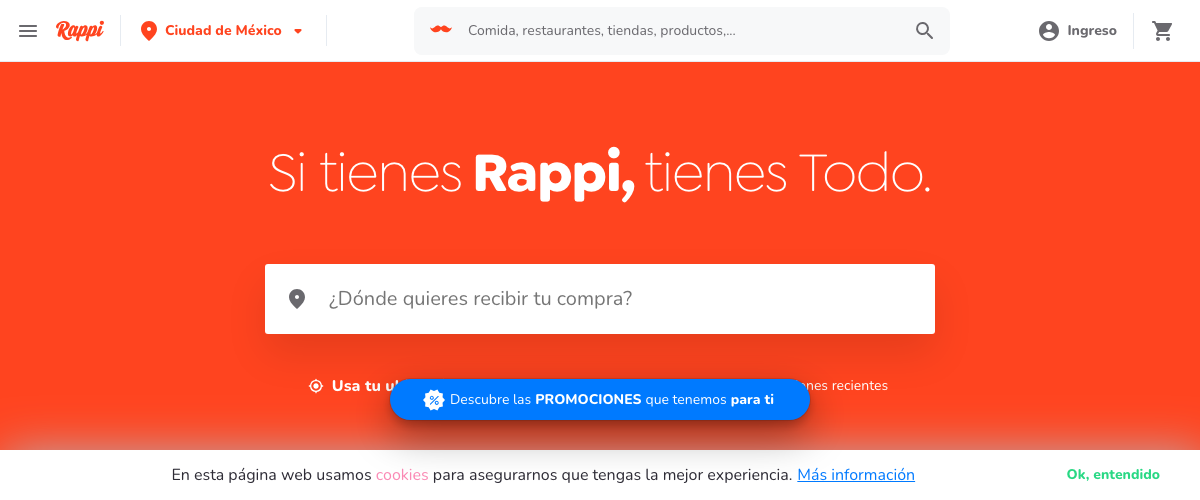
Rappi is Latin America’s leading super app, operating across Colombia, Mexico, Brazil, Argentina, Chile, Peru, Ecuador, Costa Rica, and Uruguay. Founded in 2015 in Bogota, Colombia by Simon Borrero, Sebastian Mejia, and Felipe Villamarin, the company is backed by SoftBank and valued at over $5 billion.
Rappi’s service range is staggering. Food delivery, grocery delivery, pharmacy delivery, alcohol delivery, cash withdrawals (a courier brings you cash from an ATM), bill payments, event tickets, travel bookings, and even a “Rappi Favors” category where you can request almost anything. Need someone to stand in line for you at a government office? Rappi will do it.
RappiPay, their fintech arm, has launched credit cards, savings accounts, and digital payments across multiple Latin American markets. The financial services play mirrors Grab’s strategy in Asia. Rappi Prime ($4.99/month in most markets) offers unlimited free delivery, exclusive discounts, and access to RappiPay perks.
Region: Colombia, Mexico, Brazil, Argentina, Chile, Peru, Ecuador, Costa Rica, Uruguay
Revenue model: Delivery fees, restaurant commissions, Rappi Prime subscriptions, RappiPay transaction fees, advertising
Why it works: The “deliver anything” positioning resonates in Latin American markets where traditional services are fragmented and unreliable, the Rappi Favors feature creates viral word-of-mouth, and RappiPay addresses the large unbanked population
On-Demand Apps by Region
Different regions have different leaders. Here’s a quick breakdown of which apps dominate where.
| Region | Food Delivery | Ride-Hailing | Home Services | Super App |
|---|---|---|---|---|
| United States | DoorDash, Uber Eats | Uber, Lyft | TaskRabbit, Thumbtack | – |
| United Kingdom | Deliveroo, Just Eat, Uber Eats | Uber, Bolt | TaskRabbit, Bark | – |
| EU (Western) | Deliveroo, Wolt, Just Eat Takeaway | Bolt, Uber, FREE NOW | TaskRabbit, Helpling | – |
| EU (Eastern) | Wolt, Bolt Food, Glovo | Bolt, Uber | – | Bolt |
| India | Swiggy, Zomato | Uber, Ola, Rapido | Urban Company | – |
| Southeast Asia | Grab, Foodpanda, ShopeeFood | Grab, Gojek | – | Grab, Gojek |
| Latin America | Rappi, iFood, Uber Eats | Uber, DiDi, Cabify | – | Rappi |
| Middle East | Talabat, Deliveroo, Careem | Uber, Careem | Urban Company | Careem |
What It Takes to Build an On-Demand Service App
If you’re thinking about building a startup in the on-demand space, here’s what the successful apps teach us about what actually matters.
Solve the supply side first. Every failed on-demand startup had the same problem: not enough service providers to ensure fast, reliable fulfillment. DoorDash solved this with Dasher incentives. Urban Company solves it with training and guaranteed earnings. Bolt solves it with lower commissions. Get the supply side right, and demand follows.
Pick a vertical before going horizontal. Grab started with rides before adding food, groceries, and payments. Swiggy started with food before launching Instamart and Genie. Rappi started with grocery delivery before becoming a super app. Trying to be everything from day one is a recipe for failure. Nail one category, build the logistics, then expand.
Localize aggressively. Uber’s struggles in China, Southeast Asia, and India all came from underestimating local preferences. Grab won Southeast Asia by supporting cash payments when Uber only accepted cards. Urban Company won India by providing trained professionals when western models assumed freelance workers would self-organize. The on-demand apps that dominate specific regions are the ones that understood local infrastructure and behavior first.
Unit economics matter more than growth. The quick commerce wave of 2021-2022 saw dozens of startups burn billions racing to deliver groceries in 10 minutes. Most are gone. Getir survived by retreating to profitable markets. DoorDash survived by building DashPass subscriptions. The survivors prioritized sustainable unit economics over growth-at-all-costs.
If you’re an entrepreneur exploring this space, avoid the common startup mistakes of overbuilding your MVP. Start with a single city, a single service category, and a small but reliable supply of service providers. Scale only after proving the economics work.
Key Trends Shaping On-Demand Apps in 2026
AI-powered demand prediction. DoorDash, Uber, and Grab all use machine learning to predict demand surges before they happen. This lets them pre-position drivers and delivery partners, reducing wait times. Uber’s model processes 4 petabytes of data daily to optimize matching and routing.
Gig worker regulation. The EU Platform Workers Directive (adopted 2024) will reclassify many gig workers as employees, requiring minimum wage guarantees, social security contributions, and transparent algorithmic management. The UK already implemented similar rules. India is debating a Social Security Code for gig workers. These regulations will increase costs for platforms but also improve worker retention and service quality.
Autonomous delivery. Uber, DoorDash, and Nuro are testing autonomous delivery vehicles in select US cities. Grab is piloting self-driving delivery in Singapore. This won’t replace human drivers anytime soon, but it’ll supplement capacity during peak hours and reduce last-mile costs for specific routes.
Financial services integration. Grab, Rappi, Uber, and Bolt are all building fintech layers. The logic is simple: if you already have millions of users transacting through your app, adding payments, lending, and insurance is a high-margin extension. GrabPay and RappiPay are already significant revenue drivers in their respective markets.
Subscription models everywhere. DashPass, Uber One, Deliveroo Plus, Instacart+, Swiggy One, and Rappi Prime all follow the same playbook: lock in customers with a monthly fee that makes the marginal delivery cost feel free. Subscribers order 2-3x more frequently than non-subscribers. For platforms struggling with profitability, subscriptions are the path to sustainable margins.
FAQs
What is the most popular on-demand service app globally?
Uber is the most widely available on-demand app, operating in 72 countries and over 10,000 cities. By revenue ($43.9 billion in 2024), it’s the largest. DoorDash dominates US food delivery specifically (67% market share). Grab is the most used super app in Southeast Asia. The answer depends on the region and category.
Which on-demand apps are popular in India?
Swiggy and Zomato dominate food delivery. Urban Company is the clear leader in home services (salon, repair, cleaning). Uber and Ola handle ride-hailing. Blinkit (owned by Zomato), Swiggy Instamart, and Zepto compete in 10-minute grocery delivery. Rapido leads in bike-taxi services.
What is the best on-demand home services app in Europe?
TaskRabbit is the most widely available home services app in Europe, operating in the UK, France, Germany, Italy, Spain, Portugal, and the Netherlands. Its IKEA partnership gives it strong brand recognition. For professional trade services (plumbers, electricians), options are more fragmented and country-specific. Bark and Checkatrade serve the UK market. Helpling and MyHammer operate in Germany.
How much does it cost to build an on-demand service app?
A basic MVP for one service category typically costs $50,000-150,000 for iOS and Android apps plus a backend. This includes user and provider apps, real-time matching, payment processing, and basic analytics. A more feature-rich platform with multiple services, AI matching, and a web dashboard runs $200,000-500,000+. White-label solutions like Jungleworks, Yelowsoft, and Gojek’s GoToko exist for $5,000-50,000, but they limit customization.
Which on-demand delivery app has the fastest delivery times?
For groceries, Getir and Blinkit (India) promise 10-minute delivery from dark stores. For food, Swiggy and Zomato in India average 25-30 minutes. DoorDash averages 30-35 minutes in the US. Delivery times depend heavily on your location, the time of day, and how close you are to a fulfillment center or restaurant cluster.
Are on-demand service apps profitable?
Some are. Uber achieved its first full-year operating profit in 2023. DoorDash has been GAAP profitable since Q4 2022. Bolt’s ride-hailing segment is profitable. Grab turned adjusted EBITDA positive in 2024. Food delivery and ride-hailing tend to be closer to profitability than newer categories like quick commerce, which still burn cash in most markets.
What regulations affect on-demand apps in the EU?
The EU Platform Workers Directive (adopted 2024) is the biggest regulatory change. It creates a presumption of employment for platform workers, meaning companies must prove workers are genuinely self-employed rather than workers proving they’re employees. The directive requires algorithmic transparency, limits automated decision-making, and mandates data portability for workers. Individual EU countries have until 2026 to transpose it into national law.
How do on-demand apps make money?
Most on-demand apps use a combination of revenue streams: commissions from service providers (15-30%), delivery or service fees charged to customers, subscription plans (DashPass, Uber One, etc.), advertising from restaurants and brands wanting visibility, and increasingly, financial services (payments, lending, insurance). The subscription model is becoming critical as it increases order frequency by 2-3x and improves customer lifetime value.
Bottom Line
The on-demand economy isn’t a trend. It’s infrastructure. Uber moved 2.6 billion people in 2024. DoorDash delivered 2 billion orders. Swiggy feeds millions of Indians daily. Grab processes $20 billion in transactions across Southeast Asia.
If you’re studying this market to build your own on-demand service app, the lesson from these 12 platforms is clear: pick a specific problem in a specific geography, solve the supply side first, and don’t try to be a super app on day one. The winners all started small and expanded methodically. The losers tried to be everything everywhere all at once. Start with what’s broken in your market, fix it reliably, and grow from there.