
 by
by
Time management skills are not about squeezing more tasks into a day. They are the skills that help you choose what deserves time, estimate work with less optimism, protect attention, and review the system before unfinished tasks become permanent background noise.
The practical goal is simple: finish the few outcomes that matter without turning every surprise into an evening shift. That requires a capacity budget, a short priority list, protected focus blocks, and a weekly reset.

What are the most important time management skills?
The core time management skills are prioritization, realistic estimation, scheduling, attention control, delegation, boundary setting, and review. A calendar can display these decisions, but it cannot make them for you.
- Prioritization: choosing which outcomes deserve scarce time.
- Estimation: using past work and buffers instead of best-case guesses.
- Scheduling: assigning important work a place, not leaving it on a wish list.
- Attention control: reducing self-interruption and protecting difficult work.
- Organization: keeping tasks, commitments, and reference material in trusted places.
- Review: closing loops and changing the plan when reality disagrees.
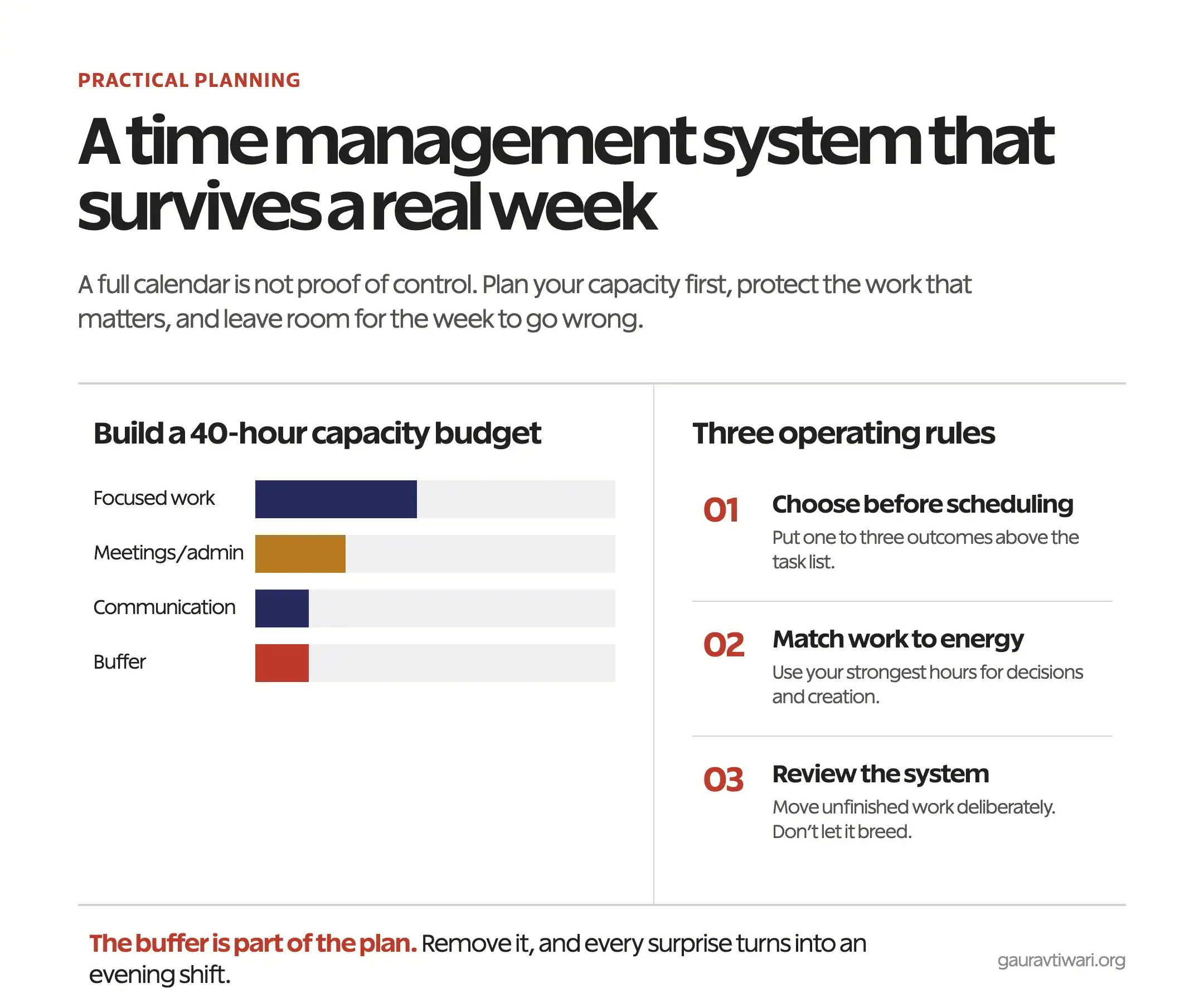
Improve time management skills with a weekly capacity budget
A useful plan starts with the hours you can actually control. Subtract fixed meetings, commuting, personal commitments, and routine administration before assigning project work. Then protect a buffer for urgent work and overruns.
If your working week is 40 hours, planning 40 hours of tasks is already overbooking. Meetings move, calls run long, and work contains uncertainty. A 10% to 20% buffer is not wasted time. It is the part of the plan that keeps the rest of it credible.
People routinely underestimate task duration even when similar tasks took longer before, a pattern studied as the planning fallacy. Research on implementation intentions and task completion found that specific plans can reduce optimistic estimates partly by reducing interruptions. The practical move is to name when and where work will happen, then compare the estimate with the actual time.
Choose outcomes before tasks
A task list mixes commitments, ideas, maintenance, and guilt into one column. An outcome answers a different question: what must be true by the end of the day or week? Choose one to three outcomes, then select the tasks that produce them.
| Weak task | Stronger outcome | Why it is easier to schedule |
|---|---|---|
| Work on website | Publish the revised pricing page | Clear finish line |
| Handle marketing | Approve and launch two search campaigns | Defined scope |
| Do accounts | Reconcile June transactions and send the invoice | Observable result |
| Study SEO | Audit five pages and document fixes | Connects learning to work |
These time management skills also make saying no easier. A request does not compete with an abstract list of 47 tasks. It competes with a named outcome and a finite capacity budget.
Use time blocks for categories, not every tiny task
Time blocking works best when the block protects a mode of work: writing, client delivery, sales calls, administration, or review. Scheduling every five-minute action creates a calendar that becomes wrong before lunch and expensive to maintain.
- Block focused work first. Put the hardest outcome in the hours when your attention is strongest.
- Batch shallow work. Give email, messages, approvals, and small admin a bounded window.
- Use one capture list. New tasks go there instead of breaking the current block.
- Leave transition time. Back-to-back meetings create late starts and rushed notes.
- Stop at a planned boundary. A block is a budget, not a dare to work until midnight.
If short intervals help you start, the Pomodoro Technique can give a focus block a useful rhythm. It is less helpful when the timer interrupts work that has already reached momentum, so treat 25 minutes as an option, not a law.
Match work to energy, not just empty time
Two free hours are not interchangeable. Some hours can carry writing, coding, analysis, or hard decisions. Others are better for routine replies and administration. Track your energy for a week and note when difficult work moves with the least resistance.
Then move high-consequence work into those hours. Don’t spend your best attention clearing notifications because the inbox offers easy completion. Save low-energy periods for tasks that do not need your full judgment.
Control interruptions before they control the schedule
Interruptions cost more than the minute used to answer them. You also have to remember the state of the original task and decide where to resume. Research on attention residue shows why part of your attention can remain attached to the previous task after a switch.
- Turn off non-urgent desktop and phone notifications.
- Close tabs and tools that are unrelated to the current block.
- Write a one-line restart note before switching: what is done, what is next, and what is blocked.
- Create office hours for questions that do not need an immediate answer.
- Use a visible emergency route so genuine urgent work can still reach you.
Not every distraction is bad. A deliberate walk, meal, or conversation can restore attention. The damaging distractions are the unplanned ones that neither move the work nor give you a real break.
Treat procrastination as a diagnosis
Procrastination can come from an unclear next action, a task that feels too large, fear of evaluation, low energy, or a decision you have not made. Telling yourself to be disciplined does not solve five different causes.
- Unclear task: write the next visible action.
- Oversized task: define a 20-minute starting slice.
- Fear of quality: create a private rough version before editing.
- Low energy: move it to a better hour or reduce the cognitive load.
- Wrong commitment: cancel, delegate, or renegotiate it.
My guide to procrastination types goes deeper into the diagnosis. The point here is to stop treating delay as one moral failure with one universal fix.
Build an organizational system you trust
Organization supports time management by reducing the number of places you must remember. Keep appointments on the calendar, actions in one task system, active project notes with the project, and reference material somewhere searchable.
The tool matters less than the boundaries. If the same action exists in email, a paper notebook, Slack, three apps, and your head, reviewing any one list cannot give you confidence. That is why collecting more productivity apps often creates more work instead of less.
Use an app only when it removes friction from the system. The lists of business productivity apps and time management apps for students are useful when you already know the job the tool must do.
Run a weekly review
A weekly review turns an imperfect week into better estimates. Clear the capture list, check the calendar behind and ahead, update active projects, close completed work, and decide what will not continue.
- What finished, and what took longer than expected?
- Which unfinished task still matters?
- Which commitment needs a new date or a conversation?
- Where did interruptions enter the week?
- What should be deleted, delegated, or made smaller?
- Which one to three outcomes deserve protected time next week?
Do not copy every unfinished task into the next week without judgment. That turns review into administrative procrastination. Move the work deliberately or admit that it is not a priority.
Practice time management skills with a daily routine
The daily routine should be smaller than the work. Ten minutes is enough to check the calendar, choose today’s outcomes, confirm the first focus block, and identify one likely interruption. At the end of the day, record the next action for unfinished work and stop.
| Moment | Action | Output |
|---|---|---|
| Start of day | Choose one to three outcomes | A short finish line |
| Before focus work | Clear tools and write the next action | A clean start |
| After interruption | Use the restart note | A reliable re-entry point |
| End of day | Close loops and move work deliberately | No hidden commitments |
| End of week | Review estimates, capacity, and priorities | A better next plan |
For entrepreneurs, the discipline is not doing everything yourself. It is protecting the work that only you can do and building a system for the rest. That fits beside the broader skills every entrepreneur needs, especially delegation, communication, and decision-making.
Frequently asked questions
What are examples of time management skills?
Examples include prioritization, estimation, scheduling, attention control, delegation, boundary setting, organization, and review. Each skill turns limited time into a decision rather than a longer task list.
How can I improve my time management skills?
Start with a weekly capacity budget, choose one to three outcomes, schedule focused work, batch shallow tasks, keep a buffer, and review actual time against estimates each week.
Is time blocking better than a to-do list?
They solve different problems. A list stores possible actions; time blocking assigns selected work a place. Use a short priority list beside broad calendar blocks rather than scheduling every tiny task.
How much buffer time should I leave?
Start with 10% to 20% of controllable work time. Increase it when your role has frequent urgent requests, uncertain project work, travel, or many dependencies.
How do organizational skills improve time management?
A trusted organizational system reduces search, duplication, and forgotten commitments. Keep appointments, actions, project notes, and reference material in clearly defined places.
What should I do when my schedule keeps failing?
Compare estimates with actual time, reduce planned capacity, make tasks smaller, and identify recurring interruptions. A schedule that fails every week is evidence about the system, not proof that you need more motivation.
A useful plan leaves room for reality
Good time management feels less like control and more like fewer broken promises. Choose the outcome, budget the capacity, protect attention, and review what happened. The buffer is not a flaw in that system. It is what lets the system survive a real week.
Tell Google you want more of this.
Add Gaurav Tiwari as a preferred sourceOne tap, and this site shows up more often in your own Top Stories, AI Overviews and AI Mode. Remove it any time.