
The Evolution of Internet Shopping: From Amazon’s Garage to a $6 Trillion Industry
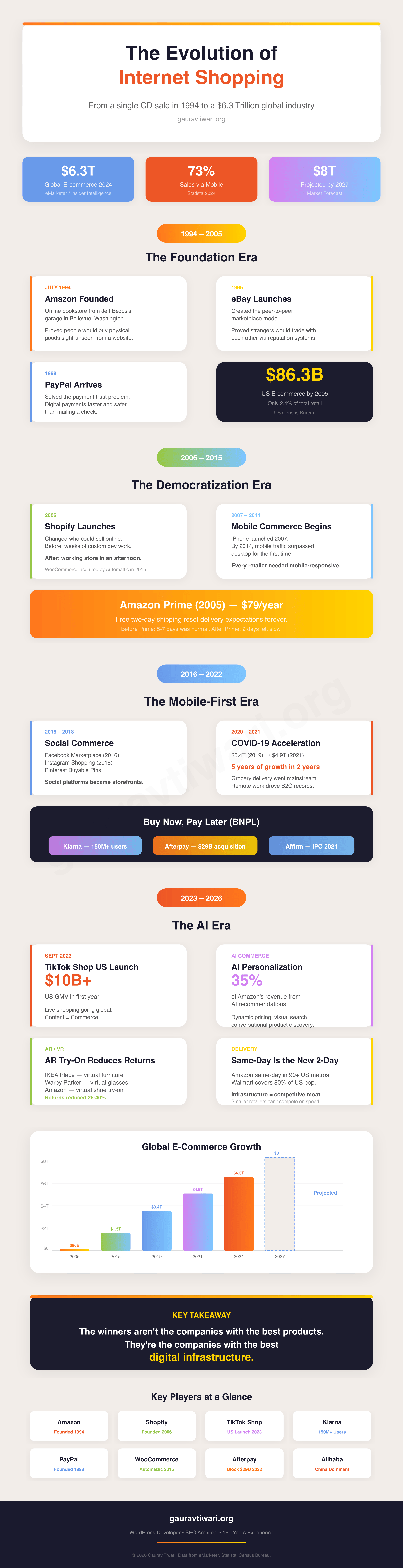
The first thing ever sold on the internet was a CD. Sting’s “Ten Summoner’s Tales,” purchased on NetMarket in August 1994. Thirty-two years later, global e-commerce generates $6.3 trillion annually, and 73% of those transactions happen on a phone screen. That trajectory, from a single CD to a $6 trillion industry, is one of the most dramatic transformations in economic history.
I’ve been building websites since 2009. I’ve watched e-commerce evolve from clunky shopping carts that barely worked on desktop to AI-powered storefronts that predict what you want before you search for it. Understanding this evolution matters whether you’re a web developer, a business owner, or just someone who buys things online.
The foundation era: 1994-2005
Amazon launched in July 1994 as an online bookstore from Jeff Bezos’s garage in Bellevue, Washington. eBay followed in 1995, creating the peer-to-peer marketplace model. PayPal arrived in 1998, solving the payment trust problem that had limited online transactions to credit cards with clunky, insecure forms.
These three companies established the primitives that everything else built on. Amazon proved that people would buy physical goods sight-unseen from a website. eBay proved that strangers would trade with each other if a reputation system existed. PayPal proved that digital payments could be faster and safer than mailing a check.
By 2005, US e-commerce had reached $86.3 billion (Census Bureau). That sounds big until you realize it was only 2.4% of total retail. Online shopping existed but it was a rounding error in the real economy.
The democratization era: 2006-2015
Shopify launched in 2006 and changed who could sell online. Before Shopify, building an online store required a developer, a hosting provider, and weeks of custom work. After Shopify, anyone with a product could have a working store in an afternoon. WordPress with WooCommerce (acquired by Automattic in 2015) did the same for the open-source ecosystem.
This was the era of mobile commerce. The iPhone launched in 2007. By 2014, mobile traffic surpassed desktop traffic for the first time. Suddenly every retailer needed a mobile-responsive site, and many weren’t ready. The gap between mobile-optimized retailers and desktop-only holdouts created massive competitive advantages for early mobile adopters.
Amazon Prime launched in 2005 ($79/year for free two-day shipping) and fundamentally reset delivery expectations. Before Prime, waiting 5-7 business days was normal. After Prime, two days felt slow. This compression of delivery time continues to shape the industry.
The mobile-first era: 2016-2022

Mobile commerce went from “nice to have” to “the only thing that matters.” By 2020, over half of all e-commerce transactions happened on mobile devices. Instagram Shopping (2018), Facebook Marketplace (2016), and Pinterest buyable pins turned social media platforms into storefronts.
Then COVID-19 happened. Global e-commerce jumped from $3.4 trillion in 2019 to $4.9 trillion in 2021 (eMarketer). Five years of projected growth compressed into two. Grocery delivery, which had been “almost working” for 25 years, finally became mainstream through Instacart, Amazon Fresh, and local services. Remote work created demand for home office equipment that drove B2C e-commerce to record levels.
Buy Now Pay Later (BNPL) emerged as a checkout revolution. Klarna (150M+ users globally), Afterpay (acquired by Block/Square in 2022 for $29 billion), and Affirm split purchases into installments at checkout. For Gen Z and millennials, BNPL is as normal as credit cards were for their parents.
The AI era: 2023-2026
We’re in the middle of this one, so the patterns are still forming. But several trends are clear.
AI personalization at scale. Amazon’s recommendation engine drives an estimated 35% of its revenue. Every major e-commerce platform now uses AI and machine learning for product recommendations, dynamic pricing, demand forecasting, and customer service chatbots. The difference between a 2016 recommendation (“people who bought this also bought…”) and a 2026 recommendation (personalized based on your browsing pattern, purchase history, time of day, and social graph) is enormous.
Social commerce is the fastest-growing channel. TikTok Shop launched in the US in September 2023 and crossed $10 billion in US GMV within its first year. Live shopping (huge in China via Douyin and Taobao Live) is expanding globally. The line between content consumption and product purchase is disappearing.
AR try-on reduces returns. IKEA Place lets you place virtual furniture in your room. Warby Parker lets you try on glasses with your phone camera. Amazon offers virtual shoe try-on. These tools reduce return rates by 25-40% (which matters enormously when returns cost retailers $816 billion in 2022, per NRF).
Same-day delivery is the new two-day. Amazon’s compression continues. Same-day delivery is available in 90+ US metro areas. Walmart’s delivery network now covers 80% of the US population. The infrastructure investment required to compete on delivery speed is a moat that smaller retailers struggle to cross.
What this means for web builders
If you’re building e-commerce sites in 2026, the table stakes have shifted dramatically from even five years ago.
Mobile-first isn’t optional. It’s the starting point. Your desktop site is the afterthought. Performance matters more than aesthetics. A beautiful product page that loads in 6 seconds loses to an ugly one that loads in 1.5 seconds. Structured data (Schema.org product markup) determines whether your products appear in rich results. Payment flexibility (Apple Pay, Google Pay, BNPL options) directly affects conversion rates.
The winners in e-commerce aren’t the companies with the best products. They’re the companies with the best digital infrastructure. That’s been true since Amazon sold its first CD, and it’s more true now than ever.
Frequently Asked Questions
How big is the global e-commerce market?
Global e-commerce reached an estimated $6.3 trillion in 2024 (eMarketer/Insider Intelligence) and is projected to hit $8 trillion by 2027. Mobile commerce accounts for roughly 73% of all e-commerce sales. The industry grew from $86.3 billion (US only) in 2005 to its current global scale in under two decades.
What is social commerce?
Buying products directly through social media platforms without leaving the app. TikTok Shop (launched US September 2023, $10B+ GMV in year one), Instagram Shopping, and Pinterest buyable pins are the major Western platforms. Live shopping, already massive in China via Douyin, is the fastest-growing format globally.
What is BNPL and why is it popular?
Buy Now Pay Later splits purchases into installments at checkout, usually interest-free. Klarna (150M+ users), Afterpay (acquired by Block for $29B in 2022), and Affirm are the major providers. It’s popular with Gen Z and millennials who prefer installments over credit card debt.
When did mobile commerce overtake desktop?
Mobile traffic surpassed desktop in 2014. By 2020, over half of all e-commerce transactions happened on mobile devices. As of 2024, 73% of e-commerce sales occur on mobile (Statista). Google’s mobile-first indexing, completed in 2023, means mobile performance directly affects search rankings.
How did COVID-19 affect e-commerce?
Global e-commerce jumped from $3.4 trillion in 2019 to $4.9 trillion in 2021, compressing five years of projected growth into two. Grocery delivery became mainstream, home office equipment sales surged, and businesses that lacked online presence scrambled to build one.
What role does AI play in e-commerce?
AI drives product recommendations (35% of Amazon’s revenue), dynamic pricing, demand forecasting, customer service chatbots, visual search (Google Lens), and AR try-on tools. The personalization gap between AI-powered and non-AI storefronts is now a competitive moat.