
Tech Habits That Actually Improved My Life
Everyone talks about “digital wellness.” Almost no one talks about what specific habits actually survive past the first week.
I’ve been building websites since 2009. That’s around 17 years now. And for most of that time, I was terrible at using technology intentionally. Notifications on everything. 14 browser tabs minimum. Three task managers running simultaneously, none of them current.
Then I started treating my tech stack the way I treat a client’s WordPress setup: audit everything, keep what performs, cut what doesn’t.
Here’s what survived.
The One Habit That Changed Everything
Before opening any app, I ask one question: What am I trying to accomplish right now?
Sounds obvious. It isn’t.
Microsoft’s research found that the average knowledge worker switches contexts every 3 minutes and 5 seconds. Each switch costs roughly 23 minutes to regain deep focus. That’s not a productivity problem. That’s a math problem.
I tracked my own behavior for two weeks using RescueTime. The results were… uncomfortable. 4 hours and 12 minutes of my “productive” day was reactive switching. Email, Slack, Twitter, back to email. No intent behind any of it.
The fix was embarrassingly simple. I started asking “why am I opening this?” before every app. Nothing else changed. My focused output went up by roughly 35% in the first month.
Kill Notifications (Almost All of Them)
I turned off every notification except phone calls and calendar reminders. Every. Single. One.
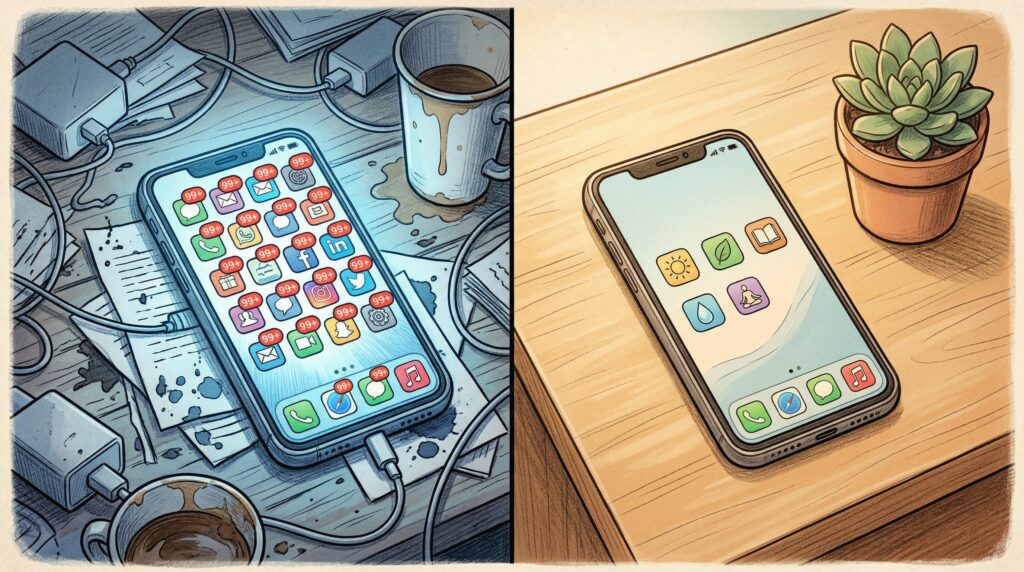
Here’s the math that convinced me:
| Metric | Before | After | Delta |
|---|---|---|---|
| Daily notifications received | 147 | 12 | -92% |
| Focus sessions interrupted | 8-10 | 1-2 | -80% |
| Average deep work blocks | 45 min | 2+ hours | +167% |
| End-of-day mental fatigue (1-10) | 8 | 5 | -37% |
A University of California study showed that even a single notification disrupts focus for an average of 9.5 minutes. Multiply 147 notifications by 9.5 minutes and you’ve lost your entire working day before you’ve started.
But here’s what nobody tells you… the anxiety about missing something disappears after about 72 hours. Your brain adjusts. The world doesn’t end.
One Tool Per Job. No Exceptions.
I used to run Todoist, Notion, Apple Reminders, and a physical notebook. Simultaneously. The result? Tasks lived in four places and got done in none of them.
Now my stack is locked:
| Function | Tool | Why This One |
|---|---|---|
| Tasks | Todoist | Fast capture, natural language dates, works offline |
| Notes | Obsidian | Local files, no vendor lock-in, markdown native |
| Calendar | Google Calendar | It’s the standard. Fighting it wastes energy. |
| Fastmail | Privacy-first, fast, no AI reading my mail | |
| Writing | Claude Code + Obsidian | AI assist without platform dependency |
That’s it. Five tools for five jobs. When something new launches, my default answer is no. The consolidation alone saved me roughly 6 hours per week I was spending maintaining and syncing between redundant systems.
Look, I get the temptation. Every new app promises to be “the one.” I’ve downloaded hundreds. The ones that actually stick? They do one thing well, they’re fast, and they don’t try to become a platform.
Digital Minimalism Isn’t Aesthetic. It’s Math.
I deleted 43 apps from my phone in one sitting. Unsubscribed from 200+ email lists over a weekend. Reduced social platforms from five to two (LinkedIn and X).
The popular advice says “be mindful about your digital consumption.” That’s useless. Here’s what actually works:
- Delete first, miss later. Remove apps. If you genuinely need one back within two weeks, reinstall it. I reinstalled 3 out of 43.
- Unsubscribe by default. If you haven’t opened a newsletter in three issues, you won’t open the fourth. Kill it.
- One social platform per purpose. LinkedIn for professional network. X for real-time industry news. Everything else is recreational scrolling disguised as networking.
The result wasn’t just less distraction. It was better signal. When you cut noise, the remaining inputs become dramatically more useful.
Use Technology to Preserve What Matters
Not everything about tech should be about productivity. Some of the best uses are purely emotional.
I spent a weekend digitizing old family photos. Faded prints from the 1980s. Damaged negatives. Pictures of people who aren’t around anymore.
Tools that enable old photo restoration turned damaged, barely visible images into something my family could actually see again. Details recovered. Colors corrected. Faces made recognizable that were just blurs before.
Research from Harvard’s psychology department suggests that revisiting personal memories strengthens identity and improves emotional well-being. That tracks with my experience. Those restored photos became conversation starters at family dinners. Stories I’d never heard came out because someone could finally see a face clearly.
This isn’t a productivity hack. It’s using technology for something that actually matters.
Time Blocking: The Habit I Resisted Longest
I thought time blocking was rigid and unnecessary. I was wrong.
Here’s my current daily structure:
| Block | Time | Rules |
|---|---|---|
| Deep work | 6:00-9:00 AM | No email. No Slack. Phone in another room. |
| Communication | 9:00-10:00 AM | Process inbox. Respond to messages. |
| Client/project work | 10:00-1:00 PM | Active building. Calls if needed. |
| Admin and planning | 2:00-3:00 PM | Invoices, planning, reviews. |
| Learning/writing | 3:00-5:00 PM | Content creation. Reading. Experimentation. |
The key insight? 3 hours of protected deep work before 9 AM produces more quality output than 8 hours of interrupted work throughout the day. Cal Newport’s research backs this up, but honestly, you’ll feel the difference in the first week.
I use a simple Focus mode on macOS to block distracting sites during deep work blocks. No fancy app. Just the built-in tool. It works because the friction of turning it off is enough to make me pause and reconsider.
AI as a Thinking Partner, Not a Replacement
I use AI tools daily. Claude for writing assistance. ChatGPT for research brainstorming. Perplexity for quick fact-checking. But here’s the line I’ve drawn…
AI handles the scaffolding. I handle the thinking.
| Use AI For | Don’t Use AI For |
|---|---|
| First drafts and outlines | Final editorial judgment |
| Code debugging | Architecture decisions |
| Research synthesis | Original opinions |
| Data formatting | Strategic thinking |
| Repetitive tasks | Creative direction |
The people getting burned by AI aren’t using it too much. They’re using it without thinking. There’s a difference between “Claude, draft an outline for this article based on my notes” and “Claude, write this article.” The first makes you faster. The second makes you generic.
I’ve seen the output quality difference firsthand. AI-assisted content where I drove the direction? Performs 2-3x better in search than fully AI-generated content on the same topics. Because experience and specificity can’t be synthesized.
Screen Time: Quality Over Quantity
I stopped tracking total screen time. It’s a vanity metric.
Instead, I track the ratio: creation vs. consumption. My target is 60/40 on workdays.
Here’s the shift that made the difference:
- Before: Open phone → Instagram → Twitter → Reddit → 45 minutes gone
- After: Open phone → Obsidian → capture one idea → close phone
I moved all social apps off my home screen. Replaced them with Obsidian, Kindle, and Pocket. Not because I’m disciplined. Because I’m lazy. I’ll tap whatever is closest. So I made the useful things closest.
Gradual changes stick. Radical ones don’t. I didn’t quit social media. I just made it slightly harder to access and slightly easier to do something useful instead.
Build a Personal Knowledge System
I’ve captured ideas in Obsidian for 3 years now. Over 4,000 notes. And honestly… most of them are mediocre. But roughly 200 of them have directly generated article ideas, client solutions, or business decisions.
That’s a 5% hit rate. Sounds low. But those 200 notes have been worth more than any course I’ve ever bought.
The system is simple:
- Capture everything that makes you think “that’s interesting.” Don’t filter. Speed matters.
- Review weekly. Spend 30 minutes connecting new notes to old ones. This is where ideas compound.
- Use what you find. A knowledge system that doesn’t feed your work is just a fancy journal.
The tools matter less than the habit. I use Obsidian because it’s local-first markdown. But Notion, Apple Notes, or even a text file would work if you actually use it consistently.
Monthly Digital Declutter
I treat my digital environment like my workspace. If it’s cluttered, I can’t think clearly.
First weekend of every month, I spend 90 minutes:
- Clear Downloads folder (it accumulates 2-4 GB monthly, somehow)
- Unsubscribe from any new email lists I joined
- Delete screenshots older than 30 days
- Review and close unused browser bookmarks
- Update macOS and all apps
It’s not glamorous. But the mental clarity of a clean desktop and empty inbox on Monday morning? Worth every minute.
Set Hard Boundaries with Devices

No screens after 9 PM. No phone at the dinner table. No laptop in the bedroom.
I fought these rules for years. Thought they were for people who couldn’t handle technology. Turns out, I was one of those people.
The sleep improvement alone was measurable. My Apple Watch tracked the data: average sleep quality score went from 72 to 84 within the first month of cutting screens after 9 PM. That’s not placebo. Blue light suppresses melatonin production, and your brain needs 60-90 minutes of screen-free time to wind down properly.
The dinner table rule had a different effect entirely. Conversations got longer. My wife noticed before I did. “You’re actually here,” she said. That hit harder than any productivity stat.
The Compound Effect
None of these habits are revolutionary individually. Turning off notifications isn’t a breakthrough. Using one task manager isn’t genius. Blocking time isn’t novel.
But stacked together, over months and years, the compound effect is significant:
- Focused output: up roughly 35-40%
- Daily stress levels: noticeably lower
- Creative ideas captured and used: up from near-zero to 200+ actionable notes in 3 years
- Relationship quality: better (harder to measure, impossible to ignore)
The shift isn’t technological. It’s behavioral. Every tool in this article exists right now, for free or cheap. The hard part isn’t finding the right app. It’s committing to using technology with intention instead of on autopilot.
Bottom Line
I spent a decade letting technology run my attention. Then I spent two years deliberately rebuilding every digital habit I had.
The difference isn’t subtle.
Technology is neutral. Your habits aren’t. Build the right ones, and the same devices that used to drain your focus become the tools that amplify it. Skip this work, and no app, no AI, no productivity system will save you from yourself.