
How to Accomplish your Goals using SMART Analysis?
You’ve set goals before. Probably dozens of them. “Grow my blog.” “Make more money.” “Build an email list.” You wrote them in a notebook, maybe stuck them on a wall, felt great for about 72 hours, then forgot they existed. I know because I did the same thing for years. The problem wasn’t motivation or discipline. The problem was the goals themselves. They were vague, unmeasurable, and completely disconnected from any system that could actually produce results.
After running my content business for over 16 years and helping clients across 90+ brands set and hit targets, I’ve found one framework that consistently separates goals that ship from goals that rot in a Notion doc. It’s SMART, Specific, Measurable, Attainable, Relevant, and Time-bound. Not new. Not flashy. But when you apply it specifically to blogger and solopreneur goals with real numbers attached, it transforms how you operate.
I’m going to walk you through exactly how to set SMART goals for 5 common blogger objectives, show you the tools I use to track them, and give you a quarterly review system you can copy today. Every example uses real numbers because “increase traffic” is not a goal. It’s a wish.
Why Bloggers Set Terrible Goals
Most bloggers and solopreneurs set goals the same way people set New Year’s resolutions. They pick something aspirational, write it down, and hope willpower carries them through. It doesn’t. Here’s why blogger goals specifically fail at a higher rate than goals in traditional businesses.
First, there’s no boss checking in. When you work for yourself, nobody asks “where are you on that Q2 target?” You’re the CEO, the employee, and the accountability partner all at once. That’s a recipe for drift.
Second, bloggers confuse activity with progress. Publishing 4 posts a week feels productive. But if those posts don’t target keywords with actual search volume, don’t build toward a content cluster, and don’t connect to a monetization strategy, you’re just staying busy. There’s a massive difference between “I wrote a lot” and “I grew organic traffic by 2,400 sessions this month.”
Third, the feedback loops are slow. You publish an article today and might not see meaningful traffic from it for 3 to 6 months. That delay makes it easy to abandon strategies before they have time to work. A SMART goal with monthly milestones fixes this because you’re tracking the inputs you control (articles published, links built, emails sent) while waiting for the outputs to catch up.
SMART Framework Applied to 5 Blogger Goals
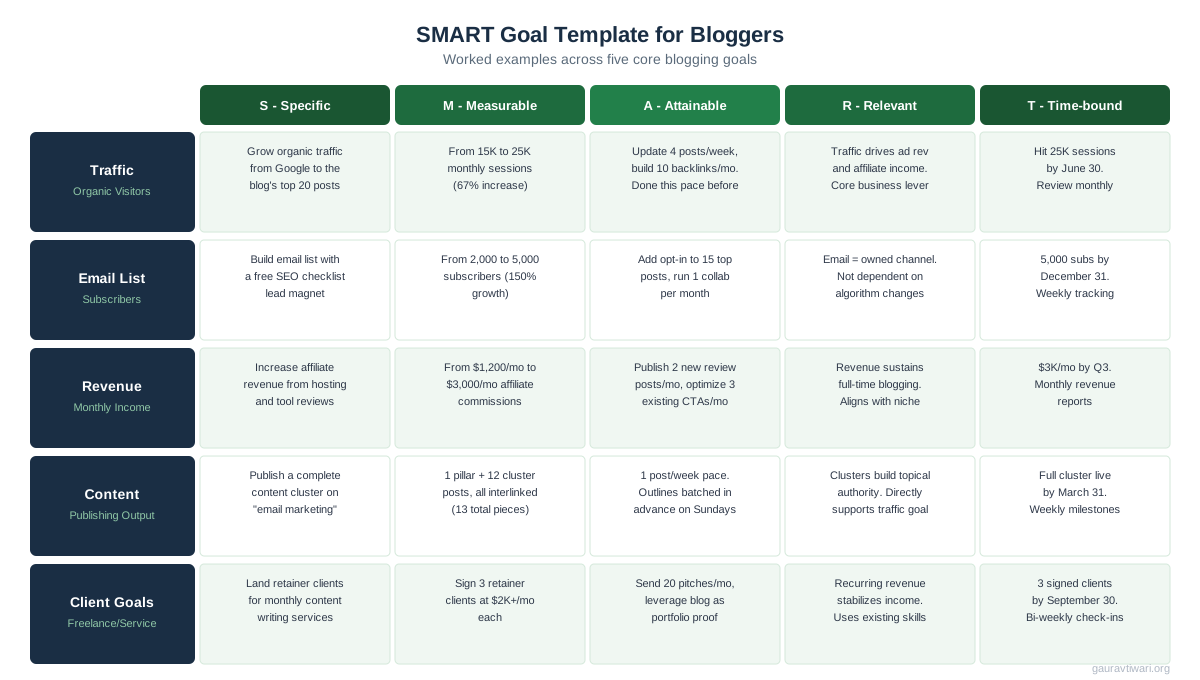
Theory is nice. Worked examples are better. I’m going to take five goals every blogger and solopreneur cares about and convert each one from a vague wish into a SMART goal you can actually execute. Each example includes the specific numbers, timeline, and strategy so you can adapt them to your own situation.
Goal 1: Traffic Growth
Vague version: “I want to grow my blog traffic.”
SMART version: “Increase organic traffic from 8,000 to 20,000 monthly sessions by December 31, 2026, by publishing 12 SEO-optimized articles per month in 3 content clusters (WordPress tools, content marketing, business productivity), updating 4 existing articles per month for freshness, and building 10 internal links per new post.”
This works because it specifies the starting point (8K sessions), the target (20K), the deadline (December 31), and the exact actions required to get there. You can check progress in Google Analytics every Monday morning. If you’re on pace by June, the strategy is working. If you’re behind, you know which lever to pull harder: more articles, better keyword targeting, or more internal links.
Goal 2: Email List Growth
Vague version: “I need to grow my email list.”
SMART version: “Grow email subscribers from 2,000 to 5,000 by June 30, 2026, by adding lead magnets to the top 20 highest-traffic posts, implementing exit-intent popups on all blog pages, and sending a weekly newsletter to improve retention and reduce unsubscribes below 0.5% per email.”
The beauty of this goal is that it breaks down into clear weekly tasks. Week 1: create lead magnet for post #1. Week 2: create lead magnet for post #2. You can see your subscriber count in your email platform dashboard daily. No guessing required.
Goal 3: Revenue
Vague version: “I want to make more money from my blog.”
SMART version: “Hit $5,000 per month in recurring revenue by December 31, 2026, through 2 affiliate programs generating $2,000/month combined, 1 digital product (a $47 content strategy template pack) generating $1,500/month, and 3 retainer consulting clients at $500/month each.”
Revenue goals need to specify the sources. “$5K/month” means nothing if you don’t know where it’s coming from. By breaking it into affiliate income, product income, and service income, you create three separate strategies you can work on in parallel. When I set my own revenue goals, I always specify the exact products and price points. It forces me to think about whether the math actually works. Can I realistically sell 32 copies of a $47 product per month? That’s about 1 sale per day. Doable with 20K monthly sessions and a 0.16% conversion rate. The numbers either check out or they don’t.
Goal 4: Content Production
Vague version: “I should publish more consistently.”
SMART version: “Publish 3 blog articles and 1 newsletter every week for 12 consecutive weeks (Q1, 2026), batch-writing on Monday and Tuesday, editing on Wednesday, and publishing on Thursday. Track completion rate in a spreadsheet with a green/red system for each week.”
This goal is about building a production habit, not just hitting a number. The specific days matter because they create a routine. I’ve found that batching content creation into specific days doubles my output compared to writing whenever I “feel like it.” After 12 weeks, the habit is locked in and you can adjust the cadence based on what’s sustainable long-term.
Goal 5: Client Acquisition
Vague version: “I want to land more clients.”
SMART version: “Sign 3 new retainer clients at $2,000+ per month by June 30, 2026, through LinkedIn outreach (10 personalized DMs per week to target decision-makers), publishing 2 case studies on the blog, and offering a free 30-minute strategy audit as the entry point.”
Client acquisition goals are the hardest to make SMART because the timeline depends on the prospect’s decision-making speed. But you can control the inputs: DMs sent, case studies published, and audits delivered. If you send 10 DMs per week for 26 weeks (that’s 260 outreach messages), converting even 1.2% of those into retainer clients gives you your 3 clients. The math works even with conservative conversion rates.
Goal Setting Tools That Actually Work
You don’t need fancy software to track SMART goals. You need something you’ll actually open every week. I’ve tested dozens of tools over the years, and three stand out for bloggers and solopreneurs who want to track goals without getting buried in project management complexity.
Notion is my personal pick for individual goal tracking. You can build a goal database with properties for each SMART criterion, link it to a content calendar, and create dashboard views that show progress at a glance. The templates are free, and you can customize everything. I keep a “Goals” database with columns for target metric, current metric, deadline, status, and a linked relation to my content calendar so I can see which articles contribute to which goals.

- Custom goal databases with SMART properties
- Linked content calendar and task views
- Free plan with unlimited pages
- Templates for OKR and quarterly review
Monday.com works better if you’re managing a team or want built-in OKR tracking. The goal-tracking widgets show progress bars, and you can set up automations that remind you when milestones are due. It’s more structured than Notion, which is either a pro or a con depending on how you work. I use it for client projects where multiple people need visibility into the same goals.

- Built-in OKR and goal tracking widgets
- Automations for milestone reminders
- Visual progress dashboards
- Team collaboration with role-based views
Google Workspace is the no-frills option. A well-structured Google Sheet with your SMART goals, weekly input metrics, and monthly output metrics is surprisingly effective. I’ve used a simple spreadsheet with conditional formatting (green for on-track, yellow for at-risk, red for behind) for years. It takes 5 minutes to set up and 2 minutes per week to update. The Sheets integration with Google Data Studio lets you build visual dashboards if you want something prettier.

- Google Sheets with conditional formatting for goals
- Looker Studio dashboards for visual tracking
- Real-time collaboration on goal docs
- Free with any Google account
The best tool is the one you’ll use every Monday morning without being reminded. If you already live in Notion, use Notion. If your team uses Monday.com, use that. If you just want a quick spreadsheet, Google Sheets works perfectly. Don’t let tool selection become another form of procrastination.
Quarterly Goal Review System
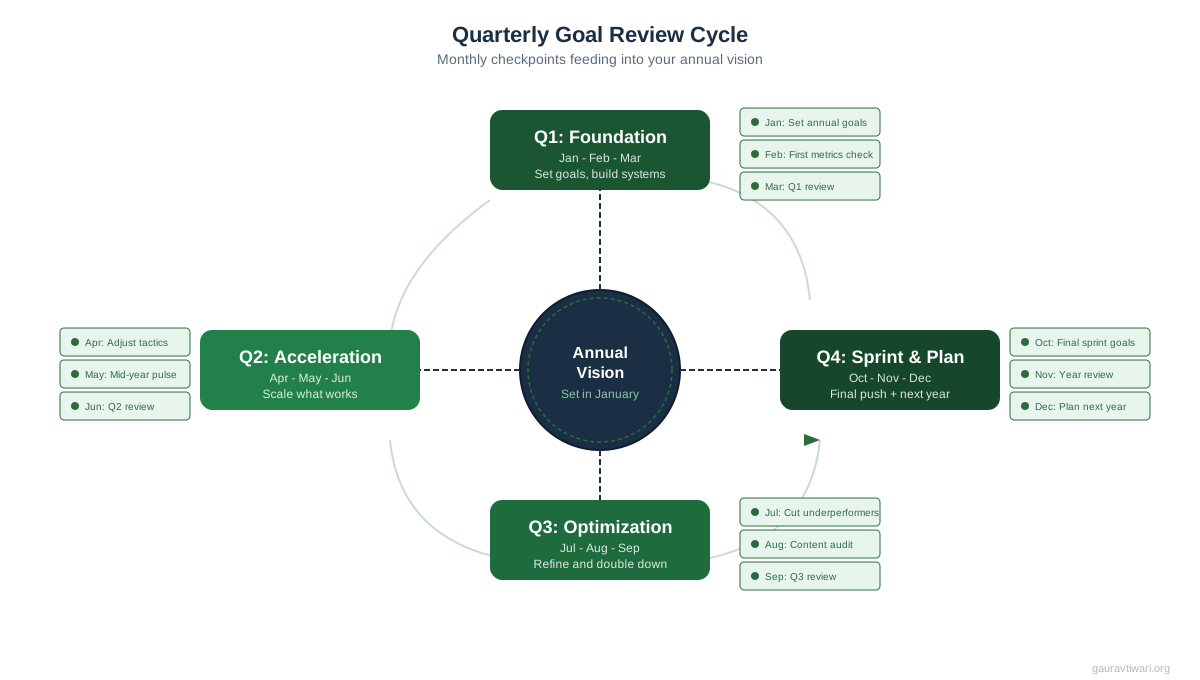
Setting SMART goals once a year is a mistake. Markets shift. Priorities change. What seemed like the right target in January might be completely irrelevant by April. That’s why I run a quarterly goal cycle instead of an annual one. Three goals per quarter, monthly reviews, full assessment at quarter end.
Here’s the exact system I use.
Quarter start (Week 1): Set exactly 3 SMART goals. Not 5. Not 7. Three. Each goal gets a one-page brief with the target metric, current baseline, deadline (end of quarter), key actions, and weekly milestones. I write these in Notion and review them every Monday.
Weekly check-in (10 minutes every Monday): Open your goal tracker. Look at the numbers. Are you on pace? If yes, keep going. If no, identify one specific action to get back on track this week. Don’t overthink it. The weekly check-in is about course correction, not deep analysis.
Monthly review (30 minutes, last Friday of the month): Score each goal on a 0 to 100% completion scale. Are your strategies working? Do you need to pivot? Are there blockers you haven’t addressed? This is where you decide if a goal needs a strategy change or just more consistent execution.
Quarter end (2 hours): Full retrospective. For each goal, document what you did, what worked, what didn’t, and what you’d do differently. Then set your next 3 goals based on what you learned. This is the most valuable part of the system. Your Q2 goals should be smarter than your Q1 goals because you have 3 months of data telling you what actually moves the needle.
Leading vs Lagging Indicators for Content Businesses
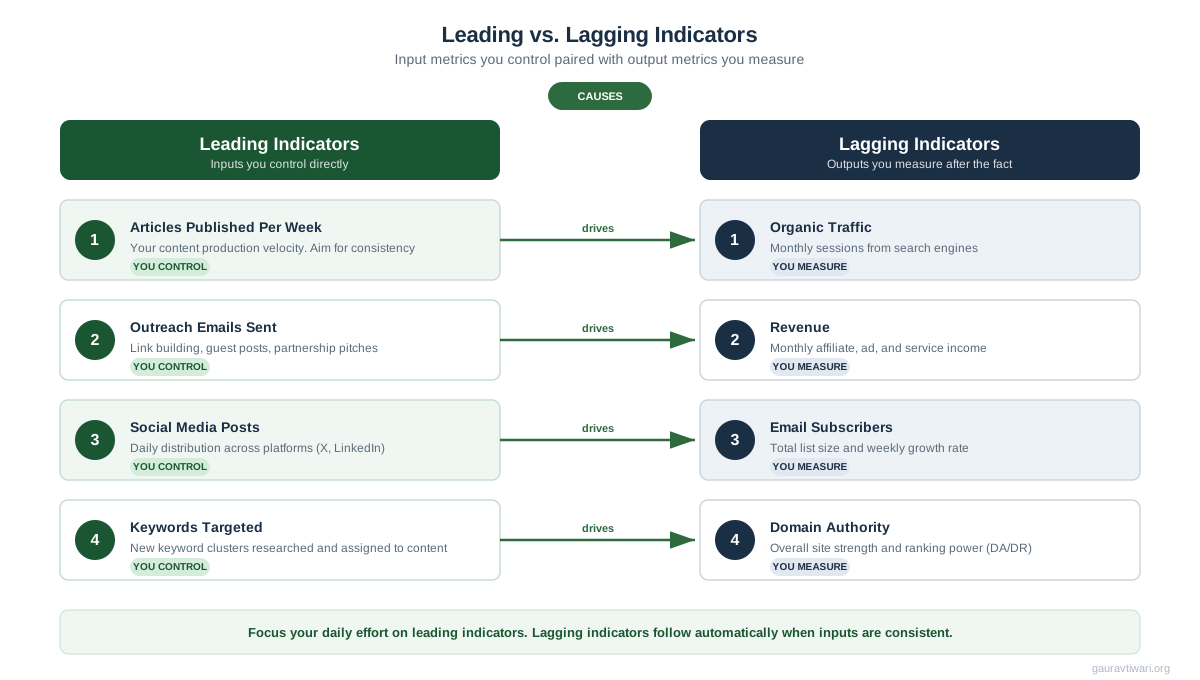
This is the concept that changed how I think about goals entirely. Every metric you track falls into one of two categories: leading indicators (things you control) and lagging indicators (results that happen later). Most bloggers only track lagging indicators, which means they’re always looking in the rearview mirror instead of through the windshield.
Organic traffic is a lagging indicator. You can’t directly control it. But you can control the leading indicators that drive it: articles published per week, keywords targeted, internal links added, old content updated. When you track leading indicators, you get real-time feedback on whether you’re doing the work. When you track lagging indicators, you get delayed feedback on whether the work paid off.
Here’s how this maps to common blogger goals:
| Goal | Leading Indicators (You Control) | Lagging Indicators (Results) |
|---|---|---|
| Traffic growth | Articles published, keywords targeted, links built | Monthly organic sessions, page views |
| Email list | Lead magnets created, opt-in forms tested, popups deployed | New subscribers per month, list size |
| Revenue | Products built, affiliate content published, pitches sent | Monthly recurring revenue, affiliate commissions |
| Content production | Writing sessions completed, batch days honored | Published articles count, content quality scores |
| Client acquisition | DMs sent, proposals submitted, case studies published | Signed contracts, retainer revenue |
My rule: track leading indicators weekly, lagging indicators monthly. If your leading indicators are strong but lagging indicators haven’t moved yet, be patient. The results are coming. If your leading indicators are weak, that’s the immediate problem to fix. Don’t stare at your Google Analytics dashboard wondering why traffic isn’t growing when you only published 2 articles last month.
Control the inputs. Measure the outputs. Adjust the strategy. Repeat every quarter.
The Anti-Goal: What You’re NOT Doing This Quarter
This is something I picked up from studying how high performers focus. An anti-goal is a list of things you’re deliberately choosing NOT to pursue this quarter. It’s just as important as your actual goals because every “yes” to a new project is a “no” to something else.
When I plan my quarter, I write down 3 anti-goals alongside my 3 SMART goals. Last quarter, my anti-goals were: no new social media platforms (I was tempted by Threads), no new client projects under $2K/month (focusing on higher-value work), and no course creation (saving it for Q3). Every time I felt the pull to start something new, I checked my anti-goal list and redirected that energy toward my actual goals.
Anti-goals protect your focus. Without them, you’ll say yes to interesting opportunities that dilute your attention from the goals that actually matter. Write them down. Put them next to your SMART goals. Review them weekly alongside everything else.
Goal Cascading: From Annual Vision to Weekly Actions
A $120,000 annual revenue goal sounds overwhelming. $10,000 per month is more manageable. $2,500 per week is actionable. That’s goal cascading, breaking a big target into smaller time-bound chunks until you reach a level where you know exactly what to do today.
Here’s how I cascade a content business goal:
Annual vision: “Build a $120K/year content business through blogging, digital products, and consulting.”
Quarterly goal (Q1): “Launch a $47 content strategy template pack and generate 50 sales ($2,350) by March 31. Simultaneously grow organic traffic to 15K monthly sessions through a WordPress tools content cluster.”
Monthly target (January): “Create the template pack (8 templates), write the sales page, set up payment processing, and publish 12 articles in the WordPress tools cluster.”
Weekly actions (Week 1 of January): “Draft templates 1 and 2. Write and publish 3 blog articles. Set up Gumroad or LemonSqueezy for payments.”
Notice how each level answers a different question. The annual vision answers “where am I going?” The quarterly goal answers “what am I building this quarter?” The monthly target answers “what must be done this month?” And the weekly actions answer “what am I doing this week?” If you can’t cascade your goal down to a weekly action, the goal is too abstract.
I keep my cascade in a single Notion page with collapsible toggles for each level. Every Monday, I open the weekly level and plan my days. Every month, I check the monthly level and adjust. This creates a content marketing plan that actually connects daily work to long-term outcomes.
How do you track your business goals?
When to Abandon a Goal
Not every goal deserves your loyalty. Sometimes the smartest move is to quit. But most people quit too early (because the results haven’t shown up yet) or too late (because of sunk cost fallacy). Here’s how to tell the difference.
The 80% rule: If you’ve given a goal consistent effort for 80% of its timeline and you’re below 30% of the target, it’s probably time to reassess. Not necessarily quit, but seriously evaluate whether the strategy is wrong, the goal was unrealistic, or external factors have changed. At 80% timeline and 30% progress, something fundamental isn’t working.
Sunk cost check: Ask yourself, “If I were starting fresh today with no prior investment, would I still choose this goal?” If the answer is no, the only reason you’re still pursuing it is because of the time and money already spent. That’s sunk cost fallacy, and it’s one of the most expensive mistakes solopreneurs make.
Opportunity cost check: What are you NOT doing because you’re still chasing this goal? If the opportunity cost is higher than the potential payoff, redirect your energy. I’ve abandoned goals that were technically achievable but would have prevented me from pursuing something with 5x the potential return. That’s not quitting. That’s strategic resource allocation.
When you do abandon a goal, document why. Write a brief retrospective: what you learned, what you’d do differently, and what you’re redirecting that time toward. This turns a “failure” into data that makes your next goal better. Your business budget works the same way. You track what you spend, learn from the data, and reallocate next quarter.
Quitting a goal that isn’t working isn’t failure. Refusing to quit a goal that isn’t working because you’ve already invested time? That’s the real failure.
Accountability Systems That Work for Solopreneurs
The biggest weakness of working alone is that nobody holds you accountable. You can move a deadline, reduce a target, or quietly forget a goal ever existed. Accountability systems fix this, and they don’t require hiring a coach or joining a mastermind (though both help).
Public commitment: Share your quarterly goals on your blog, newsletter, or social media. When your audience knows what you’re working toward, the social pressure to follow through is real. I publish my quarterly goals in my newsletter and reference progress updates throughout the quarter. It’s uncomfortable but effective.
Goal buddy: Find one person, another blogger, a business friend, a freelancer, who’s also setting quarterly goals. Check in with each other every Monday. A 5-minute message works: “Here’s what I committed to last week. Here’s what I actually did. Here’s what I’m committing to this week.” The peer pressure is subtle but powerful.
Weekly retrospective: Every Friday, spend 10 minutes answering three questions: What did I accomplish this week? What didn’t I do that I should have? What’s the one thing I must do next week? Write the answers down. This simple habit creates a paper trail that shows you exactly where your time went, and it’s much harder to lie to yourself in writing.
Financial stakes: Some people use commitment contracts. You deposit money and forfeit it if you miss your goal. StickK and Beeminder are tools built for this. I’ve found that public commitment works just as well for me, but financial stakes add another layer if you need it. Even something small like “I’ll donate $100 to a cause I dislike if I miss my Q1 targets” creates surprising motivation.
Real Example: My Business Goals in SMART Format
I’ll show you exactly what my 2026 Q1 goals looked like, formatted as proper SMART goals. These are the actual targets I set for my content business, not hypothetical examples.
Goal 1 (Content): “Update and expand 50 existing blog articles with fresh data, new sections, and 3 custom SVG graphics each by March 31, 2026. Track completion daily. Target: improved rankings for 70% of updated articles within 90 days post-update, measured via Rank Math analytics.”
Goal 2 (Revenue): “Increase affiliate revenue from $X to $Y per month by March 31 by publishing 12 new comparison and review articles targeting high commercial intent keywords, each with product boxes and clear CTAs. Measure weekly via affiliate dashboards.”
Goal 3 (Systems): “Build a reusable content update workflow that reduces per-article update time from 3 hours to 90 minutes by creating templates, SVG frameworks, and batch processing scripts. Validate by timing the last 10 articles of the quarter.”
Notice what these goals have in common: specific numbers, clear deadlines, defined measurement methods, and strategies attached. They also connect to each other. Goal 3 (building systems) makes Goal 1 (updating articles) faster, which feeds Goal 2 (affiliate revenue) by having more optimized content live. That kind of goal synergy is what happens when you think in quarterly systems instead of isolated targets.
These goals tie into the larger content marketing KPIs I track year-round. The quarterly goal isn’t separate from your business strategy. It IS your business strategy, broken into 90-day execution chunks.
If you’re looking for ways to monetize your skills, start by setting one SMART revenue goal. Just one. Make it specific, give it a deadline, and work the numbers backward until you know exactly what you need to do this week. That’s how real progress happens. Not from motivation. From math, systems, and consistent execution.
Frequently Asked Questions
What is the SMART framework for goal setting?
SMART stands for Specific, Measurable, Attainable, Relevant, and Time-bound. It’s a framework introduced by George Doran in 1981 that transforms vague goals into concrete, trackable targets. Each criterion forces you to refine your goal from a different angle. Specific defines exactly what you want. Measurable attaches numbers. Attainable ensures it’s realistic. Relevant confirms it aligns with your bigger picture. Time-bound sets a deadline. When all five criteria are met, you have a goal you can actually execute and measure.
How many SMART goals should I set per quarter?
Three. I’ve tested higher numbers and completion rates drop significantly above three goals per quarter. Three focused goals with consistent weekly execution outperform seven scattered goals every time. If something doesn’t make your top three, it waits until next quarter. The constraint forces prioritization, which is the entire point. You can always add sub-milestones under each goal if you need more granularity.
What’s the difference between SMART goals and OKRs?
SMART goals work best for individual clarity and personal accountability. They define exactly what you’ll achieve with specific measurements and deadlines. OKRs (Objectives and Key Results) work better for team alignment and ambitious stretch targets. The Objective is qualitative and inspirational, while Key Results are measurable milestones. For solopreneurs, SMART goals are usually the better choice. If you manage a team, OKRs can provide high-level direction while SMART goals handle individual execution within those OKRs.
What are leading vs lagging indicators in goal tracking?
Leading indicators are input metrics you directly control, like articles published per week, emails sent, or outreach messages delivered. Lagging indicators are output metrics that result from your actions, like organic traffic, revenue, or subscriber count. Track leading indicators weekly because they tell you if you’re doing the work. Track lagging indicators monthly because they confirm whether the work is paying off. If leading indicators are strong but lagging indicators haven’t moved, be patient. If leading indicators are weak, fix that first.
When should I abandon a SMART goal?
Use the 80% rule. If you’ve given consistent effort for 80% of the timeline and you’re below 30% of the target, reassess seriously. Ask yourself two questions: ‘If I started fresh today, would I still choose this goal?’ and ‘What am I NOT doing because I’m still chasing this?’ If the sunk cost is the only reason you’re continuing, or if the opportunity cost exceeds the potential payoff, redirect your energy. Document why you’re abandoning it so you learn from the experience.
What tools are best for tracking SMART goals?
Notion is best for individual goal tracking with custom databases and dashboard views. Monday.com works better for team goals with built-in OKR tracking and automations. Google Sheets is the simplest option, just create columns for each SMART criterion with conditional formatting for status. The best tool is whichever one you’ll actually open every Monday morning. I’ve seen people with elaborate Notion setups who never review them and people with basic spreadsheets who check in religiously. The habit matters more than the tool.
How do I make SMART goals work for creative projects?
Creative projects feel resistant to rigid frameworks, but SMART goals actually help by removing ambiguity. Instead of ‘write a book,’ try ‘write 1,000 words per day for 90 days to complete an 80,000-word first draft by March 31.’ The creative work stays creative, but the production schedule is structured. Focus on leading indicators you control (words written, hours spent, drafts completed) rather than lagging indicators you can’t (book sales, reviews). SMART goals don’t constrain creativity. They create the container that lets creativity happen consistently.
How often should I review my SMART goals?
Weekly for input metrics (10 minutes every Monday), monthly for deeper strategy assessment (30 minutes on the last Friday), and quarterly for full retrospective and goal-setting for the next period (2 hours). The weekly check-in is the most important because it catches drift early. If you skip weekly reviews, you’ll arrive at the monthly review surprised by how far off track you are. Build the Monday check-in into your routine as a non-negotiable habit and everything else follows.
Disclaimer: This site is reader-supported. If you buy through some links, I may earn a small commission at no extra cost to you. I only recommend tools I trust and would use myself. Your support helps keep gauravtiwari.org free and focused on real-world advice. Thanks. - Gaurav Tiwari