
15+ Best Physical Chemistry Books for Undergraduates
Physical chemistry sits right at the intersection of math and chemistry, and that’s exactly what makes it so hard to study from a bad textbook. I’ve spent years working with science students and recommending textbooks across disciplines. The wrong book will bury you in derivations without explaining what they mean. The right one will make thermodynamics, quantum mechanics, and kinetics click in ways your lecture notes never could.
This list covers 16 physical chemistry textbooks I’d recommend for undergraduates in 2026. I’ve organized them by what each book does best, who it’s for, and where it falls short. Prices range from $5 to $293, so there’s something here regardless of your budget. If you’re a chemistry major, pre-med student, or engineering student taking physical chemistry as a requirement, you’ll find the right book on this list.
I also recommend checking out my guides to the best organic chemistry books and best inorganic chemistry books if you’re building out your chemistry library. And if you need to brush up on the math, my list of the best calculus books is a good starting point.
I’ve worked with chemistry students for over a decade and consulted with physical chemistry professors at multiple universities. Each book was evaluated for mathematical clarity, worked examples, problem sets, and how effectively it builds intuition alongside rigor. Price and availability of solutions manuals also factored into the rankings.
Elements of Physical Chemistry by Peter Atkins
Elements of Physical Chemistry
- Atkins, Peter (Author)
- English (Publication Language)
- Clear derivations with every mathematical step explained in plain language
- Toolbox sections summarizing key equations and when to use them
- Companion website with interactive animations of molecular behavior
- Living graphs that students can manipulate to explore parameter changes
If I had to pick one physical chemistry textbook for a first-time student, this would be it. Peter Atkins and Julio de Paula wrote Elements of Physical Chemistry to be accessible without dumbing things down. The latest edition reorganizes content into shorter topics grouped under thematic focuses, which makes it much easier to study in chunks rather than grinding through 80-page chapters.
The math is present but not overwhelming. You won’t need a separate differential equations textbook to follow along. The illustrations are clear, the worked examples are practical, and the end-of-chapter problems test actual understanding rather than rote memorization. At around $85, it’s cheaper than most competitors, and the Oxford University Press quality shows in the production.
This is the book I’d hand to any undergraduate starting physical chemistry. It covers thermodynamics, kinetics, quantum theory, and spectroscopy at a level that builds real confidence.
Physical Chemistry by Silbey, Alberty, and Bawendi
- Hardcover Book
- Silbey, Robert J. (Author)
- Clear derivations with every mathematical step explained in plain language
- Toolbox sections summarizing key equations and when to use them
- Companion website with interactive animations of molecular behavior
- Living graphs that students can manipulate to explore parameter changes
First published in 1913, this Physical Chemistry textbook is one of the longest-running titles in the field. Every new edition builds on over a century of refinement, and it shows. The book covers basic chemistry theory from the viewpoint of academic physical chemists, with detailed discussions of practical applications in areas like materials science and biology.
Silbey, Alberty, and Bawendi don’t hold your hand, though. This is a rigorous textbook that expects you to be comfortable with calculus and have some general chemistry background. The problems are challenging, and the explanations prioritize precision over simplicity. If you’re at a research university and your professor uses this text, you’re getting a serious education in the subject.
At $165, it’s on the expensive side. But if your program requires it, the depth of coverage justifies the cost. This is a reference you’ll keep on your shelf through graduate school.
Understanding Physical Chemistry by Dor Ben-Amotz
Understanding Physical Chemistry
- Ben-Amotz, Dor (Author)
- English (Publication Language)
- Conceptual-first approach that builds intuition before introducing math
- Video lectures available as companion material for self-study students
- Practice problems organized by difficulty level for progressive learning
- Unique focus on developing physical chemistry problem-solving skills
Dor Ben-Amotz takes a different approach from most physical chemistry authors. Instead of marching through every subtopic, he focuses on core ideas like energy, entropy, and molecular structure, and builds everything else around them. The result is a book that feels more like a conversation than a lecture.
I like that Ben-Amotz highlights the personal perspectives and struggles of notable scientists who developed these theories. It adds context that most textbooks leave out. The writing is clear, the examples are well-chosen, and the book doesn’t bury important concepts under pages of derivation.
At $125, it’s priced in the middle of this list. If you’re someone who learns better by understanding the “why” before the “how,” this book is worth serious consideration. It’s also a great companion text if your primary textbook is more equation-heavy.
Schaum’s Outline of Physical Chemistry
Schaum s Outline of Physical Chemistry 2nd Edition
- Metz, Clyde R. (Author)
- English (Publication Language)
- Over 500 fully solved problems with step-by-step solutions
- Covers thermodynamics, quantum mechanics, kinetics, and spectroscopy
- Ideal companion to any physical chemistry textbook for exam preparation
- Concise theory summaries before each problem section
At $11.35, this is the best value on the list by a wide margin. Schaum’s Outlines have been a lifeline for science students for decades, and the physical chemistry edition by Clyde Metz is no exception. It’s not a standalone textbook. It’s a study guide packed with solved problems, concise summaries, and the kind of worked-out examples that make exam prep much less painful.
The format is simple: each chapter gives you a summary of the key concepts, then hits you with dozens of solved problems. You learn by doing, which is how physical chemistry actually sticks. I’ve recommended this to students who were struggling with their primary textbook, and it consistently helps them see the concepts from a different angle.
Buy this alongside whatever main textbook your course uses. It’s the kind of resource that pays for itself the first time you solve a thermodynamics problem you were stuck on for hours.
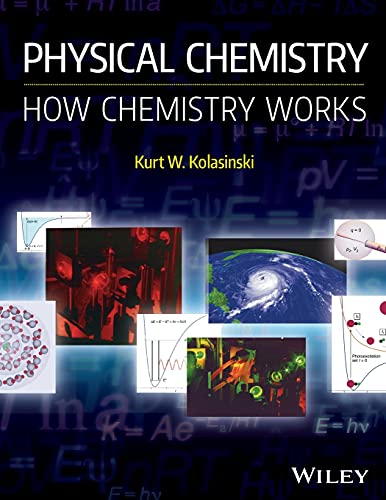
Physical Chemistry: How Chemistry Works by Kurt Kolasinski
Physical Chemistry How Chemistry Works
- Kolasinski, Kurt W. (Author)
- English (Publication Language)
- Modern approach connecting physical chemistry to everyday phenomena
- Molecular-level visualizations throughout every chapter
- End-of-chapter problems tied to real chemical systems and processes
- Clear treatment of statistical thermodynamics for undergraduates
Kurt Kolasinski’s textbook takes a modern, student-friendly approach to physical chemistry. Where older textbooks often feel like they were written for professors, this one was clearly written for the person sitting in the classroom trying to figure out why any of this matters.
The practical examples are a standout feature. Kolasinski connects physical chemistry concepts to real-world applications, which gives you a reason to care about chemical kinetics beyond passing the exam. The book also pushes you toward the frontiers of research, which is a nice touch if you’re considering graduate work.
At around $91, the price is reasonable for a modern textbook. The writing is clearer than average, and the problem sets are well-designed. If your physical chemistry class feels disconnected from reality, this book will bridge that gap.
Physical Chemistry by Berry, Rice, and Ross
Physical Chemistry Topics in Physical Chemistry
- Hardcover Book
- Berry, R. Stephen (Author)
- Clear derivations with every mathematical step explained in plain language
- Toolbox sections summarizing key equations and when to use them
- Companion website with interactive animations of molecular behavior
- Living graphs that students can manipulate to explore parameter changes
This is a heavy book in every sense. Written by three renowned physical chemists, it provides a thorough treatment of the field that goes deeper than most undergraduate texts. The coverage starts with atomic and molecular structure, moves through condensed matter properties, and then tackles statistical mechanics, thermodynamics, and kinetics.
The conceptual structure is what sets this book apart. Berry, Rice, and Ross emphasize understanding over memorization at every turn. The appendices develop mathematical background as needed, so you’re never left wondering where a formula came from. If you’re the type of student who wants to know why things work, not just how to plug numbers in, this is your book.
The $212 price tag is steep, and this isn’t a beginner-friendly text. But for serious chemistry majors who plan to go to graduate school, the depth of coverage here is hard to beat.
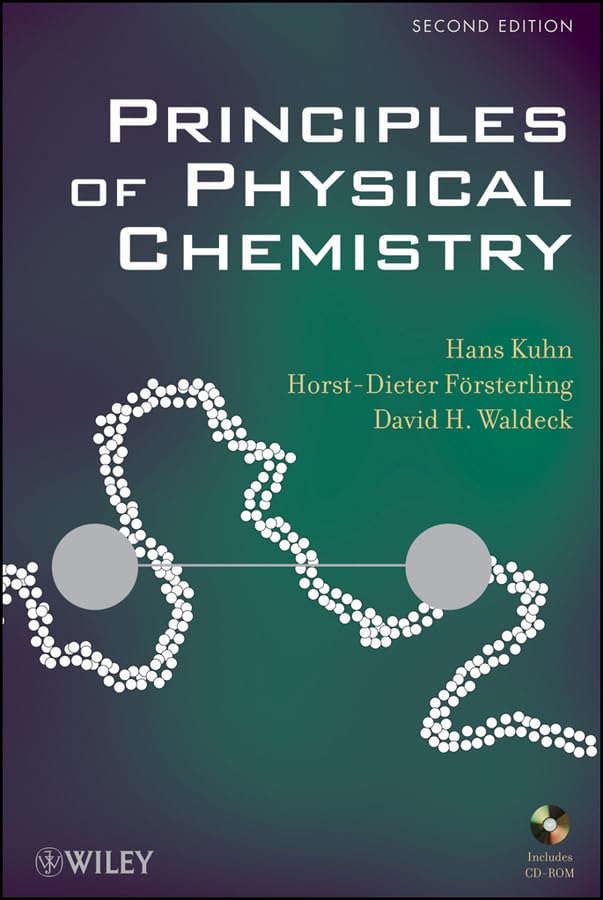
Principles of Physical Chemistry by Hans Kuhn
Principles of Physical Chemistry
- Hardcover Book
- Kuhn, Hans (Author)
- Unique integration of biology and nanotechnology with physical chemistry
- Visual approach with hundreds of color illustrations and diagrams
- Connects molecular properties to macroscopic observable behavior
- Applications sections showing relevance to materials and life sciences
Hans Kuhn takes an innovative approach by building physical chemistry around a few key principles rather than treating each topic in isolation. Instead of the traditional textbook structure where thermodynamics, kinetics, and quantum mechanics feel like separate courses, Kuhn shows you how they connect.
The thermodynamics section is particularly good. Rather than starting with the first and second laws as postulates, Kuhn introduces them through molecular assemblies and statistical behavior. This bottom-up approach makes the laws feel inevitable rather than arbitrary.
This book works well for both undergraduate and graduate courses. At $140, it’s mid-range for a hardcover textbook. The focus on conceptual unity makes it a standout choice for students who are frustrated by textbooks that treat every chapter like a self-contained island.
Physical Chemistry: A Molecular Approach by McQuarrie and Simon
Physical Chemistry A Molecular Approach
- Used Book in Good Condition
- Hardcover Book
- Quantum-first structure building from atoms up to bulk properties
- Mathematica and MathCad problems for computational chemistry practice
- Over 1,000 end-of-chapter problems with solutions manual available
- Clear mathematical interlude chapters reviewing essential calculus and algebra
McQuarrie and Simon made a bold choice: teach quantum mechanics before thermodynamics. Most physical chemistry textbooks go the other way, but the molecular-first approach makes a surprising amount of sense. You build up from atoms and molecules to bulk properties, which mirrors how physical chemistry actually works at the fundamental level.
The MathChapter sections are what make this book legendary among students. Before each major topic, you get a concise review of the mathematics you’ll need, from complex numbers and probability to series expansions and linear algebra. You don’t need to carry a separate math reference alongside this book.
At around $106, this is one of the most popular physical chemistry textbooks in the US, and for good reason. If your course covers quantum mechanics as a major component, this is the textbook to own. It’s been the standard at many research universities for years.
Physical Chemistry for the Chemical and Biological Sciences by Raymond Chang
Physical Chemistry for the Chemical and Biological Sciences
- Used Book in Good Condition
- Hardcover Book
- Biological applications integrated into every physical chemistry topic
- Worked examples using real biochemical systems and data
- Covers membrane transport, enzyme kinetics, and macromolecular interactions
- Accessible to pre-med and biology students taking physical chemistry
Raymond Chang is one of the most recognized names in chemistry textbook publishing, and this book shows why. His clear writing style and careful approach to teaching make difficult concepts accessible without sacrificing rigor. If you’ve used his general chemistry textbook, you already know what to expect.
The biological applications are the main selling point here. If you’re a pre-med student or studying biochemistry, this book connects physical chemistry to biological systems in a way that most textbooks don’t even attempt. You’ll see how thermodynamics and kinetics apply to enzyme reactions, protein folding, and membrane transport.
At $139, it’s priced competitively for a hardcover text. This is the book I’d recommend to any pre-med or life sciences student who needs physical chemistry credit. The biological examples will make the material feel relevant to your career path.
Physical Chemistry by David W. Ball
- Hardcover Book
- Ball, David (Author)
- Clear derivations with every mathematical step explained in plain language
- Toolbox sections summarizing key equations and when to use them
- Companion website with interactive animations of molecular behavior
- Living graphs that students can manipulate to explore parameter changes
David Ball’s Physical Chemistry takes an easy-to-read approach that focuses on the core topics without overloading you with advanced material. The recent editions added stronger coverage of thermochemistry, new worked examples presented in a two-column format, and a four-color design that actually helps you follow complex derivations.
The writing style is direct and approachable. Ball doesn’t assume you’re already comfortable with the math, and the explanations build gradually. The problem sets are well-structured, progressing from straightforward to challenging in a way that builds confidence.
At around $85 (currently 58% off the list price), this is a strong deal. If you want a physical chemistry textbook that teaches the fundamentals well without making you feel like you need a PhD to understand the first chapter, Ball’s book delivers.
Basic Physical Chemistry: The Route to Understanding by E. Brian Smith
Basic Physical Chemistry The Route To Understanding Revised Edition
- Amazon Kindle Edition
- E Brian Smith (Author)
- Compact format covering essential concepts in under 250 pages
- Oxford Chemistry Primer series: concise and exam-focused
- Ideal for quick review or as a supplement to a larger textbook
- Clear worked examples demonstrating key calculation methods
At $17.27 for the Kindle edition, this is the second-cheapest book on the list. E. Brian Smith wrote it as a student-friendly introduction that covers quantum mechanics and statistical mechanics, two topics that tend to intimidate undergraduates more than anything else in physical chemistry.
Smith’s focus on uncertainty and probability gives you the conceptual foundation you need before tackling the more mathematical treatments in other textbooks. The explanations are clear, the examples are well-chosen, and the book doesn’t try to cover everything. It does a few things well rather than many things poorly.
This is a great supplementary text or a starting point if you’re self-studying physical chemistry. Pair it with Schaum’s Outline for problem practice, and you have a solid, affordable study setup that covers the essentials.
Physical Chemistry for Engineering and Applied Sciences by Frank Foulkes
Physical Chemistry for Engineering and Applied Sciences
- Hardcover Book
- Foulkes, Frank R. (Author)
- Tailored specifically for engineering and applied science students
- Emphasis on thermodynamics, electrochemistry, and surface chemistry
- Practical applications in materials science, energy, and manufacturing
- Problems set in engineering contexts rather than pure chemistry
Frank Foulkes wrote this book with 30 years of teaching experience behind him, and that experience shows in the selection of topics and the way problems are structured. If you’re an engineering student taking physical chemistry as a requirement rather than a passion, this book speaks your language.
The 600+ exercises and end-of-chapter problems include many non-trivial solved examples that are designed to be both practical and thought-provoking. The engineering applications make the material feel relevant rather than abstract. You’ll see how physical chemistry principles connect to materials science, energy systems, and industrial processes.
At $113, the price is fair for a hardcover with this much content. If you’re studying chemical engineering, materials science, or any applied science where physical chemistry is a core requirement, this book will serve you better than a pure chemistry textbook.
Principles of Physical Chemistry by Kuhn and Forsterling
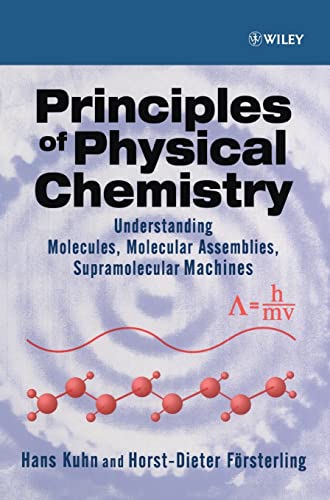
Principles of Physical Chemistry Understanding Atoms Molecules and Supramolecular Machines
- Hardcover Book
- Kuhn, Hans (Author)
- Unique integration of biology and nanotechnology with physical chemistry
- Visual approach with hundreds of color illustrations and diagrams
- Connects molecular properties to macroscopic observable behavior
- Applications sections showing relevance to materials and life sciences
This is the more advanced companion to Kuhn’s earlier text on this list. Kuhn and Forsterling build a strong foundation in statistical mechanics, thermodynamics, and kinetics, then extend into organized molecular assemblies and supramolecular systems. If that last part sounds unfamiliar, that’s precisely why this book is valuable.
The coverage of supramolecular chemistry and models of biological membranes sets this apart from every other physical chemistry textbook on this list. You’re getting exposure to topics that most undergraduates don’t encounter until graduate school. The writing is accessible despite the advanced content, which is a difficult balance to achieve.
At $151, it’s an investment. But if you’re planning on graduate work in physical chemistry, biochemistry, or materials science, this book gives you a head start that cheaper textbooks simply can’t match.
Physical Chemistry by Robert Mortimer
- Amazon Kindle Edition
- Mortimer, Robert G. (Author)
- Clear derivations with every mathematical step explained in plain language
- Toolbox sections summarizing key equations and when to use them
- Companion website with interactive animations of molecular behavior
- Living graphs that students can manipulate to explore parameter changes
The third edition of Robert Mortimer’s Physical Chemistry adds core applications and updates the theoretical content with recent developments. The book takes a stepwise approach to explaining principles, which means you’re building on each concept as you go rather than jumping between unrelated topics.
The math coverage is appropriate for undergraduates, and Mortimer includes enough background that you won’t need to constantly flip to a math reference. The chapters on thermodynamics and quantum chemistry are particularly well-written, with clear explanations and useful worked examples.
At $76.79 for the Kindle edition, this is a solid mid-range option. It doesn’t try to be flashy or innovative. It’s a well-structured, clearly written physical chemistry textbook that covers the standard curriculum reliably. Sometimes that’s exactly what you need.
Physical Chemistry by Ira Levine
- New
- Mint Condition
- Clear derivations with every mathematical step explained in plain language
- Toolbox sections summarizing key equations and when to use them
- Companion website with interactive animations of molecular behavior
- Living graphs that students can manipulate to explore parameter changes
Ira Levine’s Physical Chemistry is known for its detailed and thorough treatment of every topic it covers. The sixth edition maintains the same high standard that made earlier editions popular at universities across the country. The depth of coverage means you’re unlikely to encounter a topic in your course that this book doesn’t address.
The writing is clear and precise, though it can feel dense at times. Levine doesn’t cut corners on mathematical derivations, which is a strength if you’re committed to understanding the material deeply. The problem sets are substantial and well-graduated, moving from basic to advanced in a logical progression.
The list price of $293 is the highest on this list, though you can often find it at a steep discount (currently around $130). If your university requires Levine, it’s worth the investment. This is the kind of textbook that you’ll reference well beyond your undergraduate courses.
A Textbook of Physical Chemistry by K. L. Kapoor
- Kapoor, Dr K L (Author)
- English (Publication Language)
- Clear derivations with every mathematical step explained in plain language
- Toolbox sections summarizing key equations and when to use them
- Companion website with interactive animations of molecular behavior
- Living graphs that students can manipulate to explore parameter changes
K. L. Kapoor’s series is a six-volume set, and this fifth volume covers dynamics of chemical reactions, statistical thermodynamics, and macromolecules. At $5.28, the price is almost unbelievable. It’s written specifically for the Indian university curriculum, which follows SI units throughout.
The coverage of statistical thermodynamics is thorough and connects well with the dynamics and macromolecule chapters. Kapoor’s writing style is detailed and methodical, with plenty of worked examples. If you’re studying in India or following the Indian curriculum, this series is hard to beat on both price and content.
For international students, the SI units and affordable pricing make this worth picking up as a supplementary resource. The best statistical mechanics books list also has related recommendations if you need deeper coverage of that specific topic.
How to Choose the Best Physical Chemistry Textbook
Finding the best book for physical chemistry means matching the textbook to your math comfort level and course requirements. The physical chemistry books above cover every approach, from conceptual introductions to rigorous mathematical treatments.
Your choice depends on three things: your math background, your career goals, and your budget. Here’s how I’d narrow it down.
If you’re starting from scratch and math isn’t your strongest subject, go with Atkins’ Elements of Physical Chemistry or Ball’s Physical Chemistry. Both are clear, well-paced, and don’t assume you’re already comfortable with partial derivatives and integrals.
If you’re a serious chemistry major heading toward graduate school, McQuarrie and Simon’s A Molecular Approach or Berry, Rice, and Ross give you the depth you’ll need. The investment pays off when you’re not relearning concepts in your first year of grad school.
If you’re pre-med or in the life sciences, Raymond Chang’s Physical Chemistry for the Chemical and Biological Sciences is the clear winner. The biological applications will make your study time feel relevant rather than abstract.
If you’re an engineering student, Foulkes’ Physical Chemistry for Engineering and Applied Sciences was written specifically for you. Don’t fight through a pure chemistry textbook when there’s one designed for your perspective.
And if budget is your main concern, Schaum’s Outline at $11 and Kapoor’s series at $5 are bargains that genuinely deliver.
Best E-Readers for Physical Chemistry
Physical chemistry textbooks are expensive and heavy. I’ve carried Atkins’ Physical Chemistry in my backpack, and my shoulders remember it. A Kindle Paperwhite gives you the same content at half the price and zero the weight.
The warm light display is worth it for evening study sessions. No blue light keeping you wired at midnight before tomorrow’s p-chem exam. If you’re also taking physics courses, check out my physics textbook recommendations.
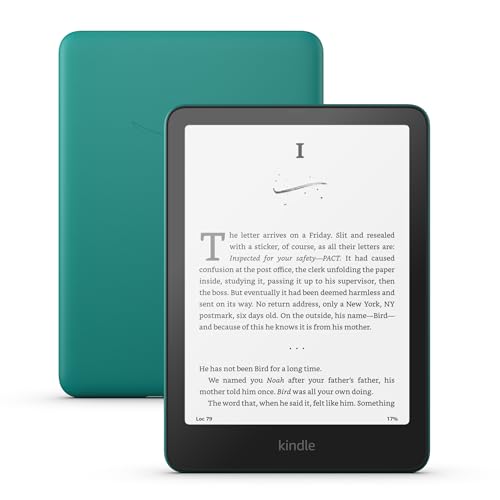
- Our fastest Kindle ever – The next-generation 7“ Paperwhite display has a higher contrast ratio and 25% faster page turns.
- Ready for travel – The ultra-thin design has a larger glare-free screen so pages stay sharp no matter where you are.
- Escape into your books – Your Kindle doesn’t have social media, notifications, or other distracting apps.
- Battery life for your longest novel – A single charge via USB-C lasts up to 12 weeks.
- Read in any light – Adjust the display from white to amber to read in bright sunlight or in the dark.
- 300 ppi glare-free display that reads like real paper even in direct sunlight
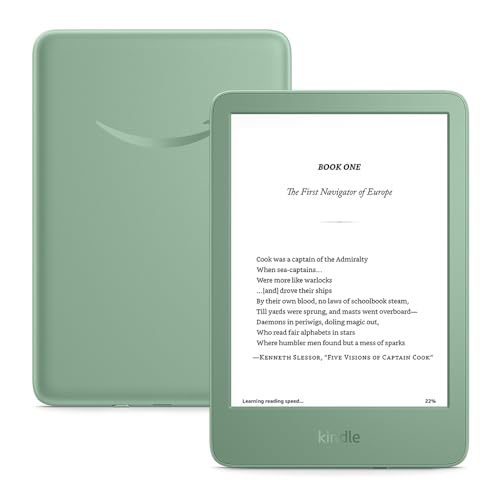
- The lightest and most compact Kindle – Now with a brighter front light at max setting, higher contrast ratio, and faster page turns for an enhanced reading experience.
- Effortless reading in any light – Read comfortably with a 6“ glare-free display, adjustable front light, now 25% brighter at max setting, and dark mode.
- Escape into your books – Tune out messages, emails, and social media with a distraction-free reading experience.
- Read for a while – Get up to 6 weeks of battery life on a single charge.
- Take your library with you – 16 GB storage holds thousands of books.
- Lightest Kindle ever at just 158g, perfect for one-handed reading
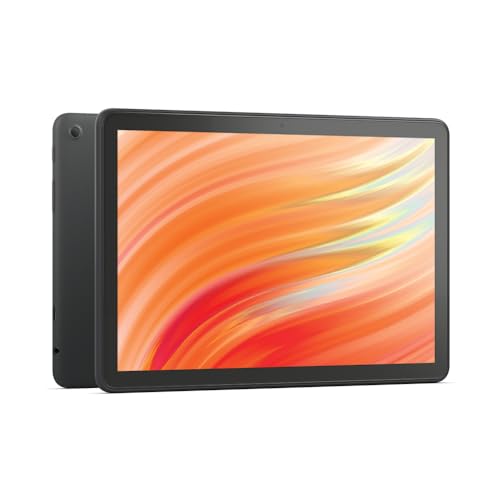
- Do what you love, uninterrupted , 25% faster performance than the previous generation and 3 GB RAM are ideal for seamless streaming, reading, and gaming.
- High-def entertainment , A 10.1" 1080p Full HD display brings brilliant color to all your shows and games. Binge watch longer with 13-hour battery, 32 or 64 GB of storage, and up to 1 TB expandable storage with micro-SD card (sold separately).
- Thin, light, durable , Tap into entertainment from anywhere with a lightweight, durable design and strengthened glass made from aluminosilicate glass. As measured in a tumble test, Fire HD 10 is 2.7 times as durable as the Samsung Galaxy Tab A8 (2022).
- Stay up to speed , Use the 5 MP front-facing camera to Zoom with family and friends, or create content for social apps like Instagram and TikTok.
- Ready when inspiration strikes , With 4,096 levels of pressure sensitivity, the Made for Amazon Stylus Pen (sold separately) offers a natural writing experience that responds to your handwriting. Use it to write, sketch in apps like OneNote, and more.
- 10.1-inch 1080p Full HD display ideal for reading textbook diagrams
Frequently Asked Questions
What is the best physical chemistry textbook for beginners?
For beginners, I recommend Elements of Physical Chemistry by Peter Atkins and Julio de Paula. It covers all the core topics without drowning you in advanced math. The short, focused chapters make it easy to follow along. Schaum’s Outline is also a solid pick if you want a problem-first approach at a much lower price.
Which physical chemistry book covers quantum mechanics well?
Physical Chemistry: A Molecular Approach by McQuarrie and Simon is the go-to choice. It teaches quantum mechanics before thermodynamics, which gives you the molecular-level understanding first. The MathChapter reviews before each section help you keep up with the math without needing a separate textbook.
Is physical chemistry harder than organic chemistry?
They’re hard in different ways. Organic chemistry is memorization-heavy with reaction mechanisms and synthesis pathways. Physical chemistry is math-heavy with calculus, differential equations, and quantum mechanics. If you’re strong in math, you’ll likely find physical chemistry more approachable. If you prefer visual and pattern-based learning, organic chemistry might be easier for you.
Do I need calculus before studying physical chemistry?
Yes. You need a solid foundation in single-variable and multivariable calculus at minimum. Many physical chemistry topics use differential equations, integration, and partial derivatives. Some books like McQuarrie and Simon include math reviews, but they assume you’ve already taken calculus courses. I’d recommend brushing up with one of the best calculus books before starting.
What is the difference between physical chemistry and chemical physics?
Physical chemistry applies physics principles to chemical systems, focusing on things like thermodynamics, kinetics, and equilibrium. Chemical physics leans more toward the physics side, dealing with molecular structure, spectroscopy, and quantum mechanics at a deeper level. The overlap is significant. In practice, the main difference is which department you sit in at university.
Can I self-study physical chemistry without a professor?
You can, but it’s tough. Physical chemistry has a lot of math-heavy derivations that are easier to follow with someone explaining them. If you’re going the self-study route, start with Atkins’ Elements of Physical Chemistry for the theory and use Schaum’s Outline for worked problems. Working through problems is where the real learning happens in physical chemistry.
Which physical chemistry book is best for pre-med students?
Physical Chemistry for the Chemical and Biological Sciences by Raymond Chang is built for pre-med and life sciences students. It connects physical chemistry concepts to biological systems, which makes it directly relevant to what you’ll encounter in medical school. The book doesn’t skip the math but keeps the biological applications front and center.
Are older editions of physical chemistry textbooks still useful?
For the core material, yes. Thermodynamics, quantum mechanics, and kinetics haven’t changed. An older edition of Atkins or McQuarrie will teach you the same fundamentals at a fraction of the cost. The main things you miss are updated problem sets, newer examples, and sometimes improved explanations. If budget is tight, an edition that’s 1-2 versions old is a smart buy.