
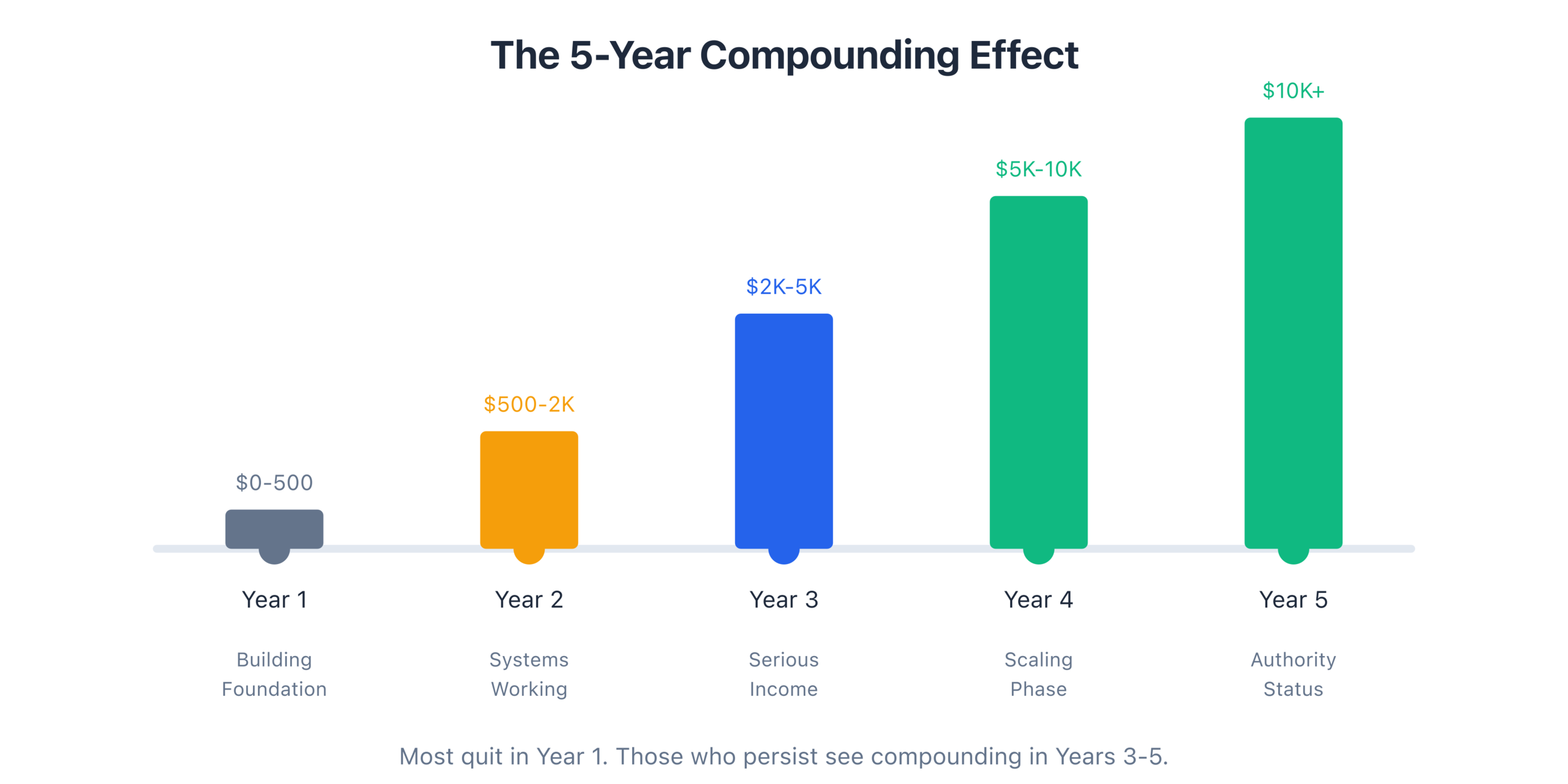
Most people treat affiliate blogging like a job. Write a post, get paid. Write another, get paid again. Linear relationship between effort and income. That’s how it works for the first few months, and honestly, it’s discouraging. You put in 40 hours of work and earn $23. The math looks terrible.
But affiliate blogging isn’t a job. It’s an investment. And like any good investment, the returns compound over time. The post you write today doesn’t just earn revenue this month. It earns revenue next month, and the month after that, and 18 months from now when it’s ranking for keywords you didn’t even target.
Understanding compounding is what separates the people who build real affiliate businesses from the people who quit at month four. Let me show you exactly how the timeline plays out.
The Compounding Timeline
Month 1-3: The Silent Phase
Nothing happens. Or at least, it feels like nothing happens.
You’re publishing content, but Google hasn’t noticed yet. Your posts are sitting on page 5 or 6 of search results. Traffic is minimal, mostly from social media shares and direct visits. Revenue is close to zero. Maybe you earn $10-50 from a handful of clicks.
This is the phase where 80% of people quit. They look at their analytics, see flat lines, and decide affiliate blogging “doesn’t work.” I get it. I nearly quit during this phase myself back in 2009.
But here’s what’s actually happening during months 1-3: Google is indexing your content. It’s learning what your site is about. It’s evaluating your content quality, your site structure, and your topical authority. Each post you publish is a data point that helps Google understand your expertise.
You’re also building something you can’t see in analytics: a content library. Each post creates internal linking opportunities. Each review establishes your voice and authority on a topic. Each comparison piece gives readers a reason to trust your recommendations.
What to do during this phase: Keep publishing. Don’t check analytics more than once a week. Focus on building out your content library for your core product stack. Aim for 2-3 high-quality posts per week.
Month 3-6: The First Signs
Somewhere around month 3, things start to move. A few posts begin ranking on page 2 of Google. Organic traffic starts appearing in your analytics. Not much, maybe 500-1,000 monthly organic visitors. But it’s real traffic from real search queries.
And here’s where compounding starts: those early rankings generate clicks to your affiliate links. The revenue is small, maybe $100-300/month. But each successful conversion tells you something. Which products convert. Which pages attract buyers. Which keywords drive commercial traffic. This data becomes the foundation for every decision you make going forward.
During months 3-6, you’ll also notice that older posts start improving in rankings without any additional work. A post you wrote in month 1 that was sitting on page 4 quietly moves to page 3, then page 2. Google is starting to trust your site. Each new post you publish adds to that trust, which lifts all your existing content.
What to do during this phase: Double down on topics that show early traction. If your hosting comparison is already on page 2, invest in supporting content around hosting (tutorials, guides, FAQs) to build topical authority. Start your monthly analytics review ritual. Begin internal linking from new content to your emerging money pages.
Month 6-12: The Growth Phase
This is when affiliate blogging starts to feel like it’s working. Multiple pages are ranking on page 1. Organic traffic is growing 15-30% month over month. Revenue jumps from hundreds to low four figures.
And the compounding is now visible. Posts you wrote six months ago are earning more today than they were last month, even though you haven’t touched them. New posts are ranking faster because your domain has built authority. Internal links are creating a web of content that reinforces itself.
During this phase, something magical happens: revenue starts growing faster than content production. You might publish 10 posts in a month and see revenue increase by 25%. That’s because your existing content is appreciating in value while new content adds to the base.
I tracked this on one of my sites during months 8-12. I published 35 new posts during that period. But 60% of the revenue growth came from posts that were already 4-6 months old. The old content was maturing, gaining authority, and climbing in rankings. The new content was adding fuel, but the old content was the engine.
What to do during this phase: Optimize your top performers aggressively. Update them with fresh data. Improve their CTAs. Test different affiliate products. Start building your email list (this becomes a multiplier later). Consider reinvesting a portion of revenue into better tools, content, or freelance help.
Year 2+: The Compounding Engine
This is where the math gets exciting.
By year 2, you have 100-200+ posts on your site. Many of them rank well. Your domain authority is established. New content ranks faster. Old content keeps earning. Your email list drives additional revenue independent of search rankings. You understand your analytics deeply enough to make data-driven decisions.
Revenue growth becomes multiplicative rather than additive. Each new post doesn’t just earn on its own. It strengthens your site’s authority, which improves rankings for existing posts, which increases traffic across the board, which generates more revenue from content you wrote a year ago.
I’ve seen affiliate sites in year 3 earning $5,000-15,000/month from content that was written in year 1 and hasn’t been substantially updated. The posts are just sitting there, ranking, driving traffic, and converting. Month after month. That’s compounding at work.
Why Most People Quit Right Before Compounding Kicks In
The timing is cruel. The work is hardest when the rewards are smallest. And the rewards get biggest when you’ve been at it long enough for most people to have given up.
I’ve watched dozens of bloggers in my circle start affiliate sites. The pattern is almost always the same. Months 1-2 are exciting. New site, fresh energy, lots of content. Month 3, the excitement fades because analytics are still flat. Month 4-5, frustration sets in. They start questioning the strategy. They look for shortcuts. They hear about someone who made $10K in their first month (usually a lie or an extreme outlier) and wonder what they’re doing wrong.
By month 6, half of them have stopped publishing. By month 9, most have abandoned the site entirely. And month 9 is roughly when their early content would have started generating real revenue.
The bloggers who make it through the dip all share one trait: they trust the process enough to keep going when results are invisible. They don’t need daily validation from their analytics dashboard. They know the math works because they’ve studied the compounding model, or because someone they trust told them it would take 6-9 months.
That’s what I’m telling you right now. It takes 6-9 months of consistent publishing before affiliate revenue becomes meaningful. If you’re in month 3 and things feel slow, you’re right on schedule. Keep going.
How Affiliate Content Compounds Differently
Not all content compounds the same way. A news article about what happened today has a shelf life of maybe 48 hours. A viral social media post might last a week. But a well-written affiliate review… that piece can earn you money for 3-5 years with periodic updates.
Here’s what makes affiliate content special in the compounding equation:
Affiliate content targets evergreen search queries. People search “best email marketing software” every single day. That query doesn’t expire. The intent behind it doesn’t change. Your review, if it ranks well, captures a portion of that daily search volume indefinitely.
Affiliate content attracts buyers. Not just readers or followers, but people with credit cards who are ready to make a decision. This means every visitor is more valuable than on a typical blog post. A single visitor to a well-optimized affiliate page can generate $5-50 in commission. A single visitor to an informational blog post might be worth $0.01 in ad revenue.
Affiliate content improves with age. Search engines favor content that’s been around for a while, that’s been updated, that has accumulated backlinks and user engagement signals. Your 18-month-old hosting review that you’ve updated three times is more trusted by Google than a brand new review by a competitor. That age advantage compounds.
Each piece of affiliate content supports the next. Your review of Tool A links to your comparison of Tool A vs. Tool B, which links to your tutorial on setting up Tool B, which links to your review of Tool B. Each new piece strengthens the entire network. After 100 posts, you have a web of interconnected content that’s far more powerful than 100 isolated articles.
The Flywheel
Compounding in affiliate blogging follows a specific pattern. I think of it as a flywheel:
Content leads to rankings. Rankings lead to traffic. Traffic leads to revenue. Revenue funds reinvestment. Reinvestment leads to more content. And the cycle starts again, but faster each time.
The flywheel is hard to get spinning at first. The first few pushes, your early content, barely move it. But each push adds momentum. By month 6, the flywheel is turning on its own. By year 2, it’s spinning fast enough that small pushes (new content, minor updates) produce outsized results.
The practical implication: every dollar you reinvest back into your affiliate business during the first year accelerates the flywheel. Better hosting means faster site speed, which means better rankings. A premium SEO tool means better keyword research, which means more targeted content. A part-time writer means more content, which means more pages ranking, which means more revenue to invest.
I reinvested 90% of my affiliate revenue during year 1. It felt painful to earn $1,500/month and put $1,350 back into the business. But that reinvestment funded better tools, more content, and a VA who handled the operational tasks. By year 2, the business was generating enough that I could both reinvest AND pay myself well.
If you’re treating affiliate revenue as pure income from day one, you’re slowing the flywheel. Consider reinvesting at least 50% of revenue during your first 12 months.
Building an Asset vs. Extracting Value
There are two mindsets in affiliate blogging, and they lead to very different outcomes.
The extraction mindset focuses on getting money out of the business as fast as possible. Publish thin content. Stuff it with affiliate links. Chase whatever’s trending. Don’t invest in quality because quality takes time. This approach can generate income in the short term, but it builds nothing lasting. The site doesn’t compound because the content doesn’t hold up over time. Rankings decay. Traffic drops. The blogger moves on to the next scheme.
The asset mindset focuses on building something that appreciates in value over time. Publish exceptional content. Build genuine authority. Create a brand that readers trust. Invest in the site’s long-term health. This approach is slower at first, but it creates a real asset.
An affiliate site built with the asset mindset can be sold for 30-40x its monthly revenue. A site earning $10,000/month is worth $300,000-400,000 on the open market. I’ve seen sales in this range on platforms like Flippa and Empire Flippers. That’s not income. That’s wealth building.
But even if you never sell, the asset mindset produces better results year over year. Quality content ranks longer. Trusted brands convert at higher rates. Strong domain authority makes every new post more effective.
Every piece of content you publish is either adding to the asset or extracting from it. Before you hit publish, ask yourself: will this piece be as valuable 18 months from now as it is today? If the answer is yes, you’re building an asset.
The 5-Year Perspective
I want to give you the long view, because the long view changes how you make decisions today.
An affiliate site that’s been thoughtfully built for 5 years isn’t just generating revenue. It’s a machine.
By year 5, you’ll have 500-1,000+ pieces of content. Hundreds of them will be ranking. Your domain authority will be strong enough to rank for competitive terms. Your email list will be a significant revenue source independent of Google. Your brand will be recognized in your niche.
The bloggers I know who’ve been at this for 5+ years are earning $15,000-50,000/month from affiliate revenue alone. Some are higher. And the work they put in today is significantly less than what they put in during year 1. Their content library does most of the heavy lifting. They spend their time updating, optimizing, and strategically publishing, not grinding out content from scratch.
Five years sounds like a long time. It’s not. I’ve been blogging since 2008. It’s been over 17 years. And looking back, the best investment I ever made was the content I published in years 1-3 that’s still earning me revenue today. Some of my best-performing affiliate pages are based on content I originally wrote in 2012 and have updated regularly since then. Those pages have earned tens of thousands of dollars. From a single piece of content, updated periodically.
When you think in 5-year terms, the daily grind of publishing looks different. You’re not writing a blog post. You’re planting a tree that will bear fruit for years. Some trees won’t produce much. Others will become massive. You can’t predict which ones at planting time. But if you plant enough trees and tend them well, the orchard will feed you.
What I’d Tell My 2008 Self
If I could go back to when I started, sitting in front of a cheap laptop with zero traffic and zero revenue, here’s exactly what I’d say.
Start with one niche and one product stack. Don’t try to cover everything. Don’t chase commission rates. Find products you genuinely use, recommend them honestly, and build deep expertise. Breadth will come later.
Write for the reader who’s about to buy, not the reader who’s casually browsing. Commercial intent keywords are where the money is. Informational content has its place (building authority, earning links), but prioritize content for people with wallets in hand.
Build your email list from month one. I waited two years to start collecting emails. Those were two years of traffic I could never recapture. An email list is the one traffic source that Google can’t take away from you.
Be patient with the numbers, but impatient with the quality. Don’t check analytics daily. Do check every piece of content against your quality standard before publishing. The numbers will come if the quality is there. They won’t come any faster if you stare at them.
Don’t take shortcuts on disclosure and ethics. The money from shady tactics never lasts. The reputation damage from getting caught always does. Play the long game. Disclose everything. Recommend honestly. It’s slower at first and faster in the long run.
Invest in learning SEO, properly. I wasted my first year relying on social media traffic. Social traffic spikes and crashes. Organic search traffic grows and compounds. Every hour you spend learning SEO properly pays dividends for years.
Track everything from day one. I ran my first affiliate site for 8 months before I set up proper tracking. That’s 8 months of data I can never get back. Set up analytics, affiliate tracking, and click monitoring before you publish your first affiliate post.
The overnight successes you see online are 2-3 years in the making. Nobody goes from zero to $10K/month in 30 days with affiliate blogging. The people claiming otherwise are either lying or selling a course. (Yes, I see the irony.) The real timeline is 6-12 months to meaningful revenue and 2-3 years to life-changing revenue. Accept that timeline. Work within it. And you’ll get there.
And the biggest one… don’t quit at month 4. I almost did. And everything I’ve built in the years since, every dollar of affiliate revenue, every client I’ve worked with, every course I’ve created, it all stems from the decision to keep going when the analytics showed nothing.
The compounding effect is real. But you have to stay long enough to see it.
Chapter Checklist
- [ ] Identify which phase of the compounding timeline you’re currently in
- [ ] Set realistic revenue expectations for the next 3 months based on your phase
- [ ] Calculate how much revenue comes from content older than 6 months
- [ ] Audit your content for evergreen potential (will it be valuable in 18 months?)
- [ ] Set up your reinvestment ratio (50%+ recommended during year 1)
- [ ] Identify 3 pieces of content worth updating this month to extend their lifespan
- [ ] Start or optimize your email list (your Google-proof traffic source)
- [ ] Review your overall strategy through the “asset vs. extraction” lens
- [ ] Plan your content calendar for the next 90 days with compounding in mind
- [ ] Commit to a specific timeline (I recommend 18 months minimum) before evaluating whether affiliate blogging “works” for you
Chapter Exercise
The Compounding Projection
This exercise helps you see where your affiliate business is headed based on realistic compounding assumptions.
-
Write down your current monthly affiliate revenue.
-
Write down how many affiliate-linked posts you currently have published.
-
Calculate your average revenue per affiliate post (total revenue divided by number of posts).
-
Now project forward. Assuming you publish 8 new affiliate posts per month and your average revenue per post grows 10% per quarter (a conservative estimate as your domain authority builds), calculate your projected monthly revenue at:
- 6 months from now
- 12 months from now
- 24 months from now
-
The numbers will surprise you. Even with conservative assumptions, the compounding math produces significant growth after month 12. The key is that each post earns more over time (not less), and each new post adds to a growing base.
-
Write your 24-month revenue projection on a sticky note. Put it where you’ll see it every day. On the days when publishing feels pointless, when analytics are flat, when you’d rather watch Netflix than write another review… look at that number.
That’s your future. The only thing between where you are now and that number is time and consistent effort. The math works. The compounding works. You just have to keep going.