
There’s a moment in every affiliate blogger’s career when things start clicking. Revenue is steady. Content is ranking. Commissions are growing. And then the question hits: how do I make this bigger without breaking what’s already working?
I’ve been through every stage of affiliate scaling, from $200/month side hustle to five-figure months. And the hardest lesson I learned is that scaling affiliate revenue is nothing like scaling other businesses. You can’t just throw money at ads. You can’t just hire five writers and 5x your output. The rules are different because trust is your currency, and trust doesn’t scale the way production does.
The Scaling Checklist: Milestones and What They Demand
Every revenue milestone brings a different set of problems. Here’s what to expect and what to focus on at each stage.
When you hit $1,000/month, you’ve proven the model works. You have content that ranks, products that convert, and a system that generates revenue while you sleep. But you’re probably doing everything yourself: writing, SEO, link building, site maintenance, analytics.
At this stage, your one job is to protect what’s working. Don’t get adventurous with new niches. Don’t chase shiny objects. Document your process for creating affiliate content. Write down exactly how you research a product, structure a review, and select affiliate programs. This documentation becomes the foundation for everything that follows.
Invest in two things: better analytics (so you know exactly which content drives revenue) and better content on your top-performing pages (update, expand, and optimize them). Don’t hire yet. Don’t diversify yet. Just deepen what’s working.
When you hit $5,000/month, the game changes. You’ve got real revenue, but you’re also hitting the ceiling of what one person can produce. Your time is the bottleneck, not your strategy.
This is when you start systematizing. Create standard operating procedures (SOPs) for every repeatable task. Product research SOP. Content outline SOP. Publishing SOP. Link-building SOP. Internal linking SOP. I’m not talking about vague guidelines. I mean step-by-step documents with screenshots, examples, and quality checklists that someone else could follow.
Start with your lowest-leverage activities. Don’t hand off the writing first (that’s your highest-value work). Hand off image creation, WordPress formatting, schema markup, internal link updates. Find a VA who can handle these tasks for $5-10/hour. This frees you up to write more content and optimize existing pages.
When you hit $10,000/month, you need content leverage. You’re probably publishing 8-12 pieces of high-quality affiliate content per month by yourself. To grow beyond this, you either need to write faster (unlikely) or bring on writers.
This is the scariest stage because you’re putting your reputation in someone else’s hands. I’ve hired 20+ writers for affiliate content over the years. Most didn’t work out. I’ll tell you exactly why in the hiring section below. But the ones who did work out allowed me to 3x my content output without sacrificing quality.
At $10K/month, also diversify your affiliate programs. You should have at least 3-4 significant programs generating revenue. If one program is responsible for more than 50% of your income, you’re exposed. One commission rate change and your business takes a massive hit. I’ve seen it happen. It happened to me.
When you hit $25,000/month, you’re running a real business. You probably have 2-3 writers, a VA, and maybe a part-time SEO specialist. Your role shifts from “content creator” to “content strategist and business operator.”
At this level, focus on building assets that compound. Create resource libraries that attract backlinks. Build email lists that you can monetize independently of search traffic. Launch comparison tools or calculators that earn links and traffic on autopilot. Start thinking about acquiring smaller affiliate sites in adjacent niches. The math on buying sites often beats the math on building from scratch, especially when you have the systems to optimize them quickly.
The Trust-Revenue Relationship
This is the concept that most affiliate marketers miss entirely, and it’s the reason most plateau before reaching their potential.
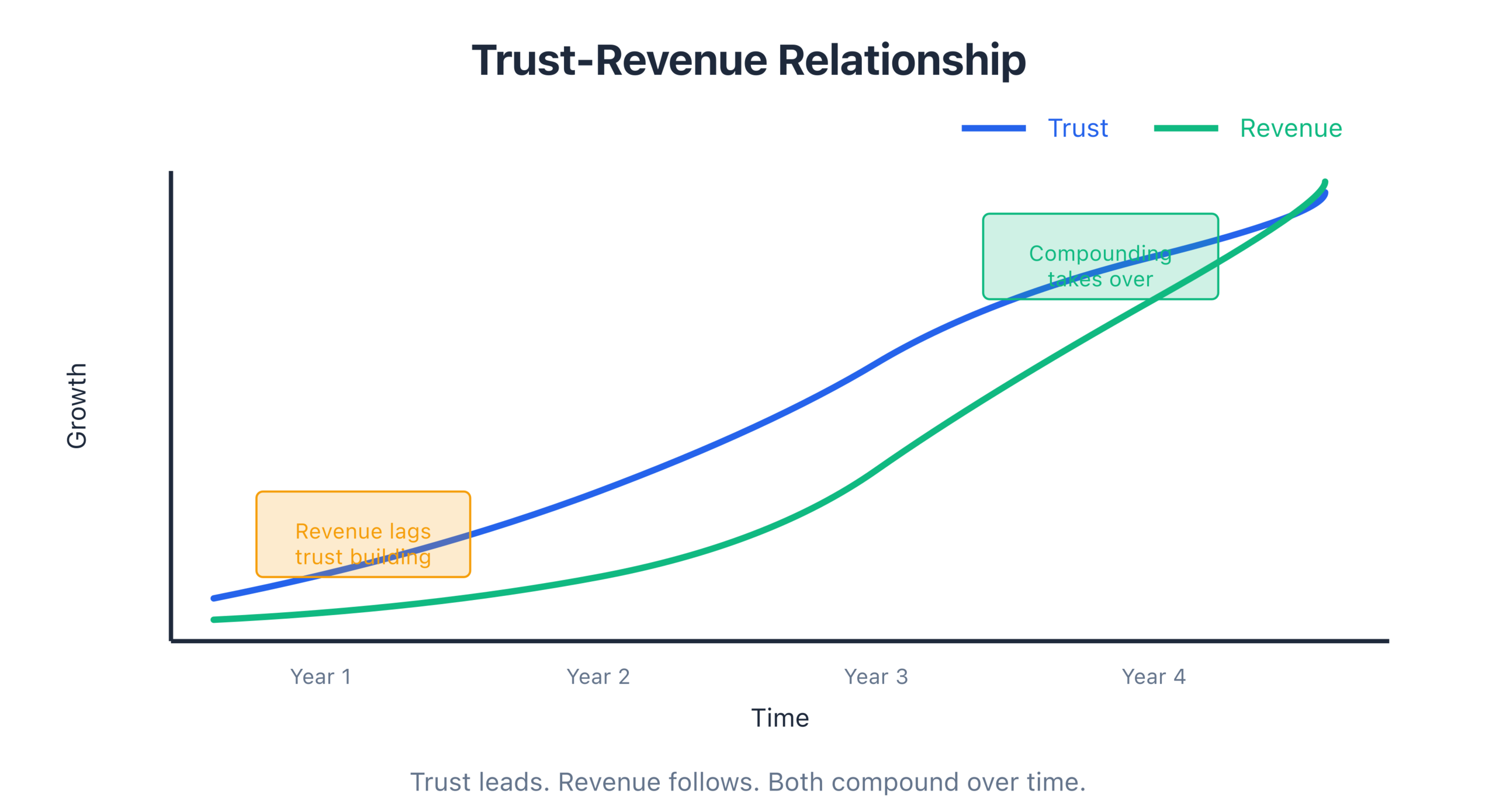
Your affiliate revenue is a direct function of audience trust. Not traffic. Trust. I’ve seen sites with 500,000 monthly visitors earn less than sites with 50,000 monthly visitors. The difference? The smaller site was built by someone their audience trusted deeply. Every recommendation carried weight. Every review was clearly based on real experience.
Trust is your scaling bottleneck because it doesn’t grow linearly with content production. You can publish 50 reviews this month, but if your audience doesn’t believe you’ve actually used all 50 products, each review carries less weight than if you’d published 5 deeply personal, experience-based reviews.
The practical implication: as you scale content production, you must also scale trust signals.
- Show your work. Screenshots of real dashboards, real results, real experiences with the products you recommend.
- Update old content. Nothing builds trust like a review that says “Updated February 2026” with genuine new insights.
- Be willing to criticize products you promote. If version 3.0 of a tool you recommend introduced bugs, say so. Your readers will respect the honesty and trust your future recommendations even more.
- Build an email relationship. Blog visitors are semi-anonymous. Email subscribers know you. They’ve read your newsletters. They’ve seen your take on industry news. When you recommend something to an email subscriber, the conversion rate is 2-5x higher than a cold blog visitor.
Every scaling decision should pass this test: “Will this increase or decrease my audience’s trust?” If hiring cheap writers leads to generic reviews, trust drops. If investing in video walkthroughs adds a personal layer, trust grows. Make decisions accordingly.
Scaling Content Production Without Sacrificing Quality
The biggest trap in scaling is believing you can just produce more. You can’t. Or rather, you can, but if quality drops, your revenue per page drops even faster.
I’ve tested this. During one push for growth, I published 40 affiliate articles in a single month using a combination of writers and my own output. Traffic grew, sure. But revenue per visitor actually declined by 35%. Why? Because the content wasn’t as strong. The reviews were thinner. The personal experience was missing. Readers could tell.
Here’s the framework I use now for scaling content while keeping quality high.
Tier your content. Not every piece needs the same level of investment.
- Tier 1 (you write): Flagship reviews, comparison posts, and “best of” lists. These are your money pages. They need your voice, your experience, your opinions. Don’t delegate these.
- Tier 2 (writer + your editing): Supporting content like tutorials, how-to guides, and informational posts that feed traffic to Tier 1. A solid writer can handle these with detailed outlines and your heavy editing.
- Tier 3 (writer with light editing): Long-tail content, FAQ posts, and supplementary pages. These exist for internal linking and long-tail traffic. They need to be accurate and helpful, but they don’t need your deep personal touch.
Set a quality floor. Define the minimum quality standard for every piece before it gets published. My quality floor includes:
- At least 3 specific claims backed by evidence, screenshots, or personal experience
- No generic advice that could apply to any product
- At least one honest criticism of the product being reviewed
- Proper affiliate disclosures in the right places
- Internal links to at least 3 related articles
- Updated pricing and feature information
If a draft doesn’t hit the quality floor, it goes back for revision. No exceptions. Publishing low-quality content damages your site’s authority with readers and search engines alike.
Batch your editing. I’ve found that editing 5 articles in one sitting is more efficient than editing them individually throughout the week. You develop a rhythm. You catch inconsistencies. Your quality standard stays sharp because you’re comparing pieces side-by-side.
Hiring Writers for Affiliate Content
I’ll be direct: most writers you hire for affiliate content won’t work out. Not because they’re bad writers, but because affiliate content requires a specific skill set that most writers don’t have.
Here’s what doesn’t work:
- Hiring a “content writer” who’s never used the products they’re reviewing. The content reads like rewritten feature pages from the product website. Readers spot this instantly.
- Hiring based on writing samples alone. A beautiful portfolio means nothing if the writer can’t follow your voice guide and produce content that matches your site’s tone.
- Paying per word. This incentivizes padding. You want writers who can say what needs to be said in as many or as few words as it takes. Pay per piece, with clear quality standards.
- Giving vague briefs like “write a review of Product X.” Without detailed outlines, even good writers will produce generic content.
Here’s what works:
- Hire writers who are practitioners in your niche. A hosting review written by someone who actually manages servers is ten times better than one written by a generalist content writer. Pay more for this expertise. It’s worth it.
- Create detailed content briefs for every assignment. I mean 500+ word briefs that include: target keywords, content structure, specific points to cover, products to compare, your honest opinion they should build around, and examples of what good looks like on your site.
- Start with a paid test article. Give them your most detailed brief for a real piece you need. Pay full rate. Judge the output. If it’s close but needs work, give feedback and try one more. If it’s fundamentally off, move on.
- Build a small, stable team rather than using a rotating roster of freelancers. I’ve found that 2-3 writers who deeply understand your site produce better work than 10 writers who each write one piece.
The writers who’ve worked best for me long-term all had the same trait: they were curious enough to actually test the products before writing about them. I give them access to tools, trial accounts, and test environments. The resulting content is night-and-day different from what you get when a writer just summarizes the product’s marketing page.
Diversifying Affiliate Programs and Income Streams
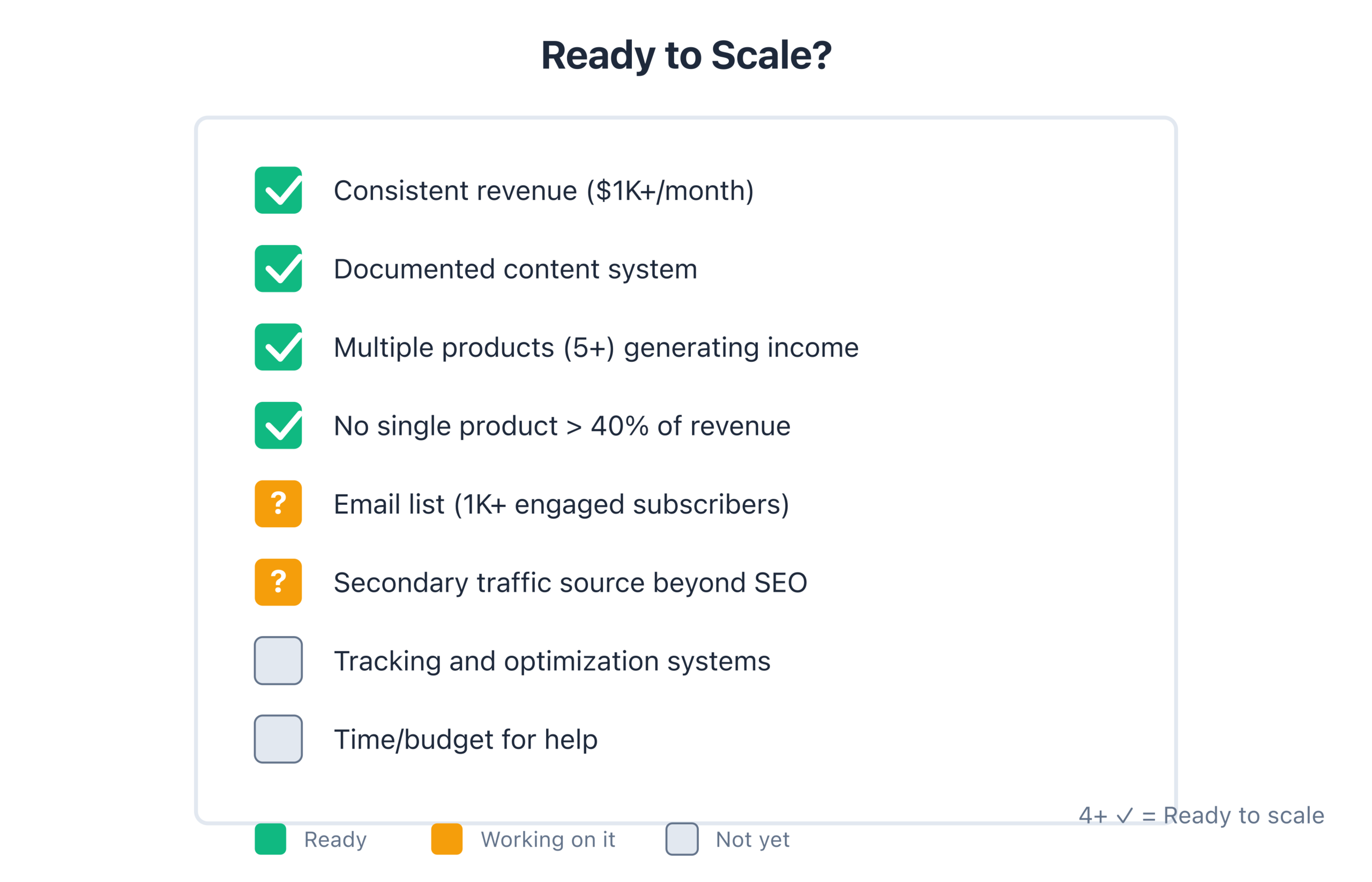
If more than 40% of your affiliate revenue comes from a single program, you need to diversify. Today.
I learned this the hard way when a hosting company I was promoting cut their commission from $100 to $40 per sale overnight. No warning. No negotiation. Just an email saying “effective immediately.” That one change cost me $3,000/month.
Here’s how to think about diversification:
Within your niche, promote products at different price points and categories. If you’re in the WordPress niche, don’t just promote hosting. Promote themes, plugins, page builders, email marketing tools, SEO tools, and online courses. Each category has its own affiliate programs, its own commission structures, and its own buying cycles. When hosting sales slow down in summer, software renewals might pick up.
Across commission models, don’t rely only on one-time commissions. Recurring commissions (common with SaaS products) build a base of monthly revenue that grows over time. I have affiliate partnerships paying me recurring commissions on sales I made three years ago. That’s $200-400/month per long-term customer, and it adds up fast. A base of $3,000/month in recurring commissions means you start every month at $3,000 before a single new sale.
Beyond affiliate revenue, consider adjacent income streams that your audience and content can support. Digital products (like this course you’re reading) convert well when your audience already trusts your expertise. Consulting or services can be lucrative but don’t scale. Sponsored content can supplement affiliate income, but be careful not to let it erode trust.
My revenue split today looks roughly like: 55% affiliate commissions, 25% digital products, 15% services, 5% sponsored content. That mix didn’t happen by accident. It happened because I intentionally built each stream while keeping affiliate as the foundation.
The Plateau Problem
Every affiliate site hits a plateau. Revenue stops growing, or worse, stagnates for months. I’ve seen it happen at $2,000/month, at $8,000/month, and at $20,000/month. Each plateau has different causes.
The content plateau happens when you’ve covered the obvious topics in your niche and new content isn’t ranking as well. The fix: go deeper, not wider. Instead of writing about a new topic, write the definitive piece on a topic you’ve already covered. Merge thin pages into comprehensive resources. Update your best-performing content with fresh data and insights.
The SEO plateau happens when your domain authority caps out and you can’t rank for more competitive keywords. The fix: invest in link building. Guest posts on relevant sites. Create linkable assets like original research, tools, or comprehensive guides that earn links naturally. It takes months to see results, but it’s the only sustainable way to break through.
The conversion plateau happens when your traffic keeps growing but your revenue doesn’t. Your conversion rate is declining. The fix: audit your top pages. Has the product changed? Has a competitor launched a better landing page? Are your CTAs stale? Sometimes a simple A/B test on your CTA button text or placement breaks through a conversion plateau.
The motivation plateau is the one nobody talks about. You’ve been doing this for 18 months. The novelty is gone. Writing another product review feels like a grind. The fix: remember why you started. Take a week off. Explore a sub-niche you find genuinely interesting. Talk to your readers. The energy usually comes back when you reconnect with the real people behind the traffic numbers.
Building Systems and SOPs for Repeatable Affiliate Content
The affiliate bloggers who build real businesses, not just side income, all have one thing in common: systems.
A system is a documented, repeatable process that produces consistent results regardless of who executes it. Here are the SOPs every affiliate site needs:
Content Research SOP: How you find topics, evaluate keyword difficulty, assess commercial intent, and decide what to write next. Include your decision criteria: minimum search volume, maximum keyword difficulty, required commercial intent signals.
Content Creation SOP: Your outline template, required sections for different content types (reviews vs. comparisons vs. guides), voice guidelines, quality checklist, and formatting standards.
Publishing SOP: Image sourcing and optimization, internal linking requirements, affiliate link placement, schema markup, disclosure placement, and the pre-publish quality check.
Content Update SOP: How often you review existing content, what triggers an update (pricing changes, new features, new competitors), the update process, and how to update without losing rankings.
Analytics SOP: Your monthly review process (from the previous chapter), the metrics you track, how you record them, and how decisions get made based on data.
Document these in whatever tool you prefer. I use Notion. Some people use Google Docs. The format doesn’t matter. What matters is that the process exists outside your head. When you hire your first team member, these SOPs cut their ramp-up time from months to weeks.
One more thing about systems: they need to evolve. Review your SOPs quarterly. What’s working? What’s outdated? What steps can be eliminated or automated? The best systems get simpler over time, not more complex.
Chapter Checklist
- [ ] Identify which revenue milestone you’re currently at ($1K, $5K, $10K, $25K)
- [ ] List the 3 most important actions for your current stage
- [ ] Audit your affiliate program concentration (% of revenue per program)
- [ ] Start diversifying if any single program exceeds 40% of revenue
- [ ] Create content tiers (Tier 1, 2, 3) and assign your existing content to each
- [ ] Define your quality floor with specific, measurable criteria
- [ ] Write at least one SOP this week (start with your content creation process)
- [ ] Calculate your recurring vs. one-time commission ratio
- [ ] Identify your current plateau type (content, SEO, conversion, or motivation)
- [ ] Make a plan to address that specific plateau
Chapter Exercise
The Scaling Roadmap
Grab a blank document and build your 90-day scaling plan:
- Write down your current monthly affiliate revenue (be honest, use last month’s actual number).
- Set a target for 90 days from now. Make it ambitious but realistic. If you’re at $1,000/month, target $1,800. If you’re at $5,000, target $7,500. A 50-80% increase in 90 days is achievable with focused effort.
- List your top 5 revenue-generating pages. For each one, write down one specific optimization you’ll make this month.
- Identify two new affiliate programs you could join that complement your existing product stack.
- Write a 1-page SOP for your content creation process. Just the basics: how you pick a topic, what goes in your outline, how you structure a review, and your pre-publish checklist.
- Block 30 minutes on your calendar for the first Monday of next month. Label it “Affiliate Analytics Review.” Make it recurring.
This exercise should take about an hour. When you’re done, you’ll have a clearer picture of where you are, where you’re going, and exactly what to do next. That clarity is worth more than any tactic.