
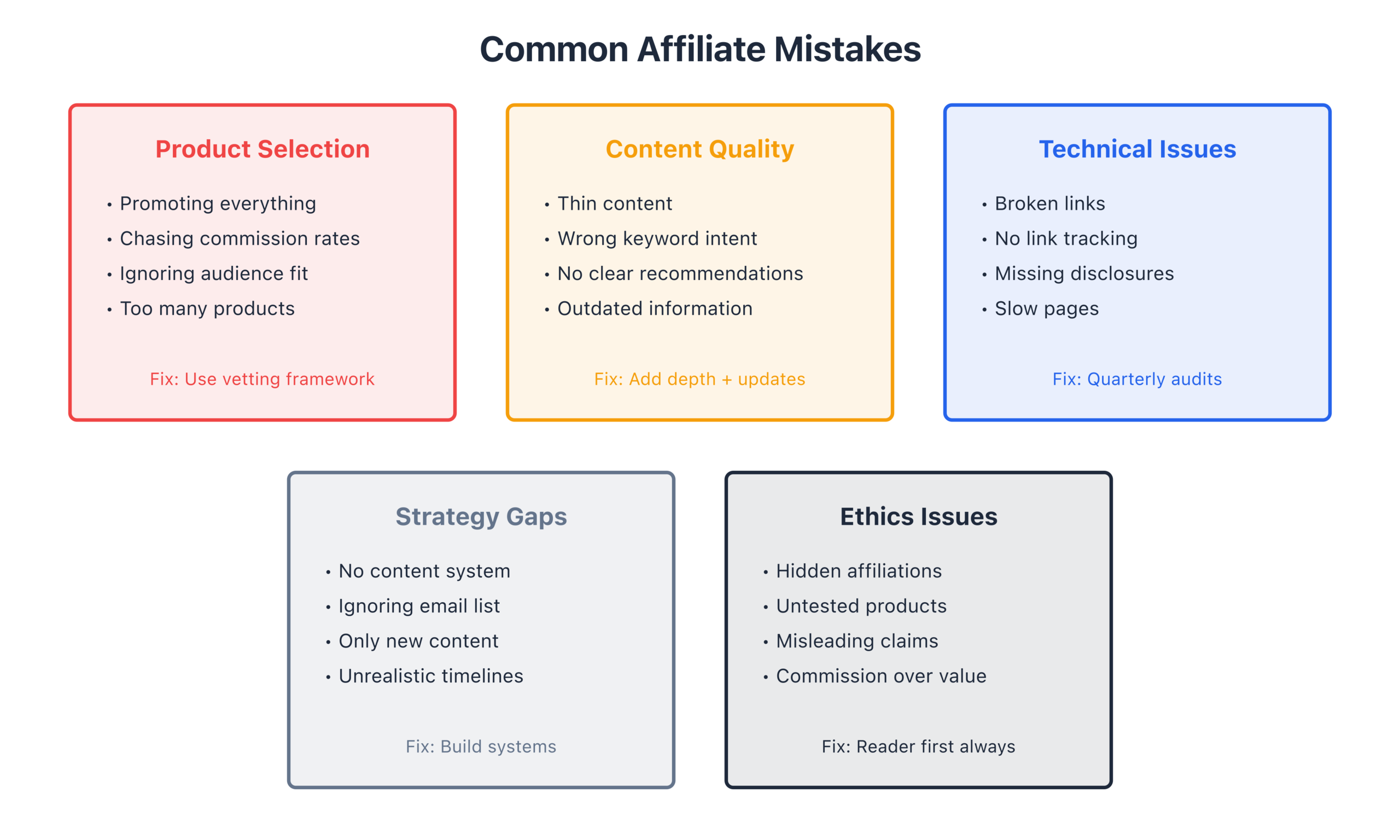
I’ve made every mistake in this chapter. Some of them more than once. The expensive ones taught me faster, but I still wish someone had handed me a list like this when I started in 2008. It would’ve saved me years of trial and error, and a lot of lost revenue.
This chapter isn’t about theory. It’s a field guide to the mistakes I’ve seen over 16+ years of building affiliate sites and consulting for hundreds of bloggers. I’ve organized them into four categories: Foundation, Content, SEO, and Ethics. Each one comes with the fix that actually works.
Foundation Mistakes
These are the structural problems that undermine everything else. You can write the best content in the world, but if your foundation is cracked, the building won’t stand.
Mistake #1: Chasing Too Many Niches
I see this constantly with new affiliate bloggers. They start a tech blog, then add travel content because they took a trip, then write about fitness because they joined a gym. Each topic attracts a different audience with different buying behavior, and none of them trusts you as an authority.
The fix: pick one niche. Stay in it for at least 12 months before even thinking about expanding. If you’re in the WordPress niche, own it. Cover hosting, themes, plugins, page builders, SEO tools, and everything in between. But don’t suddenly write about cooking recipes because you need content ideas.
The best-performing affiliate sites I’ve analyzed are laser-focused. They become the go-to resource for a specific topic. When someone searches “best WordPress hosting,” they want advice from someone who lives and breathes WordPress. Not someone who also reviews blenders.
Mistake #2: Promoting Too Many Products
Related but different from the niche problem. Within your niche, you might promote 40 different products. That’s 40 affiliate dashboards to check, 40 sets of links to maintain, 40 products to keep updated on. It’s exhausting and counterproductive.
The fix: build a product stack. A product stack is 8-12 core products you know inside out, use regularly, and recommend with genuine conviction. These become the backbone of your affiliate strategy. Everything else is supplementary.
My WordPress product stack has about 10 core products. I know their pricing, their strengths, their weaknesses, their customer support quality, and their update history. When someone asks me a question about any of them, I can answer from real experience. That depth of knowledge shows up in my content and drives conversions.
Mistake #3: No Product Stack Strategy
Even within your curated list, you need a strategy for how products relate to each other. Most bloggers treat each product recommendation as independent. But your readers don’t buy products in isolation. They’re building a system.
The fix: map out the buyer’s journey in your niche. What do they need first? What do they need next? How do products connect?
In WordPress, someone starts with hosting, then needs a theme, then plugins, then email marketing, then SEO tools. If you have a recommendation for each stage, one reader can generate 4-5 affiliate commissions as they build their site. That’s the power of a product stack strategy. You’re not just selling one product. You’re guiding someone through an entire setup, earning commission at each step.
Content Mistakes
Content mistakes are the most common and the most costly. Your content is the vehicle that carries your affiliate recommendations to readers. If the vehicle breaks down, it doesn’t matter how good the recommendations are.
Mistake #4: Thin Reviews
A thin review is 500 words of rewritten marketing copy. “Product X is a great tool for Y. It offers features A, B, and C. Pricing starts at $Z.” That’s not a review. That’s a summary of the product’s homepage. Nobody converts from that content because it offers zero value beyond what the reader could find themselves in 30 seconds.
The fix: every review needs at least one thing the reader can’t find on the product’s website. Your personal experience. A performance test. A comparison they hadn’t considered. A workflow tip. A hidden gotcha that only shows up after extended use.
My hosting reviews include actual load-test results from sites I’ve run on each platform. My plugin reviews include screenshots from my own WordPress dashboard. This stuff takes time, but it’s the difference between a $0 review and a $500/month review.
Mistake #5: No Personal Experience
This follows naturally from thin reviews, but it deserves its own section. Some bloggers review products they’ve never touched. They read other reviews, reword them, and publish. The result is a game of telephone where each generation of content gets farther from the truth.
The fix: only review products you’ve actually used. Period. If you haven’t used it, don’t review it. Get a trial. Buy it. Ask the company for a review copy. Whatever it takes. If you can’t get access, write a “based on research” comparison piece and be transparent about it.
I turn down affiliate opportunities regularly because I haven’t used the product. Some of those products pay $200+ per referral. I say no anyway. Because one bad recommendation erodes the trust that makes all your other recommendations convert. The math is simple: a single dishonest review can cost you more in lost trust than it ever earns in commissions.
Mistake #6: Ignoring Search Intent
A post targeting “what is web hosting” has informational intent. The reader wants to learn, not buy. Stuffing that post with affiliate links for hosting companies is a waste because the reader isn’t ready to purchase. They’re still figuring out what hosting even means.
Meanwhile, “best WordPress hosting for beginners” has clear commercial intent. This reader knows they need hosting and wants help choosing. This is where your affiliate links belong.
The fix: match your affiliate effort to the search intent of each page. Informational pages should educate and link to your commercial pages (via internal links). Commercial pages should compare, recommend, and include affiliate links. Mixing them up annoys readers and kills conversions.
I use a simple label system: every article in my content calendar gets tagged as Informational, Commercial, or Transactional. Affiliate links only go on Commercial and Transactional content. Informational content earns its keep by feeding internal links and building topical authority.
SEO Mistakes
SEO mistakes are particularly painful because they take months to show up and months to fix. The slow feedback loop means you can be making mistakes for half a year before you realize something’s wrong.
Mistake #7: No Internal Linking Strategy
Internal links are the most underused tool in affiliate blogging. Most bloggers publish a post and never link to it from other content. The post sits on the site, disconnected from the rest of the content, and Google doesn’t know how important it is.
The fix: every time you publish a new post, go back to 3-5 existing posts and add a relevant internal link to the new one. And every money page (your high-earning affiliate content) should have internal links pointing to it from at least 10 supporting posts.
I use Link Whisper to manage this process. It shows me orphaned content (pages with zero internal links), suggests relevant link opportunities, and makes it easy to add links across the site. After implementing a proper internal linking strategy on one site, organic traffic to my money pages increased 40% in three months. No new content. No new backlinks. Just internal links.
Mistake #8: Ignoring Keyword Difficulty
New affiliate bloggers look at a keyword like “best credit cards” with 200,000 monthly searches and think “that’s my golden ticket.” It’s not. That keyword has a difficulty score so high that you’d need years and massive authority to rank for it. Meanwhile, “best credit card for freelancers under 30” has 800 monthly searches and a fraction of the difficulty.
The fix: be realistic about what you can rank for. As a new site (under 1 year old, domain authority under 30), target keywords with difficulty scores below 30 and search volume between 200-2,000. As you build authority, gradually move up the difficulty scale.
I’d rather rank #1 for a keyword with 500 monthly searches than rank #47 for a keyword with 50,000 monthly searches. The first position drives real traffic and revenue. The 47th position drives nothing.
Mistake #9: Chasing Head Terms Only
“Best hosting” gets 100,000 searches/month. “Best WordPress hosting for small business 2026” gets 1,200. Most bloggers spend all their energy on the first one and ignore the second.
But the long-tail keyword has higher conversion rates because it’s more specific. Someone searching for “best WordPress hosting for small business” is much closer to buying than someone searching “best hosting.” They know what platform they need. They know they’re a small business. They’re comparing options.
The fix: build a keyword strategy that targets both head terms (as long-term goals) and long-tail variations (as immediate opportunities). For every head term you want to rank for, identify 10-15 long-tail variations. Create content for the long-tail keywords first. As that content earns rankings and links, your authority builds. Eventually, you’ll rank for the head term too.
My approach: I create one “pillar” page for the head term and 10-15 supporting pages for long-tail variations. All supporting pages link to the pillar page. Over time, the pillar page accumulates enough internal links and topical authority to compete for the head term. This strategy took my hosting pillar page from nowhere to page one for “best WordPress hosting” over about 14 months.
Ethics Mistakes
These are the mistakes that can destroy your affiliate business permanently. Not slowly, like the other categories. Permanently. One major ethics violation can wipe out years of audience trust and even get you in legal trouble.
Mistake #10: Hiding Affiliate Disclosures
Some bloggers hide their affiliate disclosures at the bottom of the page in tiny text, or they don’t disclose at all. This is a legal issue in most countries. The FTC in the US requires clear and conspicuous disclosure. And beyond the legal requirements, hiding disclosures makes you look shady.
The fix: put a clear affiliate disclosure near the top of every page that contains affiliate links. I use a short disclosure at the beginning of every review: “This post contains affiliate links, which means I may earn a commission if you make a purchase. This doesn’t affect my opinions or recommendations.”
I also have a full disclosure page linked in my site footer. This isn’t just legal compliance. It’s trust-building. Readers respect transparency. I’ve had readers email me saying they specifically clicked my affiliate links because they appreciated the honesty of my disclosures. Transparency pays.
Mistake #11: Recommending Products You Don’t Use
This is the cardinal sin of affiliate marketing. Recommending a product solely because it pays a high commission, without any personal experience, is a betrayal of your audience’s trust.
The fix: maintain a personal use requirement. If you haven’t used it for at least 30 days, don’t recommend it. For complex products like hosting or software, extend that to 90 days. You need enough experience to speak about real strengths, real limitations, and real use cases.
I’ve declined affiliate partnerships worth $50,000+ per year because the product didn’t meet my standards. That sounds like a sacrifice, but it’s actually an investment. The trust I maintained by saying no to those products enabled me to earn far more from the products I do recommend with genuine conviction.
Mistake #12: Ignoring FTC Guidelines
The FTC requires that affiliate relationships be disclosed clearly and prominently. They’ve been cracking down on this for years, and the fines can be significant. Beyond the FTC, many countries have similar regulations. The UK’s ASA, the EU’s consumer protection directives, and India’s ASCI all have rules about commercial content disclosure.
The fix: read the FTC’s endorsement guides. They’re written in plain English and they’re shorter than you’d think. Follow them. Disclose every affiliate relationship. Disclose every free product you received for review. Disclose every sponsorship. When in doubt, disclose.
The one-sentence version: if there’s any financial relationship between you and the product you’re recommending, tell your readers. It’s that simple.
Recovery Strategies
Already making some of these mistakes? Here’s how to fix each category.
Foundation recovery: If you’ve spread too thin across niches, don’t delete content. Instead, stop publishing outside your core niche. Let the off-topic content exist but stop investing in it. Redirect your energy to your strongest niche for the next 6 months. After 6 months, evaluate whether the off-topic content is earning its keep or should be pruned.
If you’re promoting too many products, pick your top 8-10 performers and make them your core stack. For the remaining products, leave existing content in place but stop creating new content around them. Consolidate your effort.
Content recovery: If your reviews are thin, don’t start over. Pick your top 10 affiliate pages by traffic and upgrade them one at a time. Add personal experience. Add screenshots. Add honest criticisms. Add comparison data. Each upgrade should take 2-3 hours. Do two per week. In five weeks, your top 10 pages will be solid.
For search intent mismatches, audit your affiliate pages. Remove affiliate links from purely informational content. Add strong internal links from those informational pages to your commercial content instead.
SEO recovery: Internal linking is the fastest fix. Spend one weekend doing nothing but adding internal links. Go through every post on your site and look for opportunities to link to your money pages. Use relevant anchor text. This single activity has the highest ROI of any SEO tactic for affiliate sites.
For keyword difficulty issues, don’t abandon your competitive targets. Just deprioritize them. Shift your content calendar to focus 70% on achievable long-tail keywords and 30% on competitive terms you’re building toward.
Ethics recovery: If you’ve been skimping on disclosures, fix every page this week. Add affiliate disclosures to the top of every page with affiliate links. Update your disclosure page. Set up a template so every new post gets a disclosure automatically.
If you’ve recommended products you don’t use, you have two choices: start using them (sign up, test for 30+ days, then update your review with real experience) or replace them with products you do use. Either way, update the content to reflect genuine experience.
The “One Thing” Fix
If each category feels overwhelming, focus on the single highest-impact fix.
- Foundation: Define your product stack. Write down 8-10 products you genuinely use and recommend. That’s your stack. Focus there.
- Content: Add personal experience to your top 5 affiliate pages. Real screenshots, real results, real opinions.
- SEO: Build internal links to your top 5 money pages from at least 10 supporting posts each.
- Ethics: Add clear affiliate disclosures to the top of every page with affiliate links. Do it today.
Four changes. Each one takes less than a day. Together, they fix 80% of what’s holding most affiliate sites back.
Chapter Checklist
- [ ] Audit your niche focus (are you spread across multiple unrelated topics?)
- [ ] Define your product stack (8-12 core products you know and use)
- [ ] Map your buyer’s journey showing how products connect
- [ ] Review your top 10 affiliate pages for thin content
- [ ] Verify every review is based on personal experience
- [ ] Tag all content as Informational, Commercial, or Transactional
- [ ] Check internal links to your top money pages (target 10+ each)
- [ ] Verify affiliate disclosures are present and prominent on every relevant page
- [ ] Review FTC endorsement guidelines
- [ ] Remove affiliate links from purely informational content
Chapter Exercise
The Mistake Audit
Go through each mistake in this chapter and score yourself on a scale of 1-5 for each one:
1 = I’m definitely making this mistake
3 = I’m partially making this mistake
5 = I’ve addressed this and I’m in good shape
Write your scores down for all 12 mistakes. Any score of 1 or 2 needs immediate attention. Pick the three lowest-scoring items and create a specific action plan for each:
- What’s the specific problem on your site?
- What’s the fix?
- When will you complete it? (Give yourself a specific date, not “soon.”)
Then do the foundation fix first, because every other improvement builds on a solid foundation. A strong product stack with clear niche focus makes your content better, your SEO more effective, and your ethics easier to maintain.
This audit takes about 30 minutes, but it gives you a clear picture of where your affiliate business is leaking revenue. Fix the leaks before you try to pour more water into the bucket.
Disclaimer: This site is reader-supported. If you buy through some links, I may earn a small commission at no extra cost to you. I only recommend tools I trust and would use myself. Your support helps keep gauravtiwari.org free and focused on real-world advice. Thanks. - Gaurav Tiwari