
I’ve made over $650,000 from affiliate marketing across 16 years. Not in one lucky year. Not from a single viral post. From a system that compounds month after month, year after year.
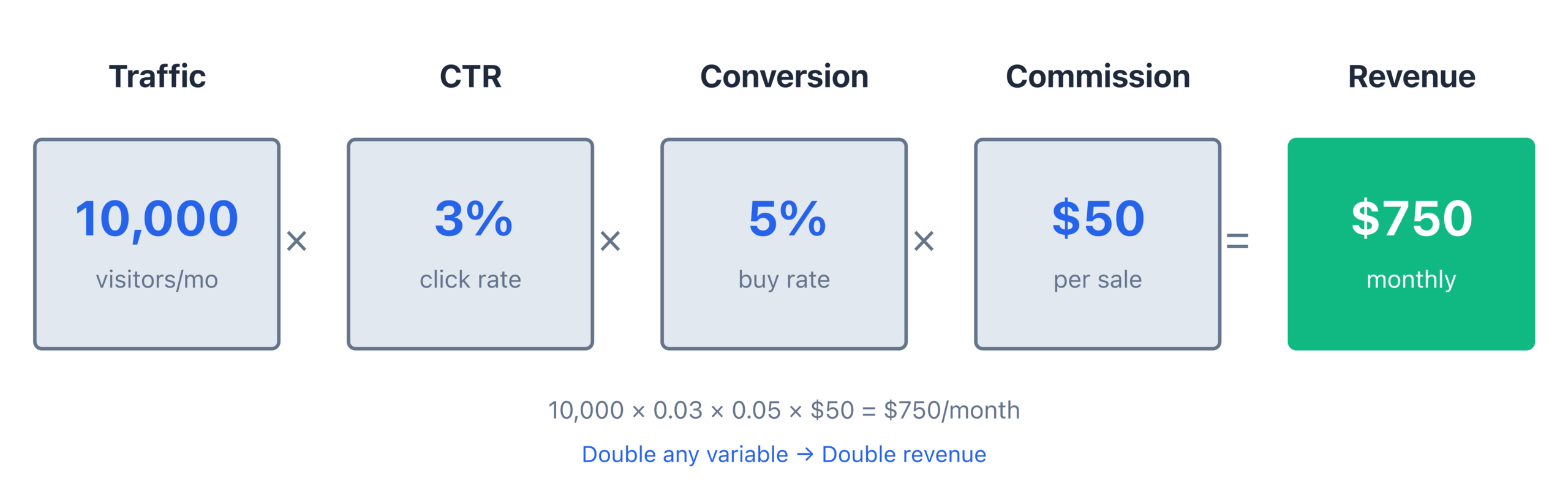
And the formula behind it is embarrassingly simple. Four numbers multiplied together. That’s it.
But most bloggers get it backwards. They obsess over the first number and ignore the other three. I did the same thing for my first three years. I was chasing pageviews like they were the only metric that mattered. Spoiler: they’re not even close.
The Four-Number Formula
Every dollar you make from affiliate marketing comes down to this:
Traffic x CTR x Conversion Rate x Commission = Revenue
Let me break each piece down with real numbers so you can see why this matters.
Traffic is the number of people who land on your affiliate content. Not your homepage. Not your about page. Your money pages, the ones with affiliate links.
CTR (Click-Through Rate) is the percentage of those visitors who actually click your affiliate link. If 1,000 people read your review and 50 click the link, your CTR is 5%.
Conversion Rate is the percentage of people who click your link and then buy. This one isn’t in your control. The merchant’s sales page, pricing, and checkout flow determine this. But you influence it by sending the right people.
Commission is what you earn per sale. Could be $5, could be $500, could be 30% recurring.
Here’s where it gets interesting. Most bloggers think the path to more revenue is more traffic. But watch what happens when you improve the other numbers instead.
Scenario A: The traffic-obsessed blogger
- 10,000 visitors/month
- 2% CTR (weak, buried links)
- 3% conversion rate
- $50 average commission
- Revenue: 10,000 x 0.02 x 0.03 x $50 = $300/month
Scenario B: Same traffic, better everything else
- 10,000 visitors/month
- 8% CTR (strategic placement, strong calls to action)
- 5% conversion rate (better product-audience match)
- $80 average commission (chose higher-value products)
- Revenue: 10,000 x 0.08 x 0.05 x $80 = $3,200/month
Same traffic. Ten times the revenue. That’s not hypothetical. I’ve seen exactly this pattern across dozens of my own pages.
Why Most Bloggers Get the Formula Wrong
The default strategy for 90% of affiliate bloggers is: write more content, get more traffic, make more money. It sounds logical. It’s also the slowest, most frustrating path to income.
I spent 2009 to 2012 doing exactly this. Publishing three to four times a week, chasing every keyword I could find, watching my traffic grow from 500 to 5,000 to 15,000 monthly visitors. My affiliate income? Barely $200/month at 15,000 visits. That’s embarrassing for the amount of work I was putting in.
The problem wasn’t traffic. I had traffic. The problems were:
- My CTR was around 1.5% because I was burying affiliate links in the middle of paragraphs with no visual emphasis
- I was promoting cheap products ($10-20 commissions) because those were the easiest programs to join
- I wasn’t matching visitor intent to the right products, so conversion rates were terrible
When I finally stopped writing new posts and spent two months fixing my existing pages, improving link placement, swapping to higher-commission products, and rewriting weak calls to action, my revenue jumped from $200/month to $1,100/month. Same pages. Same traffic. Different execution.
The lesson: traffic is the hardest and slowest variable to grow. CTR, product selection, and commission rates can be improved in a weekend.
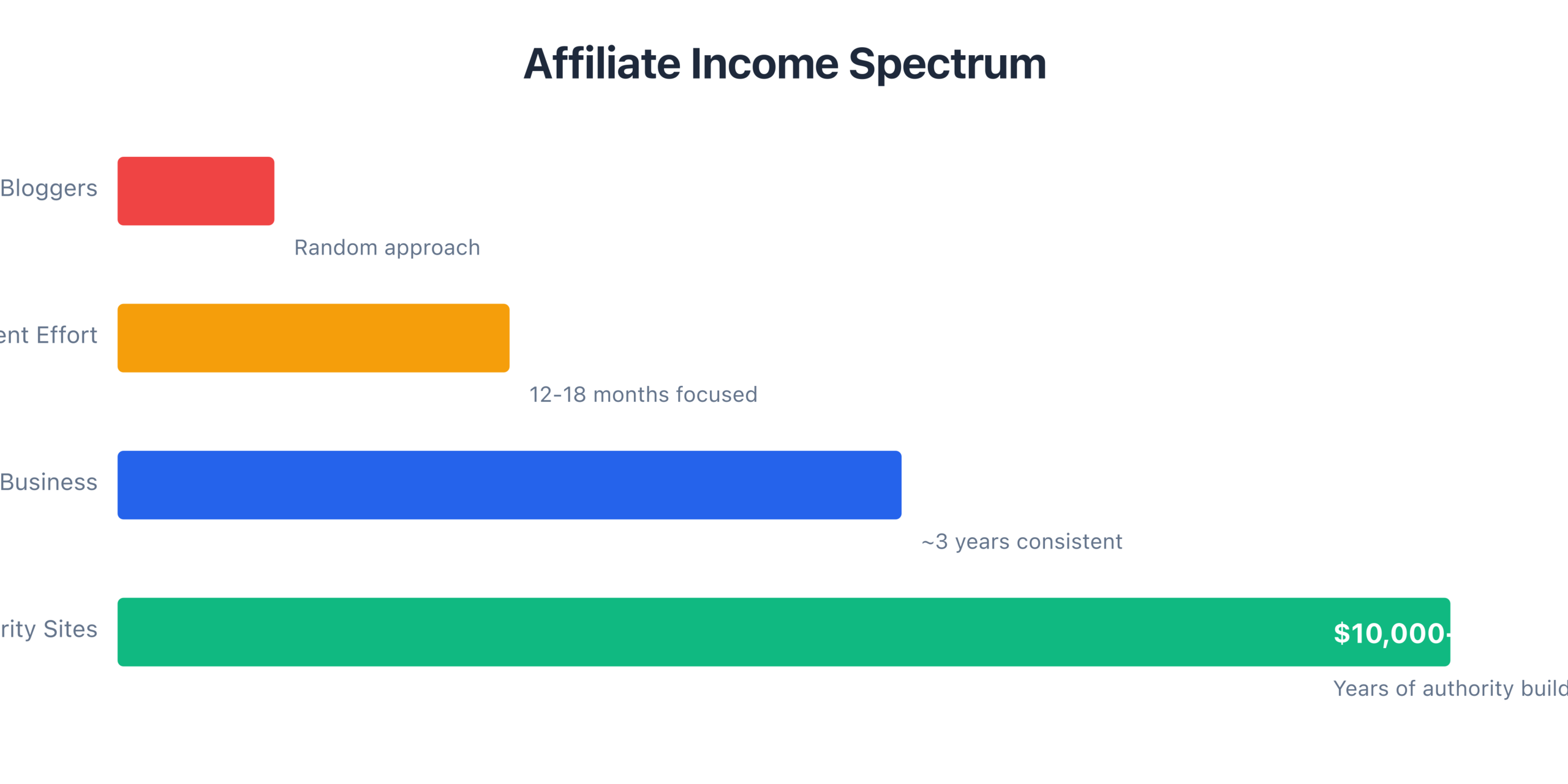
The Income Spectrum: From $0 to $50K/Month
I’ve been at every stage of this spectrum, and I’ve worked with bloggers at every stage through my consulting work. Here’s what changes as you move up.
$0-100/month: The Learning Phase
You’re publishing content, but you haven’t found product-content fit yet. Your traffic is low, your links are poorly placed, and you’re probably promoting whatever program accepted your application first. This phase lasts 3-6 months if you’re focused, 12-18 months if you’re scattered.
The fix at this stage: pick ONE product you genuinely use. Write ONE detailed review. Make the affiliate link impossible to miss. Don’t move to the next product until this page is earning something.
$100-1,000/month: Traction
You’ve got a few pages bringing in consistent clicks. You understand which content types convert. You’re starting to see patterns. This is where most bloggers get stuck because they try to scale with volume instead of improving what’s already working.
The fix: audit your top 5 pages. Improve CTR on each one. Test different products. Add comparison content that links to your existing reviews.
$1,000-5,000/month: The System Phase
Now you need a content system, not just random posts. You’re building topic clusters around your best-performing products. You have support content feeding traffic to money pages. Your internal linking actually makes sense.
I hit this level around 2014, about five years after I started affiliate marketing seriously. It would’ve been faster if I’d understood the formula from day one.
$5,000-15,000/month: Optimization
At this stage, small improvements create big gains because the base numbers are large enough to matter. A 1% CTR improvement across 50 pages can mean an extra $500-1,000/month. You’re negotiating better commission rates with merchants. You’re A/B testing layouts.
$15,000-50,000/month: Portfolio Scale
You’re running multiple sites or one large authority site with hundreds of money pages. You have systems for content production, link building, and page optimization. At this level, you’re thinking about diversification, because having one affiliate program as 80% of your income is a risk you can’t afford.
The jump between each level isn’t about working harder. It’s about working on the right variable. Early on, it’s product selection and CTR. Later, it’s traffic and scale. Most people do the opposite: they try to scale first and optimize later. That’s backwards.
Why Recurring Commissions Beat One-Time Payouts
This is the single most important strategic decision in affiliate marketing, and most bloggers don’t even think about it.
A one-time commission pays you once. You refer someone to a web hosting plan, you get $65. Done. To earn another $65, you need another referral.
A recurring commission pays you every month the customer stays. You refer someone to a SaaS tool at 30% recurring, they pay $49/month, you get $14.70 every month. After 12 months, that single referral has earned you $176.40. After two years, $352.80.
I shifted my focus toward recurring commission programs around 2016. Before that shift, I had to generate roughly the same number of referrals every month to maintain my income. If I stopped publishing for a month, revenue would dip within 60-90 days.
After building a base of recurring commissions, my baseline income kept growing even during months where I didn’t publish anything new. By 2019, about 40% of my affiliate revenue was recurring. That meant even if I stopped working entirely, I’d still earn thousands per month from referrals I’d made months or years earlier.
The math is clear:
- 100 one-time referrals at $50 each = $5,000. Done. Start over.
- 100 recurring referrals at $15/month each = $1,500 first month, $3,000 by month two, $18,000 by month twelve (assuming 80% retention).
That’s the difference between a job and an asset. One-time commissions are a job. Recurring commissions are an asset that appreciates.
When I’m evaluating affiliate programs now, recurring commission is my first filter. If it’s one-time only, the commission needs to be high enough ($100+) to justify the effort. Otherwise, I pass.
The Compounding Effect of Affiliate Content
Here’s what nobody tells you about affiliate blogging: the first year is brutal and the fifth year is almost unfair.
Affiliate content compounds in three ways.
SEO compounds. A review post you publish today might rank on page 3 of Google. Six months from now, with some internal links and natural backlinks, it moves to page 1. Your traffic on that single page might go from 50/month to 500/month without you touching it. I have posts from 2018 that still bring in 400-800 visitors per month and generate 5-15 affiliate referrals monthly. Those posts took me 4-6 hours to write. They’ve earned thousands of dollars each over the years.
Trust compounds. The more quality content you publish, the more your audience trusts your recommendations. A first-time visitor might click an affiliate link at a 3% rate. A returning visitor who’s read five of your articles? That rate jumps to 8-12% in my experience. Trust isn’t built in one post. It’s built across dozens of posts over months and years.
Revenue compounds. Especially with recurring commissions. Each month’s new referrals add to the base of existing recurring revenue. I track this in a spreadsheet, and the curve is unmistakable. Year one: flat. Year two: slow growth. Year three: noticeable acceleration. Year four and beyond: the curve steepens fast.
This is why I tell new affiliate bloggers to think in two-year windows, not two-month windows. The first year is an investment. You’re building pages that will earn for years. But you won’t see that compounding until month 18 or 24.
I know that’s not what you want to hear. I didn’t want to hear it either. But $650K+ over 16 years didn’t come from month one. It came from content I created in year one still earning in year sixteen.
The Numbers from My Experience
Let me get specific, because vague advice is useless.
Over 16 years of affiliate marketing across multiple sites and niches, I’ve generated over $650,000 in affiliate revenue. That breaks down to roughly $40,000 per year on average, but the distribution is wildly uneven. My first three years combined were probably under $15,000 total. My best single year was over $90,000.
My best-performing affiliate page has earned over $45,000 lifetime. It’s a comparison post I wrote in 2017, updated six times since then, and it still brings in $400-600/month. I spent maybe 20 hours total on that page across all updates.
My average CTR across money pages is 6.8%. My best pages hit 12-15%. My worst hover around 2-3%, and those are the ones I haven’t optimized yet.
The products I promote the most have commission rates between 20-40% recurring. I deliberately avoid programs with less than 20% recurring unless the absolute dollar amount per sale is over $100.
I maintain active affiliate relationships with about 15-20 programs at any given time. But 80% of my revenue comes from my top 5 products. That’s not unusual. It’s the Pareto principle in action.
These numbers aren’t extraordinary. I know affiliates who make more in a month than I make in a year. But my numbers are real, consistent, and built on a system that doesn’t require me to work 60-hour weeks.
Chapter Checklist
- I understand the four-variable formula: Traffic x CTR x Conversion Rate x Commission = Revenue
- I know which variable I should focus on at my current stage
- I’ve identified whether my current affiliate programs offer one-time or recurring commissions
- I understand why improving CTR and product selection is faster than chasing traffic
- I can identify which income stage I’m currently at ($0-100, $100-1K, $1K-5K, etc.)
- I’ve accepted that affiliate content compounds over years, not weeks
Chapter Exercise
Pull up your analytics for the last 30 days. If you don’t have affiliate content yet, use any blog content you have.
- Write down your current monthly traffic to your top 5 pages
- Check your affiliate dashboard: what’s your average CTR? (If you don’t know, estimate based on clicks divided by pageviews)
- What’s your average conversion rate? (Referrals divided by clicks)
- What’s your average commission per sale?
- Multiply all four numbers together. That’s your current formula output.
- Now model what happens if you double your CTR (by improving link placement) and increase your average commission by 50% (by switching to higher-value products). What does the new number look like?
This exercise alone should convince you that the fastest path to more affiliate income isn’t more traffic. It’s a better funnel.