
Picking the wrong product to promote is the most expensive mistake in affiliate marketing. Not because it costs you money directly, but because it costs you time. You’ll spend 10-15 hours writing a review, optimizing the page, building supporting content, and then watch it generate $12/month because the commission structure is garbage or the product doesn’t convert.
I’ve promoted over 200 different products across 16 years. About 30 of them generated meaningful income. About 10 of them generated 80% of my total affiliate revenue. And I could’ve gotten to those 10 much faster if I’d had a systematic way to evaluate products before investing hours of work.
That’s what this chapter gives you.
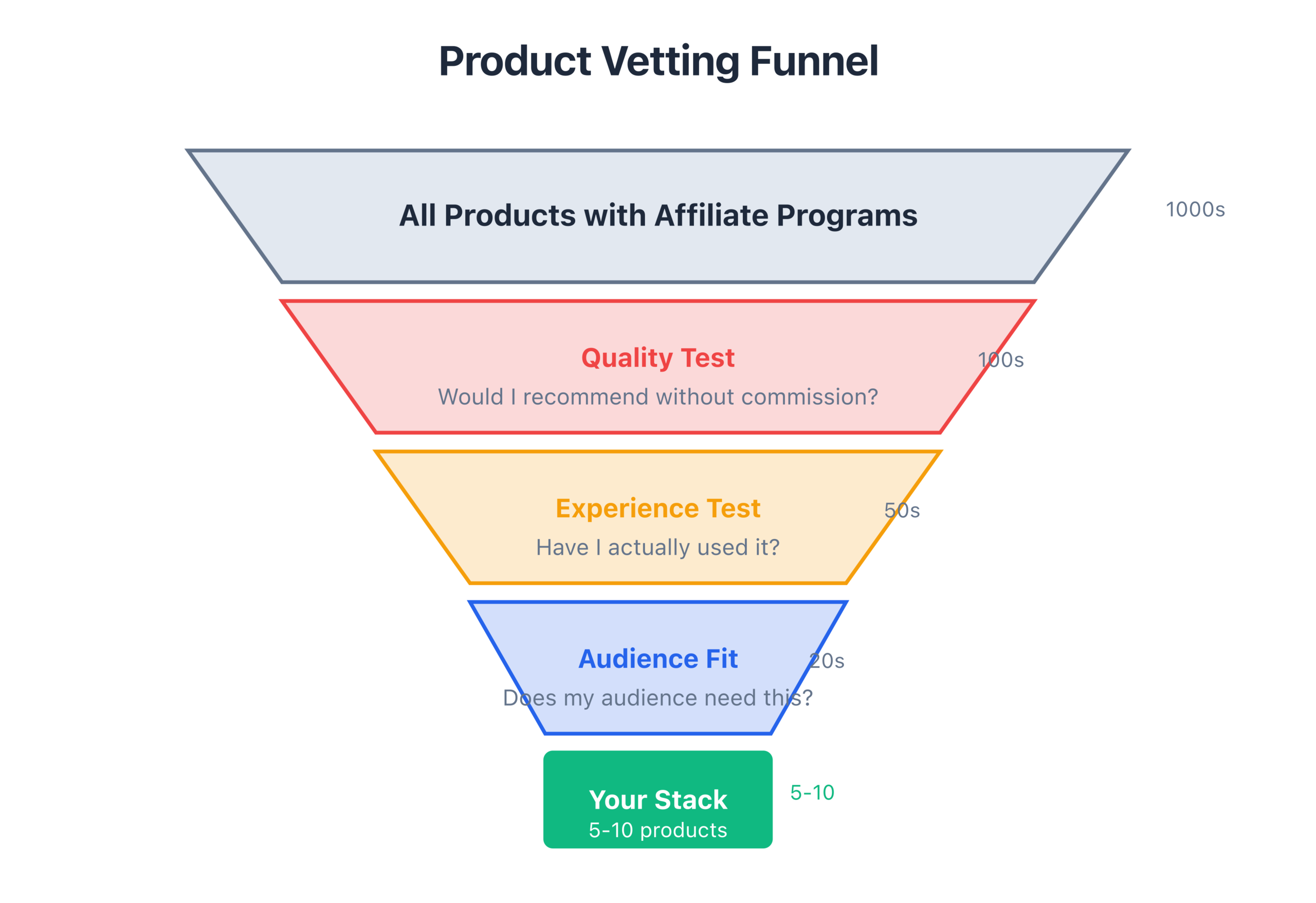
The Product Vetting Funnel
I use a funnel approach to narrow down which products deserve my time and reputation. Here’s how it works.
Stage 1: Cast a Wide Net (100 products)
For any niche, there are more products than you think. Start by listing every product with an affiliate program in your space. Check affiliate networks like ShareASale, CJ Affiliate, Impact, and PartnerStack. Search for “[product name] affiliate program” for every tool you’ve ever heard of.
In the WordPress hosting niche alone, I can name 40+ providers with affiliate programs. In email marketing, there are 50+. In website builders, another 30+.
Don’t evaluate yet. Just list them. Product name, commission rate, cookie duration, price range. Put it all in a spreadsheet. This takes an afternoon but saves months of guesswork.
Stage 2: Worth Reviewing (narrow to 20)
Now filter. Cut any product that fails these minimum criteria:
- Commission below $20 per sale (for one-time) or below $10/month (for recurring)
- Cookie duration under 30 days
- Product price under $30/year (the audience will be too price-sensitive)
- No free trial or demo (makes it hard for your readers to test before buying)
- Program has bad reviews from other affiliates (late payments, tracking issues, sudden term changes)
- Product has declining search interest (check Google Trends)
This usually kills 70-80% of your list. Good. Those products would’ve wasted your time anyway.
Stage 3: Worth Recommending (narrow to 5)
This is where I get personal. I need to actually use the product or test it extensively before I’ll recommend it. Not just a 15-minute trial. Real usage, on real projects, for at least a few weeks.
Of the 20 products that survived the filter, maybe 5 will pass the “would I use this myself?” test. The others will have deal-breaking flaws: clunky interfaces, poor performance, missing features that matter for real use cases, or terrible customer support.
I’ve signed up for hosting accounts I never used beyond testing just to evaluate the experience. I’ve installed plugins on staging sites and stress-tested them. This sounds like a lot of work, and it is. But the alternative is recommending products you haven’t tested, which destroys credibility and eventually tanks conversion rates.
Stage 4: Primary Pick (choose 1 per category)
Out of your 5 worthy products, pick one as your primary recommendation. This is the product you’ll mention first, link to most prominently, and build your “best of” content around.
Why one? Because split recommendations kill conversions. When you tell someone “here are 5 great options,” they leave your site to research all five, and you lose them. When you say “I use this one, here’s why, and here are alternatives if it’s not right for you,” they’re much more likely to click through and buy.
My primary WordPress hosting recommendation has been the same for three years. I’ve tested alternatives. I update my review when things change. But having a clear primary pick means my recommendation is consistent across all my content, and readers trust consistency.
Commission Comparison: Flat Rate vs Percentage, One-Time vs Recurring
Not all commissions are created equal. The structure matters as much as the amount.
Flat Rate commissions pay a fixed dollar amount per sale. Web hosting programs often work this way: refer a customer, get $65 regardless of which plan they buy. The advantage is predictability. The disadvantage is that you earn the same whether someone buys a $5/month plan or a $50/month plan.
Percentage commissions pay a percentage of the sale value. Most SaaS affiliate programs use this: 20-40% of whatever the customer pays. The advantage is that your commission scales with the product price. If a customer upgrades to a higher plan, you earn more. The disadvantage is that entry-level customers on cheap plans generate small commissions.
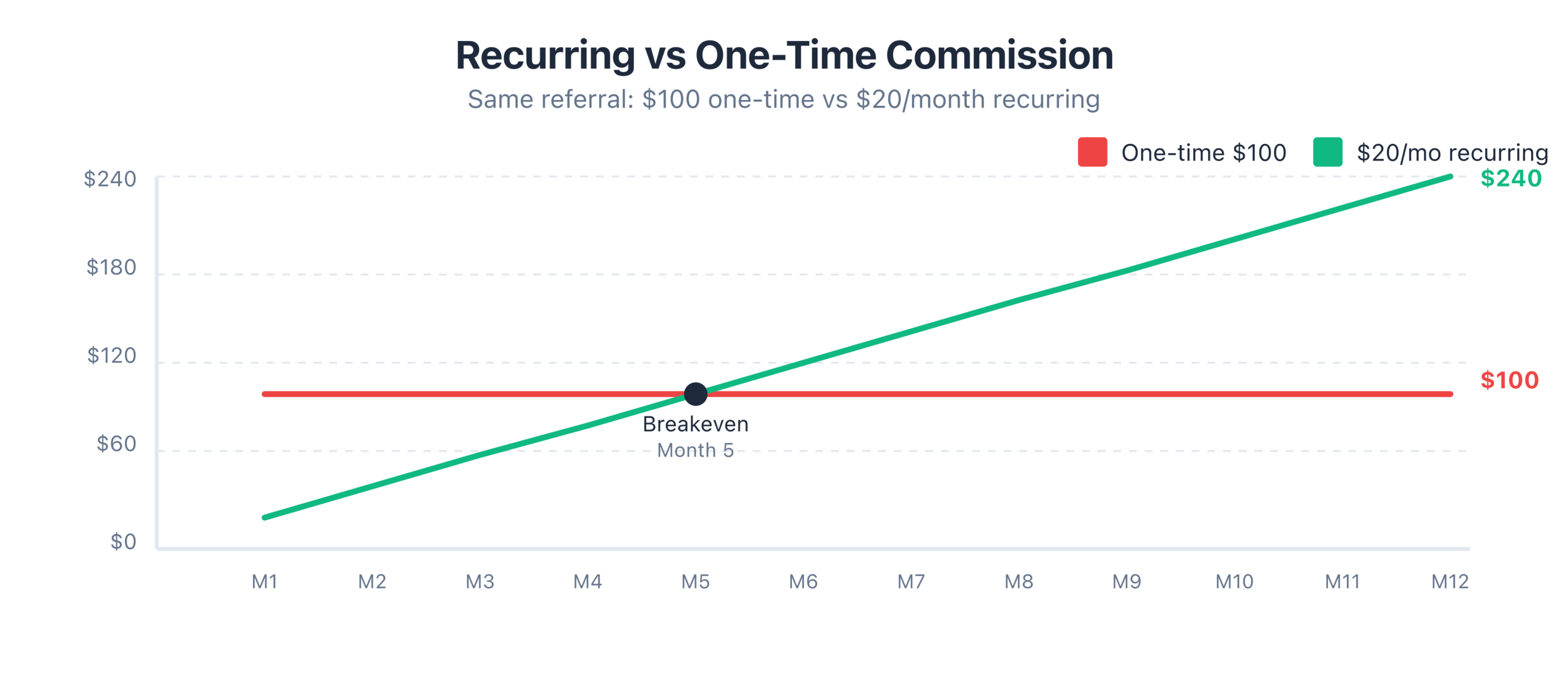
One-time commissions pay once when the sale happens. You get your $65 or your 30%, and that’s it. To maintain income, you need a constant stream of new referrals.
Recurring commissions pay you every month (or year) that the customer remains a paying user. This is the model I prioritize. A 30% recurring commission on a $49/month tool pays you $14.70/month for as long as that customer stays subscribed. After 12 months, one referral has earned you $176.
The math becomes staggering at scale. If you refer 10 people per month to a $49/month tool with 30% recurring commissions:
- Month 1: 10 referrals x $14.70 = $147
- Month 6: 60 referrals (cumulative, assuming 90% retention) x $14.70 = approximately $794
- Month 12: about 108 active referrals x $14.70 = approximately $1,588
- Month 24: about 192 active referrals x $14.70 = approximately $2,822
That’s from a consistent 10 referrals per month. Nothing viral. Nothing extraordinary. Just steady affiliate marketing with the right commission structure.
Compare that to 10 one-time referrals per month at $65 each: $650/month. Every month. No growth. To earn $2,822/month with one-time commissions, you’d need to generate 43 referrals per month, over four times the volume.
This is why I’m obsessive about recurring commissions. They fundamentally change the economics of affiliate marketing from a treadmill to a staircase.
Why Product Quality Matters More Than Commission Rate
I learned this lesson the hard way. In 2015, I promoted a web hosting provider that offered $150 per referral. That was double what their competitors were paying. I was excited. I wrote a glowing review, ranked it well, and started generating referrals.
The problem? The hosting was mediocre. Within six months, readers started emailing me, not to thank me, but to complain. Slow servers. Bad support. Unexpected price hikes after renewal. My inbox became a customer service desk for a company I didn’t work for.
I pulled the review, switched to a hosting provider with a $65 commission, and here’s what happened: my conversion rate on that page went up. Readers could tell the new recommendation was genuine. My CTR increased because I was writing from real conviction. And the emails I received shifted from complaints to “thanks for the recommendation, I love this host.”
The $150/referral product was earning me more per click, but fewer clicks and more damage to my reputation. The $65/referral product earned less per click, but generated more clicks, better conversion rates, and zero reputation damage.
Over three years, the “lower commission” product earned me roughly twice what the “higher commission” product did in its six months of promotion. And I kept my reputation intact, which is worth more than any single commission check.
The rule I follow now: I won’t promote anything I wouldn’t recommend to a friend. If the commission is high but the product is mediocre, that’s a trap. Short-term money, long-term damage.
Building a Focused Product Stack
You don’t need to promote 50 products. You need 3-5 core products that cover your niche and generate the majority of your income.
Here’s what a focused product stack looks like in the WordPress niche:
- Primary hosting recommendation: One provider I use and trust
- Primary theme/builder: One tool I build sites with
- Primary plugin suite: A few plugins I use on every project
- Primary email tool: One email marketing platform
- Primary performance tool: One caching/optimization plugin
That’s five product categories, each with one primary recommendation. Together, they cover the entire customer journey from setting up a WordPress site to growing an audience.
Each product in the stack should:
- Be something you actually use (credibility)
- Have a recurring commission or high one-time commission (economics)
- Solve a clear problem your audience has (relevance)
- Have a conversion-friendly website (good sales page, free trial, clear pricing)
- Come from a stable company (you don’t want your #1 recommendation shutting down)
The power of a focused stack is that every piece of content you write can naturally reference these 3-5 products. Your hosting review links to your theme recommendation. Your theme review links to your performance plugin. Your performance plugin review links back to hosting. It creates an interconnected web of content where readers naturally encounter multiple products from your stack.
I’ve seen bloggers with product stacks of 3-5 tools consistently out-earn bloggers who promote 30+ products, because the focused bloggers write better content about fewer products and build stronger trust with their audience.
Red Flags in Affiliate Programs
Not every affiliate program is worth joining. I’ve been burned enough times to know the warning signs. Watch for these.
Short cookie durations (under 30 days). If the cookie lasts 7 days, your reader needs to buy within a week of clicking your link. For high-consideration purchases like SaaS tools or hosting, people often research for 2-4 weeks before buying. A 7-day cookie means you lose credit for most of the sales you influenced. I prefer 60-90 day cookies. Some programs offer 120 days or even lifetime cookies.
Delayed or unreliable payments. If an affiliate program pays Net-90 (90 days after the sale), that’s a long time to wait. I’ve had programs push payment dates back with no warning, or “lose” referral data. Check forums and affiliate communities for payment complaints before investing time in a program. Net-30 with a minimum payout of $50-100 is standard and acceptable.
Frequent commission rate changes. Some programs drop their rates every 6-12 months. You build content around a 40% commission, and then one email informs you it’s now 20%. Your revenue gets cut in half overnight. Look for programs with stable rates. If a program has changed rates twice in the past two years, expect it to happen again.
Poor tracking and attribution. If you can’t see real-time clicks, conversions, and commissions in a dashboard, the program’s tracking infrastructure is probably outdated. I need to be able to verify that clicks from my site are being counted accurately. I’ve caught tracking issues that would’ve cost me thousands if I hadn’t been monitoring.
Restrictive terms and conditions. Some programs prohibit bidding on brand terms in paid ads. That’s fine. But some go further: no comparison content, no “alternatives to [product]” articles, no negative comparisons. Those restrictions eliminate the most profitable content types for affiliates. Read the terms before joining.
Program instability. Small startups change their affiliate terms frequently. Products that get acquired often shut down or restructure their affiliate programs. If a company just raised Series A funding, their affiliate program might not exist in 18 months. I’ve had three affiliate programs shut down with minimal notice. For primary recommendations, I prefer companies that have been around at least 3-5 years with stable ownership.
The “too good to be true” commission. If a product you’ve never heard of is offering 50-70% commissions, ask why. Sometimes it’s because the product is new and needs affiliates. More often, it’s because the product is overpriced, under-delivers, or has high refund rates. A 50% commission means nothing if 40% of sales get refunded.
How I Evaluate a New Affiliate Product Today
When I find a product worth considering, here’s my exact evaluation process:
- Sign up and use it for at least 2 weeks on a real project. Not a toy project. A real site for a real client.
- Read competitor reviews to see what others think. If five other affiliates praise it but none of them show evidence of actually using it, that’s suspicious.
- Check the affiliate program terms. Commission rate, cookie duration, payment schedule, restrictions.
- Analyze the product’s sales page. A poor sales page kills conversion rates, and that’s not something I can control. If the product’s website looks like it was built in 2010, I’m out.
- Search for “[product name] problems” or “[product name] complaints.” If the dominant conversation is negative, I don’t want to put my name behind it.
- Contact the affiliate manager. Ask about average conversion rates, EPC (earnings per click), and what top affiliates typically earn. Good programs share this data.
- Start small. Write one review post and monitor performance for 60-90 days before building a full content cluster around the product.
This process takes 2-4 weeks per product. That sounds slow. But it’s a lot faster than spending months promoting a product that doesn’t convert, or worse, one that damages your reputation.
Chapter Checklist
- I’ve created a master spreadsheet of all affiliate programs in my niche (aim for 50+)
- I’ve filtered down to 15-20 programs that meet minimum criteria (commission, cookie, price point)
- I’ve identified which programs offer recurring commissions
- I’ve personally tested or used my top 5 product choices
- I’ve selected one primary recommendation per product category
- I’ve checked each program for red flags (cookie duration, payment reliability, term stability)
- I’ve built a focused product stack of 3-5 core products
- I understand the math difference between one-time and recurring commissions at scale
Chapter Exercise
Build your Product Vetting Spreadsheet.
-
Open a spreadsheet with these columns: Product Name, Category, Commission Type (one-time/recurring), Commission Rate, Average Sale Value, Commission Per Sale, Cookie Duration, Payment Terms, Red Flags, Personal Experience (Y/N)
-
List at least 30 products in your niche. Fill in every column. Use the affiliate program pages, network dashboards, and direct research.
-
Sort by Commission Per Sale (or monthly recurring value for recurring programs), highest first.
-
Apply the red flag filter: remove any product with cookie duration under 30 days, commission per sale under $20 (or under $10/month recurring), or payment terms worse than Net-60.
-
From what’s left, identify your top 5 products. Circle the ONE product you’d recommend as your primary pick in each category.
-
For your primary pick, sign up and start using it this week. You can’t write a credible review of something you haven’t used. No shortcuts here.