
I ignored email marketing for the first three years of my affiliate blogging career. I had a signup form on my site because every blogging guide said I should. But I never sent anything. My list grew to about 800 subscribers who heard from me exactly zero times.
When I finally started emailing that list, about 60% of the addresses bounced. Three years of collecting emails, wasted. I essentially had to start from scratch.
Don’t make my mistake.
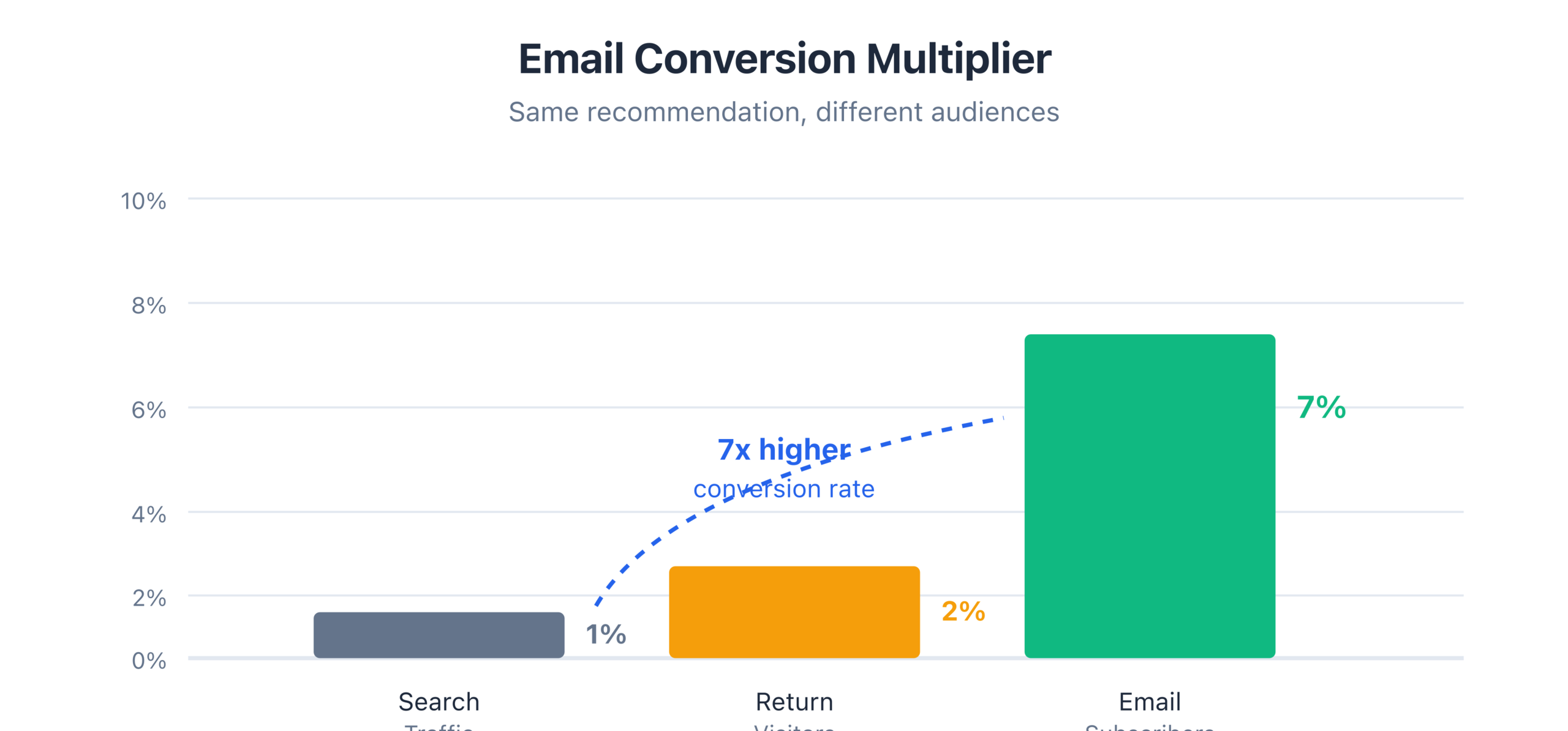
Email is the highest-converting channel for affiliate marketing. Not social media. Not organic search. Not paid ads. Email. My email subscribers convert to affiliate purchases at 3-5x the rate of my organic search visitors. Some months, a single email to my list generates more affiliate revenue than a week’s worth of search traffic.
The reason is trust. Someone who gave you their email address and continues opening your emails has a relationship with you. They know your voice. They trust your recommendations. When you tell them “I just switched to this tool and it’s worth checking out,” they actually check it out. They don’t skim your recommendation alongside ten other search results. They read it, consider it, and often act on it.
This chapter covers everything you need to build an email system that supports and multiplies your affiliate revenue.
The Email Conversion Multiplier
Search traffic is anonymous. Someone lands on your review from Google, reads it, maybe clicks your affiliate link, probably doesn’t, and leaves. You’ll never see most of them again. Your conversion rate on a cold search visitor is typically 1-3% for affiliate link clicks, and of those clicks, maybe 5-15% actually purchase. So you’re converting somewhere around 0.1-0.5% of your search traffic into affiliate commissions.
Email changes those numbers dramatically.
My email list has an average open rate of 38%. Of the people who open, about 12% click on affiliate-related links. And of those clicks, the purchase rate is 15-25% because these are warm leads who trust my judgment.
Running those numbers: if I send an email to 5,000 subscribers about a product I recommend, about 1,900 open it. About 228 click the affiliate link. And about 34-57 make a purchase. If the average commission is $50, that’s $1,700-$2,850 from a single email.
Compare that to search traffic. To get 57 affiliate purchases from organic search at a 0.3% conversion rate, I’d need about 19,000 visitors to that specific page. Getting 19,000 targeted visitors to a single review takes months of SEO work. Getting 5,000 email subscribers to open a well-crafted email takes one afternoon.
That’s the email conversion multiplier. Not a small advantage. A structural one.
The Email Funnel for Affiliate Bloggers
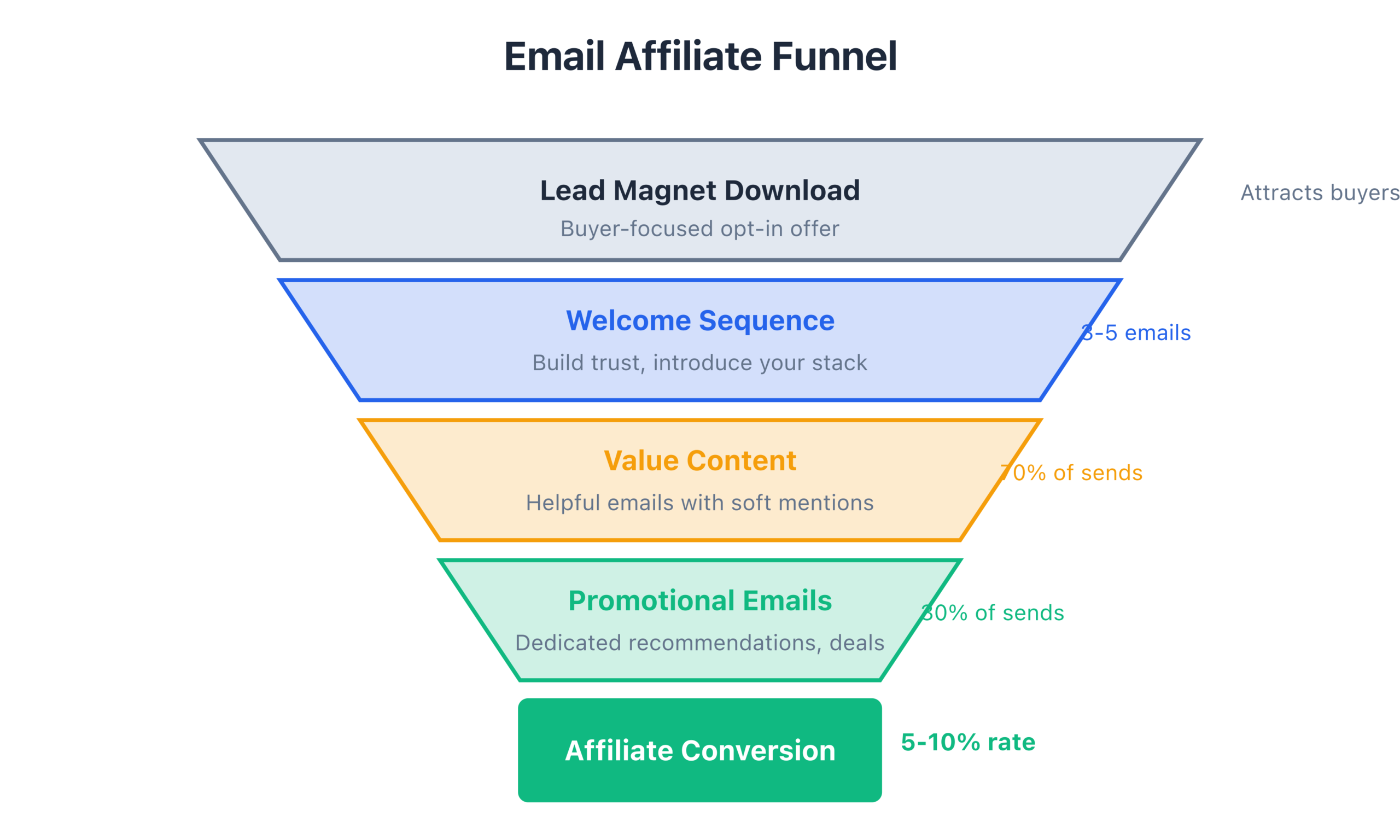
The affiliate email funnel has five stages. Each stage has a specific purpose and a different approach to affiliate recommendations.
Stage 1: Capture
Getting the email address. This is your opt-in form, your lead magnet, your signup incentive. The goal here is simple: give someone a reason to hand over their email that’s valuable enough to justify the exchange.
For affiliate bloggers, the lead magnet should relate to your niche and set up future affiliate recommendations naturally. If your niche is WordPress, a “WordPress Speed Optimization Checklist” is a great lead magnet because it naturally leads to conversations about hosting, caching plugins, and CDN services… all of which are affiliate-monetizable.
I’ll cover specific lead magnet ideas in the next section.
Stage 2: Welcome
The welcome sequence is the most important series of emails you’ll ever write. It runs automatically when someone subscribes, typically 3-5 emails over 7-10 days. This is where you establish your voice, build trust, and make your first affiliate recommendation.
Not a hard sell. A natural recommendation that fits the context of your welcome sequence.
Stage 3: Nurture
Ongoing value delivery. Weekly or biweekly emails that teach, share experiences, and keep your subscribers engaged. Most of these emails have no affiliate links at all. They’re pure value. They’re the reason people stay subscribed.
My nurture emails typically follow a 3:1 ratio. Three value emails for every one that includes an affiliate recommendation. And even the ones with affiliate recommendations lead with value first.
Stage 4: Recommend
Strategic affiliate emails sent when you have something genuinely worth recommending. A new product you’ve tested. A tool you switched to. A deal that’s too good to pass up. These are targeted, well-crafted emails that make a specific recommendation with clear reasoning.
The key word is “strategic.” Not every email is a recommendation email. When every email sells something, unsubscribe rates spike. When recommendations come occasionally and feel genuine, click rates stay high.
Stage 5: Repeat
The cycle continues. More value, more trust, occasional recommendations. Subscribers who’ve been on your list for 6+ months and have received consistent value are your highest-converting audience. They buy because they’ve learned to trust your judgment over time, not because of a single persuasive email.
Lead Magnets That Work for Affiliate Bloggers
Your lead magnet is the entry point of your funnel. A bad lead magnet attracts the wrong people or nobody at all. A good lead magnet attracts people who are likely to be interested in the products you’ll eventually recommend.
Lead magnets that consistently work in affiliate niches:
Comparison Guides: “The WordPress Hosting Comparison Guide: 7 Hosts Tested on Speed, Support, and Value.” This attracts people who are actively evaluating hosting options. They’re buyer-intent subscribers from day one. Inside the guide, you include your honest assessments and affiliate links. It’s useful, it’s relevant, and it naturally monetizes.
I’ve found that comparison guide lead magnets convert to affiliate purchases at 2-3x the rate of generic checklists. Because the person who downloads a comparison guide is closer to buying than the person who downloads a “10 Tips” PDF.
Checklists and Cheat Sheets: “The WordPress Speed Optimization Checklist: 47 Steps I Use on Every Client Site.” Practical, actionable, and related to products you recommend. In the checklist, you mention specific tools: “Step 12: Install a caching plugin (I recommend FlyingPress, here’s why…)” with your affiliate link.
Template Packs: “My Content Calendar Template for Affiliate Bloggers.” “WordPress Launch Checklist Template.” Templates have high perceived value because they save time. People will trade an email address for something they can immediately use.
Mini-Courses (Email-Based): A 5-day email course on a topic related to your niche. “5 Days to a Faster WordPress Site” or “The 5-Day Affiliate Blogging Quickstart.” Each day’s email delivers a lesson and naturally mentions tools or products relevant to that lesson. Day 3 on caching might recommend your preferred caching plugin. Day 4 on CDNs might recommend your preferred CDN. The educational frame makes the recommendation feel natural, not salesy.
The lead magnet that’s driven the most subscribers for me is a comparison guide. It attracts exactly the right audience: people who are evaluating tools, ready to make a decision, and looking for honest recommendations.
The Welcome Sequence That Builds Trust
Your welcome sequence runs automatically after someone subscribes. Most affiliate bloggers either skip this entirely (bad move) or turn it into an immediate sales pitch (worse move). The welcome sequence should build trust first, recommend second.
Here’s the 5-email welcome sequence I use:
Email 1 (Immediately after signup): Deliver the lead magnet + introduce yourself.
Keep it short. Deliver what you promised. Include a brief intro: who you are, what you do, and what they can expect from your emails. “I’m Gaurav. I’ve been building WordPress sites since 2009 and writing about what works (and what doesn’t) for 16+ years. You’ll hear from me every week with practical tips, honest product recommendations, and the occasional rant about things that waste your time.”
That’s it. No affiliate links. No pitch. Just the lead magnet and a human introduction.
Email 2 (Day 2): Your best piece of content.
Send them to the most useful, most popular article on your site. “Here’s the article my readers share most often.” This does two things: it delivers value immediately, and it gives them a taste of your writing style and depth of knowledge. If they love this article, they’ll open your future emails.
Email 3 (Day 4): A personal story with a lesson.
Share a story from your experience that relates to your niche. A mistake you made. A project that went wrong. A surprising result from a test. Make it personal and educational. This is where you become a real person to your subscriber, not just another newsletter. I usually share a story about a project failure that taught me something my subscribers can use.
Email 4 (Day 6): Your first recommendation.
Now, after three emails of pure value, you’ve earned the right to recommend something. And even here, lead with the problem, not the product. “The question I get asked most is [common problem]. After testing [X] options over [Y] years, here’s what I use and recommend.” Then introduce your top affiliate recommendation with a link.
This email typically gets my highest affiliate click-through rate of the entire sequence. Not because of aggressive selling, but because of the trust built in the first three emails.
Email 5 (Day 8-10): The “what’s coming” email.
Tell them what to expect going forward. How often you email. What type of content you share. And invite them to reply with their biggest challenge related to your niche. This does two things: it improves email deliverability (replies signal engagement to email providers), and it gives you direct insight into what your subscribers need.
That reply data is gold. When 50 people email you saying “I can’t figure out which hosting to choose,” you know exactly what to write next. Your content calendar writes itself.
Segmentation for Targeted Affiliate Recommendations
Not every subscriber cares about every product you recommend. Someone who signed up through your WordPress hosting guide doesn’t want emails about email marketing tools. Someone who runs a WooCommerce store has different needs than someone running a personal blog.
Segmentation means dividing your email list into groups based on their interests, behavior, or characteristics, and sending different content to each group.
Basic segmentation strategies for affiliate bloggers:
Interest-based segments: Tag subscribers based on which lead magnet they downloaded or which topics they’ve clicked on. If someone consistently clicks links about WordPress performance, they’re in your “performance enthusiasts” segment. When you write about caching plugins, that segment gets the email. When you write about email marketing tools, maybe they don’t.
Engagement-based segments: Separate active subscribers (opened an email in the last 30 days) from inactive ones (haven’t opened in 90+ days). Send your best affiliate recommendations to active subscribers. Run re-engagement campaigns for inactive ones. And remove truly dead subscribers (no opens in 6+ months) to keep your list healthy.
Buying behavior segments: If your email platform tracks affiliate link clicks, you can create segments based on what people clicked. Someone who clicked your hosting affiliate link but didn’t purchase is a warm lead for a follow-up email with more information or a special deal.
I keep my segmentation simple. Three primary segments based on interests, one engagement segment, and one “clicked but didn’t buy” segment for retargeting. More complex segmentation exists, but I’ve found diminishing returns beyond this point for a blog-sized email operation.
The tools I use for email marketing: Kit (formerly ConvertKit) for my main blog. It handles tagging, automation, and segmentation well without being overly complex. For client projects with larger lists, I’ve used ActiveCampaign which has more advanced automation but a steeper learning curve. If you’re starting from zero, Kit is where I’d point you. The free plan handles up to 10,000 subscribers, and the automation features are good enough for everything in this chapter.
Email Frequency: The Line Between Helpful and Spammy
How often should you email your list? I’ve tested everything from daily to monthly. Here’s what I’ve found:
Daily emails: Very high unsubscribe rates. Unless you’re a gifted daily writer with an audience that specifically signed up for daily content, this burns through your list fast. I tried daily emails for three months and my unsubscribe rate tripled. The subscriber quality (clicks, purchases) went down because people started skimming instead of reading.
2-3 times per week: Works for active niches with lots of news and updates. Too much for most affiliate bloggers. I found that the third email per week consistently underperformed the first two.
Weekly: My sweet spot. One email per week is frequent enough to stay top-of-mind but not so frequent that subscribers tune out. My open rates are highest with weekly emails, and the weekly cadence gives me enough time to craft something genuinely valuable each time.
Biweekly (every two weeks): Acceptable if you’re just starting out or have limited content to share. But you risk being forgotten between emails. Monthly is too infrequent. By the time your next email arrives, subscribers have forgotten who you are, and your open rates will reflect it.
My recommendation: start with weekly. Settle into a specific day and time. My emails go out Tuesday mornings because that’s when my open rates are highest (I tested Mon-Fri and Tues consistently won). Your best day might be different. Test it.
The frequency of affiliate recommendations within your emails matters just as much. My 3:1 ratio (three value emails for every one with affiliate recommendations) has been consistent for years. Some months it’s 4:1 if I don’t have anything genuine to recommend. It’s never 1:1. When every email pushes a product, subscribers stop trusting your recommendations. The power of affiliate email marketing comes from restraint. Recommend less, but when you do, make it count.
One last thing on email that most affiliate bloggers miss: your email list is the only audience you own. If Google changes an algorithm and your search traffic drops 50% overnight (it happens, I’ve watched it happen), your email list is still there. If social media platforms change their rules or die (remember what happened to organic reach on Facebook?), your email list is still there.
Every email subscriber you gain is a reader you can reach directly, without any platform as a middleman. That makes your email list the most valuable asset your affiliate blog will ever build. Treat it that way.
Chapter Checklist
- [ ] I understand why email converts 3-5x higher than organic search for affiliate revenue
- [ ] I have an email marketing platform set up and connected to my site
- [ ] I’ve created at least one lead magnet related to my affiliate niche
- [ ] My lead magnet attracts buyer-intent subscribers (not just anyone)
- [ ] I have a 5-email welcome sequence written and automated
- [ ] My welcome sequence delivers value before making any affiliate recommendation
- [ ] The first affiliate recommendation doesn’t appear until email 4 of the welcome sequence
- [ ] I’m emailing my list at least weekly with consistent value
- [ ] I follow a 3:1 ratio (value emails to recommendation emails)
- [ ] I have basic segmentation set up (at minimum: interest-based and engagement-based)
- [ ] I track which affiliate recommendations get clicks in my emails
- [ ] I clean my list periodically by removing truly inactive subscribers
- [ ] I view my email list as my most valuable business asset
Chapter Exercise
Build the foundation of your affiliate email funnel in one sitting:
-
Choose your lead magnet: Based on your niche, pick the lead magnet type that attracts buyer-intent subscribers. Write a one-paragraph description of what it will contain and why your target reader would want it. If you can, create the actual lead magnet today (a comparison guide or checklist is fastest to produce).
-
Draft your welcome sequence: Write the subject lines and a 2-3 sentence summary of each of the 5 welcome emails:
- Email 1: Lead magnet delivery + intro
- Email 2: Your best content piece (which article will you link to?)
- Email 3: Personal story (what story will you tell?)
- Email 4: First recommendation (which affiliate product and what problem does it solve?)
- Email 5: What’s coming + invitation to reply
-
Write Email 4 in full: This is your first affiliate recommendation email. Draft the complete email. Lead with the problem. Share your experience. Make the recommendation with a clear reason. Include your affiliate link. Keep it under 400 words.
-
Plan your first month of weekly emails: List 4 email topics for the next month. At least 3 should be pure value (no affiliate links). One can include a recommendation. For each, write a one-line description of the content and which subscriber segment it’s most relevant to.
-
Set up your email platform: If you haven’t already, sign up for Kit (free plan) or your email platform of choice. Create your first opt-in form. Connect it to your site. Set up your welcome sequence automation.
The goal isn’t to build a perfect funnel. It’s to build a working one. You can refine the copy, optimize the timing, and improve the lead magnet over time. But you can’t improve what doesn’t exist. Get the foundation in place this week, and start building your most valuable affiliate asset.
Disclaimer: This site is reader-supported. If you buy through some links, I may earn a small commission at no extra cost to you. I only recommend tools I trust and would use myself. Your support helps keep gauravtiwari.org free and focused on real-world advice. Thanks. - Gaurav Tiwari