
Most affiliate reviews are garbage. I don’t say that to be harsh. I say it because I’ve read thousands of them, and the pattern is depressingly predictable: copy the product’s feature list from their website, slap on a 4.5/5 rating, drop an affiliate link, and call it a day.
That’s not a review. That’s a press release with a commission attached.
I’ve been writing product reviews since 2009. Some of my best-converting affiliate pages are reviews I published years ago that still bring in consistent monthly revenue. The reason they work isn’t because I’m some brilliant copywriter. It’s because readers can tell I actually used the product. And that single distinction, real experience versus regurgitated marketing copy, is what separates reviews that convert from reviews that bounce.
In this chapter, I’ll break down exactly how I write reviews that build trust and convert readers into buyers. Not through manipulation. Through credibility.
The Review Credibility Framework
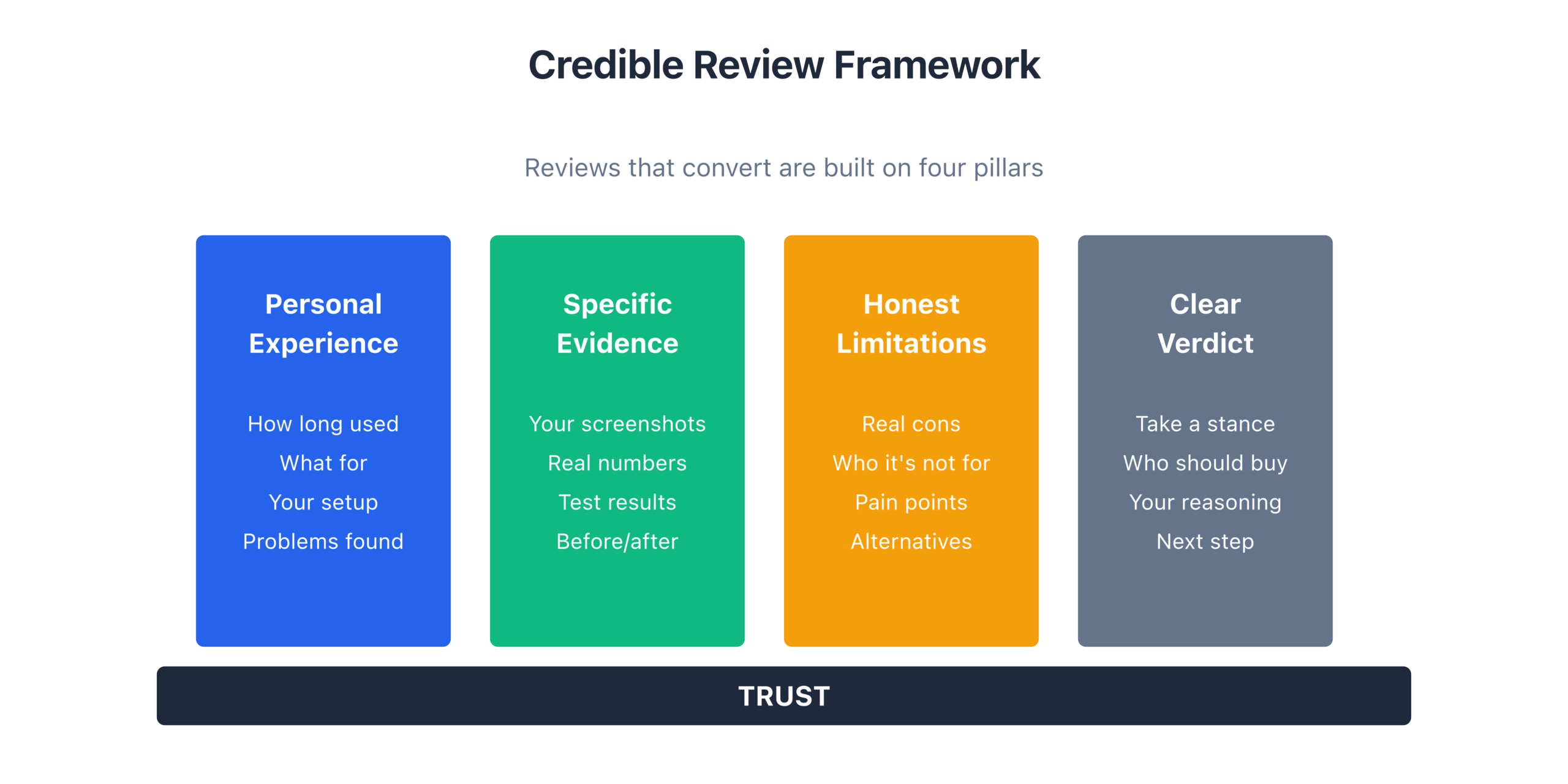
Every review that converts well follows the same four-part framework, whether the reviewer knows it or not. I call it the EEHR Framework:
- Experience: You’ve actually used the product in a real scenario
- Evidence: You can show screenshots, results, or specific details that prove your experience
- Honesty: You mention what’s genuinely bad or lacking, not just what’s good
- Recommendation: You make a clear, conditional recommendation at the end
Miss any one of these, and your review falls apart.
Skip the experience part, and you’re just summarizing a sales page. Skip the evidence, and readers have no reason to trust your claims. Skip the honesty, and everything you say sounds like an ad. Skip the recommendation, and the reader leaves confused about what to actually do next.
I’ve tested this across hundreds of reviews. The ones that follow all four steps consistently outperform the ones that skip even one. We’re talking 2-3x higher click-through rates on affiliate links. That’s not a small difference. That’s the difference between a review earning $50/month and $150/month, compounded across dozens of pages.
Why “I Actually Used This” Is Everything
There’s a sentence I include in almost every review I write, in some form or another: “I’ve been using this for [time period].”
It sounds simple. Almost too simple. But that sentence does more heavy lifting than any clever copywriting trick you’ll ever learn.
When someone searches for “[Product] review,” they’re looking for a human opinion. They’ve already seen the product’s sales page. They already know the features. What they want is someone to tell them, honestly, whether this thing is worth their money.
And the only people qualified to do that are people who’ve actually used it.
I made a rule for myself early on: I don’t review products I haven’t used. Period. If a company sends me a product to review and I don’t have time to actually use it for at least two weeks, I decline. If someone asks me to write about a tool I’ve never touched, I either buy it and test it first, or I pass on the opportunity.
This rule has cost me money in the short term. I’ve turned down paid review opportunities because I couldn’t honestly say I’d used the product enough to form a real opinion. But in the long term, it’s built a reputation that makes every new review I publish more credible by default.
Your readers are smarter than you think. They can spot the difference between “I signed up for the free trial 20 minutes ago” and “I’ve been running this on three client sites for the past six months.” The specificity of your experience is what sells.
Compare these two openings:
Generic: “FlyingPress is a caching plugin for WordPress that helps speed up your website.”
Experienced: “I switched from WP Rocket to FlyingPress eight months ago. My homepage load time dropped from 1.8 seconds to 0.9 seconds. I’ve since installed it on 12 client sites, and the results have been consistent.”
The second version isn’t fancy writing. It’s just specific. And specificity creates trust.
The Anatomy of a Review That Converts
After writing hundreds of reviews, I’ve settled on a structure that works. Not because it’s the only structure, but because it covers everything a reader needs to make a decision without wasting their time.
1. The Hook (First 100 Words)
Open with your personal experience. When did you start using this product? What problem were you trying to solve? What made you consider it in the first place?
Don’t start with the product’s history or founder story. Nobody searching for a review cares that “Company X was founded in 2015 by two Stanford graduates.” They care about whether the product works.
2. Quick Verdict (Next 50-100 Words)
Give your overall opinion upfront. Yes, before the detailed breakdown. I know this seems counterintuitive. If you tell them your conclusion, why would they keep reading?
They keep reading because they want to understand why. And giving your verdict early does two things: it hooks readers who agree with you (they want validation), and it hooks readers who disagree (they want to see your reasoning).
Something like: “After 8 months of daily use, FlyingPress is the best WordPress caching plugin I’ve tested. It’s not the cheapest, and it’s not the easiest to configure. But if performance matters to your business, it’s worth every penny.”
That’s a clear stance. It also acknowledges downsides, which builds trust immediately.
3. The Setup and Context
Explain what kind of user you are and what you were looking for. This is where you help the reader decide if your experience is relevant to their situation.
“I run a WordPress blog with 150,000 monthly visitors, heavy on long-form content with lots of images. My previous caching setup was WP Rocket plus Cloudflare, which worked but felt like it was leaving performance on the table.”
This context matters because a caching plugin that works for my use case might not work for a WooCommerce store with 50,000 products. Being specific about your context helps readers self-select.
4. Feature Deep-Dive With Your Experience
This is the meat of your review. But here’s the difference between a good review and a press release: for every feature you mention, you need to explain your experience with it.
Not: “FlyingPress includes image lazy loading.”
But: “FlyingPress handles image lazy loading out of the box. I didn’t have to configure anything. On my image-heavy posts, this shaved about 0.3 seconds off the initial page load. The only catch, images below the fold flash briefly on slower connections, which some readers have noticed.”
See the pattern? Feature, your experience, the result, and any caveats. That’s a credible feature mention.
5. Screenshots and Visual Evidence
Take screenshots. Lots of them. Before/after performance tests. Dashboard views. Settings pages. Error messages. Anything that shows you’re actually inside the product.
I can’t stress this enough. A review without screenshots feels theoretical. A review with 8-12 real screenshots from your account feels lived-in. And lived-in converts.
I keep a folder on my desktop called “Review Assets” where I dump screenshots as I use products. When it’s time to write the review, I already have 20-30 images to choose from. This habit alone has improved my reviews more than any writing technique.
6. Pricing Discussion
Don’t just list the prices. Analyze whether the pricing makes sense for different user types. “The $60/year plan covers one site. If you’re running a single blog, that’s reasonable. About $5/month for a noticeable performance improvement. But if you need it on 5+ sites, the unlimited plan at $150/year is the smarter buy.”
Include real math. Readers appreciate when you do the cost-per-site or cost-per-month calculation for them.
7. The Verdict Section (More on This Below)
A clear recommendation with conditions. Who should buy it, who shouldn’t, and what alternatives exist.
Writing Honest Negatives Without Killing Conversions
This is where most affiliate bloggers panic. “If I mention something bad, won’t people stop buying?”
No. The opposite happens.
I’ve run this experiment multiple times. Reviews that include genuine negatives consistently convert better than reviews that are 100% positive. And the psychology makes sense. When everything in a review is glowing, the reader’s internal alarm goes off. “This person is clearly just selling me something.” Trust drops. They click away and find another review.
But when you say, “I love this product, but here’s what frustrates me,” the reader leans in. Because now they believe the positive things you said too.
The key is how you frame negatives. There are three approaches that work:
The Workaround Negative: Mention the problem and how you solved it. “The reporting dashboard is pretty basic. I ended up connecting it to Google Data Studio for the detailed analytics I needed. Takes about 10 minutes to set up, and then you’ve got reporting that’s better than most premium plugins offer natively.”
The Context Negative: Explain who the negative matters to and who it doesn’t. “There’s no phone support. If you’re the kind of person who wants to pick up the phone when something breaks, this isn’t for you. But their ticket response time is usually under 2 hours, which has been fast enough for my needs.”
The Honest Trade-off Negative: Acknowledge the downside as part of a deliberate design decision. “The interface isn’t pretty. It’s functional but visually dated. I think the developer chose to invest engineering time in performance over UI polish. Given that my visitors never see the backend, I’m fine with that trade-off.”
What you don’t want to do is mention a critical flaw and then immediately minimize it. “The plugin crashed my site, but I’m sure they’ll fix it!” That’s dishonest in the other direction. If something is genuinely broken or dangerous, say so. Your readers’ trust is worth more than any single commission.
My rule: if I wouldn’t recommend the product to a friend, I don’t recommend it to my readers. Period. I’ve published negative reviews that explicitly say “don’t buy this.” Those reviews still make money because they recommend alternatives. And readers remember that I was honest, which brings them back for future recommendations.
The Verdict Section: Making a Clear Recommendation
The verdict section is where conversions happen or die. And most affiliate bloggers blow it.
A good verdict section has three components:
A Clear Recommendation: “FlyingPress is the caching plugin I’d recommend for most WordPress bloggers and content sites.” Not wishy-washy. Not “it depends on your needs.” A clear stance.
Conditions for the Recommendation: “This recommendation assumes you’re comfortable spending 15-20 minutes on initial configuration and you’re running a content-heavy WordPress site. If you want a plug-and-play solution with zero configuration, WP Rocket is the better choice, though you’ll sacrifice some performance.”
The Alternative Mention: Always mention 1-2 alternatives with brief explanations of why someone might choose them instead. This sounds like it would hurt your main recommendation’s conversions. It doesn’t. It actually increases trust and keeps readers on your site instead of sending them to Google to find alternatives.
I structure my verdicts as a “Choose X if…” format:
- Choose FlyingPress if you want the fastest results and don’t mind tweaking settings
- Choose WP Rocket if you want the easiest setup and good (not best) performance
- Choose FlyingPress + FlyingCDN if you want the full stack and are willing to invest $100+/year
This format respects the reader’s intelligence. It gives them a decision framework instead of a hard sell. And paradoxically, it converts better than a hard sell because the reader feels like they made the choice, not you.
Reviews vs Quick Takes: When to Go Deep
Not every product deserves a 2,500-word review. And writing long reviews for minor tools is a waste of your time and your reader’s time.
I split my product content into two categories:
Full Reviews (1,500-3,000+ words): For products where the affiliate commission is worth the effort, where the product is complex enough to warrant deep analysis, and where I’ve used it long enough to have a real opinion. These are your money pages. SEO-optimized, thoroughly researched, regularly updated.
Products I write full reviews for tend to have commissions of $30+ per sale or recurring commissions. The review needs to justify the time investment. A tool with a one-time $5 commission doesn’t warrant a 3,000-word review unless it’s a gateway to a larger ecosystem.
Quick Takes (300-800 words): For products that are straightforward, where your opinion can be expressed concisely, or where you’re mentioning a product within a broader article. Quick takes work well as sections within comparison posts or “tools I use” pages.
The format for a quick take is simple: what it does, who it’s for, what I like, what I don’t, and whether I recommend it. Five paragraphs. Done.
I use quick takes for about 70% of my product mentions and full reviews for the top 30%. That top 30% generates about 85% of my affiliate income. Focus your deep-review energy where the money is.
One more thing about reviews: update them. I revisit my top-performing reviews every 6 months. Products change. Pricing changes. My opinion sometimes changes. A review that was accurate in 2023 might be misleading in 2025. And Google notices when you keep content fresh. My updated reviews consistently rank better than the original versions.
Chapter Checklist
- [ ] I have the EEHR Framework memorized: Experience, Evidence, Honesty, Recommendation
- [ ] I only review products I’ve personally used for at least 2 weeks
- [ ] My reviews open with my personal experience, not the product’s feature list
- [ ] I give my verdict early, then explain the reasoning
- [ ] Every feature mention includes my specific experience and results
- [ ] I include 8-12 real screenshots from my own account
- [ ] Pricing sections include real cost analysis, not just a price list
- [ ] My negative points use one of the three framing approaches (workaround, context, trade-off)
- [ ] My verdict section has a clear recommendation with conditions and alternatives
- [ ] I know which products deserve full reviews vs quick takes
- [ ] I have a system for updating reviews every 6 months
Chapter Exercise
Pick one product you use regularly and genuinely like. Open a document and write the following:
- Your experience sentence: “I’ve been using [Product] for [time period] to [specific use case].”
- Three specific results: Quantifiable outcomes from using this product (speed improvements, time saved, money earned, problems solved).
- Two honest negatives: Things that genuinely frustrate you about this product.
- Your verdict in 3 sentences: A clear recommendation, the conditions, and one alternative.
- Screenshot inventory: Open the product right now and take 5 screenshots that could support claims in your review.
Don’t write the full review yet. Just assemble these components. If you can fill all five with specific, honest details, you have the foundation for a review that converts. If you’re struggling to fill them, you probably haven’t used the product enough to write a credible review. Use it for another month and come back.
Disclaimer: This site is reader-supported. If you buy through some links, I may earn a small commission at no extra cost to you. I only recommend tools I trust and would use myself. Your support helps keep gauravtiwari.org free and focused on real-world advice. Thanks. - Gaurav Tiwari