
Money pages are the engine of your affiliate income. They’re where clicks happen, where commissions are generated, and where all your support and trust content ultimately points. But not all money pages are created equal. There’s a hierarchy, and understanding it is the difference between a site that earns $300/month and one that earns $5,000/month.
I’ve published over 150 money pages across my sites over 16 years. Some of them earn $50/month. A few earn $2,000+/month. The difference isn’t always traffic. It’s the type of money page, its structure, and how it fits into the broader content ecosystem.
The Money Page Hierarchy
Think of money pages as a pyramid. Each level captures visitors at a different stage of their buying decision. The higher up the pyramid, the broader the audience, but the further from the purchase. The lower down, the narrower but more purchase-ready.
Level 1: “Best Of” Roundups
These sit at the top of the hierarchy. “Best email marketing tools,” “Best WordPress hosting,” “Best project management apps.” They cast the widest net and capture the most search volume.
A well-written “best of” page is your most important money page. It’s the one you’ll update most frequently, the one that generates the most affiliate clicks, and the one that ranks for the most keywords. My top “best of” page ranks for over 200 keyword variations and generates 30-40% of that niche’s total affiliate revenue.
But “best of” pages are also the most competitive. Everyone writes them. Standing out requires genuine testing, specific opinions, and a structure that helps readers make decisions fast.
Level 2: Comparison Posts
“[Product A] vs [Product B]” posts. These capture people who’ve narrowed their choices to two options. The intent is strong, they’re about to buy, they just need help choosing.
Comparison posts typically have lower search volume than “best of” posts but much higher conversion rates. Someone searching “ConvertKit vs Mailchimp” is further along than someone searching “best email marketing tools.” They’ve already done the research. They need a tiebreaker.
I’ve found that comparison posts convert at roughly 2x the rate of “best of” posts. The traffic is smaller, but the revenue per visitor is higher.
Level 3: Alternatives Posts
“[Popular Product] alternatives” captures a specific audience: people who know about the market leader but have decided it’s not right for them. Maybe it’s too expensive. Maybe they’ve read bad reviews. Maybe they’ve outgrown it.
These visitors are motivated buyers. They already know they need a solution. They just need a different one. And they’re grateful when you give them clear alternatives with real reasons to switch.
My “[popular tool] alternatives” posts consistently rank in the top 3 for their keywords because bigger publications often don’t bother with this format. They focus on standalone reviews and “best of” lists. Alternatives posts are a niche within a niche, and they convert well.
Level 4: Individual Reviews
Deep, detailed reviews of a single product. “ConvertKit review,” “SiteGround hosting review,” “Ahrefs review.” These capture people who are close to buying a specific product but want validation, or want to know the downsides before committing.
Individual reviews are the backbone of your content ecosystem. They give you a canonical page for each product in your stack, a page you can link to from “best of” posts, comparisons, tutorials, and support content.
My individual reviews are typically 3,000-5,000 words. They cover pricing, features, performance, pros, cons, who it’s for, and who should look elsewhere. They include screenshots from my actual usage, not stock images from the vendor’s website.
Level 5: Tutorials with Affiliate Context
“How to start an email list with ConvertKit,” “How to speed up WordPress with SiteGround.” These combine educational content with product-specific instruction. The primary intent is learning, but the affiliate link is natural because you’re teaching with a specific tool.
Tutorial money pages have the lowest direct conversion rates, but they build the strongest product affinity. When someone follows your 20-step tutorial using a specific tool, they’re invested. They’ve set up their account. They’ve configured settings. The affiliate link at the beginning of the tutorial is where they signed up, and the recurring commission is where you get paid.
Which Money Page Types Convert Best and Why
Based on my data across 150+ money pages:
Comparison posts have the highest conversion rate per visitor (typically 4-8% of link clicks result in a sale). The intent is razor-sharp. These people are comparing their final two options.
Alternatives posts are second (3-6% conversion rate). Motivated buyers looking for specific solutions.
Individual reviews are third (2-5% conversion rate). High intent but some visitors are still in research mode.
“Best of” roundups are fourth for conversion rate (1-3%) but first for total revenue because the traffic volume is so much higher.
Tutorials are last for direct conversion (0.5-2%) but they create the longest reader sessions and the strongest trust building.
The takeaway: you need all five types. “Best of” pages bring the volume. Comparisons and alternatives bring the conversion rate. Reviews provide the depth. Tutorials build the trust. The hierarchy works as a system.
Anatomy of a High-Converting “Best Of” Page
I’ve tested dozens of structures for “best of” pages. Here’s the format that consistently performs best.
The Opening (100-200 words)
Skip the “choosing the right [tool] can be overwhelming” garbage. Start with your credibility and your pick.
Something like: “I’ve tested 25+ email marketing tools over the past 8 years, on my own sites and for client projects. [Tool name] is my top recommendation for most bloggers. But it’s not right for everyone, so here’s the full breakdown.”
That opening does three things. It establishes credibility (25+ tools, 8 years). It gives the impatient reader an immediate answer. And it promises a full breakdown for readers who want details.
Quick Comparison (before the deep content)
Right after the opening, give a scannable summary. I use a simple list format:
- Best overall: [Tool] – one-sentence reason, link
- Best for beginners: [Tool] – one-sentence reason, link
- Best value: [Tool] – one-sentence reason, link
- Best for advanced users: [Tool] – one-sentence reason, link
This captures the readers who just want an answer. About 20-30% of visitors will click an affiliate link from this summary section without scrolling further. Let them. Don’t force them to read 3,000 words if they know what they want.
Individual Product Sections (300-500 words each)
For each product in your list (I recommend 5-7, never more than 10), include:
- Product name with affiliate link
- One-paragraph overview of what it does and who it’s for
- What you specifically like about it (from actual usage)
- What you don’t like (honest negatives build trust)
- Pricing breakdown
- Who should choose this product
- Who should skip it
That last part, “who should skip it,” is powerful. It shows you’re not trying to sell everything to everyone. It builds immense trust. And counterintuitively, it increases conversion rates because readers trust that your positive recommendations are genuine.
Your Recommendation Section (at the end)
After covering all products, end with a clear recommendation section. Restate your top pick and why. Address the most common objection. Include your affiliate link one final time.
This section catches the readers who scrolled through everything, read every section, and still want one more push toward a decision. Give it to them.
What I Don’t Include:
- Feature comparison matrices (readers’ eyes glaze over at 15-row comparison charts)
- Affiliate disclosure buried in a footnote (put it at the top, clearly and honestly)
- Products I haven’t tested (if it’s on my list, I’ve used it)
- More than 7-8 products (too many choices paralyze readers)
The Structure of a Money Page That Ranks AND Converts
Ranking and converting often feel like opposing goals. SEO says add more content, more keywords, more depth. Conversion optimization says simplify, reduce friction, make the CTA obvious.
Here’s how I balance both.
For ranking, you need:
- Comprehensive coverage of the topic (2,500-4,000 words for “best of” pages, 2,000-3,500 for reviews)
- Relevant subheadings that cover related queries (these capture long-tail keywords)
- Internal links from supporting content
- Original information that competitors don’t have (your testing data, your specific experience, your unique take)
- Fresh content signals (update your money pages at least quarterly)
For converting, you need:
- A clear recommendation within the first 200 words
- Scannable structure (readers skim before they read)
- Affiliate links at multiple points, not just one buried link
- Honest negatives (builds the trust that drives clicks)
- A clear CTA that tells people what to do next
The balance point is structure. A well-structured money page satisfies both goals.
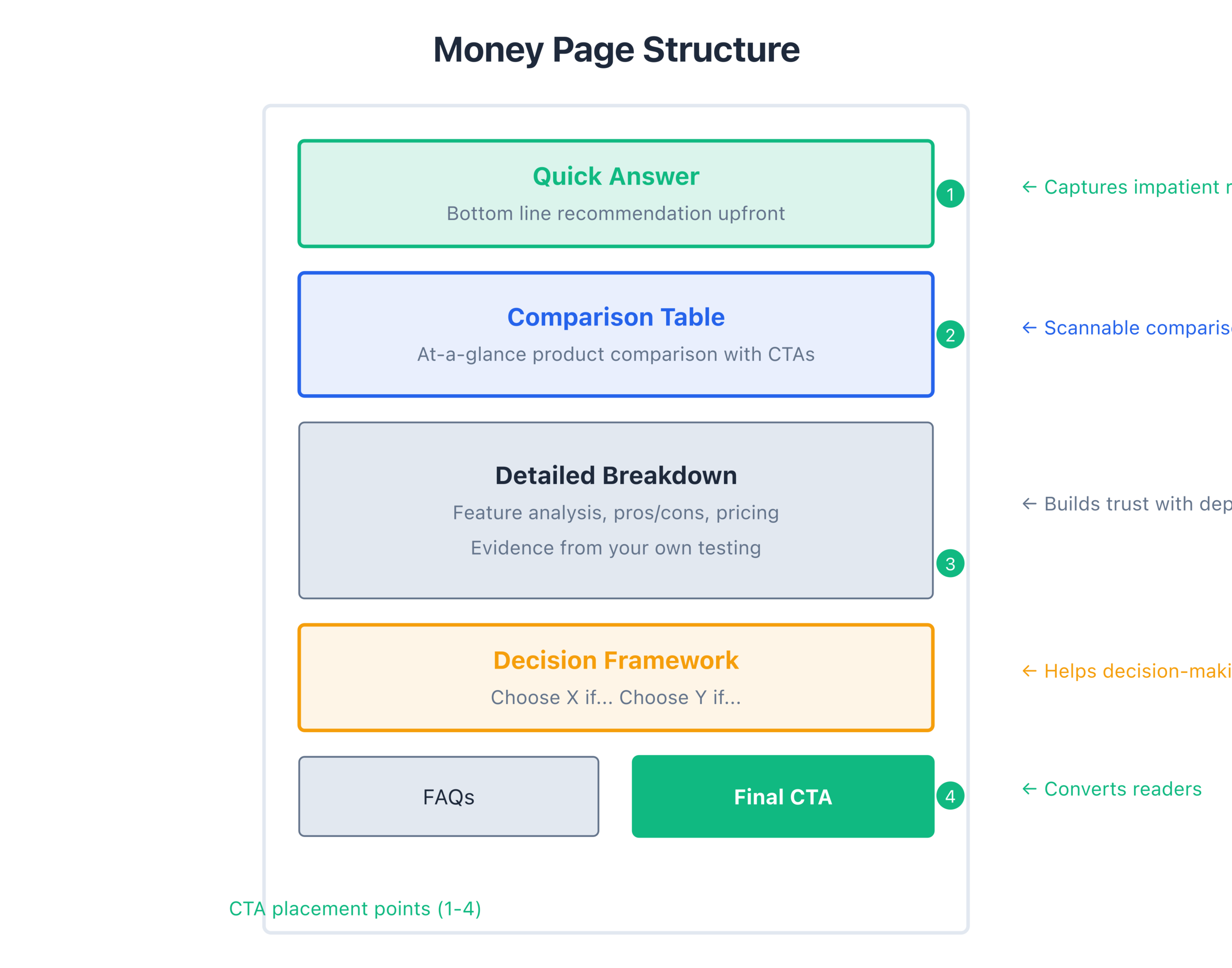
My typical money page structure:
- Opening hook + primary recommendation (100-200 words) – Captures both “just tell me” readers and sets context for SEO
- Quick summary (50-100 words) – Scannable list of top picks with links
- Methodology note (50-100 words) – How you tested/evaluated, builds trust and SEO depth
- Individual product sections (300-500 words each) – The meat of the page, covers each product with original insights
- Use case recommendations (200-300 words) – “If you need X, choose Y” format helps readers self-select
- FAQ section (200-400 words) – Captures additional long-tail keywords and addresses objections
- Final recommendation (100-150 words) – Restates primary pick, includes final CTA
Total: 2,500-4,000 words depending on the number of products. Long enough to rank, structured enough to convert.
Internal Linking Strategy: From Support Content to Money Pages
Internal linking is how your content ecosystem actually functions. Without it, you just have a collection of isolated posts. With it, you have a machine that funnels readers from discovery to decision.
Here’s how I think about internal linking for affiliate sites.
The Hub and Spoke Model
Your “best of” page is the hub. Everything else is a spoke.
- Individual reviews link to the hub (“see my full roundup of [category]”)
- Comparisons link to the hub AND to individual reviews
- Support content links to the hub (naturally, where relevant)
- Tutorials link to the specific product review AND the hub
The hub accumulates the most internal links, which tells search engines it’s the most important page on the topic. This helps it rank higher. And because it ranks highest, it drives the most traffic, which generates the most revenue.
Contextual Linking Rules:
Every internal link should pass the “would this help the reader?” test. If the answer is no, don’t add the link. Forced internal links look spammy and don’t provide value.
- Link from within paragraph text, not from a “related posts” sidebar
- Use descriptive anchor text, not “click here”
- Link to the most relevant page, not just the highest-earning page
- Limit to 3-5 internal links per 1,000 words (more than that dilutes the value)
The Link Priority:
Not all internal links are equal. I prioritize links from support content to money pages because those links move readers from education to decision. That’s the direction that generates revenue.
My priority order:
- Support content linking to money pages (highest priority, this drives revenue)
- Money pages linking to other money pages (comparison to review, hub to spoke)
- Trust content linking to money pages (credibility building that leads to conversion)
- Money pages linking back to support content (for readers who need more education)
The Update Cycle:
Every time I publish a new post, I go back to 3-5 existing posts and add links to the new content where relevant. This takes 15-20 minutes and ensures new content gets indexed faster and integrated into the ecosystem immediately.
I also do a quarterly internal link audit where I check my top 20 money pages and make sure they have adequate internal links pointing to them. If a money page has fewer than 5 internal links, it’s under-supported and probably under-performing.
The Money Page Publishing Sequence
When you’re starting a new product category on your site, the order you publish money pages matters.
Month 1: Individual review of your primary recommendation
Start with your #1 pick. Write the deepest, most detailed review you can. This becomes the canonical page for that product on your site. All future content will reference it.
Month 2: 2-3 comparison posts
Compare your primary pick to its top competitors. “[Your Pick] vs [Competitor A],” “[Your Pick] vs [Competitor B].” These posts reinforce your primary recommendation while capturing high-intent search traffic.
Month 3: Alternatives post + “best of” roundup
Now you have enough depth to publish your “best of” page. It links to your individual review and your comparison posts. The alternatives post captures people looking to move away from the category leader.
Month 4+: Additional reviews and comparisons
Expand coverage. Review the other products in your comparison posts. Add more comparison combinations. Each new money page strengthens the cluster.
This sequence ensures you never publish a “best of” page without depth behind it. The hub (your roundup) always has spokes (reviews, comparisons) to support it. Readers who want more detail can find it. And search engines see comprehensive topical coverage.
I’ve violated this sequence before, publishing a “best of” page before individual reviews, and the results were consistently worse. The roundup ranked slower, converted at a lower rate, and felt shallow without supporting pages to link to. Don’t skip the sequence.
Chapter Checklist
- I understand the five-level money page hierarchy (Best-of, Comparisons, Alternatives, Reviews, Tutorials)
- I know which types convert best and why
- I’ve planned the structure for my first “best of” page
- I understand the dual optimization challenge: ranking AND converting
- I have an internal linking strategy mapped out
- I know the publishing sequence: review first, then comparisons, then “best of”
- I’ve identified my hub page for each product category
- I’ve committed to updating money pages quarterly
Chapter Exercise
Plan your first money page cluster for your primary product category.
-
Write down your primary product category (e.g., “email marketing tools” or “WordPress hosting”)
-
List the specific money pages you’ll create:
- 1 “best of” roundup: “Best [category] for [audience]”
- 3 comparison posts: your top pick vs the 3 most popular alternatives
- 1 alternatives post: “[most popular product] alternatives”
- 1 individual review: your #1 recommendation
-
For each page, write a one-sentence thesis, the one thing you want the reader to take away. Example: “SiteGround is the best WordPress hosting for bloggers who want fast support and don’t want to manage a server.”
-
Map the internal links: draw arrows showing how each page links to the others. Your “best of” page should link to every individual review. Each comparison should link to the “best of” page and to both product reviews. The alternatives post should link to the “best of” page.
-
Assign your publishing schedule using the sequence from this chapter: individual review in month 1, comparisons in month 2, “best of” and alternatives in month 3.
-
Open a document and write the opening 200 words for your “best of” page right now. Not the full page. Just the opening. Your credibility statement, your primary pick, and your promise of what the full page delivers. If those 200 words are strong, the rest of the page will follow.
Start building your money page cluster this week. The longer you wait, the longer it takes for the compounding to kick in. And compounding, as you learned in Chapter 1, is how affiliate income stops being a grind and starts being an asset.
Disclaimer: This site is reader-supported. If you buy through some links, I may earn a small commission at no extra cost to you. I only recommend tools I trust and would use myself. Your support helps keep gauravtiwari.org free and focused on real-world advice. Thanks. - Gaurav Tiwari