Partial Fraction Decomposition Calculator
Looking for a partial fraction decomposition calculator? If you are, look no further. On this page, you will find all information that you need to define and calculate partial fractions, along with a partial fraction decomposition calculator.
Partial Fraction Calculators like this are a great way to discover and understand fractional expressions.
You can use the Partial Fraction Decomposition Calculator right here:
Partial Fraction Decomposition
Break down rational expressions into simpler fractions
Enter a rational expression to decompose
Decompose an expression to see the steps
Your calculation history will appear here
Input Syntax
| Operation | Syntax | Example |
|---|---|---|
| Division | / | (x+1)/(x-1) |
| Power | ^ | x^2 |
| Multiplication | * or implicit | 2*x or 2x |
| Addition | + | x+1 |
| Subtraction | - | x-1 |
| Grouping | ( ) | (x+1)^2 |
Decomposition Rules
| Factor Type | Partial Fraction Form |
|---|---|
Linear: (ax+b) | A/(ax+b) |
Repeated Linear: (ax+b)^n | A₁/(ax+b) + A₂/(ax+b)² + ... |
Irreducible Quadratic: (ax²+bx+c) | (Ax+B)/(ax²+bx+c) |
Repeated Quadratic: (ax²+bx+c)^n | (A₁x+B₁)/(ax²+bx+c) + ... |
Tips
- The numerator’s degree must be less than the denominator’s
- Use lowercase
xfor the variable - Parentheses help clarify complex expressions
- The denominator must be factorable
- Click any example to try it instantly
Let’s talk about some fundamentals and types of partial fraction decomposition.
What is a Partial Fraction Decomposition?
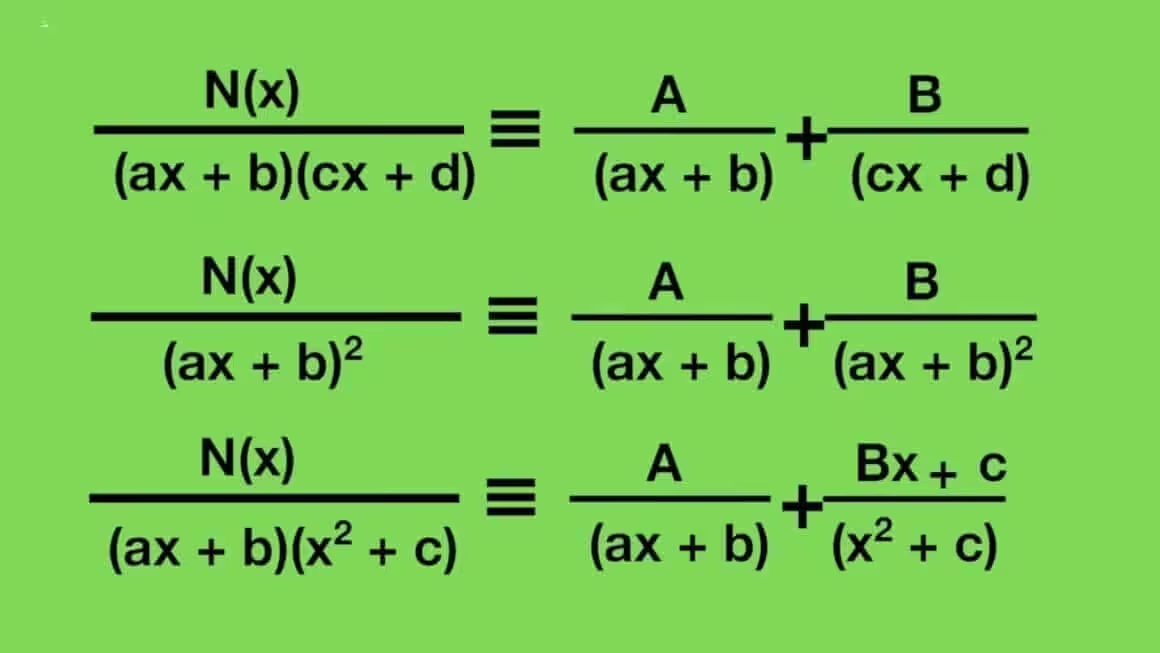
Let \( R (x) = \dfrac { P (x)} { Q (x)} \) be a rational function, where \( P (x) \) and \( Q (x) \) are expressible as polynomial functions.
Let \( Q (x) \) be expressible as:\( Q (x) = \displaystyle \prod_{k = 1}^n {q_k} (x) \) where the \( {q_k} (x) \) are themselves polynomial functions of degree at least \( 1 \).
Let \( R (x) \) be expressible as:\( R (x) = r (x) \displaystyle \sum_{k = 0}^n \dfrac { {p_k} (x)} { {q_k} (x)} \) where:
\( r (x) \) is a polynomial function which may or may not be the null polynomial, or be of degree 0 (that is, a constant) each of the \( {p_k} (x) \) are polynomial functions the degree of \( {p_k} (x) \) is strictly less than the degree of \( {q_k} (x) \) for all \( k \).
Then \( r (x) \displaystyle \sum_{k = 0}^n \dfrac { {p_k} (x)} { {q_k} (x)} \) is a partial fractions expansion of \( R (x) \).
In simple words, Partial fraction decomposition is defined as the process of expressing an algebraic fraction as the sum of two or more algebraic fractions.
The partial fraction decomposition or partial fraction expansion of a rational function is an operation that consists of expressing the fraction as a sum of a polynomial and one or several fractions with a simpler denominator.
So, the partial fraction decomposition process offers simpler fractions for complex ones.
For this, we need first to decompose the denominator of the fraction.
After this, you have to write the fractions with one of the factors for each denominator. As the numerators are unknown, we have to assign variables (any capital letters) for these unknown values. The result is an expression that can be more easily integrated and nondifferentiated.
Methods in Partial Fraction Decomposition
These partial fractions can be solved using various methods, such as Lagrange interpolation and residues. The Lagrange interpolation formula is a method to find a polynomial that takes on certain values at arbitrary points.
Explore these books on Alegbra to learn more about these.
But the smart and newer method to solve these is by using partial fraction calculators.
Partial Fraction Decomposition Calculator
A partial fraction calculator is an online tool that makes calculations very simple and exciting. This calculator can decompose any given rational fraction and can generate equivalent sums of fractions whose denominators cannot be reduced. It can, too, determine asymptotes and evaluate integrals.
How does it work?
This calculator works based on some steps for finding the partial fraction decomposition.
1. Enter Your Rational Function
- Use the variable x (lowercase).
- Powers are written with
^, e.g.x^3. - Always wrap numerators/denominators in parentheses if they contain more than one term, e.g.
(x^2 + 1)/(x^3 - x)
2. Click “Decompose”
Hit the Decompose button. The tool will:
- Factor the denominator.
- Split your fraction into simple terms.
- Convert the result to LaTeX and render it with KaTeX.
3. Read or Note the Result
You’ll see the final decomposition displayed as math.
Use only polynomials in the numerator and denominator (no trigonometry, exponentials, etc.).
Syntax matters: mismatched parentheses or unsupported characters will trigger an error.
By looking into these steps you might have figured out how quick this process is.
However, do not ignore the fact that this calculator has a lot to do with it.
Usage of a partial fraction calculator
- The easy-to-use interface and built-in calculation with detailed explanations make our work effortless.
- In integration and differentiation.
- Saves a lot of time.
Partial fraction decomposition rewrites one rational expression as a sum of simpler fractions. The value stays the same, but integration, inverse Laplace transforms, and algebraic simplification become much easier.
How to use this calculator
Make sure the rational expression is proper: the numerator degree must be lower than the denominator degree. If it is not, perform polynomial long division first.
Factor the denominator over the number system required by the problem. Use one constant numerator for each linear factor and a linear numerator for each irreducible quadratic factor. Repeated factors need a term for every power.
- Divide first if the fraction is improper.
- Factor the denominator completely.
- Write the full decomposition template, including repeated powers.
- Clear denominators, match coefficients or substitute convenient roots, then verify by recombining.
Worked example
Decompose \((5x+1)/[(x-1)(x+2)]\). Write \(A/(x-1)+B/(x+2)\). Clearing denominators gives \(5x+1=A(x+2)+B(x-1)\).
Set \(x=1\) to get \(6=3A\), so \(A=2\). Set \(x=-2\) to get \(-9=-3B\), so \(B=3\). The result is \(2/(x-1)+3/(x+2)\).
How to read the result
The decomposition is valid away from the original denominator zeros. Rewriting the expression does not remove those domain exclusions.
For a repeated factor such as \((x-1)^3\), include \(A/(x-1)+B/(x-1)^2+C/(x-1)^3\). Omitting intermediate powers makes the coefficient system incomplete.
Common mistakes to avoid
- Skipping long division for an improper rational expression.
- Forgetting repeated-factor terms.
- Using a constant numerator over an irreducible quadratic instead of \(Ax+B\).
- Canceling a factor and forgetting the original excluded value.
How to verify the result
Recombine the returned fractions over a common denominator. After expanding and collecting terms, the numerator must match the original numerator exactly. Also retain every value excluded by the original denominator.
Before decomposing, confirm that the rational expression is proper and the denominator is fully factored over the required number system. Repeated linear factors need a term for every power; irreducible quadratic factors need linear numerators.
Exact coefficients are more useful than early decimals because the decomposition is usually an intermediate algebra step. If numerical coefficients are unavoidable, test the original and decomposed expressions at several allowed x-values.
Limits of the calculation
Factoring high-degree denominators can be the hardest step. Numerical roots may produce unstable or unreadable decimal decompositions.
Complex partial fractions may be useful in advanced analysis, but real-variable calculus often keeps irreducible quadratic factors together to preserve real coefficients.
Related calculators
Use Definite Integral Solver, Polynomial Factoring Calculator, Inverse Function Calculator when the next part of the problem needs a different method.
Useful calculus books and tools
For partial fractions, factor the denominator completely and verify the decomposition by recombining the terms. Calculus answers are easier to trust when you can connect the symbolic work to a graph, an estimate, and the theorem behind the method.
- Practice beyond one example: Browse calculus textbooks and workbooks on Amazon. Look for worked problems, review exercises, and clear treatment of limits and applications.
- Sketch before calculating: Browse graph-paper notebooks on Amazon. A quick graph often reveals sign errors, incorrect bounds, and unreasonable answers.
As an Amazon Associate, I earn from qualifying purchases.
FAQ
What is a Partial Fraction Decomposition?
Partial fraction decomposition is defined as the process of breaking an algebraic fraction (generally a complex one) as the sum of two or more algebraic fractions.
How does the Calculator work?
Just enter the values needed and press calculate.