P-Series: Definition and P-Series Test Calculator
The p-series is one of the first convergence tests you learn in calculus, and for good reason — it is the benchmark against which dozens of other series are compared. This p-series test calculator tells you instantly whether your series converges or diverges, with a visual graph that shows exactly what is happening to the partial sums.
Here is the rule that drives everything: the p-series \( \sum \frac{1}{n^p} \) converges when \( p > 1 \) and diverges when \( p \leq 1 \). Simple to state, surprisingly deep in its consequences. Let me walk you through the theory, the edge cases, and how this p-series calculator can save you time on homework and exams.
What is a P-Series? Definition and Form
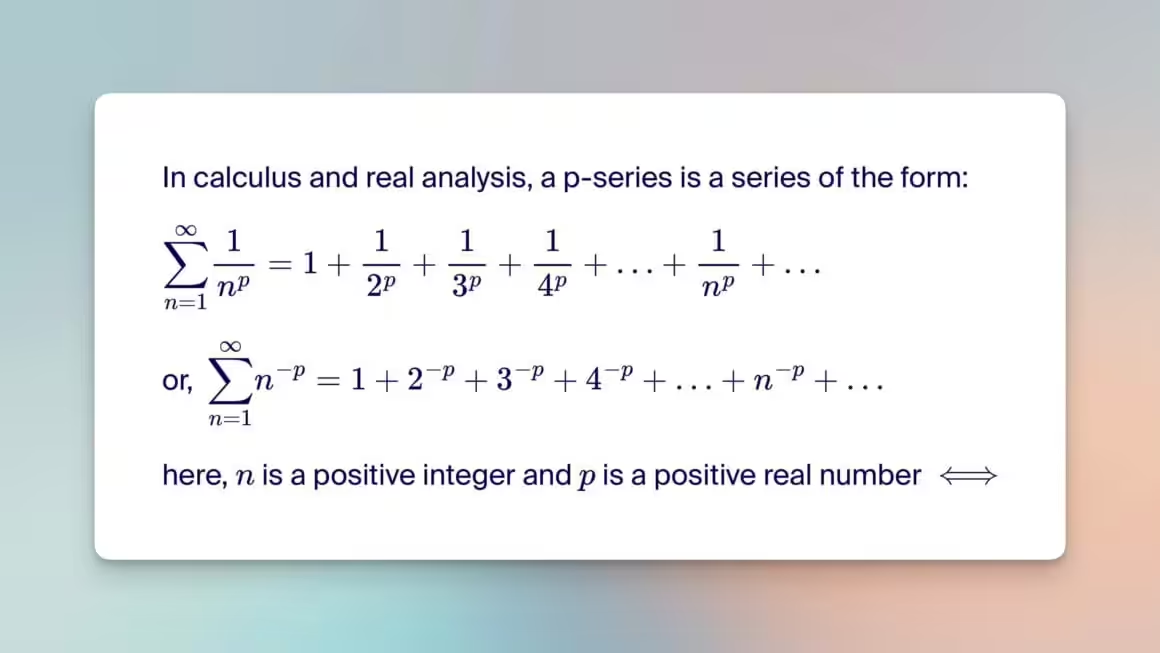
In calculus and real analysis, a p-series is a series of the form:
$$\sum_{n=1}^{\infty} \frac{1}{n^p} = 1 + \frac{1}{2^p} + \frac{1}{3^p} + \frac{1}{4^p} + \cdots$$
or equivalently:
$$\sum_{n=1}^{\infty} n^{-p} = 1 + 2^{-p} + 3^{-p} + 4^{-p} + \cdots$$
Here, \( n \) is a positive integer and \( p \) is a real number. The value of \( p \) completely determines whether the series converges or diverges — nothing else matters.
The p-series is closely related to the Riemann zeta function, defined by Bernhard Riemann as:
$$\zeta(p) = \sum_{n=1}^{\infty} \frac{1}{n^p}$$
When \( p > 1 \), the zeta function returns the exact sum of the p-series. This function is one of the most important objects in all of mathematics, connecting number theory, complex analysis, and the distribution of prime numbers.
The P-Series Test of Convergence
The p-series convergence test is straightforward:
| Condition | Result | Example |
|---|---|---|
| \( p > 1 \) | Converges | \( \sum \frac{1}{n^2} \) converges to \( \frac{\pi^2}{6} \) |
| \( p = 1 \) | Diverges (harmonic series) | \( \sum \frac{1}{n} = 1 + \frac{1}{2} + \frac{1}{3} + \cdots = \infty \) |
| \( p < 1 \) | Diverges | \( \sum \frac{1}{\sqrt{n}} \) diverges |
| \( p \leq 0 \) | Diverges (terms do not approach 0) | \( \sum 1 \) obviously diverges |
Why Does the P-Series Test Work? The Integral Test Proof
The most elegant proof uses the integral test. Consider the function \( f(x) = \frac{1}{x^p} \) for \( x \geq 1 \). This function is positive, continuous, and decreasing when \( p > 0 \).
The integral test says that \( \sum \frac{1}{n^p} \) converges if and only if \( \int_1^{\infty} \frac{1}{x^p} \, dx \) converges.
Evaluating the integral:
$$\int_1^{\infty} x^{-p} \, dx = \begin{cases} \frac{1}{p-1} & \text{if } p > 1 \\ \infty & \text{if } p \leq 1 \end{cases}$$
When \( p > 1 \), the antiderivative \( \frac{x^{1-p}}{1-p} \) approaches zero as \( x \to \infty \), giving a finite result. When \( p = 1 \), the integral becomes \( \ln(x) \), which diverges. When \( p < 1 \), the power function grows without bound.
This proof is important not just for the p-series itself, but because the integral test is one of the most widely applicable convergence tests in calculus.
The Harmonic Series: The Most Famous Divergent Series
The case \( p = 1 \) deserves special attention. The harmonic series:
$$\sum_{n=1}^{\infty} \frac{1}{n} = 1 + \frac{1}{2} + \frac{1}{3} + \frac{1}{4} + \cdots$$
diverges, even though its terms approach zero. This surprises many students — the terms get smaller and smaller, yet the sum is infinite.
How slowly does it diverge? The partial sums grow logarithmically. After \( N \) terms:
$$\sum_{n=1}^{N} \frac{1}{n} \approx \ln(N) + \gamma$$
where \( \gamma \approx 0.5772 \) is the Euler-Mascheroni constant, discovered by Euler in 1734. To reach a partial sum of just 10, you need about 12,367 terms. To reach 100, you need roughly \( e^{100} \approx 2.7 \times 10^{43} \) terms.
The harmonic series is the boundary between convergence and divergence for p-series. Any exponent even slightly above 1 makes the series converge; any exponent at or below 1 makes it diverge.
P-Series Calculator and Grapher
Use the calculator below to test any p-series for convergence. Enter your value of \( p \) and see the partial sums graphed in real time.
Please note that the calculator uses the \( \sum n^{-p} \) form, which is the same as the \( \frac{1}{n^p} \) form you may have been seeing in your textbooks.
Click on the button above to launch the p-Series Test Calculator and Grapher. If the button doesn't appear then you are using an incompatible browser or your browser doesn't have proper Javascript support. Try opening this page in Google Chrome or any other modern browser. This works on mobile devices too.
Worked Examples: P-Series Convergence in Practice
Example 1: \( \sum \frac{1}{n^2} \) (The Basel Problem)
This is the p-series with \( p = 2 \). Since \( 2 > 1 \), it converges.
But what does it converge to? This question, known as the Basel problem, was posed by Pietro Mengoli in 1650 and remained unsolved for nearly a century. In 1735, Euler stunned the mathematical world by proving:
$$\sum_{n=1}^{\infty} \frac{1}{n^2} = \frac{\pi^2}{6} \approx 1.6449$$
This result connected an innocent-looking series of fractions to the transcendental number \( \pi \), and it launched Euler's legendary career.
Example 2: \( \sum \frac{1}{n^{3/2}} \)
Here \( p = 3/2 = 1.5 \). Since \( 1.5 > 1 \), this series converges. Its exact sum is \( \zeta(3/2) \approx 2.612 \). Unlike the Basel problem, there is no known closed-form expression for this value.
Example 3: \( \sum \frac{1}{\sqrt{n}} \)
This is the p-series with \( p = 1/2 \). Since \( 1/2 < 1 \), it diverges. Even though \( \frac{1}{\sqrt{n}} \to 0 \), the terms decrease too slowly for the sum to be finite.
Example 4: \( \sum \frac{1}{n^{1.001}} \)
Here \( p = 1.001 \), which is just barely above 1. This series converges, but extremely slowly. The sum is approximately \( \zeta(1.001) \approx 1000.6 \). This example shows how the boundary at \( p = 1 \) is razor-sharp.
P-Series vs. Geometric Series: Key Differences
Students often confuse p-series with geometric series. Here is a clear comparison:
| Feature | P-Series | Geometric Series |
|---|---|---|
| Form | \( \sum \frac{1}{n^p} \) | \( \sum ar^n \) |
| What changes | The base \( n \) changes | The exponent \( n \) changes |
| Convergence condition | \( p > 1 \) | \( |r| < 1 \) |
| Closed-form sum | Only for special \( p \) values | Always: \( \frac{a}{1-r} \) |
| Rate of convergence | Polynomial decay | Exponential decay |
The geometric series converges much faster because its terms decay exponentially, while p-series terms decay only polynomially. This is why geometric series always have a neat closed-form sum, while p-series sums involve the Riemann zeta function.
Using the P-Series Test with Other Convergence Tests
The p-series test becomes even more powerful when combined with the comparison test. Here is the strategy:
Direct Comparison
If \( 0 \leq a_n \leq \frac{1}{n^p} \) for all \( n \) and \( p > 1 \), then \( \sum a_n \) converges.
If \( a_n \geq \frac{1}{n^p} \) for all \( n \) and \( p \leq 1 \), then \( \sum a_n \) diverges.
Example: Does \( \sum \frac{1}{n^2 + 5} \) converge?
Since \( \frac{1}{n^2 + 5} < \frac{1}{n^2} \) and \( \sum \frac{1}{n^2} \) converges (p-series with \( p = 2 \)), the original series converges by comparison.
Limit Comparison
If \( \lim_{n \to \infty} \frac{a_n}{1/n^p} = L \) where \( 0 < L < \infty \), then \( \sum a_n \) and \( \sum \frac{1}{n^p} \) either both converge or both diverge.
Example: Does \( \sum \frac{3n + 1}{n^3 - 2n} \) converge?
For large \( n \), this behaves like \( \frac{3n}{n^3} = \frac{3}{n^2} \). The limit comparison with \( \sum \frac{1}{n^2} \) gives \( L = 3 \), which is finite and positive. Since \( \sum \frac{1}{n^2} \) converges, so does our series.
For finding the radius and interval of convergence of power series — where p-series often appear during endpoint testing — use the interval of convergence calculator. For more advanced series analysis, these math solvers handle symbolic computation.
The Riemann Zeta Function: Where P-Series Leads
When the p-series converges (\( p > 1 \)), its sum defines the Riemann zeta function \( \zeta(p) \). Some remarkable values:
| \( p \) | \( \zeta(p) \) | Notes |
|---|---|---|
| 2 | \( \frac{\pi^2}{6} \approx 1.6449 \) | Basel problem (Euler, 1735) |
| 3 | \( \approx 1.2021 \) | Apery's constant, proven irrational in 1978 |
| 4 | \( \frac{\pi^4}{90} \approx 1.0823 \) | Euler computed this too |
| 6 | \( \frac{\pi^6}{945} \approx 1.0173 \) | All even values involve \( \pi \) |
Euler proved that \( \zeta(2k) \) has a closed form involving \( \pi^{2k} \) and Bernoulli numbers for every positive integer \( k \). The odd values \( \zeta(3), \zeta(5), \zeta(7), \ldots \) remain mysterious — we know \( \zeta(3) \) is irrational (proven by Roger Apery in 1978), but we still do not have closed-form expressions for any of them.
Key Points to Remember
- The boundary is at \( p = 1 \). Converges for \( p > 1 \), diverges for \( p \leq 1 \). No exceptions.
- The harmonic series (\( p = 1 \)) diverges. This is the most common exam mistake — students assume that terms going to zero is sufficient for convergence. It is necessary but not sufficient.
- P-series are comparison benchmarks. Most convergence problems involve comparing your series to a known p-series.
- The integral test proves it. If you need to justify the p-series test on an exam, use the integral \( \int_1^{\infty} x^{-p} \, dx \).
- Riemann zeta function is the sum. When the series converges, \( \zeta(p) = \sum 1/n^p \) gives the exact value.
Frequently Asked Questions
What is the p-series test and how does it work?
The p-series test determines whether the series sum of 1/n^p converges or diverges based solely on the exponent p. If p is greater than 1, the series converges to a finite value given by the Riemann zeta function. If p is less than or equal to 1, the series diverges to infinity. The proof relies on the integral test applied to f(x) = x^(-p).
Why does the harmonic series diverge even though its terms approach zero?
The terms 1/n approach zero, but they decrease too slowly for the partial sums to remain bounded. You can prove divergence by grouping terms: 1/3 + 1/4 > 1/2, and 1/5 + 1/6 + 1/7 + 1/8 > 1/2, and so on. Each group exceeds 1/2, so the sum grows without bound. Terms approaching zero is necessary but not sufficient for convergence.
How is the p-series related to the Riemann zeta function?
The Riemann zeta function is defined as zeta(s) = sum of 1/n^s for s > 1, which is exactly the p-series sum. Euler computed zeta(2) = pi^2/6 and found closed forms for all even integer arguments. The zeta function extends to complex numbers via analytic continuation and is central to the unsolved Riemann Hypothesis about the distribution of prime numbers.
What is the difference between a p-series and a geometric series?
A p-series sum of 1/n^p has a variable base raised to a fixed power, while a geometric series sum of r^n has a fixed base raised to a variable power. Geometric series decay exponentially and always have closed-form sums, while p-series decay polynomially and their sums involve the zeta function. The convergence criteria differ: p > 1 for p-series versus |r| < 1 for geometric.
Can I use the p-series test on series that are not exactly in the form 1/n^p?
Not directly, but you can use the comparison test or limit comparison test to relate your series to a known p-series. If your series behaves like 1/n^p for large n, the limit comparison test confirms they share the same convergence behavior. This strategy works for series like sum of 1/(n^2+3n), which behaves like 1/n^2 and therefore converges.