
Business Lead Generation: What Must Every Business Know in 2026
I tracked lead sources across 47 client projects last year. The results surprised me: businesses relying on a single lead generation channel saw 34% lower conversion rates than those using three or more channels. And the ones still running the same playbook from 2022? Their cost per lead had jumped by 60% or more.
The problem isn’t that lead generation is broken. It’s that most businesses haven’t updated their approach to match how buyers actually find and evaluate vendors in 2026. Buyers are doing 70% of their research before ever talking to sales. AI tools have made it possible to identify, enrich, and score leads at a fraction of the cost. Yet most companies are still stuffing forms into pop-ups and hoping for the best.
I’ve generated leads for my own businesses and for clients across SaaS, e-commerce, professional services, and local businesses since 2010. This guide covers everything I’ve learned about what works now, what’s changed, and the specific tools and frameworks that consistently deliver results.
Understanding Your Target Audience
Every failed lead generation campaign I’ve audited shares one root cause: the business didn’t understand who they were trying to reach. Not in a “we target small businesses” way. I mean they couldn’t describe their ideal buyer’s Tuesday morning routine, what podcasts they listen to, or what keeps them up at 2 AM.
Buyer personas aren’t just marketing exercises. They’re the foundation of every decision you’ll make about channels, messaging, and budget. A well-built persona includes demographics (job title, company size, revenue), psychographics (fears, goals, buying triggers), and behavioral data (where they spend time online, how they research solutions, who influences their decisions).
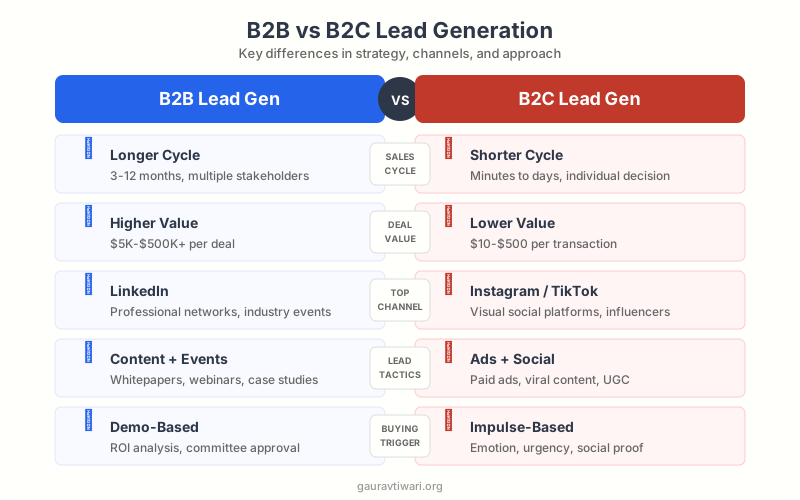
Here’s what I’ve seen work best: start with your existing customers. Pull data from your CRM, interview your top 10 clients, and look for patterns. When I did this for a B2B SaaS client, we discovered that 68% of their best customers came from companies with 50-200 employees, and the decision maker was almost always a VP of Operations, not the CEO we’d been targeting.
Intent data platforms like Bombora and G2 Buyer Intent reveal which companies are actively researching solutions like yours. Instead of spraying cold emails at everyone, you can focus on prospects who are already in buying mode. I’ve seen this reduce sales cycles by 40% for B2B clients.
The biggest mistake? Assuming your B2C and B2B audiences behave the same way. A CIO at a Fortune 500 company isn’t going to click your Facebook ad. They’re reading industry reports on Gartner, attending invite-only roundtables, and getting recommendations from peers on LinkedIn. Meanwhile, a local restaurant owner might discover you through a Google search or an Instagram reel. Match the channel to the buyer, not the other way around.
For a deeper look at tools that help identify and reach B2B buyers, check out my guide on 7 B2B lead finder platforms.
Inbound vs Outbound Lead Generation
Inbound lead generation attracts prospects who come to you. Outbound lead generation puts you in front of prospects who haven’t heard of you yet. Both work. The right mix depends on your budget, timeline, and how your buyers actually shop.
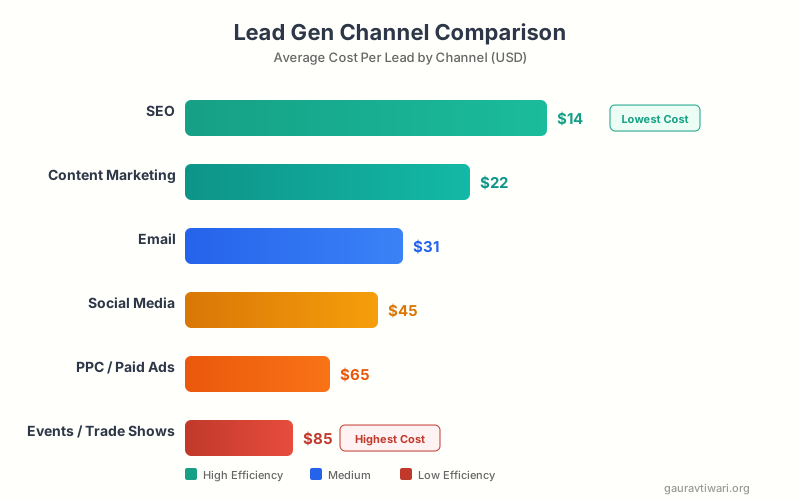
Inbound strategies include SEO, content marketing, social media, podcasts, webinars, and organic community building. The cost structure is front-loaded: you invest time and money creating content, and that content keeps generating leads for months or years. One blog post I wrote for a client in 2021 still brings in 40+ leads per month. That’s the compounding power of owned media.
Outbound strategies include cold email, cold calling, LinkedIn outreach, paid ads (Google Ads, Meta Ads, LinkedIn Ads), direct mail, and trade shows. You pay for every touchpoint, and leads stop the moment you stop spending. But outbound gives you speed and control. If you need leads this week, not this quarter, outbound is the answer.
From running campaigns for clients since 2010, here’s my honest breakdown:
| Factor | Inbound | Outbound |
|---|---|---|
| Time to first lead | 2-6 months | 1-2 weeks |
| Cost per lead (mature) | $5-$50 | $25-$200 |
| Lead quality | Higher (self-qualified) | Variable (depends on targeting) |
| Scalability | Compounds over time | Linear with spend |
| Best for | Long-term growth, authority | Quick wins, new markets |
Most successful businesses I work with run a 60/40 split favoring inbound for long-term growth, with outbound filling gaps and testing new markets. If you’re just starting out and need revenue fast, flip that ratio temporarily.
For building landing pages that convert inbound traffic, I recommend checking out these 14 landing page builders I’ve tested.

Creating Irresistible Lead Magnets
A lead magnet is a free resource you offer in exchange for contact information, usually an email address. The concept is simple. The execution is where most businesses fail.
I’ve tested over 50 different lead magnets across client campaigns. The ones that convert at 15%+ all share three traits: they solve one specific problem, they deliver value in under 5 minutes, and they’re directly related to the paid product or service.
Here’s what’s working in 2026, ranked by conversion rate from my experience:
- Interactive tools and calculators (ROI calculators, graders, assessments): 20-30% conversion rate. They require more upfront development but outperform everything else.
- Templates and swipe files (email templates, spreadsheets, Notion templates): 15-25% conversion rate. People love ready-to-use resources they can implement immediately.
- Checklists and cheat sheets (one-page references, step-by-step checklists): 12-20% conversion rate. Quick wins that promise instant value.
- Video training and mini-courses (3-5 short videos on a specific topic): 10-18% conversion rate. Higher perceived value, but requires more commitment from the prospect.
- eBooks and guides (comprehensive PDFs on a topic): 5-12% conversion rate. These used to be the gold standard, but fatigue has set in. Everyone has an eBook now.
Don’t create a lead magnet about a topic unrelated to your core offering. I once helped a web design agency that had a “Social Media Calendar Template” as their lead magnet. It converted well, but the leads never became clients because they wanted social media help, not web design. Match your magnet to your sales funnel.
Tools for Creating Lead Magnets
For design, Canva handles most lead magnet formats (eBooks, checklists, infographics). For interactive tools, Outgrow and Typeform let you build calculators and quizzes without coding. For delivery and email capture, I use ConvertKit because its landing page builder and automation sequences are built specifically for creators and small businesses. You can have a lead magnet funnel live in under an hour.
If you’re running WordPress for lead generation, plugins like OptinMonster and WPForms make the integration straightforward.
Lead Nurturing: Moving Leads Through the Funnel
Generating a lead is only the beginning. According to data from MarketingSherpa, 79% of marketing leads never convert to sales due to lack of nurturing. I’ve seen this play out dozens of times: a business collects 500 emails from a webinar, sends one follow-up, and then wonders why nobody bought.
Lead nurturing is the process of building relationships with prospects at every stage of the funnel. It means sending the right message, at the right time, through the right channel. Not blasting your entire list with the same “Buy Now” email.
Here’s the nurturing framework I use with clients:
- Days 1-3 (Welcome sequence): Deliver the lead magnet, introduce yourself, set expectations. This is where you build trust.
- Days 4-14 (Value sequence): Send 3-4 emails with educational content related to their pain point. No selling. Share case studies, tips, and quick wins.
- Days 15-21 (Soft pitch): Share a customer success story, then introduce your solution as the logical next step.
- Days 22-30 (Direct offer): Make a clear offer with a deadline. Address objections head-on.
- Day 30+ (Long-term nurture): Weekly or biweekly value emails to stay top of mind. Not everyone buys on your timeline.
The tools matter here. ConvertKit is my top pick for creators and small businesses because of its visual automation builder and subscriber tagging. For larger teams managing complex pipelines, Close CRM combines email sequences, calling, and pipeline management in one tool. I’ve used both extensively, and they handle nurturing workflows without the bloat of enterprise platforms.
Avoid the common email marketing mistakes that kill nurturing sequences, like sending too frequently, ignoring segmentation, or writing subject lines that sound like spam.

Top Lead Generation Strategies
After running lead gen campaigns across dozens of industries, these are the strategies that consistently deliver. Not theoretical ideas from marketing textbooks, but approaches I’ve seen generate measurable pipeline.
Event Marketing
Hosting webinars, virtual summits, and workshops remains one of the highest-ROI lead generation tactics for B2B companies. I ran a webinar series for a SaaS client that generated 1,200 registrations per event with a 22% conversion to qualified pipeline. The key? Make the content genuinely useful, not a thinly veiled sales pitch. ON24 and Webinar Jam are solid platforms for hosting. Pair them with LinkedIn promotion for B2B audiences.
Referral Programs
Your existing customers are your best salespeople. Referral leads convert 30% better than leads from other channels because trust is already built in. The structure is simple: reward customers for bringing new clients. Dropbox grew from 100K to 4 million users in 15 months using a referral program. You don’t need that scale. Even offering a 10% discount or a free month of service can drive consistent referrals.
Account-Based Marketing (ABM)
ABM flips traditional lead gen on its head. Instead of casting a wide net, you identify specific target accounts and build personalized campaigns for each one. It’s resource-intensive but devastatingly effective for high-value B2B deals. I’ve seen ABM campaigns with 5x higher close rates compared to broad campaigns. Tools like Demandbase, 6sense, and even LinkedIn Campaign Manager’s account targeting make this accessible to mid-market teams.
Content Marketing and SEO
Publishing search-optimized content that answers your buyer’s questions is still the most sustainable lead generation strategy. But the bar has risen. Generic “What is X?” posts don’t cut it anymore. You need original research, first-person experience, and specific data. One comprehensive guide on a high-intent keyword can generate hundreds of leads per month for years. My own blog posts from 2019 still drive qualified leads because they rank for buyer-intent keywords.
Building a complete digital marketing strategy that connects content, SEO, and lead capture is what separates businesses that struggle from those that scale.
Partnerships and Co-Marketing
Partnering with complementary businesses lets you tap into an audience that already trusts someone else. Co-host a webinar, create a joint resource, or run a cross-promotion campaign. I partnered with an SEO tool company for a co-branded audit template that generated 800+ leads in two weeks, split between both companies. The trick is finding partners who share your audience but don’t compete with you.
LinkedIn Outreach
For B2B businesses, LinkedIn is the most underpriced lead generation channel in 2026. Not the spray-and-pray connection requests. I’m talking about thoughtful engagement: commenting on prospects’ posts, sharing relevant insights, then sending personalized messages that reference specific challenges. LinkedIn Sales Navigator makes this scalable by letting you build targeted lead lists, track prospect activity, and integrate with your CRM.
AI-Powered Lead Generation Tools
AI has fundamentally changed how businesses find, qualify, and engage leads. Tools that required a team of five SDRs two years ago can now be handled by one person with the right AI stack. I’ve tested most of the major platforms, and here’s what actually delivers results versus what’s just hype.
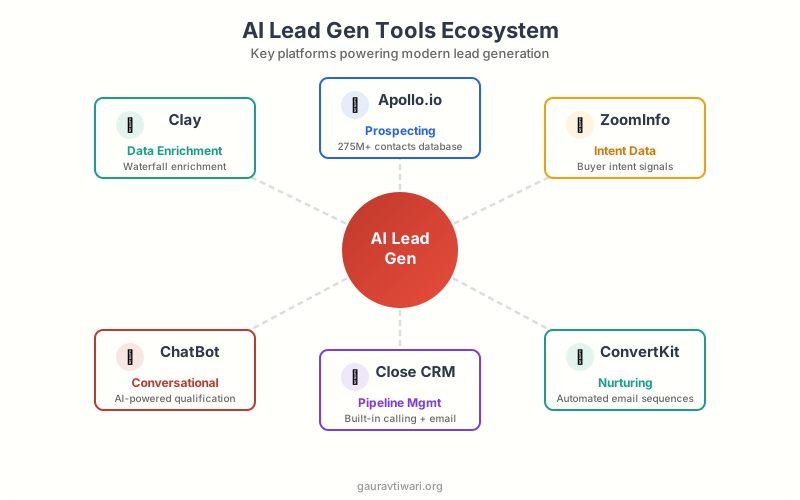
For most B2B businesses, the combination of Apollo.io (prospecting and outreach), Clay (data enrichment and workflows), and Close CRM (pipeline management) gives you 80% of what enterprise tools provide at 20% of the cost. Total cost: $250-$500/month for a solo operator or small team.
Clay
Clay is the tool that made me rethink how I approach lead enrichment. It pulls data from over 50 sources (LinkedIn, company websites, Clearbit, Hunter.io, and more) and lets you build automated enrichment workflows. Feed it a list of company URLs, and it returns decision maker names, emails, tech stack details, funding data, and more. I used Clay to enrich a list of 2,000 prospects in 3 hours, a task that would have taken a VA two weeks. Pricing starts at $149/month for 2,000 credits.
Apollo.io
Apollo.io combines a database of 275+ million contacts with built-in email sequencing, calling, and meeting scheduling. It’s the closest thing to an all-in-one prospecting platform for small and mid-market teams. The free tier gives you 10,000 email credits per month, which is generous enough to validate the platform before committing to paid plans ($49/month and up). I’ve found their email verification rates to be around 92%, which keeps bounce rates acceptable.
ZoomInfo
ZoomInfo is the enterprise standard for B2B contact data. Their database is massive and the intent data features are best-in-class. The catch? Pricing starts around $15,000/year, which puts it out of reach for most small businesses. If you’re running a team of 5+ SDRs and targeting mid-market or enterprise accounts, ZoomInfo’s data accuracy and depth justify the investment. For smaller teams, Apollo.io delivers 80% of the value at a fraction of the cost.
LinkedIn Sales Navigator
At $99/month, LinkedIn Sales Navigator is the most accessible premium lead generation tool. Advanced search filters (company size, industry, seniority, recent job changes, posted content) let you build laser-targeted prospect lists. The “Lead Alerts” feature notifies you when prospects change jobs, get promoted, or post content, which are all natural conversation starters. I connect it with my CRM through Zapier to auto-log interactions and keep my pipeline clean.
AI-Powered Email Tools
Tools like Instantly.ai, Smartlead, and Lemlist use AI to write personalized email sequences, manage inbox rotation across multiple sending accounts, and optimize send times. Instantly.ai in particular has impressed me: I ran a cold email campaign for a B2B client that achieved a 4.7% reply rate across 5,000 emails, all with AI-generated personalization that would have taken weeks to write manually.

Conversational Marketing and Chatbots
Chatbots aren’t just customer support tools anymore. In 2026, AI-powered chatbots qualify leads, book meetings, and guide prospects through your funnel 24/7 without human intervention.
I added a Drift chatbot to a client’s pricing page and it increased qualified demo bookings by 35% in the first month. The bot asked three qualifying questions (company size, budget range, timeline), then routed qualified prospects directly to the sales team’s calendar. Unqualified visitors got redirected to helpful resources instead of wasting a rep’s time.
The major players in this category are Drift (now part of Salesloft), Intercom, ChatBot, and HubSpot’s chatbot builder. For small businesses, ChatBot offers a solid entry point with pre-built templates and a visual flow builder. Intercom is better for SaaS companies that want tight product integration.
I’ve seen businesses deploy chatbots that feel like talking to a phone tree. If your bot can’t answer a question in three exchanges, route to a human. Prospects tolerate chatbots for quick questions and scheduling. They don’t tolerate them as a wall between themselves and real help.
The conversational marketing approach extends beyond chatbots. WhatsApp Business, Facebook Messenger, and even SMS-based lead capture are all growing channels. A local dental practice I advised switched from form-based appointment booking to WhatsApp-based booking and saw a 52% increase in new patient inquiries. People prefer messaging over filling out forms.
Lead Scoring and Qualification Frameworks
Not all leads are equal. Lead scoring assigns numerical values to leads based on their behavior, demographics, and engagement level, so your sales team focuses on the prospects most likely to buy instead of wasting time on tire-kickers.
Here’s the scoring model I use for B2B clients:
Demographic scoring (who they are):
- Matches ideal customer profile (job title, company size, industry): +20 points
- Located in target geography: +10 points
- Company revenue in target range: +15 points
Behavioral scoring (what they do):
- Visited pricing page: +25 points
- Downloaded lead magnet: +15 points
- Attended webinar: +20 points
- Opened 3+ emails: +10 points
- Requested demo/consultation: +30 points
Negative scoring (red flags):
- Free email domain (Gmail, Yahoo): -10 points
- Unsubscribed from emails: -20 points
- No engagement in 30+ days: -15 points
Leads scoring 50+ points are “marketing qualified leads” (MQLs) ready for sales outreach. Leads above 75 are “sales qualified leads” (SQLs) that should get immediate attention.
The qualification framework I recommend is BANT (Budget, Authority, Need, Timeline) for straightforward B2B sales, and MEDDIC (Metrics, Economic Buyer, Decision Criteria, Decision Process, Identify Pain, Champion) for complex enterprise deals. Both give your sales team a consistent way to evaluate whether a lead is worth pursuing.
CRM tools like Close CRM and Monday CRM have built-in lead scoring features. Close is my preference for small sales teams because the scoring integrates directly with their calling and email tools, so reps can prioritize without switching between platforms.
Common Lead Generation Mistakes to Avoid
I’ve made most of these mistakes myself, and I’ve watched clients make them too. Here are the ones that cost the most money and time.
1. Targeting everyone. When you try to appeal to every possible buyer, you appeal to none of them. I had a client spending $8,000/month on Google Ads targeting “business software.” Their cost per lead was $340. We narrowed to “project management software for construction teams” and dropped the CPL to $45. Specificity wins.
2. Ignoring follow-up speed. Harvard Business Review found that companies responding to leads within 5 minutes are 21x more likely to qualify them. I’ve audited companies where the average response time was 47 hours. By then, the prospect has already talked to three competitors. Set up automated immediate responses and aim for human follow-up within 30 minutes during business hours.
3. Overcomplicating lead forms. Every additional form field reduces conversions by roughly 11%. For top-of-funnel offers, ask for name and email only. Save the qualifying questions for after they’ve engaged with your content. I’ve seen clients go from 3% to 11% conversion rates just by cutting their form from 8 fields to 2.
4. No lead segmentation. Sending the same email to your entire list is lazy and expensive. Segment by industry, company size, engagement level, or funnel stage. A segmented email campaign for one of my clients produced 42% higher open rates and 3x more click-throughs compared to their unsegmented blasts.
5. Measuring vanity metrics. Traffic and impressions feel good but don’t pay bills. Track cost per lead, cost per qualified lead, lead-to-customer conversion rate, and customer acquisition cost. If you can’t tie a metric to revenue, question whether it belongs on your dashboard.
Not having a system. Ad hoc lead generation, where you try something for two weeks and move on, will never produce consistent results. Build a repeatable system: define your ICP, choose 2-3 channels, set up tracking, and commit for at least 90 days before evaluating. The businesses that win at lead generation are the ones that treat it as a system, not a series of experiments.
6. Buying email lists. Purchased lists have bounce rates above 20%, deliverability rates that tank your sender reputation, and conversion rates near zero. Build your list organically through lead magnets, content upgrades, and events. It’s slower but infinitely more effective.
7. Neglecting mobile optimization. Over 60% of B2B search queries happen on mobile devices. If your landing pages, forms, and emails aren’t mobile-optimized, you’re losing more than half your potential leads before they even engage.
Measuring Lead Generation Success
You can’t improve what you don’t measure. But measuring everything creates noise. Here are the metrics that actually matter for lead generation, prioritized by impact on revenue.
Primary metrics (check weekly):
- Cost per lead (CPL): Total spend divided by number of leads. Benchmark varies by industry: SaaS averages $50-$200, e-commerce $10-$30, professional services $30-$100.
- Lead-to-customer conversion rate: Percentage of leads that become paying customers. Healthy B2B benchmarks are 2-5% for cold leads, 10-20% for warm leads.
- Customer acquisition cost (CAC): Total marketing and sales spend divided by new customers acquired. Your CAC should be less than 1/3 of customer lifetime value (LTV).
- Marketing qualified leads (MQLs): Leads that meet your scoring threshold and are ready for sales engagement.
Secondary metrics (check monthly):
- Landing page conversion rate: Percentage of visitors who submit a form. Target 10-25% for dedicated landing pages.
- Email open and click rates: Benchmarks are 20-30% open rate and 2-5% click rate for nurture sequences.
- Pipeline velocity: How fast leads move through your funnel from first touch to closed deal.
- Channel attribution: Which channels produce the most and best leads. Use UTM parameters and multi-touch attribution if your budget allows.
I track all of this in a simple dashboard using Monday.com combined with Google Analytics 4 and my CRM data. Monday’s dashboard widgets let me pull in data from multiple sources and spot trends without drowning in spreadsheets. For teams that need more sophisticated attribution, tools like HockeyStack and Dreamdata connect marketing touches to actual revenue.
The single most important habit: review your lead generation metrics every Monday morning. Look at last week’s numbers, identify what worked and what didn’t, and make one adjustment. Small, consistent optimizations compound into massive improvements over 6-12 months.
Frequently Asked Questions
What is business lead generation and why does it matter?
Business lead generation is the process of attracting and converting strangers into people who have expressed interest in your product or service. It matters because without a steady flow of new leads, your sales pipeline dries up and revenue stalls. Companies with mature lead generation systems grow 133% more revenue compared to those without one, according to Forrester Research.
How much should a business spend on lead generation?
Most B2B companies allocate 5-10% of revenue toward lead generation. For startups and growth-stage companies, that number can be 15-20%. The key metric isn’t total spend but customer acquisition cost (CAC) relative to customer lifetime value (LTV). If your LTV is $10,000, spending $2,000-$3,000 to acquire a customer is healthy. Start small, measure results, and scale what works.
What are the best AI tools for lead generation in 2026?
For B2B prospecting, Apollo.io (275+ million contacts, free tier available) and Clay (multi-source data enrichment) are the best value options. LinkedIn Sales Navigator ($99/month) is essential for relationship-based selling. ZoomInfo is the enterprise standard but starts at $15,000/year. For email outreach, Instantly.ai and Lemlist use AI to personalize sequences at scale. For CRM and pipeline management, Close CRM combines calling, email, and scoring in one platform.
How long does it take to see results from lead generation?
Outbound strategies (cold email, paid ads) can produce leads within 1-2 weeks. Inbound strategies (SEO, content marketing) typically take 3-6 months to gain traction. A balanced approach produces quick wins from outbound while building long-term, compounding results from inbound. I recommend committing to any lead generation channel for at least 90 days before evaluating its effectiveness.
What is the difference between MQLs and SQLs?
Marketing qualified leads (MQLs) have shown interest through actions like downloading content, attending webinars, or visiting your pricing page. Sales qualified leads (SQLs) have been vetted by the sales team and confirmed to have budget, authority, need, and timeline (BANT). MQLs are handed from marketing to sales. SQLs are actively being worked by sales reps. The MQL-to-SQL conversion rate is a critical metric, with healthy B2B benchmarks ranging from 13% to 25%.
Is cold email still effective for lead generation?
Yes, when done correctly. Cold email achieves 1-5% reply rates with good targeting and personalization. The keys are verified email addresses (to keep bounce rates under 3%), personalized first lines that reference something specific about the prospect, clear value propositions, and proper warm-up of sending domains. AI tools like Instantly.ai have made personalization at scale much more accessible. What kills cold email is generic templates and purchased lists.
How do I generate leads for a local business?
Local businesses should focus on Google Business Profile optimization (this alone can drive 50+ leads per month), local SEO targeting city-specific keywords, Google Local Services Ads (you only pay for actual leads), referral programs with existing customers, community partnerships, and review generation. Social media works for local businesses when focused on Instagram Reels and Facebook Groups rather than paid ads. WhatsApp Business for appointment booking is also growing fast in local markets.
Lead generation isn’t a one-time project. It’s an ongoing system that needs regular tuning, fresh ideas, and honest measurement. The businesses that grow consistently are the ones that commit to a process: define their ideal buyer, build multi-channel campaigns, nurture leads with genuine value, and track every dollar from first touch to closed deal.
Start with one channel. Master it. Then add another. If you’re looking for a starting point, get your CRM set up with Close CRM or Monday.com, pick one inbound and one outbound strategy, and commit for 90 days. That’s how you build a lead generation engine that compounds.
Disclaimer: This site is reader-supported. If you buy through some links, I may earn a small commission at no extra cost to you. I only recommend tools I trust and would use myself. Your support helps keep gauravtiwari.org free and focused on real-world advice. Thanks. - Gaurav Tiwari