
6 of the Best Driving Gadgets that You Need Today
Cars built before 2018 skip features that are standard on anything rolling off a lot today. No backup camera. No blind-spot monitor. No lane departure warning. No tire pressure alerts. The result: a 23% higher rate of low-speed collisions, according to a 2024 NHTSA analysis of vehicles without modern driver-assistance systems.
Buying a newer car to get those features costs $35,000 or more. That’s not a realistic option for most drivers. What is realistic: six aftermarket gadgets, each under $150, that close the gap between a 2012 commuter and a 2026 model with a full safety package.
None of these require a mechanic. Most install in under 30 minutes. And every one of them costs less than a single tow truck call or fender-bender repair estimate.
Best Driving Gadgets at a Glance
- VIOFO A129 Plus Duo — Dual-channel dashcam with backup view; best pick for pre-2018 vehicles missing a factory rear camera
- Bouncie GPS Tracker — OBD-II plug-in with real-time location and teen driver alerts for $8/month
- NOCO Boost Plus GB40 — 1000A lithium jump starter that fits in a glove box and doubles as a USB power bank
- wiiyii P6 HUD — OBD+GPS dual-system heads-up display that keeps speed data at eye level
- resqme Escape Tool — Sub-$13 seatbelt cutter and window breaker trusted by 15 million drivers and first responders
- Tymate TM7 TPMS — Four-sensor tire pressure monitor with real-time PSI and temperature alerts, installs in 10 minutes

Backup Camera Dashcams
Best for: Drivers with pre-2018 vehicles that lack a factory backup camera and want collision recording on top of rear visibility.
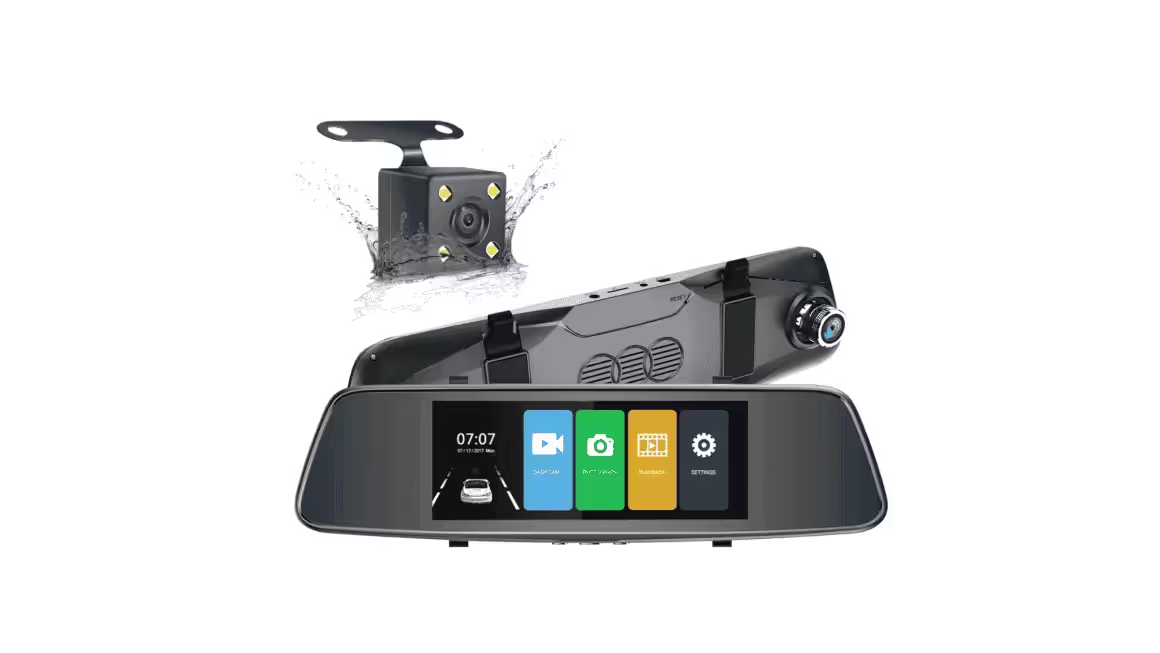
Federal law required all new cars sold after May 2018 to include backup cameras. If your vehicle predates that rule, you’re reversing on guesswork, and that’s exactly how low-speed parking lot accidents happen. The NHTSA estimated backup cameras reduce backover fatalities by up to 31% on vehicles where they replaced nothing.
The VIOFO A129 Plus Duo is the dual-channel model worth buying. It shoots 2K 1440P front footage and 1080P rear footage simultaneously, uses a super capacitor instead of a lithium battery (which means it won’t swell or fail in extreme heat), and stamps GPS coordinates on every clip. When you shift into reverse, the rear feed goes live on a dashboard display. Installation takes about 30 minutes: run the rear camera cable along the headliner, connect to the license plate light wire for power, and mount the front unit near the rearview mirror. No mechanic required.
The honest downside: you’ll need a microSD card (sold separately, budget $15-$20 for a 64GB U3 card), and the rear camera captures 1080P rather than the front’s 1440P. For reading license plates in a rear collision, 1080P is sufficient. Dual-channel units like this run $100-$130. Single-channel front-only cameras start at $50, but they won’t help you park. The dual-channel configuration is the one that earns its place in the car every single day.
A GPS Tracker
Best for: Parents of teen drivers, fleet owners, and anyone who wants theft recovery data without a dealer subscription.
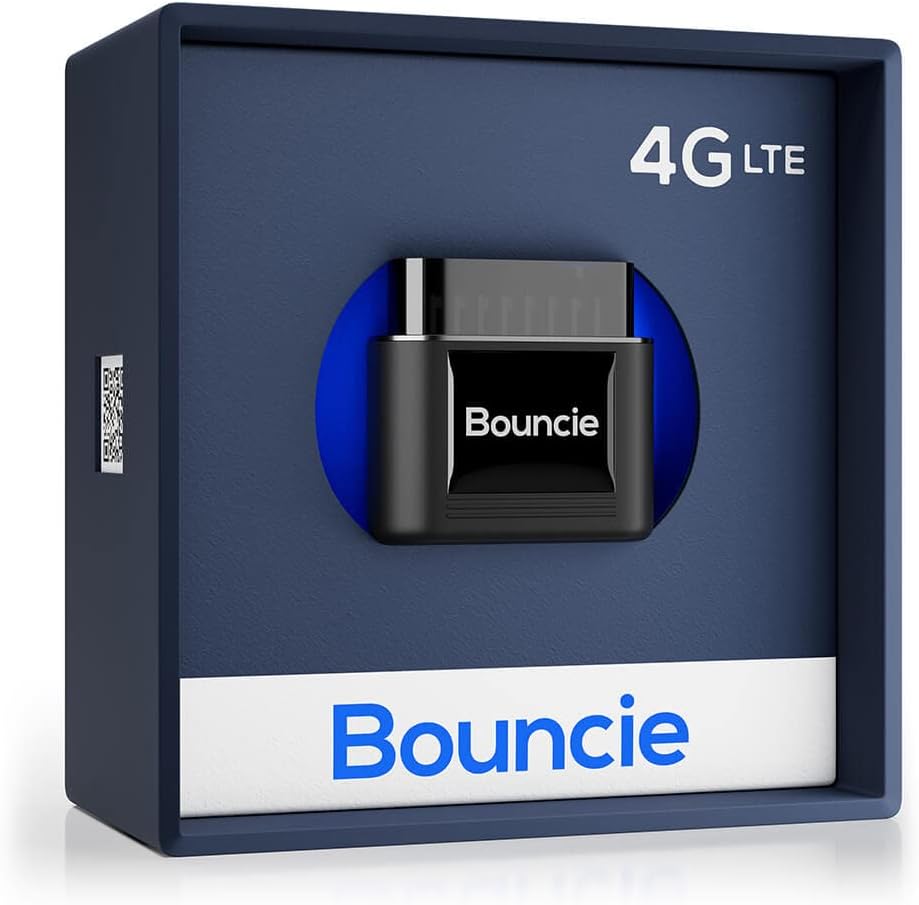
The Bouncie GPS tracker plugs into your OBD-II port, the diagnostic port found under the dashboard on virtually every car built after 1996. Setup takes about two minutes: plug it in, download the app, done. From that point, the app shows real-time location updated every 15 seconds, trip history, top speed, hard braking events, and vehicle health codes. The device costs $77 and the cellular subscription runs $8 per month with no annual contract.
Two situations where this pays off quickly. First: theft recovery. Vehicle theft in the US hit 1.02 million cases in 2023, a 29-year high according to the NICB. When a stolen car has a live GPS signal, law enforcement can intercept it within minutes rather than days. Second: teen drivers. Bouncie lets parents set geofence boundaries (get an alert if the car leaves a defined area), speed alerts (notification if the driver exceeds a set limit), and review trip-by-trip data. The simple awareness that the car is being tracked changes driving behavior, particularly among new drivers.
One practical note: the OBD-II port location makes the Bouncie visible to anyone who looks under the dash. If pure theft-deterrent stealth is the goal, the LandAirSea 54 ($35-$50 device plus $24.95/month) uses a magnetic weatherproof case that hides behind a bumper panel or under the chassis. It’s less feature-rich than Bouncie but effectively invisible. Choose based on use case: teen monitoring and trip data favor Bouncie; maximum concealment favors LandAirSea.
A Portable Car Battery Booster
Best for: Road trippers, cold-climate drivers, and anyone whose battery is three or more years old.
A dead battery on a rural highway at 11 PM is a genuinely bad situation: no nearby cars, possibly no cell signal, and AAA average response times that can stretch past 45 minutes even in suburban areas. A portable lithium jump starter removes that variable entirely.
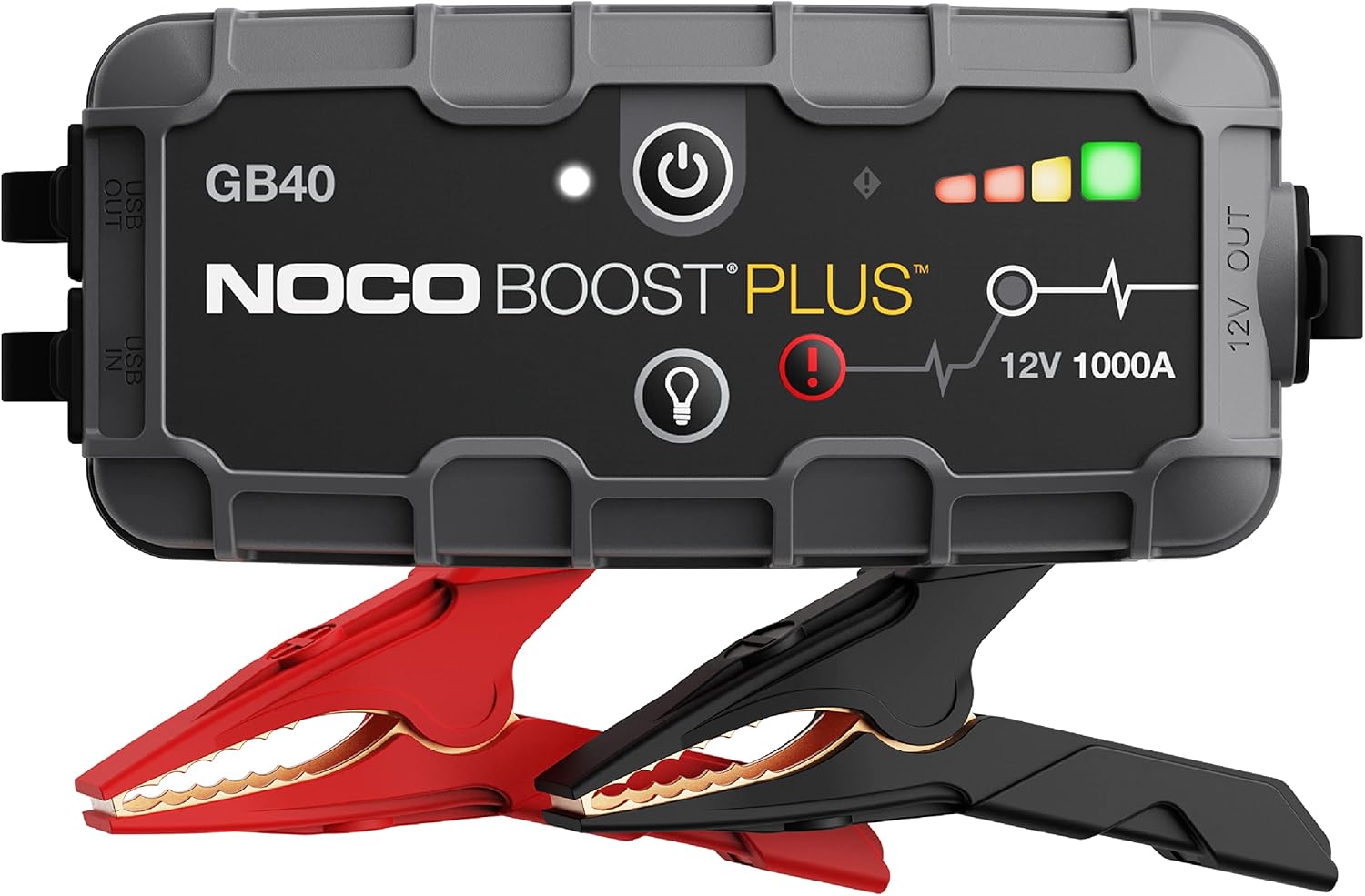
The NOCO Boost Plus GB40 delivers 1000 peak amps from a unit that weighs under 2 pounds and fits in a glove box. It handles engines up to 6.0L gas or 3.0L diesel and provides up to 20 jump-starts on a single charge. The spark-proof clamp system means connecting in the wrong order won’t damage the car’s electronics — it won’t engage at all until the clamps are correctly placed. The GB40 also functions as a USB power bank, so it charges phones on road trips while the car runs. At $99.95 on Amazon, it costs less than one roadside service call in most markets.
Keep it in the trunk, not the garage. Lithium-ion units hold a charge for several months without use, so leaving it in the car doesn’t require constant top-ups. Batteries degrade faster in both extreme heat (above 95°F) and cold (below 20°F), which makes this a year-round gadget, not just a winter precaution. If you have a diesel-powered truck with a larger engine than 3.0L, step up to the NOCO GB70 (2000A) or GB150 (4250A) — those cover 8.0L and 10.0L respectively.
A Heads-Up Display Speedometer
Best for: Frequent highway drivers and anyone who has received a speeding ticket in the past 12 months.
Standard dashboard speedometers sit low on the instrument cluster. Every glance down pulls your eyes off the road for 0.5 to 1.0 seconds. At 60 mph that’s 44 to 88 feet of driving blind. The Virginia Tech Transportation Institute found that taking your eyes off the road for more than two seconds doubles your crash risk — and repeated short glances compound the same problem.
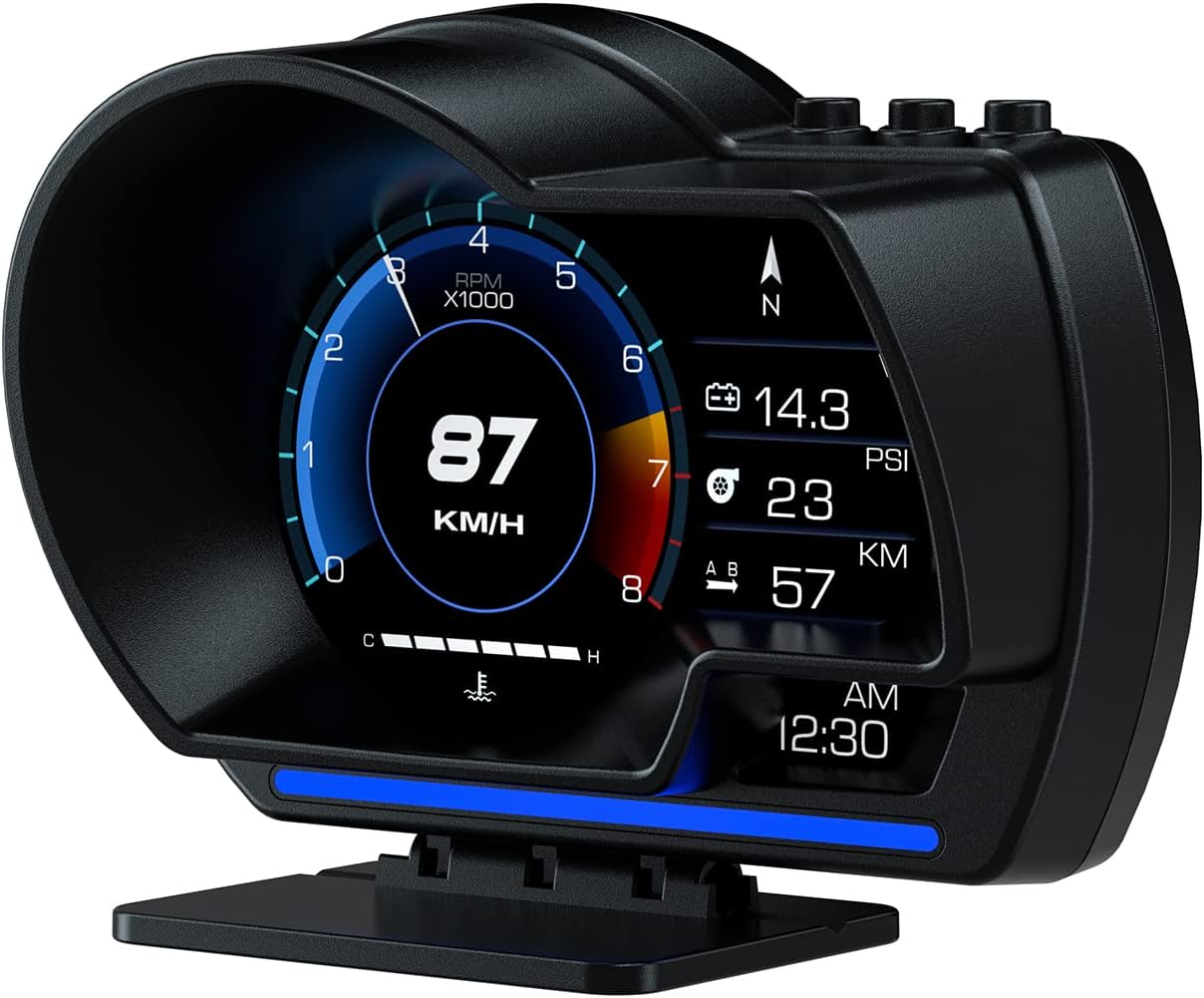
The wiiyii P6 HUD projects speed data onto a transparent film just above the base of your windshield, within normal forward sight lines. It runs on both OBD2 and GPS simultaneously, so if your OBD2 connection drops, GPS speed reading takes over automatically. The display shows speed, RPM, water temperature, voltage, and an overspeed alarm you set yourself. The P6 mounts on the dashboard or the A-pillar trim (the vertical post between your windshield and front door window), which keeps the reading closer to your natural line of sight than a flat-dash unit. It costs $45-$56 on Amazon and works on most vehicles from 2008 onward.
The limitation to plan around: OBD2 mode requires a 2008 or newer vehicle with a functioning OBD2 port. If your car is older, it’ll default to GPS speed, which is accurate but shows a one-to-two-second lag during rapid acceleration. Bright midday sun can also wash out the reflective film on cheaper units — the P6’s display holds up reasonably well, but parking in a garage at noon and then driving into direct sun is when any HUD gets tested. One other note: the HUD won’t prevent a speed trap if you don’t look at it. It’s a tool for drivers who want constant, passive speed awareness, not a substitute for attention.
An Emergency Escape Tool
Best for: Every driver. This is the one item on this list that costs under $13 and belongs in every car without exception.
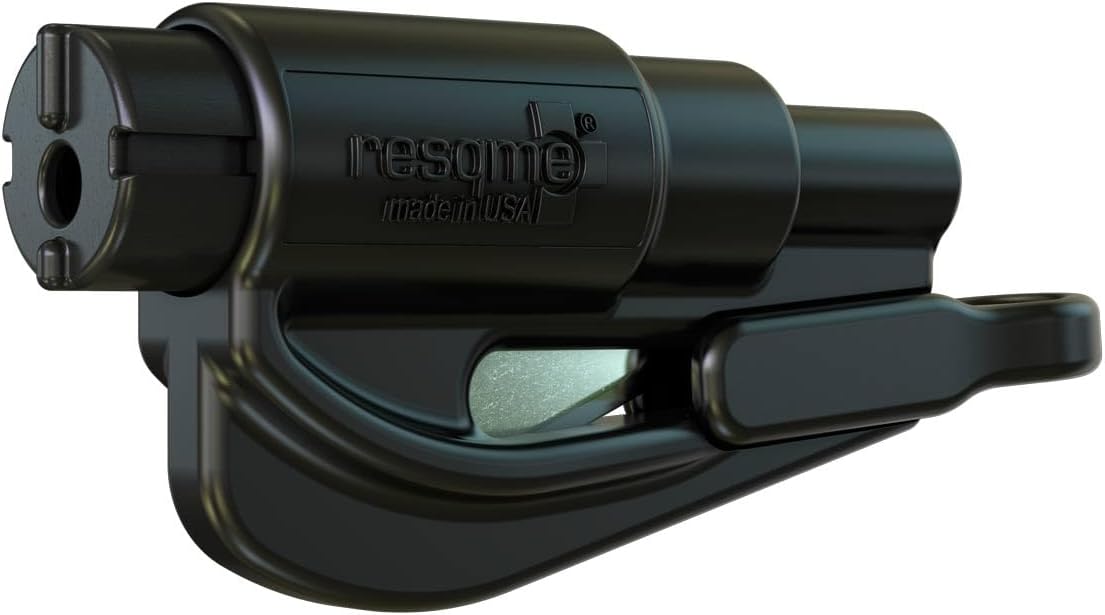
The resqme Original Keychain Car Escape Tool combines two functions in a device smaller than a lip balm. A spring-loaded stainless steel spike breaks tempered side windows without requiring a swing or significant force — press the tip against the glass and the spring fires automatically. A recessed stainless steel blade cuts a jammed or locked seatbelt without risking contact with skin during a chaotic situation. The spring mechanism resets after each use. Over 15 million units are in use globally, and it’s standard issue for many fire departments and EMT teams in the US.
In a rollover, the seatbelt locking mechanism can jam under load. In a vehicle submersion — which NHTSA data shows kills around 400 Americans per year — door pressure from surrounding water makes opening doors impossible until internal and external pressure equalize, which takes time most occupants don’t have. A window breaker changes the equation in both scenarios. The resqme won’t work on laminated windshields (those don’t shatter the way tempered side glass does), but side windows are the correct exit point anyway.
Placement matters as much as ownership. Don’t throw it in the glovebox or the trunk. Mount it on the driver’s-side sun visor using its built-in clip, or attach it to the seatbelt anchor near the buckle, where it’s reachable without arm mobility. At $9.99-$12.99 for a single unit, this is the easiest purchase on this list to justify. The 3-pack drops the per-unit cost below $8, which makes equipping every family vehicle a non-decision.
A Tire Pressure Monitoring System
Best for: Owners of pre-2008 vehicles without factory TPMS, trailer towers, and anyone who drives more than 200 miles in a single stretch.
Underinflated tires don’t just wear unevenly. They increase stopping distance, reduce fuel economy by up to 3% per the US Department of Energy, and raise blowout risk significantly once pressure drops below 25% of the recommended PSI. Most passenger cars run 30-35 PSI, but a slow leak of 1-2 PSI per week won’t trigger any visible warning until the tire looks noticeably flat, which is typically 10-15 PSI below safe operating pressure. Federal law required factory TPMS on all new US vehicles from 2008 onward; pre-2008 cars have no built-in warning at all.
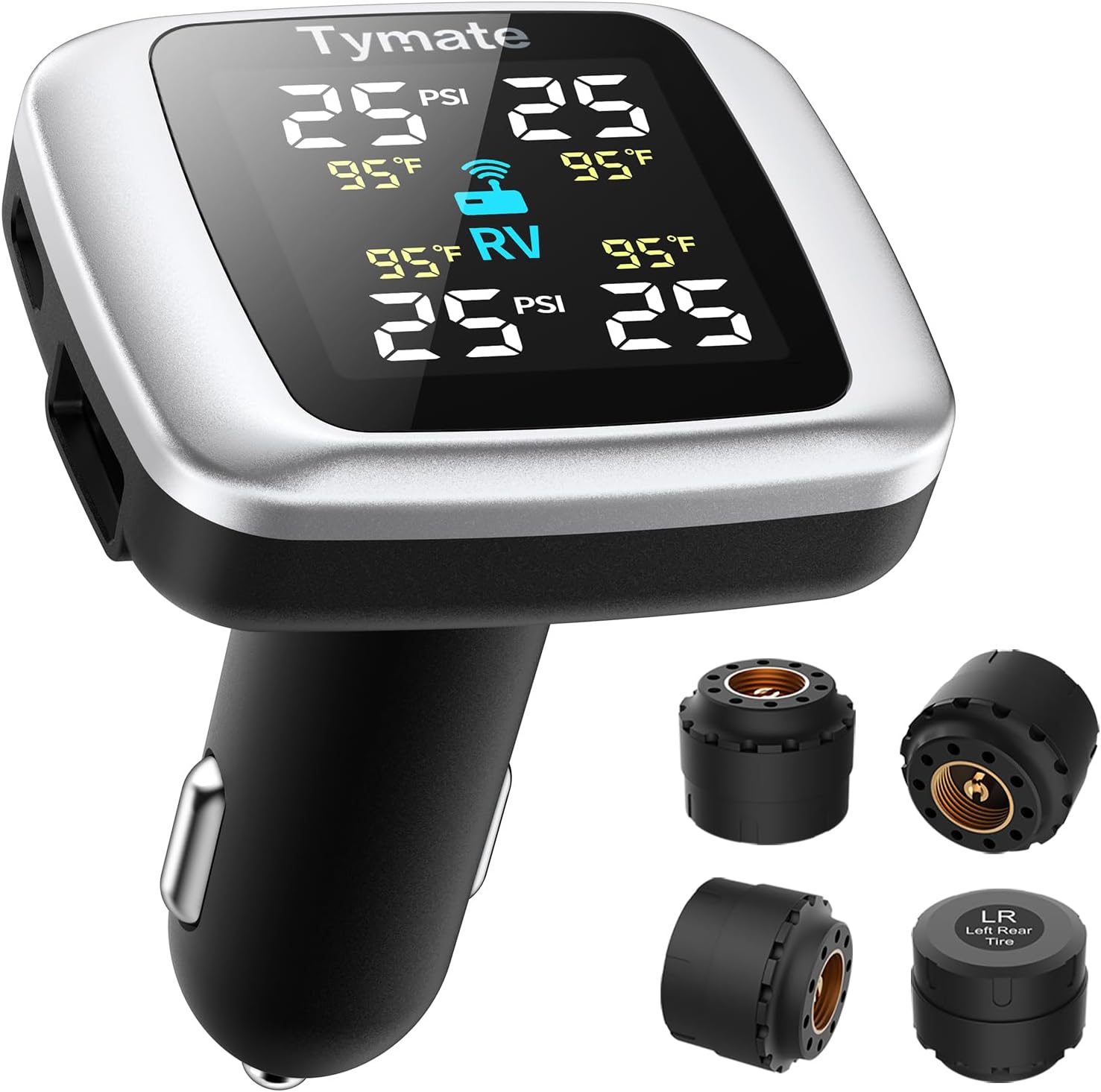
The Tymate TM7 uses four external sensors that screw onto valve stems in place of standard caps. A powered display (plugs into the 12V cigarette lighter socket) shows real-time PSI and temperature for all four tires simultaneously, with six alarm modes: high pressure, low pressure, high temperature, rapid deflation, sensor signal loss, and low battery. Accuracy sits at ±1.5 PSI, which is precise enough to catch slow leaks before they become emergencies. It covers 0-87 PSI and works on sedans, SUVs, MPVs, and pickups. The whole system installs in under 10 minutes with no tools, and the display powers off automatically when you shut the car down. It costs $39.99-$59.99 depending on the current Amazon listing.
The practical limitation: the display occupies the cigarette lighter port. If that port is already in use for a phone charger, you’ll need a USB splitter or a dual-port adapter. The external sensors also add a small amount of weight to each valve stem, which is imperceptible while driving but worth knowing if you get your wheels balanced after installation. For towing, the Tymate TM12 supports up to 12 sensors and covers trailer axles as well — it costs about $20 more but eliminates the need for a second TPMS system on the trailer.
Which Gadgets to Buy First
If the car predates 2026 and has no backup camera, start there: the VIOFO A129 Plus Duo and the resqme escape tool together cost under $135 and cover the two highest-frequency gaps — parking visibility and crash survival. Add the NOCO GB40 next if the vehicle is driven outside city limits regularly or the battery is aging. The Bouncie GPS tracker and Tymate TPMS make sense for specific profiles: teen drivers or theft-risk areas in the former case, older vehicles or long-haul driving in the latter.
Every gadget on this list costs less than a single fender-bender repair estimate. That’s the calculation that matters.