
Affordable Childcare: Is Hiring an Au Pair Cheaper Than Daycare?
Childcare in the US costs between $800 and $2,500 per month per child. If you’re bootstrapping a business on irregular income, that number isn’t just expensive. It’s terrifying. One slow month and your daycare payment competes directly with your business runway.
I’ve worked with hundreds of entrepreneur-parents who face this exact tension: fixed family expenses versus unpredictable business revenue. The answer isn’t to choose between your kids and your company. It’s to build a financial structure that supports both without breaking when income fluctuates.
This guide covers the full picture. Childcare options compared with real costs, financial planning strategies for irregular income, tax advantages most parent-entrepreneurs miss, and the tools that actually help you track it all. If you’re running a business while raising kids, this is the financial framework I wish someone had given me years ago.
The Parent-Entrepreneur Financial Challenge
Regular employees with kids have one problem: childcare is expensive. Entrepreneur-parents have two: childcare is expensive AND income is unpredictable. This combination creates a financial stress pattern that’s fundamentally different from what salaried parents face.
A W-2 employee earning $6,000/month can budget $1,500 for daycare and know exactly what’s left. An entrepreneur who earned $12,000 last month and $2,000 this month can’t do that math. The daycare doesn’t care about your revenue cycle. They want $1,500 on the first of every month regardless.
According to a Care.com survey, 72% of parents say childcare costs influence their career decisions. For entrepreneurs, the stakes are higher. A bad childcare month doesn’t just strain your budget. It can force you to take on wrong-fit clients, delay product launches, or pull money from business accounts that should be funding growth.
The solution isn’t one thing. It’s a system. Let’s build it piece by piece, starting with the expense that brought you here.
Childcare Options Compared: Real Costs in 2026
Not all childcare costs the same, and the cheapest option isn’t always the best ROI when you factor in flexibility and productivity. Here’s an honest breakdown of five common options with real monthly costs.
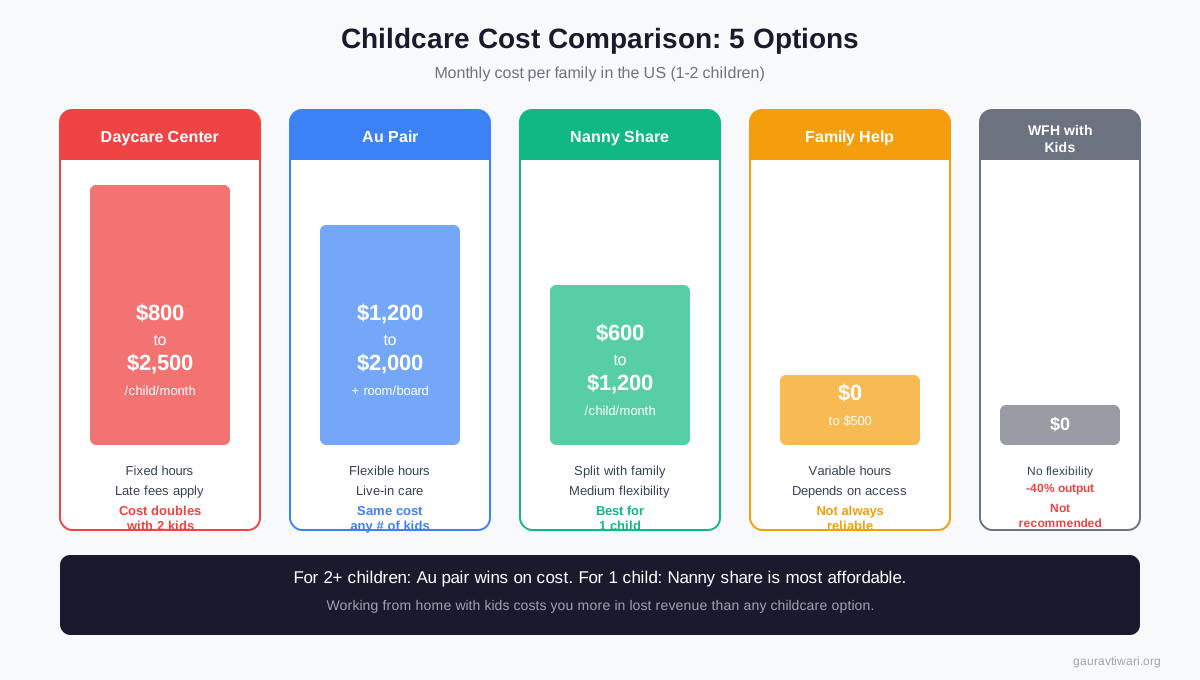
| Option | Monthly Cost | Flexibility | Best For |
|---|---|---|---|
| Daycare center | $800 – $2,500/child | Low (fixed hours) | Predictable 9-5 schedules |
| Au pair | $1,200 – $2,000 + room/board | High (live-in) | Multiple kids, irregular hours |
| Nanny share | $600 – $1,200/child | Medium | One child, neighborhood network |
| Family help | $0 – $500 (gifts/support) | Variable | Available, willing relatives nearby |
| Work from home with kids | $0 | None (you’re working) | Nobody. Productivity drops 40% |
That last row needs emphasis. I see entrepreneur-parents try to work from home with small children constantly. Research from the Bureau of Labor Statistics shows productivity drops roughly 40% when you’re simultaneously caring for kids under 5. You’re not saving money. You’re losing revenue while burning out.
The au pair option deserves a closer look. The term “au pair” comes from French, meaning “on equal terms.” It’s a cultural exchange program where a young person (usually from another country) provides childcare in exchange for room, board, and a weekly stipend of about $195.75 (the US State Department minimum). Agency fees run $7,000-$10,000 per year. When you add room, board, and stipend, total annual cost lands around $18,000-$26,000, regardless of how many children you have. For families with 2+ kids, that’s often cheaper than daycare.
The biggest advantage for entrepreneurs isn’t cost. It’s flexibility. An au pair lives in your home and can adapt to your unpredictable schedule. Client call at 7am? Covered. Workshop running until 8pm? Covered. Daycare charges $10-15 per minute for late pickup. Au pairs don’t.
Financial Planning for Irregular Income
The single biggest financial mistake entrepreneur-parents make is treating business income as personal income. When a $15,000 client payment hits your account, it feels like you have $15,000. You don’t. You have revenue that needs to be allocated across business expenses, taxes, and then, maybe, your personal salary.
Here’s the system that works. I’ve refined it over years of running my own business while managing household expenses.
Separate Your Accounts
You need a minimum of three accounts: business operating, personal checking, and a personal emergency fund. Every dollar of revenue goes into the business account first. Always. Never deposit client payments directly into personal checking.
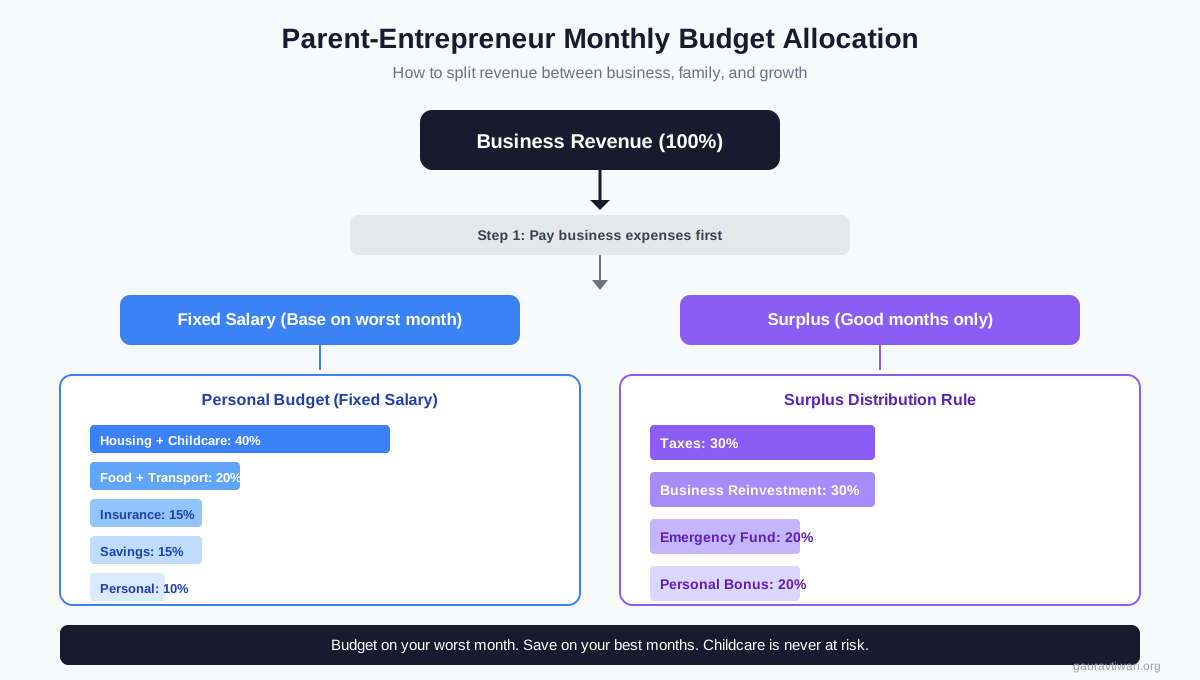
From the business account, pay yourself a fixed salary on the 1st and 15th. This salary should be based on your lowest reasonable revenue month, not your average. If your worst month in the past year was $4,000 in revenue, your personal salary might be $2,500/month after business expenses. Yes, that’s low. But it’s predictable, and predictable is what lets you budget for childcare without panic.
Build a Personal Emergency Fund
Most financial advice says 3-6 months of expenses. For entrepreneurs, I recommend 6-9 months. Your income disruptions aren’t just possible. They’re guaranteed. A fund of $15,000-$25,000 (depending on your monthly expenses) means one bad quarter doesn’t force you to pull your kids out of their childcare arrangement.
The Surplus Distribution Rule
In months where revenue exceeds your baseline salary, distribute the surplus: 30% to taxes, 30% to business reinvestment, 20% to personal emergency fund (until it’s full), and 20% as a bonus to yourself. This system means good months build security instead of inflating your lifestyle. When the slow month comes, and it will, your family doesn’t feel it.
Creating a business budget that actually works requires separating what feels true (we had a great month!) from what is true (our average monthly revenue is $6,200). The budget lives on the average, not the peak.
How do you manage childcare while running a business?
Tax Strategies for Entrepreneur-Parents
This is where most parent-entrepreneurs leave money on the table. The tax code has several provisions specifically designed for working parents, and entrepreneurs can stack these with business deductions in ways that W-2 employees can’t.
Child and Dependent Care Tax Credit
You can claim up to $3,000 in childcare expenses for one child, or $6,000 for two or more. The credit ranges from 20% to 35% of those expenses depending on your adjusted gross income. For a family spending $6,000/year on qualifying childcare, that’s $1,200 to $2,100 back in your pocket. This applies to daycare, au pair stipends, and nanny costs.
Dependent Care FSA
If you’ve set up your business as an S-corp or C-corp and pay yourself a salary, you can contribute up to $5,000 pre-tax to a Dependent Care Flexible Spending Account. That $5,000 isn’t subject to income tax or self-employment tax. At a combined marginal rate of 30%, that’s $1,500 in real savings. Note: you can’t use both the FSA and the full tax credit on the same expenses. Run the numbers both ways. For most entrepreneurs earning $50,000+, the FSA wins.
Home Office Deduction
If you work from home (which many parent-entrepreneurs do specifically to be near their kids), you can deduct a portion of your housing costs. The simplified method gives you $5/square foot up to 300 square feet ($1,500 max). The regular method lets you deduct the actual percentage of your home used exclusively for business. A 200 sq ft office in a 2,000 sq ft home means 10% of your mortgage, utilities, insurance, and repairs are deductible.
Child Tax Credit
Up to $2,000 per qualifying child under 17. This is a direct credit, not a deduction, so it reduces your tax bill dollar for dollar. For a family with two kids, that’s $4,000 off your taxes. Combined with the dependent care benefits above, the tax code can effectively subsidize 30-40% of your childcare costs.
Health Insurance Strategies for Self-Employed Parents
Health insurance is the other fixed expense that keeps entrepreneur-parents up at night. Without an employer plan, a family of four pays $1,500-$2,500/month for marketplace coverage in 2026. Here are the realistic options.
Spouse’s employer plan. If your partner has a W-2 job with benefits, this is almost always the best option. Family coverage through an employer typically costs $400-$800/month for the employee share, subsidized by the employer. This single benefit can be worth $15,000-$20,000/year. If either partner has access to employer insurance, use it.
ACA Marketplace plans. If you’re both self-employed, the Affordable Care Act marketplace is your main option. The premium tax credit makes this affordable for lower-income years, which early-stage entrepreneurs often have. A family earning $60,000 might qualify for $800-$1,200/month in premium subsidies. The self-employed health insurance deduction lets you deduct 100% of premiums from your adjusted gross income.
Health share ministries. Organizations like Samaritan Ministries or Medi-Share cost $300-$600/month for families. These aren’t insurance. They’re member-funded sharing programs with religious affiliations. Monthly costs are lower, but coverage is limited and pre-existing conditions may not be covered. I know entrepreneurs who use these successfully, but go in with eyes open. Read the fine print on what’s excluded.
The self-employed health insurance deduction is one of the most valuable tax breaks available to entrepreneurs. It reduces your adjusted gross income, which also lowers your self-employment tax. On a $15,000 annual premium, you could save $4,000-$5,000 in combined taxes. Protecting your business income starts with making sure a health emergency doesn’t wipe out your savings.
Time Management for Parent-Entrepreneurs
Money isn’t the only resource under pressure. Time is the constraint that actually determines whether your business grows or stalls. Here’s what I’ve learned about managing both.
Schedule around childcare, not the other way around. Whatever childcare arrangement you choose, build your work schedule around its boundaries. If daycare runs 7:30am to 5:30pm, those are your work hours. Period. Don’t plan to “finish up after bedtime.” That’s how burnout starts.
Batch your deep work. The average parent-entrepreneur gets interrupted every 11 minutes. You can’t do strategic thinking in 11-minute increments. Block 2-3 hours of uninterrupted time during your best childcare hours for your highest-value work. Everything else (email, admin, social media) fills the gaps.
Hire before you think you’re ready. Most entrepreneurs wait too long to delegate. If you’re spending 10 hours/week on tasks worth $20/hour when your time is worth $75/hour, you’re losing $550/week. That’s $28,600/year. Hiring a virtual assistant for $1,500/month ($18,000/year) gives you a net gain of $10,600 plus your sanity. Reducing operating costs sometimes means spending more on the right things.
Protect your weekends. The temptation to work weekends when you have childcare during the week is enormous. Resist it. Burnout doesn’t announce itself. It accumulates silently until you can’t function. Your kids need present parents, not exhausted ones who happen to be in the room.
When to Invest More in Childcare: The ROI Calculation
Here’s a question most parent-entrepreneurs don’t ask: what is one hour of childcare actually worth to your business? Let’s do the math.
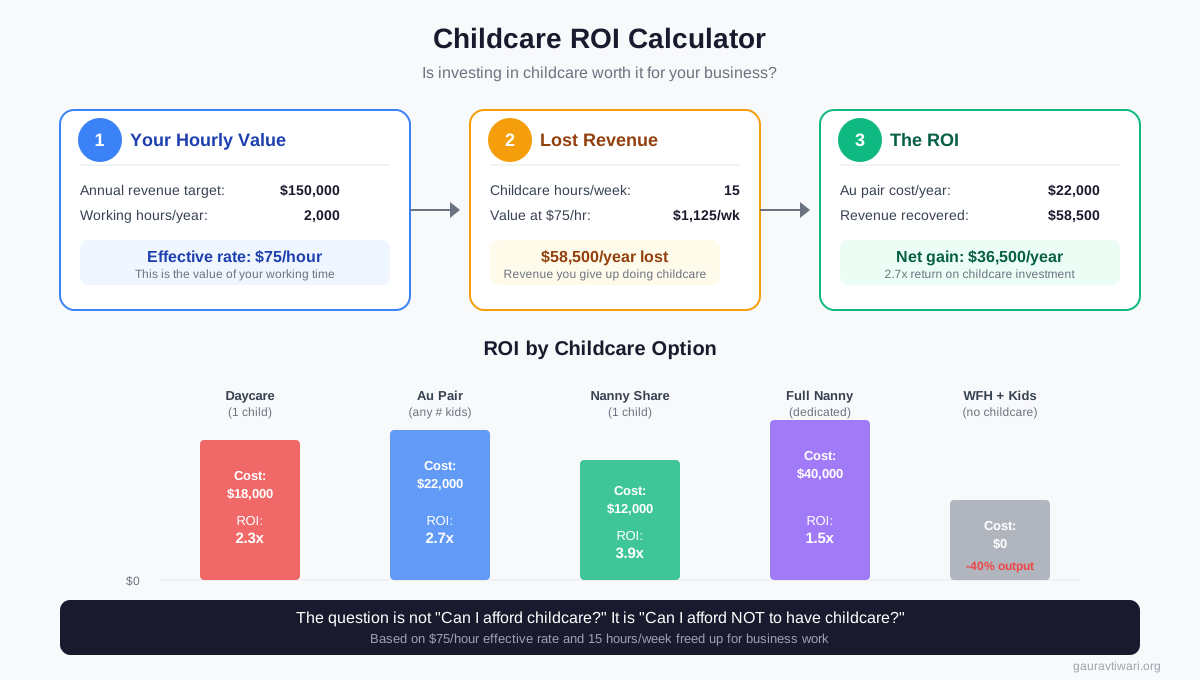
Say your effective hourly rate is $75 (that’s $150,000/year at 2,000 working hours, a reasonable target for an established solo business). Every hour you spend on childcare instead of billable work costs you $75 in potential revenue. If you’re doing 15 hours/week of childcare that could be delegated, that’s $1,125/week or $58,500/year in lost revenue.
An au pair costs roughly $350/week all-in. A full-time nanny costs $600-$900/week. Even the most expensive childcare option gives you a 2-3x return if it frees up billable hours. The question isn’t “Can I afford childcare?” It’s “Can I afford NOT to have childcare?”
This doesn’t mean you should outsource every hour. Being with your kids matters. But it does mean that guilt about spending money on childcare is mathematically irrational if that spending enables revenue that exceeds the cost. Reframe childcare as a business investment, not a personal expense. Because that’s what it is.
Building passive income is the long-term solution. Every product, course, or automated revenue stream you create during childcare-enabled work hours reduces your dependence on trading time for money. Eventually, your business generates revenue whether you’re at your desk or at the playground.
Financial Tools That Actually Help
You don’t need 15 apps. You need 2-3 tools that give you clarity on where money goes and what’s coming in. Here’s what I recommend.
For business finances: FreshBooks handles invoicing, expense tracking, and tax preparation for solo entrepreneurs and small teams. It connects to your bank accounts, categorizes expenses automatically, and generates the profit/loss reports your CPA needs at tax time. The simple interface means you actually use it instead of letting receipts pile up. Plans start at $19/month, which pays for itself the first time it catches a missed expense.
For family budgeting: YNAB (You Need A Budget) is built for irregular income. Its “give every dollar a job” method works perfectly for entrepreneurs because you budget based on money you actually have, not money you expect. At $99/year, it’s the best personal budgeting tool for variable income households. The 50/30/20 rule (50% needs, 30% wants, 20% savings) is a good starting framework, but entrepreneurs should adjust to 60/20/20 until revenue stabilizes.
For planning and tracking: Notion works as a family command center. I use it to track childcare schedules, business goals, household budgets, and the weekly review that keeps everything coordinated. A shared Notion workspace means both parents see the full financial picture without needing to sync constantly.

- Invoicing, expense tracking, and tax reports in one place
- Connects to bank accounts for automatic categorization
- Generates profit/loss reports for tax season
- Plans from $19/month with 30-day free trial

- Family command center for budgets, schedules, and goals
- Shared workspace keeps both parents aligned
- Templates for business planning and household tracking
- Free plan handles most family needs
Reducing Household Costs to Fund Business Growth
Every dollar you save on household expenses is a dollar available for business investment. Here are the strategies that actually move the needle, not the “skip your latte” nonsense.
Refinance while rates allow. If your mortgage rate is above current market rates, refinancing can save $200-$500/month. On a $300,000 mortgage, dropping from 7% to 5.5% saves roughly $300/month or $3,600/year. That’s enough to cover 2-3 months of daycare or a meaningful business investment.
Audit subscriptions quarterly. The average American household spends $219/month on subscriptions. Many of these run on autopilot long after you’ve stopped using them. Every quarter, review your credit card statements for recurring charges. I typically find $50-$100/month in subscriptions I forgot about or no longer use.
Meal plan aggressively. Families with young children waste 25-30% of purchased food. A simple weekly meal plan and grocery list cuts food spending by $200-$400/month for a family of four. That’s not a marginal improvement. That’s an extra $2,400-$4,800/year.
Negotiate your bills. Call your internet, phone, and insurance providers once a year and ask for a better rate. Mention competitor pricing. This takes 2-3 hours total and typically saves $50-$150/month across all bills. Reducing costs isn’t about deprivation. It’s about redirecting money from things that don’t matter to things that do.
The Guilt Factor: Reframing Childcare Spending
Let’s address the elephant in the room. Parent-entrepreneurs carry a unique form of guilt. You feel guilty working when you could be with your kids. You feel guilty being with your kids when you should be working. You feel guilty spending money on childcare when you could “just do it yourself.”
Here’s the reframe that changed everything for me: childcare isn’t an expense. It’s an investment in your family’s financial future. Every hour of childcare that enables you to build your business is an hour invested in the financial security of the very children you’re paying someone to watch.
The entrepreneur who invests $20,000/year in quality childcare and uses that time to build a business worth $500,000 has given their family something no amount of personal childcare hours could provide: financial freedom. The stay-at-home-and-bootstrap approach sounds noble, but building a real business requires real time, which means real childcare.
Your kids don’t need a parent who’s physically present but mentally stressed about money. They need a parent who’s fully present during family time and fully focused during work time. Good childcare makes both possible.
Cash flow problems sink otherwise healthy businesses. Don’t let guilt about childcare spending create the cash flow crisis that kills your business and the financial security it was supposed to provide.
Frequently Asked Questions
These are the questions I get most often from parent-entrepreneurs navigating family finances alongside business growth.
Is an au pair cheaper than daycare for one child?
Usually not for a single child. Daycare for one child costs $800-$2,500/month depending on location. An au pair costs $1,200-$2,000/month plus room and board. The au pair becomes cheaper when you have two or more children because the cost stays flat regardless of how many kids you have. For one child, a nanny share ($600-$1,200/month) is often the most cost-effective option.
How much should an entrepreneur-parent keep in an emergency fund?
6-9 months of household expenses minimum. This is higher than the standard 3-6 month recommendation because entrepreneurial income is inherently variable. For a family spending $5,000/month, target $30,000-$45,000 in a high-yield savings account. This ensures one bad quarter doesn’t force you to make desperate financial decisions.
Can I deduct childcare as a business expense?
Childcare itself isn’t directly deductible as a business expense. However, you can claim the Child and Dependent Care Tax Credit (up to $6,000 for two children) and contribute to a Dependent Care FSA ($5,000 pre-tax) if your business pays you a salary. Combined with the Child Tax Credit ($2,000 per child), the tax benefits can effectively subsidize 30-40% of childcare costs.
When should I switch from free childcare to paid childcare?
When your effective hourly rate exceeds the cost of childcare per hour. If you can earn $50/hour and childcare costs $15/hour, every hour you spend on childcare instead of work costs you $35 in lost revenue. The transition point is usually when your business consistently generates $3,000-$5,000/month and you have clear opportunities to earn more with additional time.
How do I budget for childcare when my income changes every month?
Base your childcare budget on your lowest revenue month from the past year, not your average. Pay yourself a fixed salary from your business account that assumes worst-case revenue. In good months, the surplus goes to emergency savings and business reinvestment. This way, childcare is always affordable because it’s budgeted against your floor, not your ceiling.
What is the best financial tool for entrepreneur-parents?
FreshBooks for business finances (invoicing, expenses, tax reports) and YNAB for personal budgeting. FreshBooks starts at $19/month and handles the business side. YNAB costs $99/year and is specifically designed for irregular income. Together they give you complete visibility into both business and household cash flow for under $30/month total.
Managing family expenses while building a business isn’t about choosing between your kids and your company. It’s about building financial systems that support both. Separate your accounts, pay yourself a predictable salary, use every tax advantage available, and invest in childcare that frees your highest-value hours for business growth.
Start this week. Open that separate business account if you haven’t already. Run the childcare ROI calculation with your actual numbers. Look into the Dependent Care FSA for next tax year. Small structural changes now compound into massive financial stability over the next 2-3 years.
Your family’s financial future is the best reason to build a business. Make sure your financial structure actually lets you do it.
Disclaimer: This site is reader-supported. If you buy through some links, I may earn a small commission at no extra cost to you. I only recommend tools I trust and would use myself. Your support helps keep gauravtiwari.org free and focused on real-world advice. Thanks. - Gaurav Tiwari