
How to Choose the Right MVP Development Partner
You have a product idea, limited runway, and need to ship something real in 3 months. So you hire an MVP development partner. They quote $25,000, promise delivery in 8 weeks, and disappear into a sprint cycle. Twelve weeks later you get a half-built app with no tests, no documentation, and code so tangled that the next developer tells you it’s cheaper to start over.
I’ve seen this happen to about half the founders I work with. They come to me after burning $20,000-$50,000 on MVP development services that delivered nothing usable. The damage isn’t just the money. It’s the 4-6 months of lost time, the missed market window, and the investor confidence that evaporates when your demo crashes on stage.
The fix is choosing the right partner before writing the first check. Over the past decade, I’ve built MVPs for 30+ startups and I’ve evaluated dozens of agencies on behalf of clients. This guide covers exactly what separates a good MVP development partner from a bad one, the specific questions to ask, and the red flags that should kill the deal.
What an MVP Actually Is (Most Founders Get This Wrong)
An MVP (Minimum Viable Product) is the smallest version of your product that lets real users test your core assumption. It’s not a prototype. It’s not a demo. It’s a functional product with just enough features to validate whether people will actually use and pay for what you’re building.
The keyword is “minimum.” If your MVP has 15 features, it’s not an MVP. It’s a product with 12 features nobody asked for. The best MVPs I’ve worked on had 3-5 core features, launched in 6-10 weeks, and gave founders clear data on whether to keep building or pivot.
Dropbox’s MVP was a 3-minute video. Zappos tested demand by posting shoe photos online and buying from retail stores when orders came in. Buffer launched with a single landing page and a signup form. None of them built the full product first.
A good development partner understands this. They’ll push back when you try to add features. They’ll ask “what assumption does this test?” before writing a single line of code. If a partner agrees to build everything on your wishlist without questioning scope, that’s your first red flag.
What to Look for in an MVP Development Partner
After working on both sides of this equation (hiring developers for client projects and being hired as one), here’s what actually matters when evaluating a development partner.
Startup Experience, Not Just Development Experience
Building an MVP is fundamentally different from building enterprise software. An agency that builds $500,000 custom apps for corporations will over-engineer your MVP, blow past your timeline, and drain your budget. You need a team that has shipped MVPs before. They should know how to make hard trade-offs between speed and quality, when to use no-code tools vs. custom development, and how to structure the codebase so it’s extendable when you need to scale.
Ask specifically: “How many MVPs have you shipped in the last 2 years? What happened to them after launch?” You want to hear about products that got real users, raised funding, or pivoted based on data. Not projects that launched and disappeared.
Technical Versatility
Your partner should recommend the tech stack based on your product, not their comfort zone. A team that only builds in React Native will recommend React Native even when a progressive web app would ship faster and cost half as much.
For most MVPs, I recommend:
| MVP Type | Recommended Stack | Timeline | Cost Range |
|---|---|---|---|
| Web app (SaaS) | Next.js + Supabase or Laravel + Vue | 8-12 weeks | $15,000-$40,000 |
| Mobile app | React Native or Flutter | 10-14 weeks | $25,000-$60,000 |
| Marketplace | Next.js + Stripe Connect + PostgreSQL | 12-16 weeks | $30,000-$70,000 |
| AI/ML product | Python backend + React frontend | 10-16 weeks | $25,000-$80,000 |
| No-code MVP | Bubble, FlutterFlow, or Webflow + Zapier | 3-6 weeks | $5,000-$15,000 |
If a partner can’t explain why they’re recommending a specific stack for your specific product, they’re not thinking strategically. They’re just building with what they know.
A Portfolio You Can Actually Verify
Don’t just look at screenshots. Download the apps. Visit the live sites. Check if they’re still running. Half the “portfolio” items on agency websites are dead links to products that never got traction, which might not be the developer’s fault, but at least verify the work exists.
Better yet, ask for 2-3 references and actually call them. Questions I’d ask previous clients:
- Did the project ship on time and on budget?
- How did they handle scope changes mid-project?
- Was the code clean enough for another team to maintain?
- Would you hire them again?
How the Best MVP Partners Work
The MVP development process matters as much as the final product. Here’s what a good engagement looks like versus a bad one.
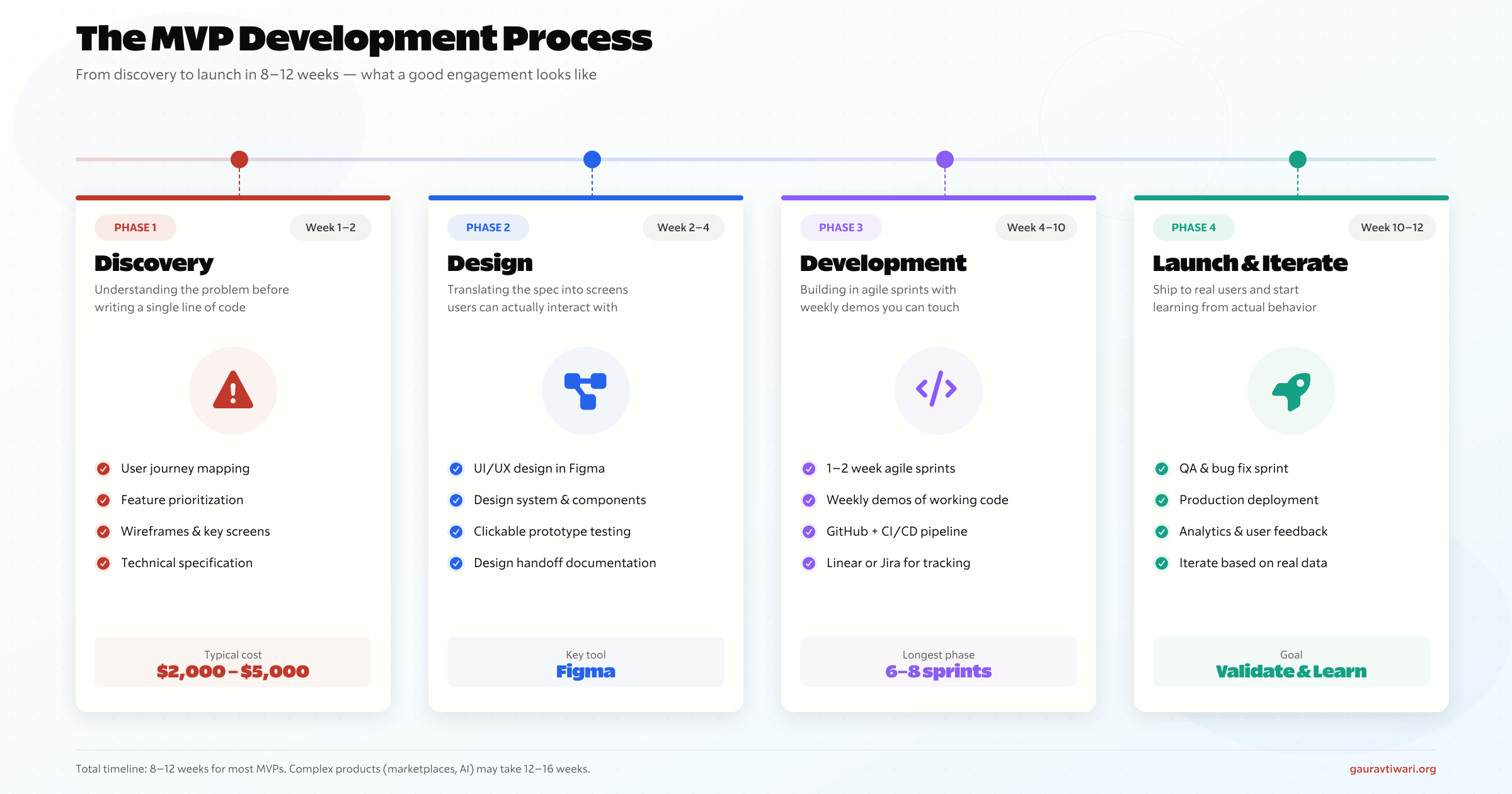
Discovery Phase (Week 1-2)
A competent MVP development partner spends 1-2 weeks on discovery before writing code. This includes mapping your user journey, defining the core features (and explicitly cutting everything else), wireframing the key screens, and writing a technical specification. If a partner wants to skip discovery and start coding immediately, run. You’ll pay for that shortcut later in rewrites and miscommunication.
Discovery should cost $2,000-$5,000 and produce a clear document that any developer could pick up and build from. This protects you. If the relationship doesn’t work out, you own the spec and can take it to another team.
Agile Sprints with Weekly Demos
After discovery, development should happen in 1-2 week sprints with a demo at the end of each one. You should see working software every week or two, not a big reveal after 3 months. This catches problems early when they’re cheap to fix.
Tools I expect a modern development team to use: Jira or Linear for project management, GitHub or GitLab for code (with proper branching), Figma for design handoff, and Slack or Teams for daily communication. If they’re tracking tasks in spreadsheets or emailing you ZIP files of code, that’s a maturity issue.
Transparent Communication
The best partners tell you bad news fast. “We found a technical limitation that adds 2 weeks” is infinitely better than silence followed by a missed deadline. Ask during the evaluation: “Tell me about a project that went sideways. What happened and how did you handle it?” The answer tells you everything about how they’ll communicate when things get tough with your project.
Pricing Models: What to Expect
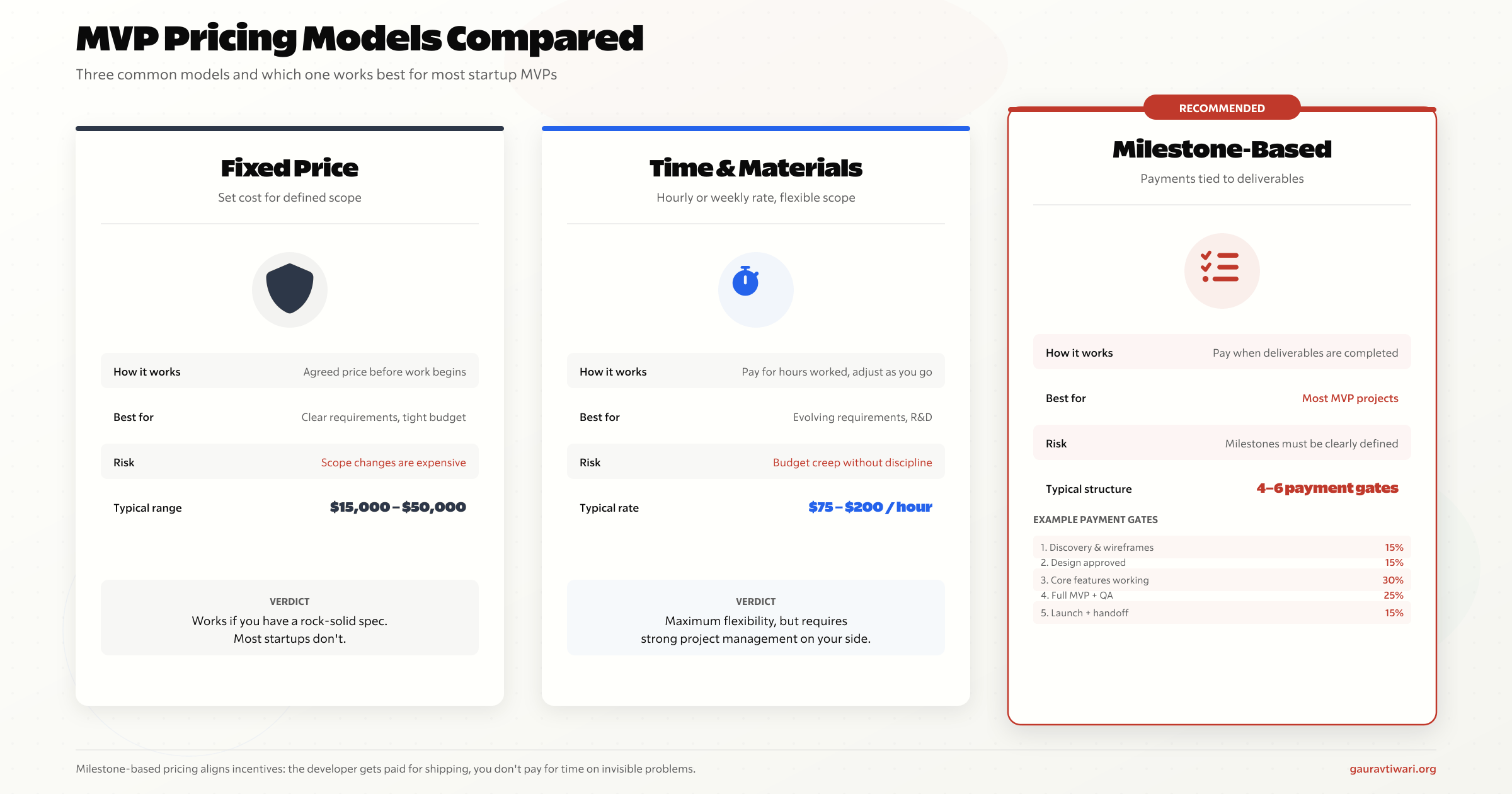
There are three common pricing models for MVP development. Each has trade-offs.
| Model | How It Works | Best For | Risk |
|---|---|---|---|
| Fixed price | Set cost for defined scope | Clear requirements, tight budget | Scope changes are expensive |
| Time & materials | Hourly/weekly rate, flexible scope | Evolving requirements | Budget can creep without discipline |
| Milestone-based | Payments tied to deliverables | Most MVPs (best balance) | Milestone definitions must be specific |
I recommend milestone-based pricing for most MVP development services. You pay when specific deliverables are completed: wireframes done, backend API complete, user authentication working, payment integration live, etc. This aligns incentives. The developer gets paid for shipping, and you don’t pay for time spent on problems you can’t see.
Budget reality check: if someone quotes you $3,000 for a full MVP, they’re either outsourcing to the cheapest developers they can find or planning to deliver something unusable. Quality MVP development services from an experienced team cost $15,000-$50,000 for most products. No-code MVPs can be $5,000-$15,000. Anything below that and you should question what you’re getting.
Red Flags That Should Kill the Deal
I’ve seen every version of a bad development partnership. These are the warning signs I look for now:
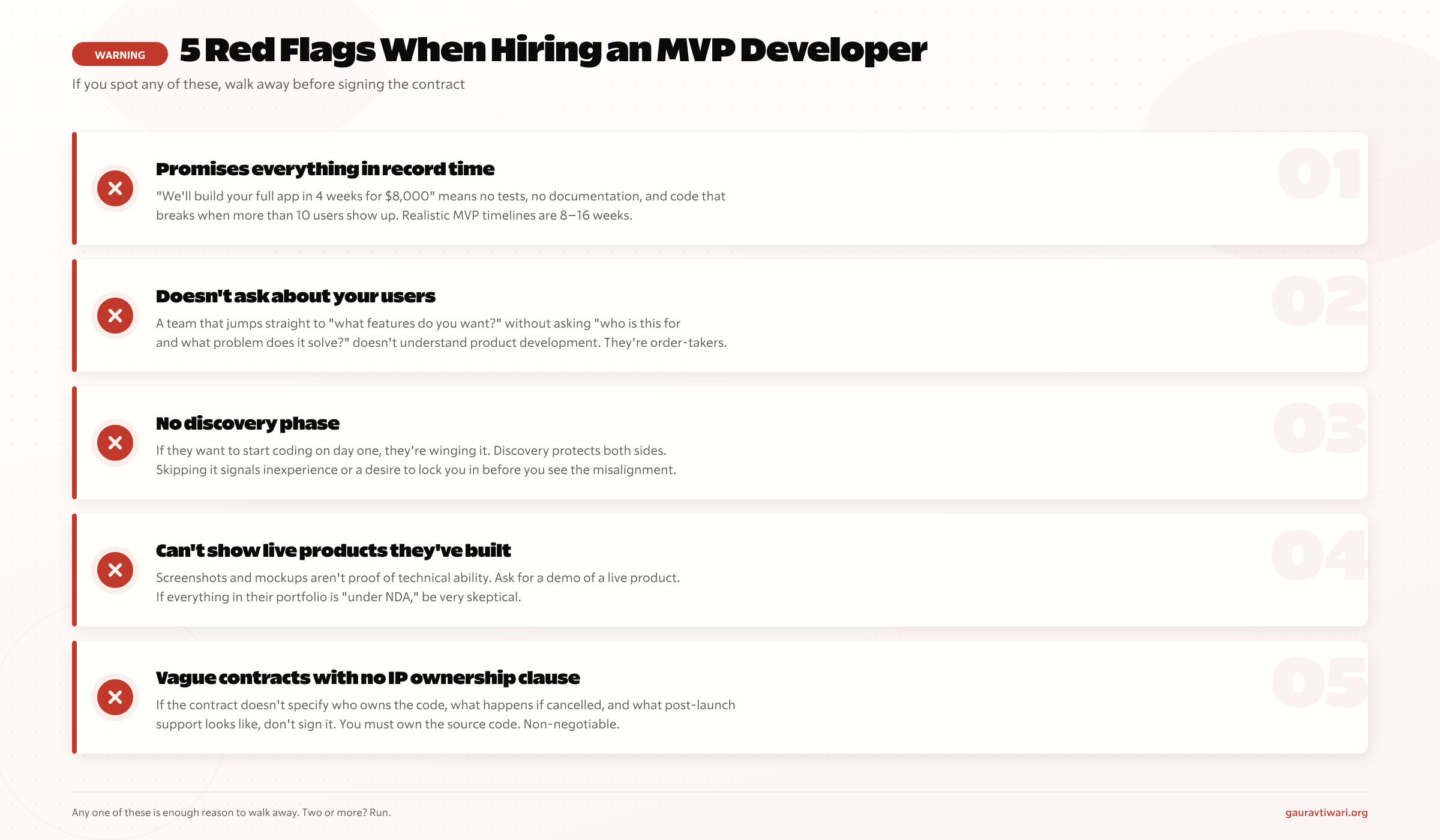
They promise everything in record time. “We can build your app in 4 weeks for $8,000” sounds great until you get a buggy product with no tests, no documentation, and code that falls apart when more than 10 users sign up. Realistic timelines for an MVP are 8-16 weeks depending on complexity.
They don’t ask about your users. A team that jumps straight to “what features do you want?” without asking “who is this for and what problem does it solve?” doesn’t understand product development. They’re order-takers, not partners.
No discovery phase. If they want to start coding on day one, they’re winging it. Discovery protects both sides. Skipping it is a sign of inexperience or a desire to lock you in before you realize the project is misaligned.
They can’t show you working code from previous projects. Screenshots and mockups aren’t proof of technical ability. Ask for a demo of a live product they’ve built. If everything in their portfolio is “under NDA,” be skeptical.
Vague contracts. If the contract doesn’t specify who owns the code, what happens if the project is cancelled, and what post-launch support looks like, don’t sign it. IP ownership is non-negotiable. You must own the code.
Post-Launch: What Happens After the MVP Ships
Your MVP launching is the beginning, not the end. The first version will have bugs. Users will request features you didn’t anticipate. Your analytics will reveal that the feature you thought was most important is barely used, while a secondary feature is driving all the engagement.
A good development partner plans for this. Before signing, clarify:
- Bug fix SLA: How quickly will they respond to critical bugs? 24 hours is reasonable for launch-critical issues.
- Iteration support: Can you continue working with them on a retainer for post-launch improvements? What’s the hourly or monthly rate?
- Handoff quality: If you hire an in-house team later, is the codebase documented well enough for someone else to take over? Ask for code review by a third party before final payment.
- Hosting and DevOps: Who manages the servers, CI/CD pipeline, and deployments after launch? Some partners handle this. Others hand you the keys and walk away.
The best MVP development partner relationships evolve from “build my product” to “be my technical advisor as I grow.” That only happens if the post-launch plan is clear from day one.
Questions to Ask Before Signing
Use this checklist when evaluating any MVP development partner. These are the exact questions I’d ask:
- How many MVPs have you shipped in the last 2 years? What happened to them?
- Walk me through your discovery process. What does it cost and what do I get?
- What tech stack would you recommend for my product and why?
- How do you handle scope changes mid-project?
- What does your sprint cadence look like? How often will I see working software?
- Who specifically will work on my project? Can I meet them?
- What’s your pricing model and what does it include?
- Who owns the IP and source code?
- What does post-launch support look like?
- Can I speak to 2-3 previous clients?
If a partner can answer all 10 clearly and confidently, they’re worth serious consideration. If they dodge more than two, keep looking.
Frequently Asked Questions
How much does MVP development cost?
Most MVPs cost $15,000 to $50,000 for custom development with an experienced team. No-code MVPs using tools like Bubble or FlutterFlow run $5,000 to $15,000. Mobile apps tend to cost more ($25,000 to $60,000) than web apps ($15,000 to $40,000). Be wary of quotes under $5,000 for custom development since the quality will reflect the price.
How long does it take to build an MVP?
Plan for 8 to 16 weeks for custom-built MVPs including discovery, design, development, and testing. No-code MVPs can ship in 3 to 6 weeks. Complex products like marketplaces or AI tools may take 12 to 16 weeks. Any partner promising a full MVP in under 4 weeks is cutting corners you’ll pay for later in bugs and technical debt.
Should I use a freelancer or an agency for my MVP?
Freelancers work well for simple MVPs with clear specs and budgets under $15,000. Agencies are better for complex products requiring design, frontend, backend, and project management. The middle ground is a small studio of 3 to 8 people, which gives you agency-level coordination at closer to freelancer pricing. That’s often the sweet spot for MVP development.
Should I build my MVP with no-code tools?
No-code tools like Bubble, FlutterFlow, and Webflow are excellent for validating demand quickly and cheaply. If your MVP is primarily content-based, form-based, or a simple marketplace, no-code can work. But if you need custom algorithms, complex integrations, real-time features, or plan to scale to thousands of users, start with custom code. Migrating from no-code to custom code later is essentially a full rebuild.
Who should own the source code after the MVP is built?
You should. This is non-negotiable. The contract must state that all source code, designs, and documentation are your intellectual property upon final payment. Some agencies retain code ownership and license it back to you, which means you can’t switch developers without their permission. Walk away from any deal that doesn’t give you full IP ownership of your product.
Your MVP development partner shapes the first version of your product, your burn rate, and your timeline to market. Don’t rush this decision. Evaluate at least 3 teams, check references, verify portfolios, and make sure the contract protects you. The right partner doesn’t just build your MVP. They help you figure out what to build, ship it fast, and set you up to scale when the data tells you to go.