
What is Growth Marketing?
Your marketing budget keeps climbing but revenue stays flat. You’re running Facebook ads, publishing blog posts, sending email campaigns, and posting on social media. Traffic looks decent. But new customers trickle in slowly, existing ones churn after 60 days, and your cost per acquisition keeps creeping higher. Something in the engine is broken, and you can’t figure out which part.
The real issue isn’t your budget or your team. It’s that traditional marketing treats each channel as a silo. You optimize ads without thinking about onboarding. You drive sign-ups but ignore activation. You celebrate top-of-funnel numbers while your retention rate bleeds revenue every month. I’ve worked with companies spending $15,000/month on paid ads that couldn’t keep customers past 30 days. They didn’t have a traffic problem. They had a full-funnel problem that no single campaign could fix.
Growth marketing solves this by treating the entire customer journey as one interconnected system. Every stage gets tested, measured, and optimized: awareness, acquisition, activation, revenue, retention, and referral. In this guide, I’ll break down exactly how growth marketing works, the AAARRR framework that powers it, the tools you need, and how to run experiments that compound into sustainable growth.
Growth Marketing Definition
Growth marketing is a scientific approach to marketing where every decision is driven by data, every strategy is treated as a hypothesis, and every campaign is an experiment that either gets scaled or killed based on results.
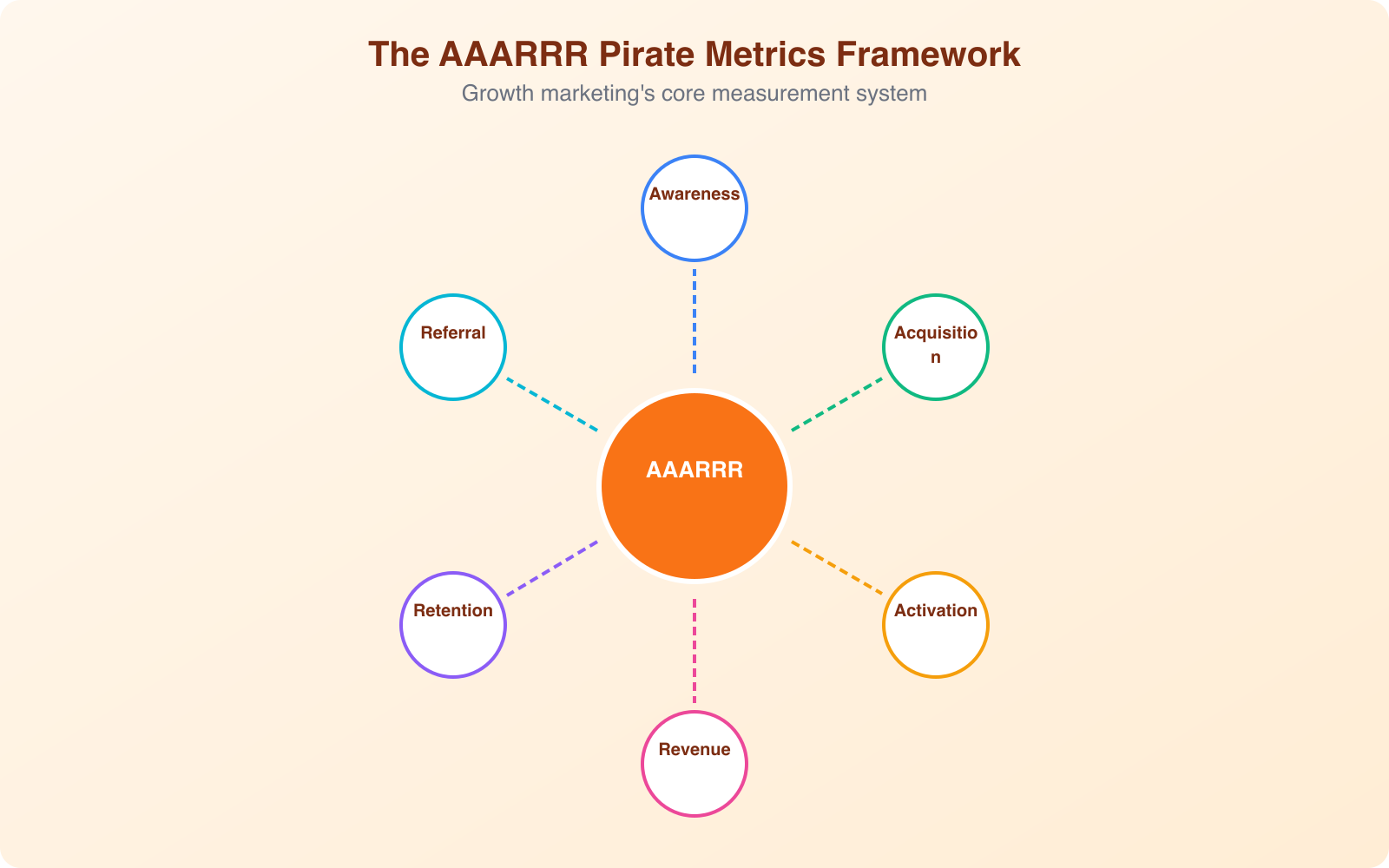
Unlike traditional marketing that focuses primarily on getting people through the door, growth marketing optimizes the full customer lifecycle: awareness, acquisition, activation, revenue, retention, and referral. These six stages form the AAARRR framework (also called pirate metrics), and they’re the backbone of every growth marketing strategy.
The core principle is simple. Find the biggest bottleneck in your funnel, design an experiment to fix it, measure the results, and either scale what works or try something new. Repeat this loop weekly. Companies that run 10-20 experiments per month consistently outgrow companies that run one big campaign per quarter.
The AAARRR Framework Explained
The AAARRR framework (pirate metrics) is the operational model that growth marketers use to structure their work. Each stage represents a different part of the customer journey, and each one has specific metrics and experiments associated with it.
Awareness
Awareness is about getting your brand in front of the right people. This is where most traditional marketing stops, but for growth marketers, it’s just the starting point. The key experiments here involve testing which channels deliver the most qualified traffic, not just the most traffic.
Common awareness experiments include: A/B testing blog post headlines for organic CTR, testing different social media posting frequencies, running paid ad creative tests across platforms, and measuring which content formats drive the most engagement. The goal isn’t just eyeballs. It’s eyeballs from people who actually match your ideal customer profile.
Acquisition
Acquisition is converting that awareness into leads. Someone goes from knowing your brand to giving you their email address, signing up for a free trial, or creating an account. This is where lead generation strategies come in.
Growth marketers test everything at this stage: landing page headlines, form length, CTA button color and copy, lead magnet types, sign-up flow steps, and pricing page layouts. Even small changes here can have massive impact. I’ve seen a single headline change on a landing page increase conversion rates by 40%. The difference between “Start Your Free Trial” and “See Results in 14 Days” can be enormous.
Tools like ConvertKit make it straightforward to set up email capture forms, automated sequences, and landing pages that you can A/B test without touching code. For content-driven businesses, email acquisition is usually the highest-leverage experiment to run first.
Activation
Activation is the most overlooked stage. It’s the moment when a new user or customer actually experiences the value of your product or service for the first time. In SaaS, this might be completing their first project. In ecommerce, it’s receiving their order and being delighted by it. In services, it’s getting the first meaningful result.
The speed at which someone reaches this “aha moment” directly predicts whether they’ll stick around or churn. Growth marketers obsess over reducing time-to-value. They test onboarding flows, welcome email sequences, in-app tutorials, and guided setup processes. Every friction point between sign-up and first value is a potential experiment.
Revenue
Revenue optimization means testing how you make money, not just that you make money. This includes pricing experiments (testing different price points, billing frequencies, and tier structures), upsell sequences, cross-sell recommendations, and checkout flow optimization.
One experiment I ran for a client involved testing annual vs monthly billing presentation on the pricing page. Simply showing the annual price per month (instead of per year) alongside the monthly price increased annual plan selection by 28%. That’s the kind of small, data-driven change that growth marketing is built on.
Retention
Retention is where growth marketing really separates itself from traditional marketing. Getting a new customer costs 5-7x more than keeping an existing one. If your retention rate is poor, no amount of acquisition spending will save you. You’re filling a leaky bucket.
Growth marketers test re-engagement email sequences, product usage triggers, loyalty programs, customer success outreach cadences, and feature adoption campaigns. They measure churn rate, net revenue retention, and customer lifetime value (LTV). Improving retention by even 5% can increase profits by 25-95%, depending on your business model.
Referral
Referral closes the loop. Happy customers bring in new customers, which feeds right back into the awareness stage. This is how compound growth happens. Growth marketers build and test referral programs that incentivize sharing: discounts for both parties, credit-based rewards, exclusive access, or premium features unlocked through referrals.
Dropbox is the classic example. Their referral program (extra storage for inviting friends) was responsible for 35% of daily sign-ups and helped them grow from 100K to 4M users in 15 months. That’s growth marketing at its best: a systematic, measurable program that compounds over time.
Growth Marketing vs Traditional Marketing vs Growth Hacking
These three terms get used interchangeably, but they describe fundamentally different approaches. Traditional marketing builds brand awareness through established channels. Growth hacking chases quick wins with creative shortcuts. Growth marketing sits in between: it uses the rigor of traditional marketing with the speed and experimentation of growth hacking, applied across the entire funnel.
Here’s a breakdown that makes the differences concrete:
| Traditional Marketing | Growth Hacking | Growth Marketing | |
|---|---|---|---|
| Focus | Brand awareness, top-of-funnel | Rapid user acquisition | Full funnel optimization |
| Timeframe | Quarterly campaigns | Days to weeks | Continuous weekly sprints |
| Method | Planned campaigns, big launches | Creative hacks, viral tricks | Hypothesis-driven experiments |
| Budget | Large upfront spend | Minimal (scrappy) | Scaled based on results |
| Measurement | Impressions, reach, brand recall | Signups, virality | CAC, LTV, retention, activation rate |
| Sustainability | Moderate | Low (hacks stop working) | High (compounds over time) |
| Team | Marketing department | Solo hacker or small team | Cross-functional growth team |
| Example | $50K Super Bowl ad buy | Hotmail “PS I Love You” footer | Dropbox referral program |
The key distinction: growth hacking looks for the one clever trick. Growth marketing builds a repeatable process. Tricks stop working. Processes compound. I’ve watched startups burn through 6 growth hacks in a year and end up exactly where they started. The companies that win are the ones running 15 disciplined experiments a month, learning from each one, and stacking small gains.
Growth hacking looks for the one clever trick. Growth marketing builds a repeatable process. Tricks stop working. Processes compound.
Real Growth Marketing Experiments (With Numbers)
Theory is nice, but you need to see what growth marketing looks like when it’s actually working. Here are three well-documented examples that show the experiment-driven approach in action.
Dropbox: The Referral Engine
Dropbox’s referral program is the textbook example for a reason. In 2008, their customer acquisition cost through paid ads was $233-$388 per user for a product that cost $99/year. The math didn’t work. So they ran an experiment: offer 500MB of free storage to both the referrer and the referred friend.
The result: permanent signups jumped 60%, and referrals drove 35% of all daily new signups. They grew from 100,000 users to 4 million users in 15 months. The cost per acquired user through referrals was essentially zero compared to $233+ through ads. That’s a growth marketing experiment, not a growth hack, because they continued to measure, iterate, and optimize the referral program for years after launch.
HubSpot: Free Tools as Acquisition
HubSpot built free tools like Website Grader, Email Signature Generator, and Blog Ideas Generator. These weren’t products. They were acquisition experiments. Website Grader alone has been used by over 4 million websites. Each user gets a taste of HubSpot’s value, enters their email, and lands in a nurture sequence.
HubSpot’s free CRM now has over 228,000 customers. The free tools strategy reduced their blended CAC by giving them an organic acquisition channel that compounds over time. Every free tool user who converts to a paid plan has a near-zero acquisition cost.
Canva: Template SEO at Scale
Canva created landing pages for thousands of specific design templates: “Instagram story template,” “business card template,” “resume template.” Each page targets a long-tail keyword, shows a preview, and requires a free account to edit. This strategy generates millions of monthly organic visits. Canva now has over 190 million monthly active users across 190 countries.
The growth marketing insight: Canva didn’t just create the templates. They tested which template categories drove the highest signup-to-paid conversion, then doubled down on producing more templates in those categories. That’s the difference between content marketing and growth marketing. Content marketing creates content. Growth marketing experiments with content to find what drives measurable business outcomes.
Growth Marketing for Content Creators
You don’t need to be a SaaS company to use growth marketing. If you run a blog, newsletter, or content business, you can apply the same experiment-driven framework to grow your audience and revenue. I’ve been doing this with my own sites for over a decade, and the principles are identical.
Here’s how to adapt the AAARRR framework for a content business:
Awareness: Test different content formats (long-form guides vs. short posts), publishing frequencies, and distribution channels. Track which topics bring the most organic traffic. Use Semrush to identify keyword gaps where your competitors rank but you don’t. Run experiments on headline formats to see which ones get the highest CTR in search results.
Acquisition: Your acquisition metric is email subscribers. Test different lead magnets, opt-in form placements, call-to-action formats, and landing page designs. I found that a specific resource (like a checklist or template) converts 3-5x better than a generic “subscribe for updates” prompt. Use ConvertKit to set up A/B tests on your forms without any coding.
Activation: For content businesses, activation is the moment a new subscriber reads their first email and clicks through to your site. Test your welcome email sequence. The first email you send after someone subscribes is the most-opened email you’ll ever send (open rates of 50-80% are common). Make it count. Give immediate value, not a sales pitch.
Revenue: Test monetization experiments. Affiliate product placement, sponsored content pricing, digital product pricing, and course launch sequences all benefit from the growth marketing approach. I’ve tested placing affiliate links in the first paragraph vs. after demonstrating value, and the “value first” approach consistently generates 2-3x more clicks.
Retention: For content creators, retention is email open rates and return visits. Test sending frequency, subject line formats, content types, and send times. Segment your list by engagement level and send re-engagement campaigns to subscribers who haven’t opened in 30+ days.
Referral: Build sharing into your content. Add “share this with a colleague” prompts in your emails. Create content that people naturally want to forward (data-driven research, original frameworks, contrarian takes). Track which pieces get shared most and create more of that type.
Growth Marketing vs Traditional Marketing
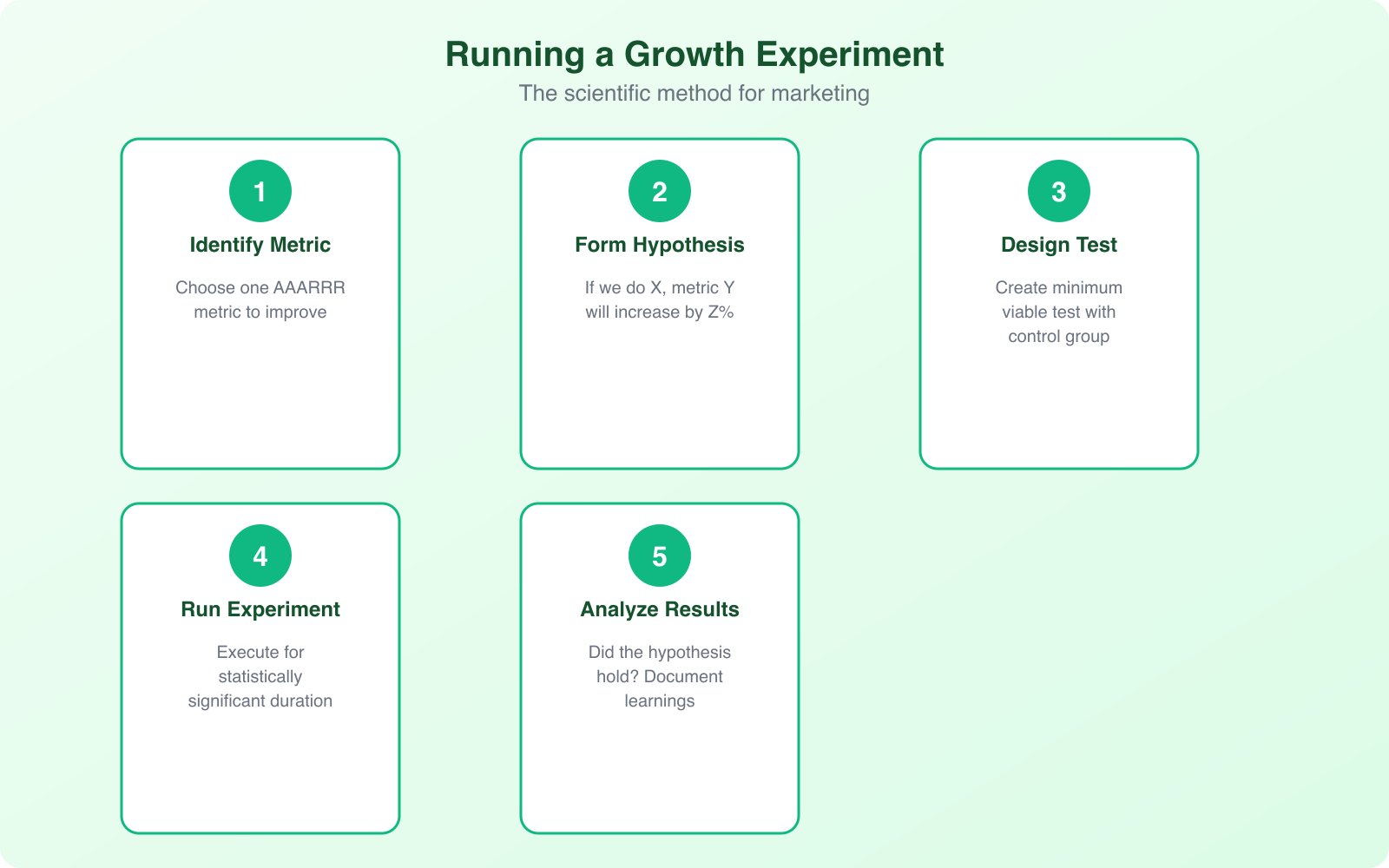
The fundamental difference comes down to mindset. Traditional marketing plans a campaign, executes it, and then reviews results at the end. Growth marketing treats every action as an experiment, measures results in real-time, and adjusts course constantly.
Here’s what that looks like in practice:
Traditional approach: “Let’s run a brand awareness campaign on social media for Q2. Budget: $50K. We’ll measure impressions and reach.” Three months later, you have a report showing you reached 2 million people. Great. But did those people buy anything? Did they even remember your brand a week later? Unknown.
Growth approach: “Our biggest funnel bottleneck is sign-up to first purchase. Let’s run three experiments this week: a new onboarding email sequence, a simplified checkout flow, and an in-app product recommendation engine. We’ll measure first-purchase conversion rate for each.” Seven days later, you know which changes moved the needle and you scale the winner.
Growth marketing isn’t opposed to brand campaigns or traditional channels. It just applies a more rigorous, experiment-driven framework to everything. You can run brand awareness on Instagram and still be doing growth marketing, as long as you’re testing hypotheses, measuring outcomes, and iterating based on data.
The Growth Experiment Process
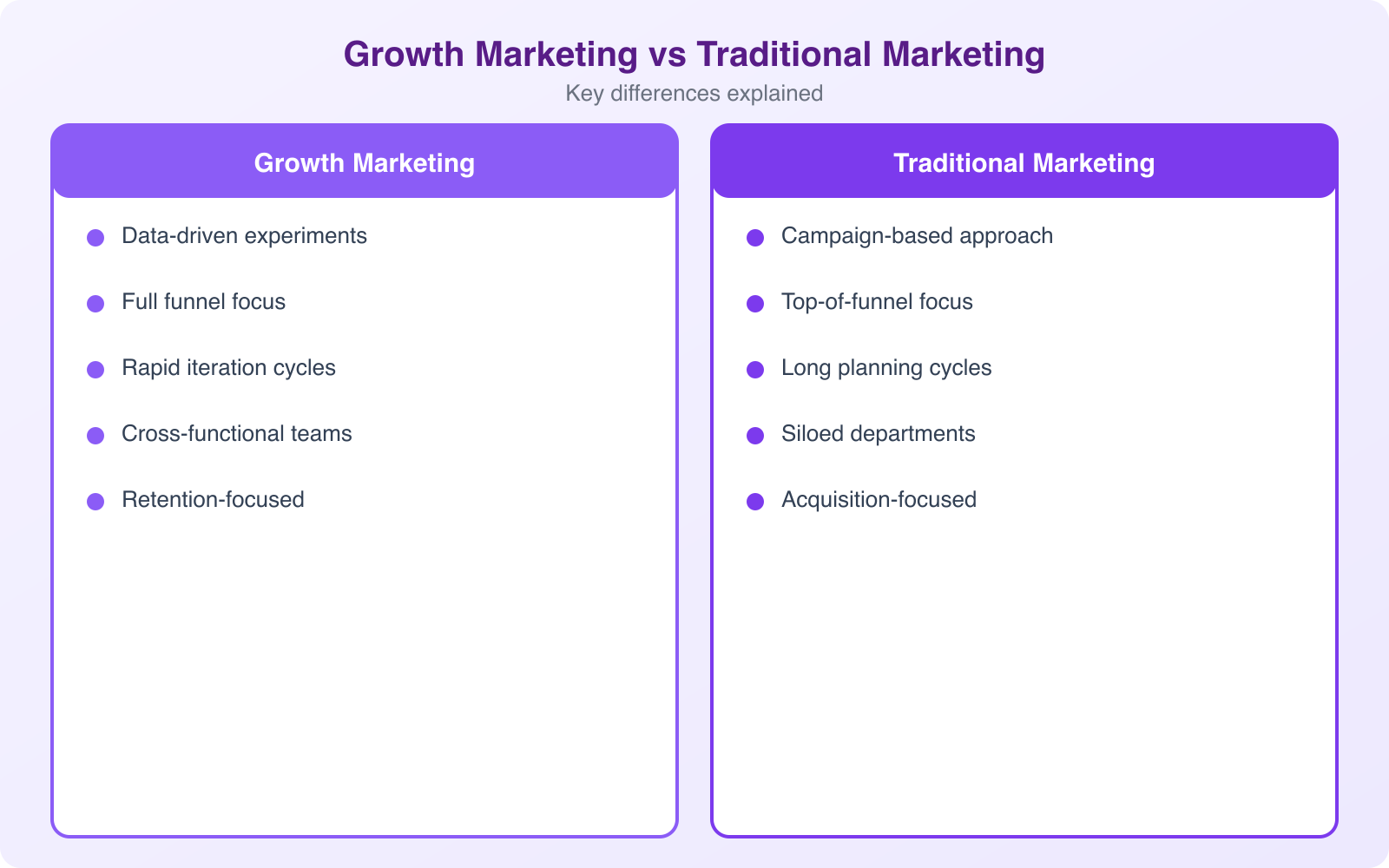
Running effective growth experiments follows a repeatable five-step loop. This is the engine that drives everything. Master this process and you’ll outpace competitors who are still guessing.
Step 1: Analyze Your Data
Start by looking at your current metrics across the entire funnel. Where’s the biggest drop-off? If 10,000 people visit your site but only 50 sign up, your acquisition is the bottleneck. If 500 people sign up but only 20 make a purchase, activation or revenue is the problem.
Use tools like Google Analytics, Mixpanel, or Amplitude to map your funnel and identify the stage with the worst conversion rate. That’s where you’ll get the highest ROI from experimentation.
Step 2: Generate Ideas
Brainstorm potential experiments that could improve the bottleneck stage. Look at what competitors are doing. Read case studies from companies that solved similar problems. Talk to your customers about what’s confusing or frustrating them.
Score each idea using the ICE framework: Impact (how big the potential effect is, 1-10), Confidence (how sure you are it’ll work, 1-10), and Ease (how easy it is to implement, 1-10). Multiply the three scores together and prioritize the highest-scoring experiments.
Step 3: Design and Run the Test
For each experiment, document your hypothesis (“If we change X, we expect Y to improve by Z%”), define your success metric, set the minimum sample size needed for statistical significance, and establish a time limit (usually 1-2 weeks).
Run the experiment properly. Don’t change multiple variables at once. Don’t peek at results too early. Don’t call a winner without enough data. Disciplined testing is what separates growth marketing from random tinkering.
Step 4: Measure Results
When the test period ends, analyze the results against your success criteria. Did the change produce a statistically significant improvement? Was the improvement large enough to be worth implementing permanently? What did you learn, even from failed experiments?
Document everything. Your experiment log is one of your most valuable assets. Failed experiments teach you just as much as successful ones because they narrow down what doesn’t work and sharpen your intuition for future tests.
Step 5: Scale or Kill
If the experiment worked, implement the change permanently and scale it. If it’s an ad creative that performed well, increase the budget. If it’s a checkout flow improvement, roll it out to 100% of traffic. If it failed, stop it immediately and move to the next experiment. Don’t throw good money after bad.
Then go back to Step 1 and start the loop again. Growth marketing is a continuous process, not a one-time project.
The Growth Marketing Tech Stack
You don’t need 20 tools to do growth marketing. You need the right tools in five categories, and you need to use them properly. Here’s the stack I recommend based on what I’ve seen work across dozens of client projects.
Analytics and Funnel Tracking
Google Analytics 4 (GA4) is the baseline. It’s free and handles traffic, conversion, and event tracking. For product analytics and deeper funnel analysis, Mixpanel (free up to 20M events/month) gives you cohort analysis, retention curves, and user flow visualization that GA4 can’t match. If you’re serious about understanding where users drop off, Mixpanel is worth setting up.
SEO and Content Research
Semrush is the tool I use for keyword research, competitive analysis, site audits, and content gap analysis. It costs $139.95/month for the Pro plan, which covers everything a small growth team needs. The keyword gap tool alone is worth it because it shows you exactly which keywords your competitors rank for that you don’t. That’s a direct pipeline of content experiments to run.
Email Marketing and Automation
ConvertKit is my pick for content-driven businesses. It starts at $25/month for 1,000 subscribers and includes visual automation builders, A/B testing on subject lines and content, tagging, segmentation, and landing pages. If you need a full CRM with email, Freshworks handles both sales pipeline and marketing automation in one platform starting at $15/user/month.
A/B Testing
VWO (Visual Website Optimizer) is the most growth-marketer-friendly A/B testing tool I’ve used. It handles landing page tests, heatmaps, session recordings, and multivariate tests. Plans start at $314/month for the Testing plan. If that’s too steep, Google Optimize’s replacement is built into GA4 as Experiments, and it’s free.
Project Management for Experiments
You need a system to track your experiment pipeline: ideas, in-progress tests, results, and learnings. Monday.com works well for this because you can build a custom board with columns for hypothesis, ICE score, status, start/end date, and results. It keeps your growth team aligned and ensures no experiment gets lost. Plans start at $9/seat/month.
Growth Marketing Metrics That Matter
You can’t do growth marketing without tracking the right numbers. I’ve seen teams drown in dashboards with 30+ metrics and still miss the signals that matter. Focus on these six, and you’ll have a clear picture of what’s working and what isn’t. For a deeper dive into the financial metrics, check my guide on CAC payback and SaaS metrics.
Customer Acquisition Cost (CAC)
Total marketing and sales spend divided by new customers acquired in a given period. If you spent $10,000 last month and acquired 100 customers, your CAC is $100. Track this by channel. You’ll usually find that 1-2 channels have dramatically lower CAC than the rest. Double down on those.
Customer Lifetime Value (LTV)
The total revenue a customer generates over their entire relationship with you. For subscription businesses, it’s average revenue per user (ARPU) divided by monthly churn rate. Your LTV-to-CAC ratio should be at least 3:1 for a healthy business. Below 3:1 means you’re spending too much to acquire customers relative to what they’re worth.
Activation Rate
The percentage of new users who reach their first value moment. Define what “activated” means for your product (completed onboarding, created first project, made first purchase) and track what percentage hit that milestone within 7 days. If this number is below 40%, nothing else matters. Fix activation before spending on acquisition.
Retention Curves
Plot the percentage of users still active at Day 1, Day 7, Day 30, Day 60, and Day 90 after signup. A healthy retention curve flattens out (meaning a stable cohort sticks around long-term). A curve that keeps dropping means you have a leaky bucket. For SaaS, monthly churn under 5% is the benchmark. For content businesses, track email open rates and repeat visits as retention proxies.
Viral Coefficient
The average number of new users each existing user brings in. If 100 users invite friends and 25 of those friends sign up, your viral coefficient is 0.25. A coefficient above 1.0 means exponential growth (each user brings in more than one new user). Most businesses sit between 0.1 and 0.5. Dropbox’s referral program pushed theirs well above 0.5, which drove their explosive growth.
Experiment Velocity
This is the meta-metric: how many experiments your team runs per week or month. Companies that run 10+ experiments per month grow 2-3x faster than those running 2-3. Track this number and optimize for it. If experiment velocity is low, figure out what’s blocking you. It’s usually one of three things: too much process, not enough ideas, or experiments that take too long to set up.
The team that learns the fastest wins. Track experiment velocity as a KPI, and you’ll naturally accelerate growth.
Key Acquisition Channels for Growth
Growth marketers work across multiple channels simultaneously, testing which ones deliver the best return for their specific business. Here are the channels worth experimenting with:
Content marketing and SEO are the foundation for most growth strategies. Creating content that attracts organic traffic is a compounding investment. The blog post you write today can drive traffic for years. Focus on bottom-of-funnel content that targets people who are already looking for a solution, not just top-of-funnel educational content. Track which content marketing KPIs actually correlate with revenue, not just traffic.
Email marketing is the highest-ROI channel for most businesses, averaging $36 for every $1 spent. Build your email list aggressively with lead magnets, free tools, and gated content. Then nurture subscribers with automated sequences that move them through your funnel. ConvertKit is the tool I recommend for content-driven businesses because its automation builder and segmentation features are built specifically for this kind of growth-focused email strategy.
Paid acquisition (Google Ads, Meta Ads, LinkedIn Ads) gives you instant traffic and fast experimentation cycles. The key is tracking cost per acquisition (CPA) and customer lifetime value (LTV). If your LTV is $500 and your CPA is $100, you’ve got a scalable channel. If CPA exceeds LTV, kill that campaign immediately.
Product-led growth turns your product itself into a marketing channel. Freemium models, free tools, viral features, and in-product referral loops all fall into this category. Companies like Slack, Notion, and Canva grew primarily through product-led growth strategies.
Retention Strategies That Actually Work
Retention is the multiplier that makes everything else in growth marketing more profitable. A 5% improvement in retention can increase profits by 25-95%. Yet most businesses spend 90% of their marketing budget on acquisition and almost nothing on keeping customers around.
Here are retention experiments worth running:
- Onboarding optimization: Map your first-week customer experience. Identify where people drop off and add support at those moments. Welcome emails, tutorial videos, and check-in messages during the first 7 days make a massive difference.
- Usage-based triggers: Set up automated emails or notifications when users hit certain milestones or when they haven’t logged in for a specific period. “You haven’t visited in 7 days. Here’s what you’re missing…” works surprisingly well.
- Customer success outreach: Proactively reach out to customers who show signs of disengagement before they churn. A personal email from a real person asking if they need help often saves accounts.
- Community building: Create a space where customers interact with each other. Facebook groups, Slack communities, or forums increase switching costs and make your product part of their routine.
- Regular product updates: Show customers that you’re constantly improving. Monthly update emails or changelogs demonstrate that their investment in your product is appreciating over time.
Building a Growth Marketing Team
Growth marketing works best when it’s cross-functional. A growth team typically includes people with skills in analytics, marketing strategy, copywriting, design, and basic engineering (or at least enough technical skill to set up experiments without waiting for a dev sprint).
At a small company, one person can play all these roles. The growth marketer wears many hats: setting up analytics, writing email sequences, building landing pages, running ads, and analyzing results. What matters isn’t the team size but the process: systematic experimentation with disciplined measurement.
Here’s when to hire for each role based on what I’ve seen work:
- 0-$500K revenue: One growth generalist who can do analytics, email, and basic landing pages. Use Monday.com to track experiments and prioritize weekly.
- $500K-$2M revenue: Add a dedicated content/SEO person and a designer. The generalist becomes the growth lead running experiments while the specialist roles produce assets faster.
- $2M-$10M revenue: Build out the full team: growth lead, data analyst, content marketer, performance marketer (paid ads), product marketer, and a front-end developer who can ship experiment code quickly.
- $10M+ revenue: Specialized growth pods for different funnel stages. One team owns acquisition, another owns activation and retention, and a third owns monetization experiments.
The traits that make someone a strong growth marketer include: comfort with data and basic statistics, curiosity about why things work, speed of execution (perfect experiments that never launch are worthless), and the emotional resilience to handle frequent failure. Most experiments fail. That’s expected. What matters is learning quickly and moving on.
Common Growth Marketing Mistakes
I’ve watched enough growth teams stumble to identify the patterns that kill momentum. Avoid these seven mistakes and you’ll be ahead of most companies that claim to do growth marketing.
Premature Scaling
Pouring money into a channel before you’ve proven it works is the most expensive mistake. I’ve seen a startup spend $80,000 on Facebook Ads in one month because their first $2,000 test looked promising. They hadn’t validated the conversion path beyond the ad click. Result: 80% of that traffic bounced. Don’t scale a channel until you’ve run at least 3-4 experiments proving the full funnel converts.
Vanity Metrics Obsession
Page views, social media followers, and email list size are vanity metrics if they don’t connect to revenue. I know bloggers with 100,000 monthly visitors who make less than bloggers with 10,000 visitors. The difference is funnel optimization. Track metrics that tie directly to business outcomes: CAC, LTV, activation rate, and conversion rate by stage.
Ignoring Retention
Most growth teams are biased toward acquisition because it’s more visible and exciting. But if your 90-day retention is 10%, you need 10 new customers just to replace every churned customer. Fix retention first. It’s boring work, but it’s the highest-leverage thing you can do. A 10% improvement in retention compounds every single month.
No Experiment Documentation
Running experiments without documenting hypotheses, results, and learnings means you’ll repeat failures. I’ve seen teams re-run the same failed experiment 6 months later because nobody recorded why it didn’t work the first time. Use a shared experiment log (a simple spreadsheet works) and review it before starting any new test.
Testing Too Many Things at Once
If you change the headline, the CTA, and the layout simultaneously, you won’t know which change caused the result. Isolate variables. Test one thing at a time unless you have enough traffic for proper multivariate testing (which requires 10x the sample size).
Copying Without Context
Reading that Dropbox used a referral program doesn’t mean a referral program will work for your B2B consulting firm. Every experiment exists in context: the product, the audience, the price point, the competitive landscape. Use case studies for inspiration, but always validate with your own data.
Giving Up Too Early
Growth marketing compounds. The first month feels slow. The second month feels frustrating. By month 3-4, small wins start stacking. By month 6, the compounding effect becomes visible. Teams that quit after 6 weeks never see the payoff. Commit to at least 12 weeks of consistent experimentation before judging whether the approach works.
Essential Growth Marketing Metrics
Here’s a quick-reference table of the metrics every growth team should have on their dashboard:
| Metric | Formula | Healthy Benchmark | Check Frequency |
|---|---|---|---|
| CAC | Total spend / new customers | LTV:CAC ratio of 3:1 or higher | Monthly |
| LTV | ARPU / monthly churn rate | 3x CAC minimum | Quarterly |
| Activation Rate | Users reaching value moment / total signups | 40%+ within first week | Weekly |
| Monthly Churn | Lost customers / starting customers | Under 5% for SaaS | Monthly |
| Viral Coefficient | Invites sent x conversion rate | Above 0.3 | Monthly |
| Experiment Velocity | Experiments completed per month | 10+ per month | Weekly |
| NPS | % Promoters minus % Detractors | 50+ is excellent | Quarterly |
Which growth channel drives the most results for you?
Getting Started With Growth Marketing
You don’t need a huge team or a massive budget to start doing growth marketing. You need a funnel, a way to measure it, and the discipline to run experiments consistently. Here’s a practical starting plan:
Week 1-2: Map your current funnel. What are your conversion rates from awareness to acquisition, acquisition to activation, and so on? Use Google Analytics, your CRM, and your product analytics to build a complete picture. Identify the stage with the worst drop-off.
Week 3-4: Generate 10-15 experiment ideas for your biggest bottleneck. Score them using the ICE framework. Pick the top 3 and run them. Track results rigorously.
Week 5-8: Analyze your first round of experiments. Scale winners. Kill losers. Generate new ideas based on what you learned. Run the next batch. You’re now in the growth loop.
The companies that grow fastest aren’t the ones with the biggest budgets. They’re the ones that learn the fastest. Growth marketing is fundamentally about increasing the speed at which you learn what works for your specific business, your specific audience, and your specific product. Start experimenting this week.
Growth Marketing Tools Worth Your Money
Here are the specific tools I recommend for building your growth marketing stack. I’ve used all of these across client projects and my own businesses.

- Keyword gap analysis across competitors
- Site audit with 140+ technical checks
- Content marketing toolkit with topic research
- Position tracking for 500+ keywords
- Backlink analytics and link building tools

- Visual automation builder for nurture sequences
- A/B testing on subject lines and content
- Subscriber tagging and segmentation
- Built-in landing pages and opt-in forms
- Free plan for up to 10,000 subscribers

- Custom boards for experiment tracking
- Automations for status changes and notifications
- Dashboard views for experiment velocity metrics
- Integrations with 200+ tools
- Free plan for up to 2 users
Frequently Asked Questions
What is the difference between growth marketing and growth hacking?
Growth hacking focuses on finding quick, often unconventional shortcuts to rapid growth, sometimes at the expense of long-term sustainability. Growth marketing is a more systematic, data-driven approach that optimizes the full customer journey, from awareness through referral. Growth marketing builds sustainable growth engines through continuous experimentation, while growth hacking is often about one-time tactics that stop working once competitors catch on.
How long does it take to see results from growth marketing?
Individual experiments can show results within 1-2 weeks. However, the compounding effect of growth marketing typically becomes visible after 2-3 months of consistent experimentation. Companies that commit to 10-20 experiments per month for 6 months typically see dramatic improvements in their key metrics. Set expectations with stakeholders early: this is a 90-day minimum commitment, not a 2-week trial.
Can small businesses do growth marketing?
Absolutely. Growth marketing is actually more accessible to small businesses than traditional marketing because it doesn’t require large upfront budgets. You can start with free tools like Google Analytics 4 and ConvertKit’s free plan, run experiments on your existing traffic, and scale your spending only when you’ve proven what works. A solo founder running 2-3 experiments per week can achieve meaningful growth without a dedicated team.
What tools do growth marketers use?
The essential toolkit includes analytics (Google Analytics 4 or Mixpanel for funnel tracking), email marketing (ConvertKit for automated sequences and A/B testing), SEO research (Semrush for keyword and competitor analysis), A/B testing (VWO or GA4 Experiments), and project management (Monday.com to track your experiment pipeline). Start with free tiers and upgrade as your needs grow.
What is the ICE scoring framework in growth marketing?
ICE stands for Impact, Confidence, and Ease. Each experiment idea is scored 1-10 on these three dimensions: Impact (how big the potential effect on your target metric), Confidence (how certain you are it will work based on data), and Ease (how quick it is to implement). Multiply the three scores to get a priority ranking. High-ICE experiments get run first because they offer the best potential return for the effort invested.
What is a good LTV to CAC ratio?
A healthy LTV:CAC ratio is 3:1 or higher. This means a customer should generate at least 3x more revenue over their lifetime than it cost to acquire them. Below 3:1 indicates you are spending too much on acquisition relative to customer value. Above 5:1 might mean you are underinvesting in growth and leaving market share on the table. Track this ratio monthly by acquisition channel to identify your most efficient growth levers.
How many growth experiments should I run per month?
Aim for 10-20 experiments per month once your process is established. Start with 2-3 per week in the first month while you build your experiment pipeline and tracking systems. The key is consistency, not volume. Running 3 well-documented experiments per week beats running 10 sloppy tests with no clear hypothesis or measurement plan.
Is growth marketing only for startups and SaaS companies?
No. Growth marketing works for ecommerce, content businesses, service companies, and even brick-and-mortar businesses with an online presence. The AAARRR framework applies to any business with a customer journey. A local gym can run growth experiments on their signup flow, retention emails, and referral program just as effectively as a SaaS company. The principles are universal. Only the specific metrics and channels change.
Disclaimer: This site is reader-supported. If you buy through some links, I may earn a small commission at no extra cost to you. I only recommend tools I trust and would use myself. Your support helps keep gauravtiwari.org free and focused on real-world advice. Thanks. - Gaurav Tiwari