by
by
Vedic multiplication is a place-value algorithm that groups digit products vertically and crosswise. I first found the one-line method in the Hindi magazine Bhaskar Lakshya before college. It looked like magic because the partial-product rows had disappeared.
The magic disappears once you write the algebra, and that is a good thing. The method works because it collects the same digit products as long multiplication by powers of ten. It can be a useful mental pattern, but it is not automatically faster, it does not use fewer single-digit multiplications, and every carry still matters.
- Method: Urdhva-Tiryagbhyam, usually translated as “vertically and crosswise.”
- What changes: partial products are grouped by answer column instead of written as full rows.
- What does not change: two n-digit factors still need n² single-digit products in the grade-school model.
- Verification: the implementation used for this update matched ordinary multiplication for all 1,000,000 ordered factor pairs from 0 through 999.
- Best use: an alternative mental or written algorithm after place value and multiplication facts are secure.
What Vedic multiplication means here
This guide teaches one multiplication algorithm, not a claim that every technique carrying the Vedic-mathematics label has the same history or evidence. The modern label is associated with Bharati Krishna Tirtha’s book Vedic Mathematics.
- Publication record: the LBSNAA library record lists Bharati Krishna Tirtha, the title, a 1965 publication, and 367 pages.
- Historical boundary: the calculation below does not establish that the sutra has been located in a surviving Vedic text. That is a textual-history claim, not an arithmetic one.
- Mathematical claim: the vertical-and-crosswise digit rule is correct because it is a reordering of the distributive law and base-10 place values.
I still call it Vedic multiplication because that is the name under which I learned it and the term readers search for. But I would not use a successful worked example as proof of historical provenance.
The traditional way versus the Vedic way
Both methods multiply the same digit pairs. Standard long multiplication stores them in shifted partial-product rows; the vertical-and-crosswise method sums them by final place-value column.
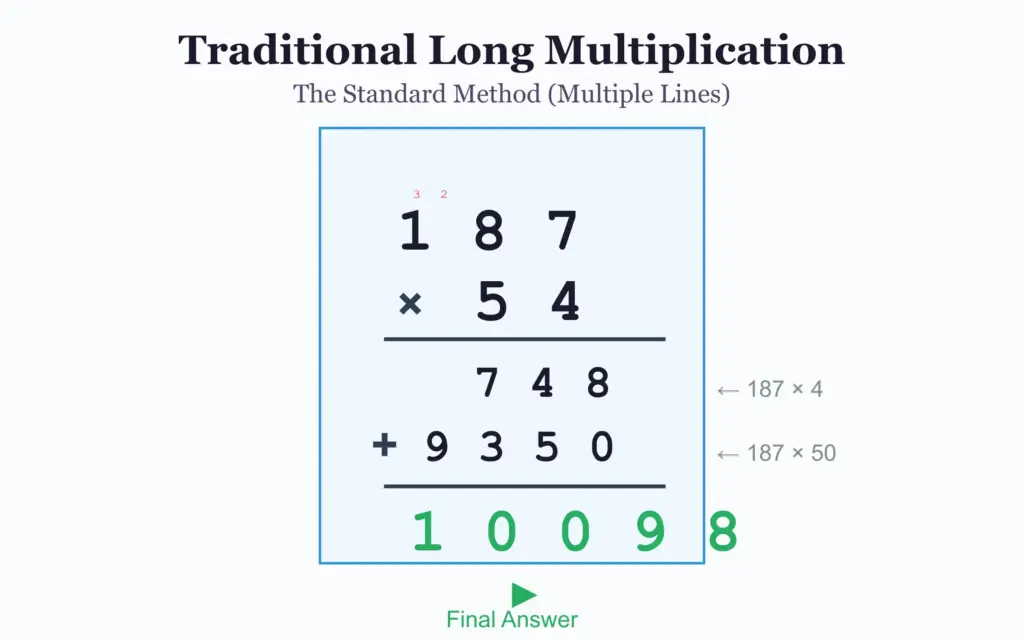
For 187 x 54, long multiplication writes 187 x 4 = 748 and 187 x 50 = 9,350, then adds them to get 10,098. The vertical-and-crosswise version forms the same place-value totals from right to left.
The OpenStax standard multiplication lesson describes the standard algorithm as multiplying by each digit, lining up place values, and adding partial products. Keep that method. An alternative algorithm is useful only when you can explain why both give the same answer.
| Equal-length factors | Digit products | Diagonals | Long method products |
|---|---|---|---|
| 2 digits x 2 digits | 4 | 3 | 4 |
| 3 digits x 3 digits | 9 | 5 | 9 |
| 4 digits x 4 digits | 16 | 7 | 16 |
| 5 digits x 5 digits | 25 | 9 | 25 |
Why the vertical-and-crosswise method works
The method is digit convolution in base 10. Number the digits from the right starting at zero. For each answer position k, multiply every pair of digits whose position numbers add to k.
Two-digit derivation
Write the factors as \(10a+b\) and \(10c+d\). Then:
\[(10a+b)(10c+d)=100ac+10(ad+bc)+bd.\]
- Units diagonal: \(bd\).
- Tens diagonal: \(ad+bc\).
- Hundreds diagonal: \(ac\).
- Carry rule: add the incoming carry, write the units digit, and carry the remaining tens or hundreds.
For 23 x 41, the raw diagonal sums are 3, 14, and 8 from right to left. Write 3; write 4 and carry 1; then 8 + 1 = 9. The answer is 943.
Three-digit derivation
Write the factors as \(100a+10b+c\) and \(100d+10e+f\). Expanding and grouping by powers of ten gives:
\[10000ad+1000(ae+bd)+100(af+be+cd)+10(bf+ce)+cf.\]
Those five coefficients are the five vertical-and-crosswise diagonals. Carries convert coefficients larger than 9 into ordinary base-10 digits.
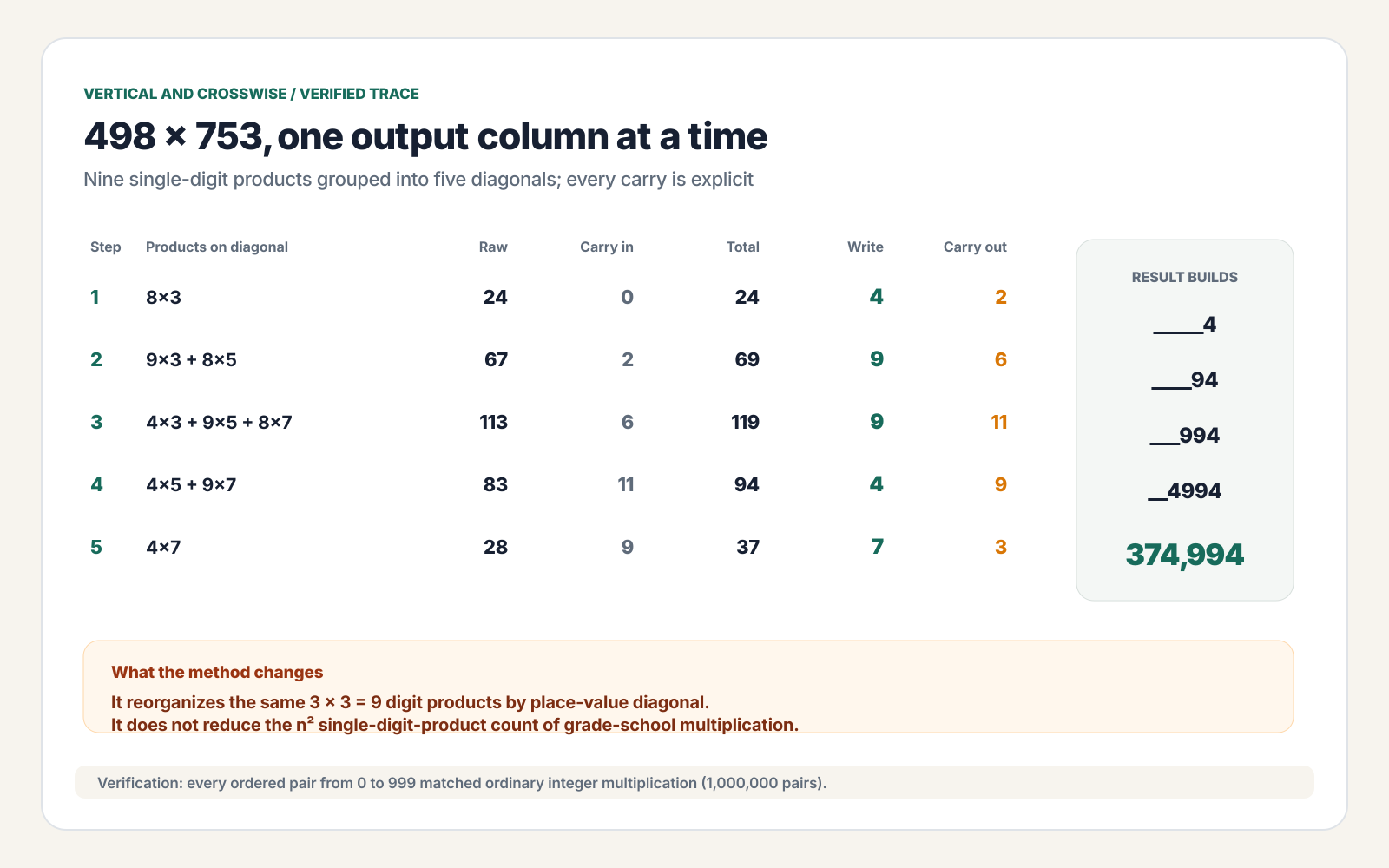
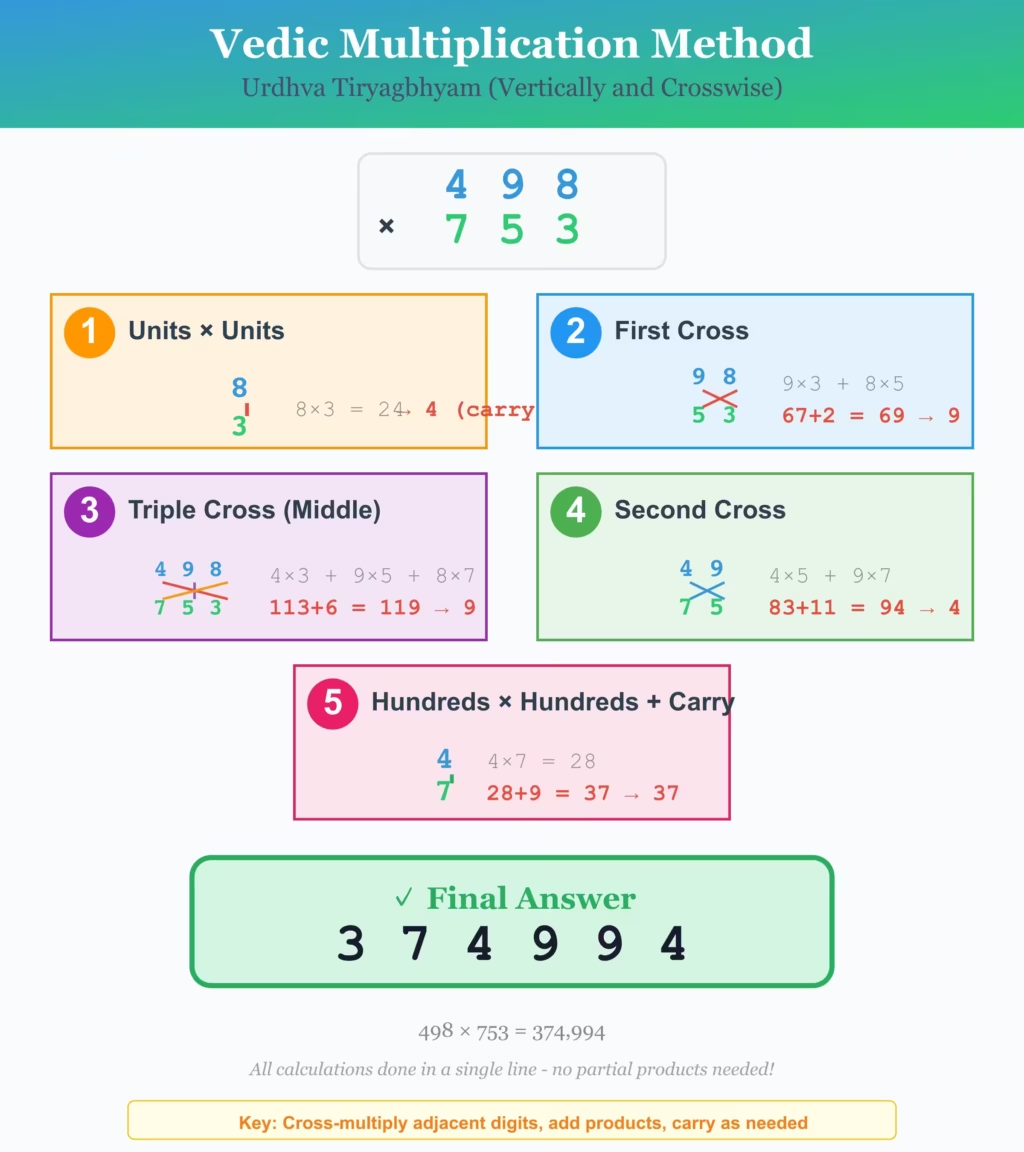
Worked example: 498 x 753
The correct product is 374,994. Work from the units side and keep the carry separate from the next raw diagonal sum.
Step 1: units diagonal
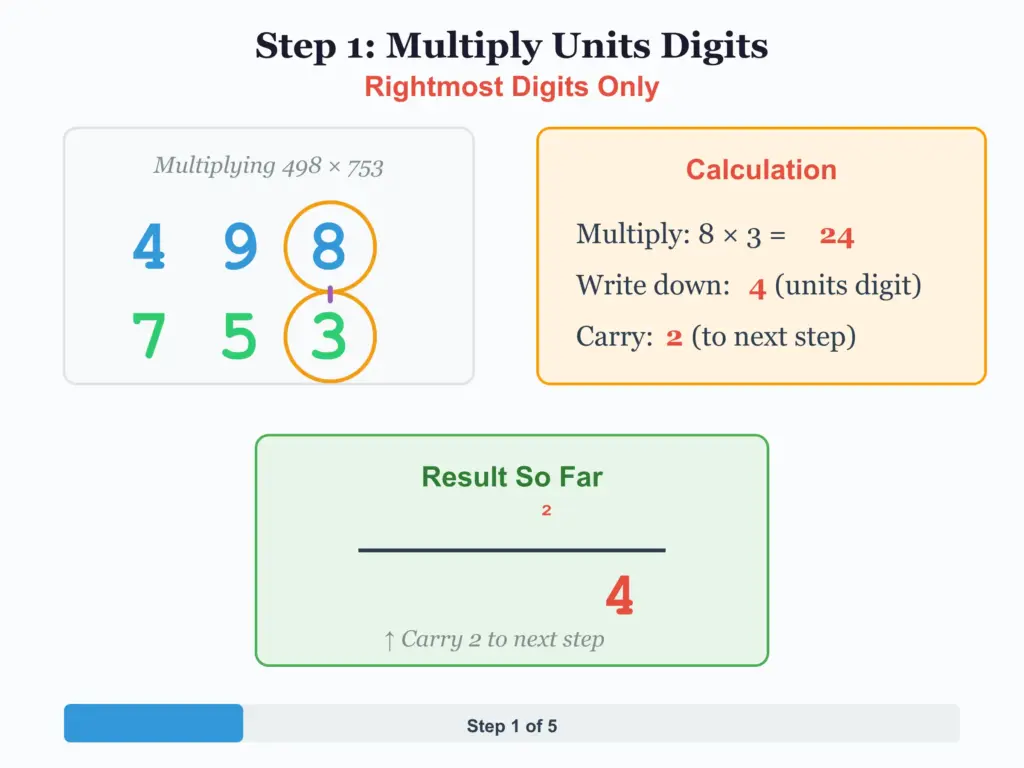
- Multiply 8 x 3 = 24.
- Write 4 in the units place.
- Carry 2.
Step 2: first cross
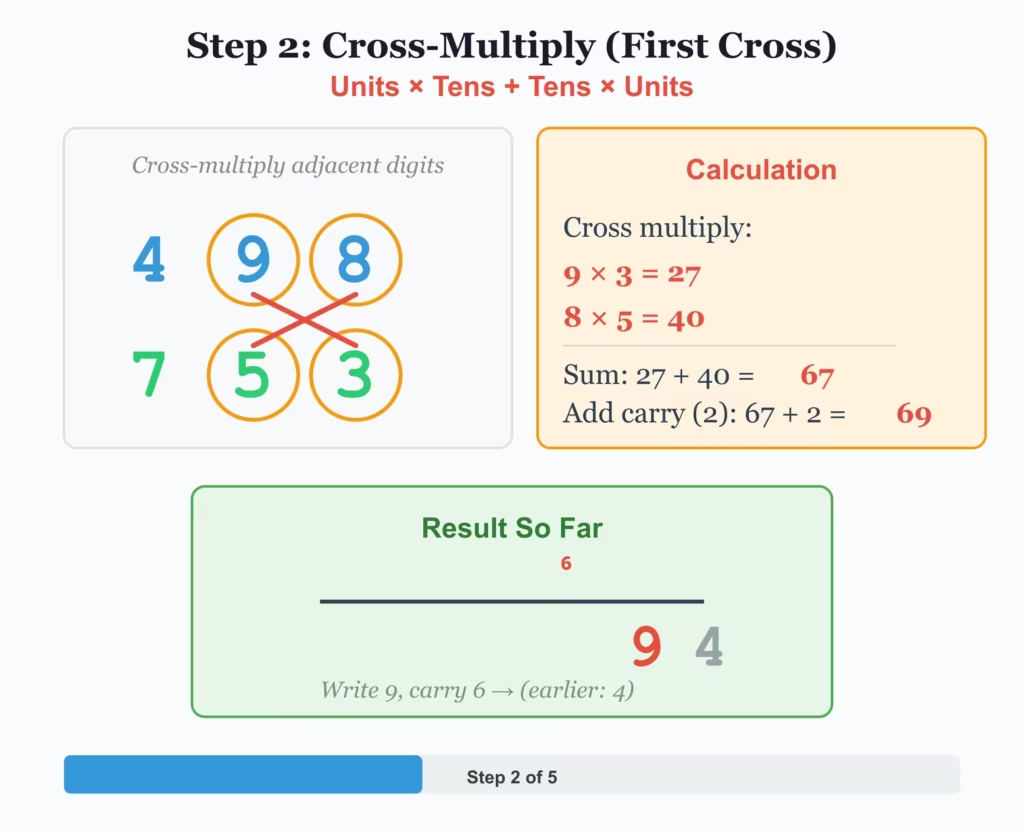
- Raw diagonal: (9 x 3) + (8 x 5) = 27 + 40 = 67.
- Add the carry: 67 + 2 = 69.
- Write 9; carry 6.
Step 3: middle triple
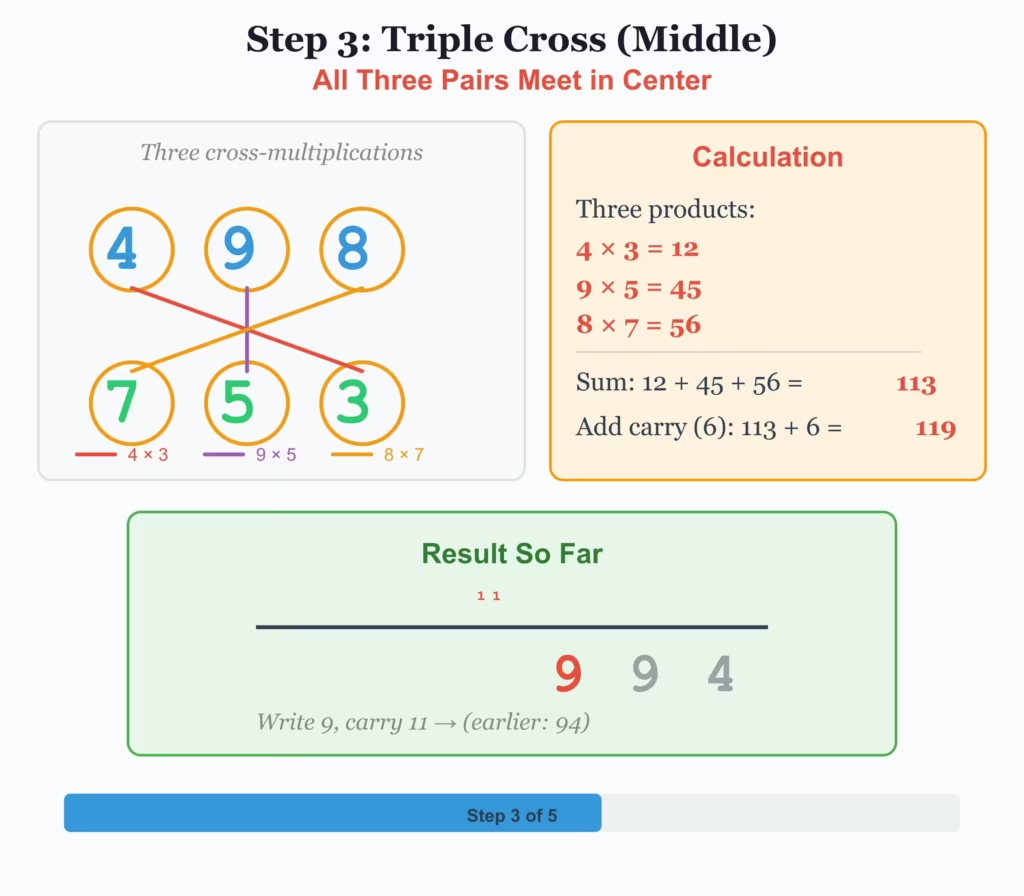
- Raw diagonal: (4 x 3) + (9 x 5) + (8 x 7).
- The three products are 12 + 45 + 56 = 113.
- Add the carry: 113 + 6 = 119.
- Write 9; carry 11.
Step 4: second cross
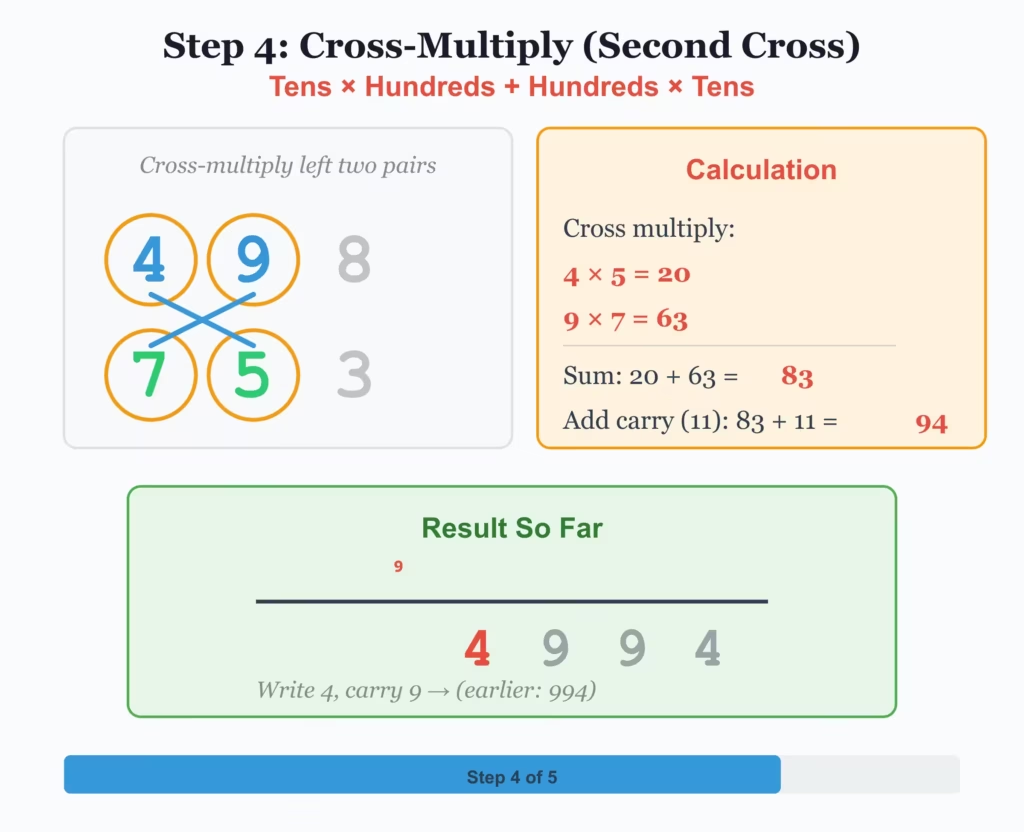
- Raw diagonal: (4 x 5) + (9 x 7) = 20 + 63 = 83.
- Add the carry: 83 + 11 = 94.
- Write 4; carry 9.
Step 5: final vertical
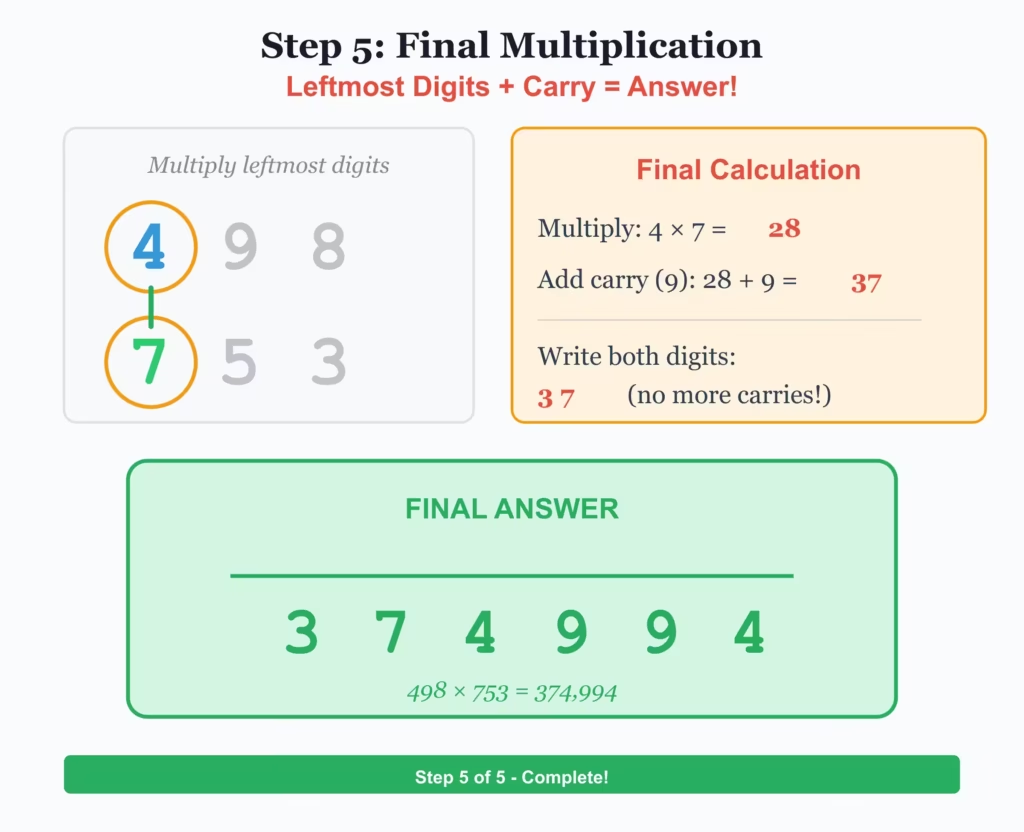
- Multiply 4 x 7 = 28.
- Add the carry: 28 + 9 = 37.
- No diagonals remain, so write the complete 37 to the left.
- Final result: 374,994.
How the arithmetic was verified
A worked example catches a typo; a derivation and broad test catch an algorithm error. I implemented the diagonal formula directly and compared it with ordinary integer multiplication.
- Range: both factors from 0 through 999 inclusive.
- Ordered pairs: 1,000 x 1,000 = 1,000,000.
- Product mismatches: 0.
- Commutativity failures: 0 when comparing a x b with b x a.
- Finite-test limit: the test validates the implementation on that range. The algebraic expansion explains why the rule works for any finite base-10 integers.
| Example | Verified product | Useful edge |
|---|---|---|
| 23 x 41 | 943 | Two-digit carry |
| 187 x 54 | 10,098 | Unequal digit lengths |
| 498 x 753 | 374,994 | Carry 11 in the middle |
| 999 x 999 | 998,001 | Large carries |
| 105 x 23 | 2,415 | Zero as a place holder |
| 286 x 407 | 116,402 | Internal zero in one factor |
This is the same distinction I use when auditing a possible proof of the Collatz conjecture: many correct examples support a calculation, while a general mathematical claim still needs a valid derivation.
Four common mistakes and what they produce
Most wrong answers come from bookkeeping, not the crosswise pattern. The failure cases below were injected into the checked examples so the wrong outputs are reproducible.
| Mistake | Wrong result | Correct result | Repair |
|---|---|---|---|
| Drop every carry in 498 x 753 | 83,374 | 374,994 | Keep carry-in and raw diagonal sum in separate columns |
| Omit 8 x 7 from the middle diagonal | 369,394 | 374,994 | For diagonal k, include every digit pair whose indices add to k |
| Collapse the zero place in 105 x 23 into 15 x 23 | 345 | 2,415 | Pad and preserve zeroes as positions |
| Forget two decimal places after 125 x 34 | 4,250 | 42.50 | Restore the combined decimal-place count |
The OpenStax decimal-operations rule uses the same decimal rule: multiply as whole numbers, then place the decimal using the total decimal places in the factors.
When this method helps and when it does not
Use the method when the diagonal pattern reduces your written clutter without increasing your errors. Do not use it merely because someone advertises a dramatic speed claim.
- Good fit: you know single-digit products fluently, can hold a carry, and want an independent checking method.
- Useful for learning: the diagonals expose the place-value structure hidden inside shifted partial-product rows.
- Useful for exams: only after mixed, timed practice shows that it is accurate under the real format.
- Poor fit: the middle diagonals overload working memory or you start skipping zeroes and carries.
- Keep the standard method: it is familiar, easy to show for method marks, and scales predictably on paper.
- Use a calculator: for high-stakes finance, engineering, tax, or safety calculations, then verify inputs and units as well as arithmetic.
The National Academies review of computational fluency recommends examining why algorithms work and comparing their advantages and disadvantages. It also treats mental arithmetic as a chance to make sense of number properties. That is a stronger reason to learn this method than an unsourced promise that every student will calculate in four seconds.
The What Works Clearinghouse mathematics practice guide recommends brief timed activities as one way to build fluency, alongside systematic instruction and representations. Time yourself only after you can produce and explain correct work. Use study techniques that actually work and memory methods that make revision stick to space and mix the practice.
How to check the answer without repeating the same mistake
An independent check should fail differently from the method that produced the answer. Repeating the same diagonal work can repeat the same omitted term.
- Last digit: 8 x 3 ends in 4, so 498 x 753 must end in 4.
- Estimate: 500 x 750 = 375,000, so 374,994 has the right scale.
- Modulo 9: 498 is 3 modulo 9 and 753 is 6 modulo 9. Their product is 0 modulo 9. The digits of 374,994 sum to 36, also 0 modulo 9.
- Independent algorithm: compute 498 x 700 + 498 x 50 + 498 x 3 = 348,600 + 24,900 + 1,494 = 374,994.
- Know the limit: the modulo-9 check can miss an error whose difference is a multiple of 9.
Practice questions
Write every carry for the first three problems. Then try the last three with less notation. Do not look at the answer table until you have also estimated the product.
- 32 x 14
- 47 x 62
- 105 x 23
- 286 x 407
- 999 x 876
- 12.5 x 3.4
Answers and verification cues
| Problem | Answer | Quick check |
|---|---|---|
| 32 x 14 | 448 | Ends in 8; 30 x 15 is about 450 |
| 47 x 62 | 2,914 | Ends in 4; 50 x 60 is about 3,000 |
| 105 x 23 | 2,415 | 100 x 23 + 5 x 23 |
| 286 x 407 | 116,402 | 286 x 400 + 286 x 7 |
| 999 x 876 | 875,124 | 876,000 – 876 |
| 12.5 x 3.4 | 42.50 | 125 x 34 = 4,250; restore two places |
If you want the steps to survive past one practice session, use retrieval instead of rereading. My guide to remember better for your exams explains how to schedule that.
Vedic multiplication FAQ
These answers separate the arithmetic, history, speed, and exam questions.
Is Vedic multiplication faster than long multiplication?
It can feel faster after practice because it groups digit products by output column and can be performed in one running line. It does not reduce the basic n-squared single-digit-product count: two three-digit factors still require nine digit products. Speed depends on recall, carry control, working memory, and the numbers.
Why does the vertical-and-crosswise method work?
It is ordinary place-value multiplication written as a digit convolution. For each power of ten, multiply every digit pair whose place indices add to that power, add the incoming carry, write the units digit, and carry the rest. Expanding the two numbers algebraically gives the same diagonal sums.
Is Urdhva-Tiryagbhyam proven to come from the Vedas?
This guide uses the conventional name attached to Bharati Krishna Tirtha’s book Vedic Mathematics, published in 1965. The arithmetic derivation here proves the algorithm, not an ancient textual origin. Treat the historical provenance as a separate research question.
Does Vedic multiplication work with zeroes and decimals?
Yes, if place value is preserved. Keep zeroes as digit positions. For decimals, multiply as integers and restore the total number of decimal places from both factors. For example, 12.5 x 3.4 becomes 125 x 34 = 4,250, then two decimal places gives 42.50.
Can I use this method in an exam?
Use any mathematically valid method the exam permits, but show the required working when marks depend on method. Practice under the same time and format constraints before relying on it. If the carry pattern is not automatic, the standard algorithm may be safer.
How can I check a Vedic multiplication answer?
Use more than one check: compare the last digit, estimate the size, check residues modulo 9, and recompute with an independent method. A modulo-9 check can miss errors whose difference is divisible by 9, so it should never be the only verification.
The one requirement
You need reliable multiplication facts and honest carry bookkeeping. The criss-cross diagram cannot rescue a weak 8 x 7 or a missing zero position.
Start with two digits. Explain the algebra. Check every answer with a different route. Then move to three digits only when the diagonal order feels boring. That is the point at which the method becomes useful rather than impressive.
Tell Google you want more of this.
Add Gaurav Tiwari as a preferred sourceOne tap, and this site shows up more often in your own Top Stories, AI Overviews and AI Mode. Remove it any time.