
How to Build a Trading Plan That Actually Holds Up Under Pressure
 by
by
Most traders don’t fail because they picked the wrong asset. They fail because they walked into the market with a vibe, not a plan.
I’ve watched friends blow up $20,000 accounts in a weekend. Not because the market was rigged. Because they had no written rules, no position sizing, and no exit condition. They were hoping. Hope is not a plan. It’s the opposite of a plan.
A trading plan is a one-page document that tells you exactly what to do before, during, and after every trade. When the market moves against you and your heart rate spikes, the plan is the thing standing between your account and a margin call. That’s the whole point.
Verdict: Most retail traders lose. ESMA’s own data puts 74-89% of retail CFD and forex accounts in the red, and for active day traders the failure rate runs 89-95% inside the first year. The edge isn’t a secret indicator. It’s a written trading plan with hard risk management: 1% risk per trade, a stop-loss typed into the platform, and a review schedule. That combination is what separates the 5-7% still profitable after five years from everyone else. This is for anyone trading their own money who keeps blowing up despite “good” setups. It is not financial advice.
Here’s how to build one. Five steps, in the order that actually matters.
Trading Plan vs Trading Strategy: Not the Same Thing
Quick clarification before we go further, because the two get confused every single day.
A strategy is the specific setup you trade. “Buy when the 50-day moving average crosses above the 200-day on SPY.” That’s a strategy.
A plan is the container around the strategy. It tells you how much capital to risk, when you’re allowed to trade, what triggers you to pause, how you journal results, and when you review the whole thing. The plan is the operating system. The strategy is one app running on it.
You can have a beautiful strategy inside a terrible plan and still blow up. You can have an average strategy inside a disciplined plan and build wealth slowly. Most traders skip the plan part and wonder why the great setups they read about on Twitter don’t work for them.
Performance tracking across the best CFD trading platforms can also provide useful benchmarks for adjusting those targets based on market conditions and actual results. The platform matters less than the discipline. But knowing what a decent execution environment looks like saves you from blaming tooling for mistakes that are really plan gaps.
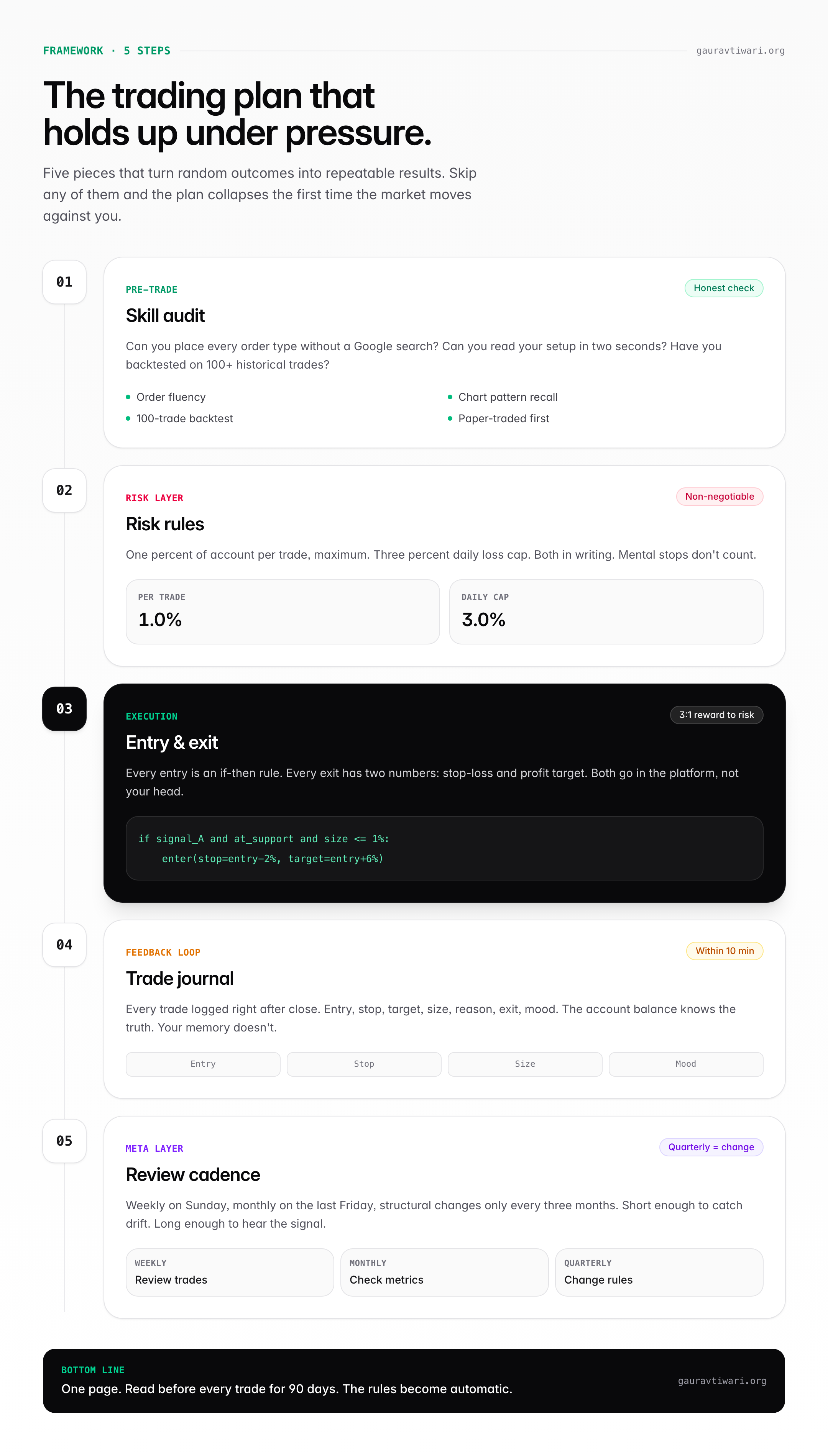
The five pieces above are what I’d put on the one-page plan. Each one is explained below.
Why most traders fail (the data): Under ESMA rules, every broker must publish the share of clients who lose money, and the regulator’s own analysis of national authorities found 74-89% of retail CFD accounts end up in the red, with average losses ranging from roughly €1,600 to €29,000 per client. For active day traders the numbers are worse: studies put the one-year loss rate at 89-95%, more than 75% quit within two years, and only about 5-7% are still net profitable after five years. The common thread among the survivors isn’t a better strategy. It’s risk management and a plan they actually follow. Sources: ESMA product-intervention disclosures; aggregated 2024-2025 broker risk warnings. Trading carries a real risk of loss.
| Plan component | What it locks in | My default rule |
|---|---|---|
| Skill audit | Whether you’re ready for live capital | 3 yes/no checks, 100+ back-tested setups |
| Risk rules | How much you can lose per trade and per day | 1% per trade, 3% daily loss cap |
| Entry and exit | When you’re allowed in, and where you get out | If-then entries, 3:1 reward-to-risk, hard stop |
| Trade journal | The feedback loop that turns trades into skill | Every trade logged within 10 minutes of close |
| Review cadence | When you’re allowed to change the plan | Weekly, monthly, quarterly deep-dive |
If you’re newer to markets than this assumes, get the foundations first. My guide on how to invest in stocks for beginners covers order types and account setup, and the simple math behind long-term growth explains why position sizing and compounding beat swinging for home runs.
Step 1: Be Honest About What You Actually Know
Start here. Not with the strategy. With the skill audit.
Trading is a performance sport. You wouldn’t sign up for a marathon without knowing your current pace. Most new traders sign up for a $10,000 live account without knowing if they can place an order, read a chart, or tell the difference between a limit order and a stop-limit.
The honest skill assessment is three questions:
Can you place, modify, and cancel every order type your broker offers? If you’ve never closed a position from the mobile app at 3 AM with sweaty palms, you don’t know the UI. You know the demo.
Can you read the chart patterns your strategy depends on without looking them up? If your plan says “enter on a bullish flag breakout,” you need to be able to spot a bullish flag in two seconds, not argue with yourself about whether the consolidation is tight enough.
Have you back-tested the strategy on at least 100 historical setups? Not 10. Not 20. One hundred. Until you’ve seen the pattern fail in every imaginable way, you don’t know the pattern.
If any of those three is a no, trade on paper for another month. Nobody’s giving out prizes for speed.
I realize this sounds slow. It is slow. It’s also the step that separates the 10% of traders who last five years from the 90% who quit inside the first year.
Step 2: Lock In Your Risk Rules Before You Open a Position
Risk rules are the most important part of the plan. Everything else is optional. Risk rules are not.
The rule I’d write down first: never risk more than 1% of your account on a single trade. Some aggressive traders stretch to 2%. Nobody with a decade in the market goes higher than that on a regular basis.
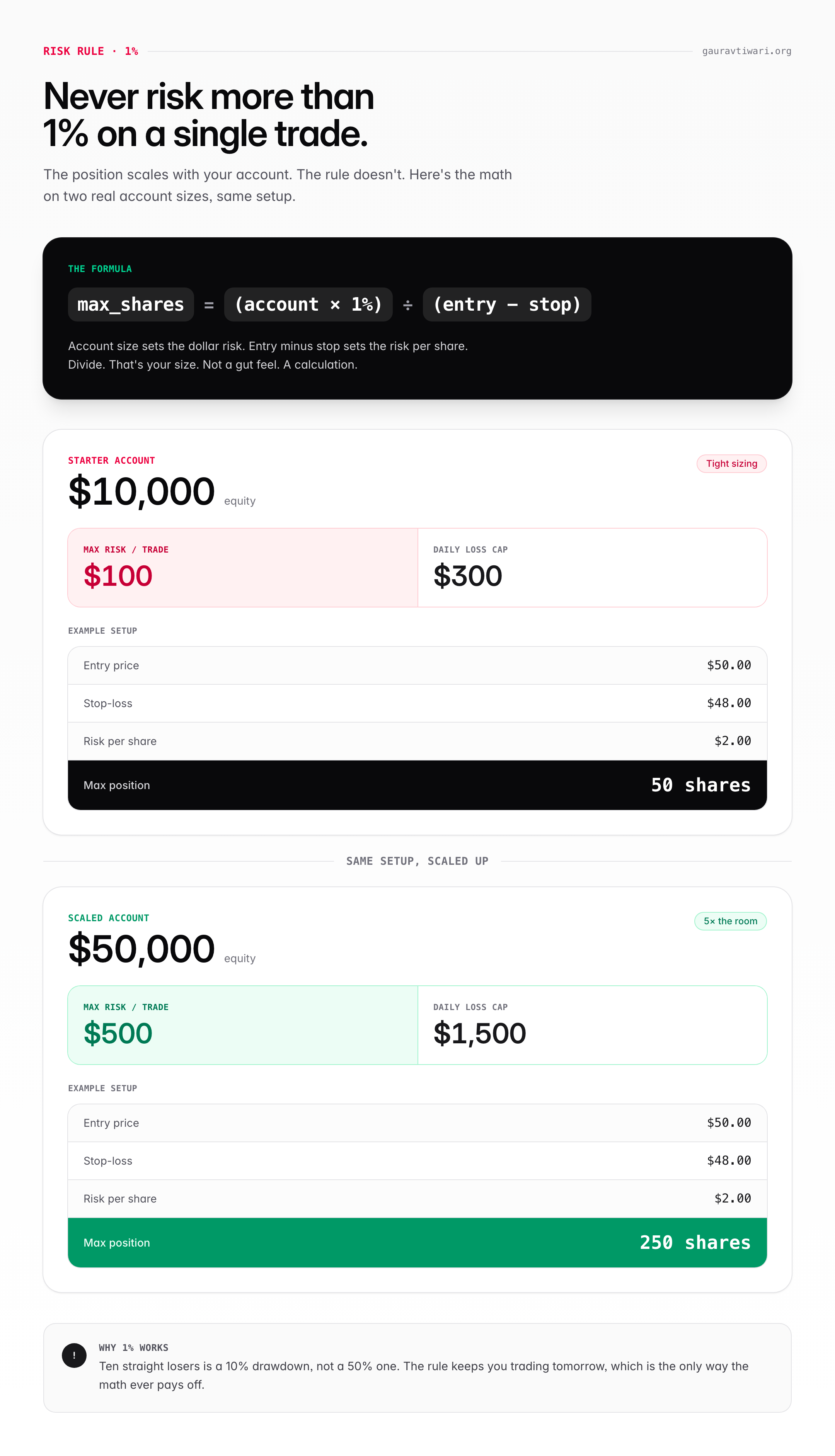
The math is non-negotiable.
On a $10,000 account, 1% is $100. That’s the maximum you can lose on one trade. If your entry is $50 and your stop-loss is $48, you’re risking $2 per share. Divide $100 by $2 and you get 50 shares. That’s your position size. Not 100. Not “let me just grab 75 since this one feels strong.” Fifty.
On a $50,000 account with the same setup, the rule gives you 250 shares. Same entry, same stop, same risk percentage. The position scales with the account. The rule does not.
The second risk rule: a daily loss cap. Mine would be 3% of the account. If the day’s P&L hits -3%, the screen closes. No revenge trades. No “one more setup to get it back.” Get up, go for a walk, come back tomorrow. I’ve seen traders turn a -2% day into a -18% day chasing the red. Never seen anyone earn back a bad day by forcing trades.
Both rules go on the plan in writing. Not in your head. Mental stops don’t count.
Step 3: Define Your Entry and Exit Rules in Plain English
Most new traders spend 90% of their time thinking about entries and 10% on exits. That ratio is backwards. The exit is where the money is made or lost. The entry just gets you in the room.
Write every entry rule as an if-then statement. No ambiguity.
“If the 50-day crosses above the 200-day AND price is within 1% of a key support level AND my position size is within the 1% rule, then I enter at market open the next day with a stop-loss 2% below entry.”
That sentence is four conditions and one action. A trade either passes all four checks or it doesn’t happen. No gut feel. No “I just have a good feeling about this one.”
Exits are trickier because they’re emotional. Two exits exist for every trade:
The stop-loss. Set before entry. Written in the platform, not in your head. If it hits, you close. If it hits, you do not widen the stop. If it hits, you do not hold “just in case it bounces.” It hits, you’re out. The stop is the only thing between you and a catastrophic loss.
The profit target. Ideally three times your stop distance. If you’re risking $2 per share, you’re targeting $6 per share of profit. That’s the 3-to-1 risk-reward ratio, and it’s the math that lets you win 40% of your trades and still grow the account.
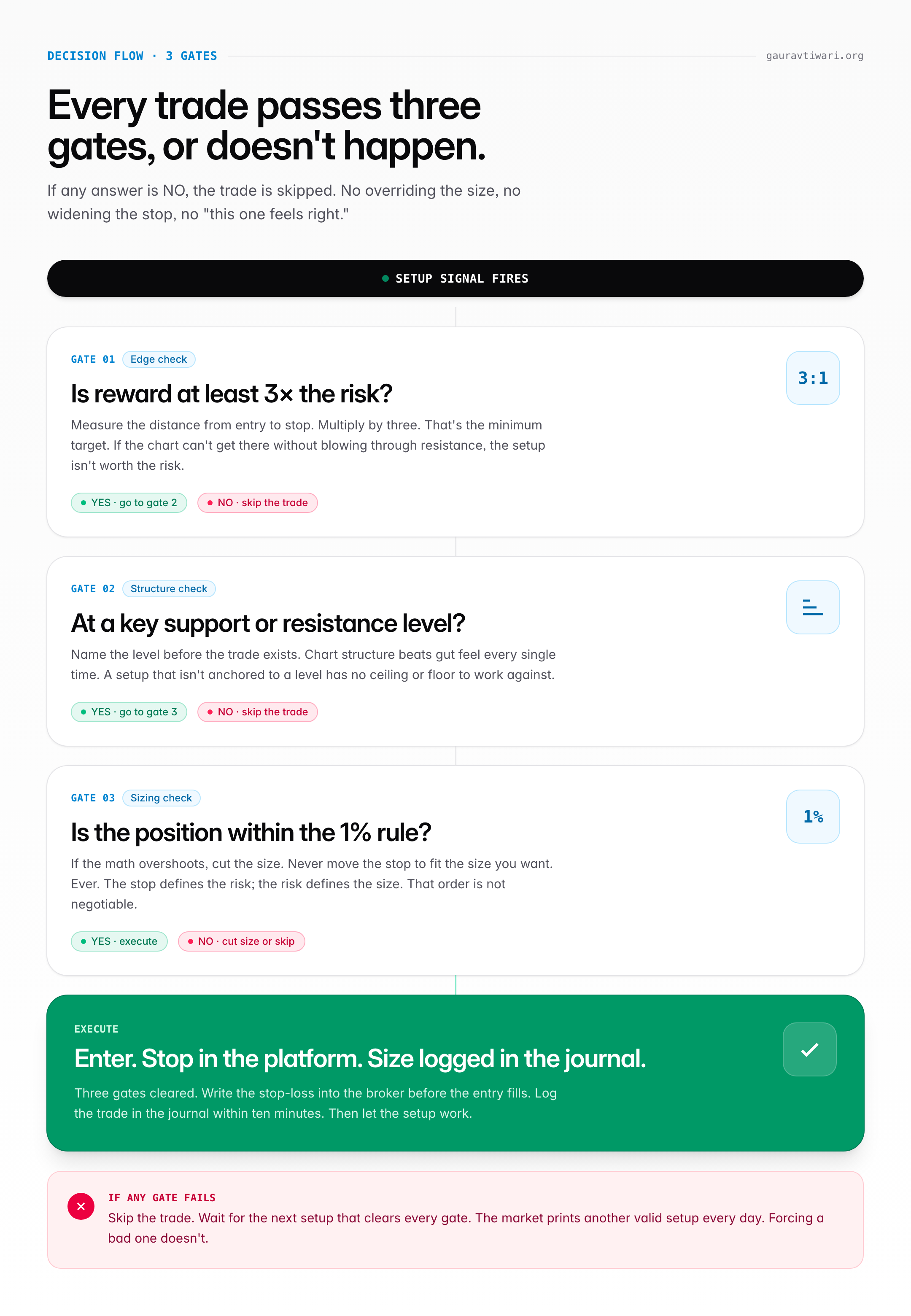
The flowchart above is the mental checklist I’d tape to the monitor. Every trade runs through it. If the answer is NO at any step, the trade doesn’t happen.
Here’s the uncomfortable part. You will skip the checklist sometimes. Everyone does. The plan’s job is not to make you perfect. It’s to make you catch yourself within three trades, not within three months.
Step 4: Journal Every Trade. Winners and Losers.
Traders who last are not smarter. They’re better record-keepers.
The trade journal is the feedback loop that turns random outcomes into a skill. Without a journal, you can trade for a decade and still have no idea which setups actually make you money. You’ll remember the big wins and forget the steady losses. The account balance knows the truth. Your memory doesn’t.
A working journal for every trade captures:
- Date and time of entry
- Ticker or pair
- Setup type (which of your strategies fired)
- Entry price, stop-loss, profit target
- Position size and total capital at risk
- Reason for entering, in one sentence
- Exit price and reason for exiting
- P&L in dollars and as a percentage
- Screenshot of the chart at entry and at exit
- A one-line note on how you felt during the trade
The last one sounds soft. It’s the most important entry in the journal. “Felt anxious during the trade, moved the stop twice” tells you more about why you lost than any technical reason ever will.
I’d use Notion or a Google Sheet. Doesn’t matter which. It matters that you fill it out inside 10 minutes of closing the trade, while the memory is fresh. Do it at the end of the week and you’ll invent reasons that didn’t exist.
After 50 trades, start looking for patterns. Which setup has the highest win rate? Which day of the week drains the account? Which times of day produce the cleanest entries? The answers are always surprising. Read your journal the way you’d read a company’s books in financial statement analysis, where the numbers tell you what’s actually working regardless of how the trades felt. One of my friends discovered he lost money every Monday for eight straight months before he ran the numbers. He stopped trading Mondays. His equity curve turned the corner inside a quarter.
Step 5: Review the Plan on a Schedule
The plan isn’t set in stone. It’s a living document that needs regular revision.
My review cadence:
Weekly review, every Sunday. Look at the week’s trades. What worked? What didn’t? Any rule violations? If you broke a rule, why? Was it a one-off slip or a pattern? Write down one thing to do differently next week.
Monthly review, last Friday of the month. Zoom out. What’s the month’s win rate? Average R-multiple (how many times your risk did you make or lose per trade)? Are the numbers trending up or down? If the drawdown is getting deeper month over month, something’s broken.
Quarterly deep-dive, every three months. This is when you change the plan. Not before. Three months is enough data to know whether a rule is working. Anything shorter is noise. Quarterly is when you might tighten the daily loss cap, add a new setup, remove a setup that doesn’t pay, or raise your risk per trade because the account grew.
The trap: reviewing too often and changing rules every week. You’ll never know what works if you don’t give a rule time to prove itself. Three months minimum before you change anything structural. Stick to it even when the results are mixed.
The Mental Preparation Layer Nobody Talks About
Plans don’t fail on paper. They fail on Tuesday at 2:47 PM when the chart does something your plan didn’t anticipate and your pulse is at 120.
A few things I’d put on the plan for the mental side:
Sleep is a trading tool. Six hours or less and your P&L will show it. I don’t mean a little. I mean the same trader on 8 hours and 5 hours is literally a different trader. The 5-hour version takes worse setups, holds losers longer, and exits winners earlier. Track your sleep alongside your P&L for a month and you’ll see the correlation.
Have a pre-market routine. Ten minutes of chart review. Scan the economic calendar. Check news that could move your positions. Write down the three setups you’re watching today and nothing else. The routine grounds you before the market opens. Trading cold is how mistakes happen.
Have a hard stop on screen time. If your strategy is a 30-minute chart setup, you do not need to be watching the 1-minute chart between entries. You will see patterns that aren’t there. You will talk yourself into trades. Close the platform between scans. Walk the dog. Come back.
Know when you’re tilted. Tilt is a poker word that fits trading perfectly. It’s the state where every trade feels urgent and every loss demands immediate revenge. The signs: tight chest, anger at the chart, increasing position size to “get it back,” abandoning the checklist. The moment you notice any of those, close the platform. No exceptions. Tilt costs more than any single bad trade.
The Two Rules I’d Tattoo on My Forearm
If the entire plan above got erased and I could only keep two rules, it would be these:
One percent per trade, maximum. Every other rule exists to keep the account alive long enough for your strategy to work. This is the rule that keeps the account alive.
The stop-loss goes in the platform, not your head. The moment you tell yourself “I’ll exit if it hits this level” without typing the number into your broker, you’ve already lost the trade. You just don’t know it yet.
Every other rule is customizable. Those two are not.
Common Plan-Killers I’ve Seen
A few patterns that end plans faster than anything else:
Plan is too long. If it’s longer than one page, you won’t use it. The whole thing needs to fit on something you can read before the market opens in 90 seconds. Cut everything that doesn’t change your behavior at the desk.
Plan is too strict. If the rules are so tight that no realistic setup ever passes, you’ll start ignoring the plan within two weeks. Rules that can’t be followed aren’t rules.
Plan ignores costs. Commissions, spreads, swap fees, slippage. A strategy with a 0.3% edge per trade can be net-negative after costs. Every plan needs a cost section with the fees you actually pay, not what the broker advertises. This bites hardest in volatile assets, which is one reason I’m cautious about treating crypto as a trading vehicle until your plan and risk rules are airtight.
Plan doesn’t match your schedule. If your strategy is intraday scalping but you have a full-time job, the plan is fiction. Build a plan for the time you actually have, not the time you wish you had. Swing trades on a daily chart exist for a reason.
No drawdown rule. A plan without “when do I pause and reassess” turns into a slow bleed. Set a max drawdown from peak equity. Mine would be 15%. If I hit it, the live account closes and I’m back on paper until I can explain what went wrong.
So What’s the Minimum Viable Plan?
If all of this feels like a lot, here’s the one-page starter version I’d write down today:
- Account size: $_______
- Risk per trade: 1% of current account size
- Daily loss cap: 3% of starting day balance
- Setups I’ll trade: [List 1-3 specific setups, no more]
- Entry rule: Trade only triggers when all setup conditions are met AND risk-reward is at least 3:1
- Stop-loss: Written in platform at time of entry, never moved against me
- Profit target: 3x the stop distance, first scale-out at 2x
- Journal: Every trade logged inside 10 minutes of close
- Review: Weekly on Sunday, monthly on last Friday, deep review every quarter
- Break-glass rule: Hit the daily loss cap? Close platform. Come back tomorrow.
Print it. Tape it next to the monitor. Read it before you place every trade for the first 90 days.
Final Word
A trading plan isn’t a guarantee of profit. It’s a guarantee that when you do profit, you’ll know why. And when you lose, you’ll know what to fix.
Most traders never get that clarity because they never write anything down. They run on feel for a year, blow up, and decide trading doesn’t work. Trading works. Feel doesn’t.
Build the plan. One page. Five steps. Read it every morning until the rules are so automatic you don’t notice them anymore.
Then, and only then, does the market stop feeling like chaos and start looking like a system you can work with.
Tell Google you want more of this.
Add Gaurav Tiwari as a preferred sourceOne tap, and this site shows up more often in your own Top Stories, AI Overviews and AI Mode. Remove it any time.