
The Story Of The Real-Life Soñador: Mariah’s Storm
 by
by
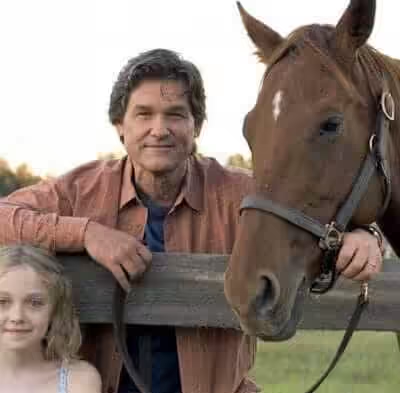
Dreamer, the 2005 movie starring Dakota Fanning and Kurt Russell, tells the story of Soñador, a Thoroughbred mare who suffers a catastrophic leg injury during a race. Her trainer, Ben Crane, and his daughter Cale refuse to give up on her. They nurse her back to health, discover she can still run, and eventually enter her in the Breeders’ Cup Classic, one of the most prestigious races in North American horse racing.
The movie is a Cinderella story. The mare is dismissed by everyone. The family is broke. The odds are impossible. And then she wins.
Most people who watch the film assume it is pure fiction. It is not. Soñador is fictional, but the movie is based on the real story of a Thoroughbred mare named Mariah’s Storm, whose career followed a remarkably similar arc: a devastating injury, a comeback nobody expected, and a legacy that reshaped the sport.
The Real Horse: Mariah’s Storm
Mariah’s Storm was born in 1991, a bay mare sired by Rahy out of Immense (by Roberto). She was bred in Kentucky and owned by Bill Peters, a Chicago-area businessman who raced horses as a passion project rather than a corporate operation.
From the start, she was special. She won her debut race by thirteen lengths. Not a close call. Thirteen lengths. That kind of margin gets attention immediately, and she was quickly pointed toward stakes competition as a two-year-old in the fall of 1993.
She finished second in the Palatine Breeders’ Cup Stakes, then came back to win the Grade II Arlington-Washington Lassie Stakes by a length. The Breeders’ Cup Juvenile Fillies was the target. Everything was on schedule.
The Injury That Should Have Ended Everything
Her next start was the Grade II Alcibiades Stakes at Keeneland. She was running mid-pack when she suddenly went down. A fractured cannon bone. In Thoroughbred racing, this is one of the most feared injuries. It frequently ends careers. It often ends lives.
Most owners would have retired her immediately, if she survived the surgery at all. A cannon bone fracture in a racehorse is not like a broken bone in a human. Horses bear roughly 60% of their body weight on their front legs. A fracture compromises not just the injured leg but the opposite leg, which takes on the extra load during recovery. Secondary laminitis, the condition that killed Barbaro in 2007, is a constant threat.
Bill Peters and trainer Don Von Hemel decided to try anyway. They chose surgery and rehabilitation over retirement or euthanasia. Like Ben and Cale in the movie, they believed their filly could come back.
The Comeback
Less than a year later, Mariah’s Storm reappeared on a racetrack. Not for a light workout. Not for a training exercise. For the Grade III Ak-Sar-Ben Oaks. A real race, against real competition, with real stakes money on the line.
She won by five and a half lengths.
That alone would have been a remarkable story. But she kept going. She won the Rolling Meadows Stakes. Then the Grade III Arlington Heights Oaks. Three wins in a row for a horse who had fractured her cannon bone less than a year earlier.
As a four-year-old, she delivered what may have been her finest performance: the Grade II Turfway Park Budweiser Breeders’ Cup Handicap. She did not just win. She won by daylight. And among the horses she beat was Serena’s Song, who would go on to be named the American Champion Older Female Horse that year. Mariah’s Storm beat a champion, and she did it convincingly.
Where the Movie Diverges from Reality
The Dreamer screenplay takes creative liberties with Mariah’s Storm’s story. Two differences stand out.
The Breeders’ Cup Classic. In the movie, Soñador enters the Breeders’ Cup Classic and wins against male competition in one of the most dramatic fictional finishes in sports movie history. In reality, Mariah’s Storm never ran against males. She was entered in the 1995 Breeders’ Cup Distaff (the top race for female horses), where she ran an uncharacteristically flat race and finished ninth behind winner Inside Information. No fairy tale ending on the track.
The breeding legacy. This is where real life is actually more interesting than the movie. In Dreamer, Soñador cannot reproduce. It is a bittersweet detail that adds emotional weight to her racing comeback. In reality, Mariah’s Storm became one of the most influential broodmares of her generation.
Giant’s Causeway: The Legacy That Changed Racing
After retiring from racing, Mariah’s Storm was bred to Storm Cat, one of the most commercially successful stallions in Thoroughbred history. Her first foal was a chestnut colt named Giant’s Causeway.
Giant’s Causeway became the best racehorse in Europe in 2000. He earned the nickname “The Iron Horse” for his relentless consistency, finishing first or second in nine consecutive Group/Grade 1 races. He won the Eclipse Stakes, the Irish Champion Stakes, and the International Stakes, among others. He was named European Horse of the Year.
At stud, Giant’s Causeway was even more successful than he was on the track. He became a leading sire worldwide, producing champions across multiple continents. His stud fee peaked at $300,000 per breeding. His offspring earned hundreds of millions in prize money. The Coolmore Stud operation, which stood him in Ireland and later in Kentucky, built significant parts of their global breeding empire around his bloodline.
Mariah’s Storm also produced other notable runners, including Freud (a multiple graded stakes winner who became a successful sire himself) and You’resothrilling (dam of multiple Group 1 winners in Europe). Her influence on the modern Thoroughbred gene pool is substantial. Every time a descendant of Giant’s Causeway or Freud wins a major race, Mariah’s Storm’s legacy continues.
Why This Story Matters
Dreamer grossed $32.7 million at the box office and introduced millions of people to a story they did not realize was real. The movie works as entertainment. But Mariah’s Storm’s actual story is more compelling than the screenplay.
A horse breaks her cannon bone, an injury that kills more racehorses than any other. She survives surgery. She recovers. She comes back and wins stakes races. She beats a champion. She retires and produces the best racehorse in Europe, a horse whose descendants are still winning major races more than 25 years later.
No screenwriter would pitch that story because it sounds too unlikely. But it happened.
Mariah’s Storm died in 2010 at the age of 19. She is buried at Ashford Stud in Kentucky, near her son Giant’s Causeway, who died in 2018. Between them, they changed the trajectory of Thoroughbred racing and breeding in ways that will be felt for decades.
Frequently Asked Questions
Is the movie Dreamer based on a true story?
Yes. Dreamer (2005) is based on the real story of Mariah’s Storm, a Thoroughbred mare who fractured her cannon bone during a race in 1993, was rehabilitated, and returned to win multiple stakes races. The movie takes creative liberties (Soñador wins the Breeders’ Cup Classic; Mariah’s Storm did not), but the core story of injury and comeback is real.
What happened to the real horse from Dreamer?
Mariah’s Storm retired from racing after the 1995 season and became a broodmare. Her first foal, Giant’s Causeway, became European Horse of the Year in 2000 and one of the most successful stallions in modern racing history. She died in 2010 at age 19 and is buried at Ashford Stud in Kentucky.
Did Mariah’s Storm win the Breeders’ Cup?
No. Unlike her fictional counterpart Soñador, Mariah’s Storm never ran in the Breeders’ Cup Classic. She was entered in the 1995 Breeders’ Cup Distaff but finished ninth behind Inside Information. Her biggest victories were the Grade II Turfway Park Budweiser Breeders’ Cup Handicap and the Grade III Ak-Sar-Ben Oaks.
Who is Giant’s Causeway?
Giant’s Causeway was Mariah’s Storm’s first foal, sired by Storm Cat. He was named European Horse of the Year in 2000 after winning or placing in nine consecutive Group/Grade 1 races. At stud, he became a leading sire worldwide with a peak breeding fee of $300,000. He died in 2018.
What injury did Mariah’s Storm suffer?
She fractured her cannon bone during the Grade II Alcibiades Stakes at Keeneland in 1993. This is one of the most dangerous injuries in horse racing and frequently ends careers or lives. She underwent surgery and returned to racing less than a year later.
Who owned Mariah’s Storm?
Bill Peters, a Chicago-area businessman, owned Mariah’s Storm throughout her racing career. Don Von Hemel trained her. Peters made the decision to attempt surgery and rehabilitation rather than retire or euthanize her after the cannon bone fracture.
What is a cannon bone fracture in horses?
The cannon bone is the large bone between the knee and the fetlock in a horse’s leg. A fracture here is extremely serious because horses bear most of their weight on their front legs. Recovery is complicated by the risk of laminitis in the opposite leg, which takes on extra load during healing. This is the same complication that killed Barbaro in 2007.
Is Dreamer worth watching?
Yes, especially if you enjoy horse racing or underdog stories. Dakota Fanning and Kurt Russell give strong performances, and the racing sequences are well filmed. Knowing the real story behind it makes the movie more interesting, even though the screenplay changes significant details.
Tell Google you want more of this.
Add Gaurav Tiwari as a preferred sourceOne tap, and this site shows up more often in your own Top Stories, AI Overviews and AI Mode. Remove it any time.