
Free ebook · Number theory
Easy to state. Brutal to prove. That’s number theory at its best.
Number theory is the queen of mathematics, and this free ebook explores three of its most fascinating corners: Fermat numbers, Euler’s prime-generating polynomial, and the Collatz conjecture. Every chapter comes with proofs, complete tables, and the open problems that keep the subject alive.
Free ebook · instant download · no payment step
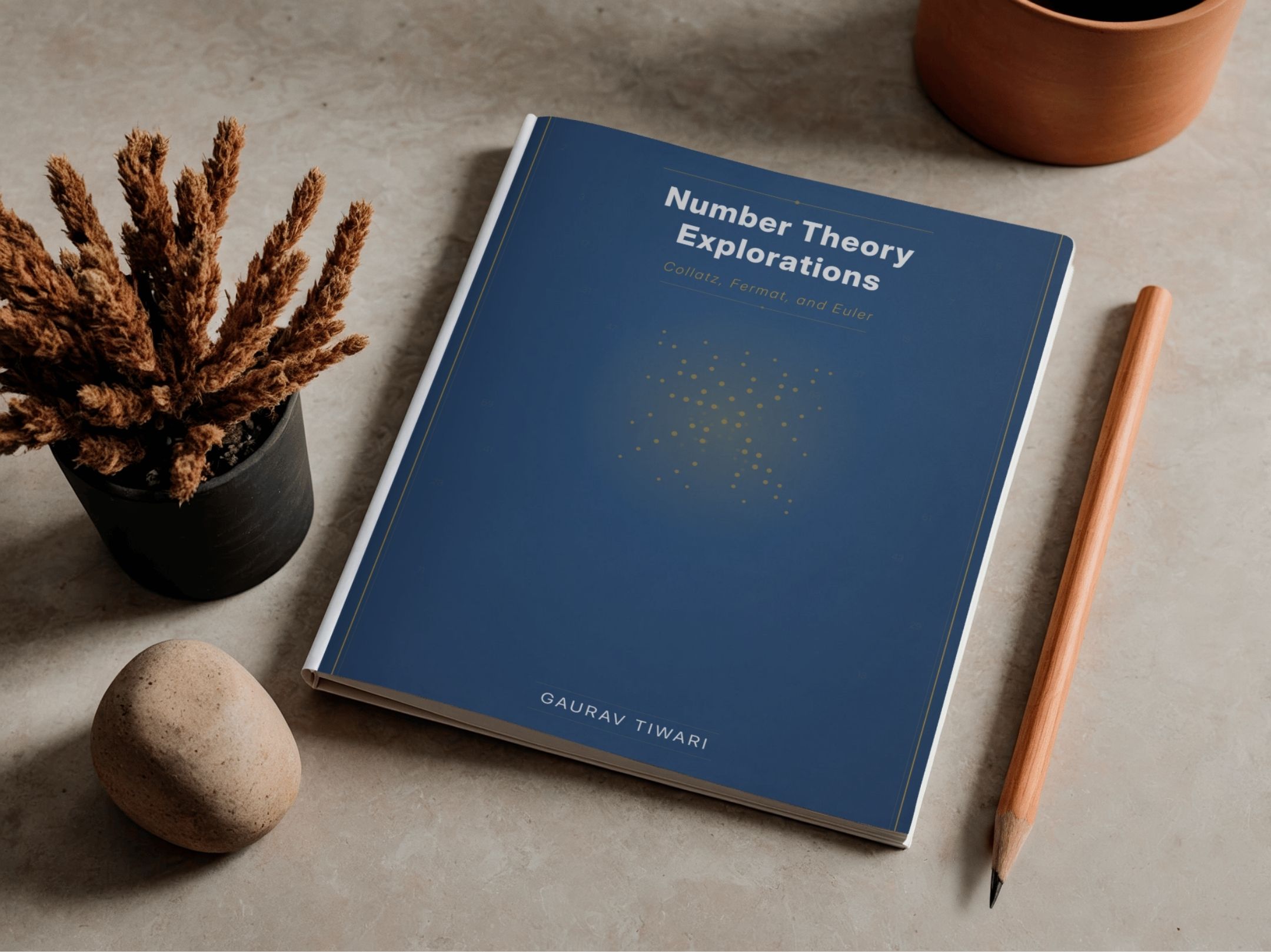
What’s inside
Three corners, each with proofs, tables, and a frontier.
Fermat numbers, Euler’s prime-generating polynomial, and the Collatz conjecture, connected to each other via quadratic residues.
Fermat numbers
- Why the exponent must be a power of 2, proved from the start.
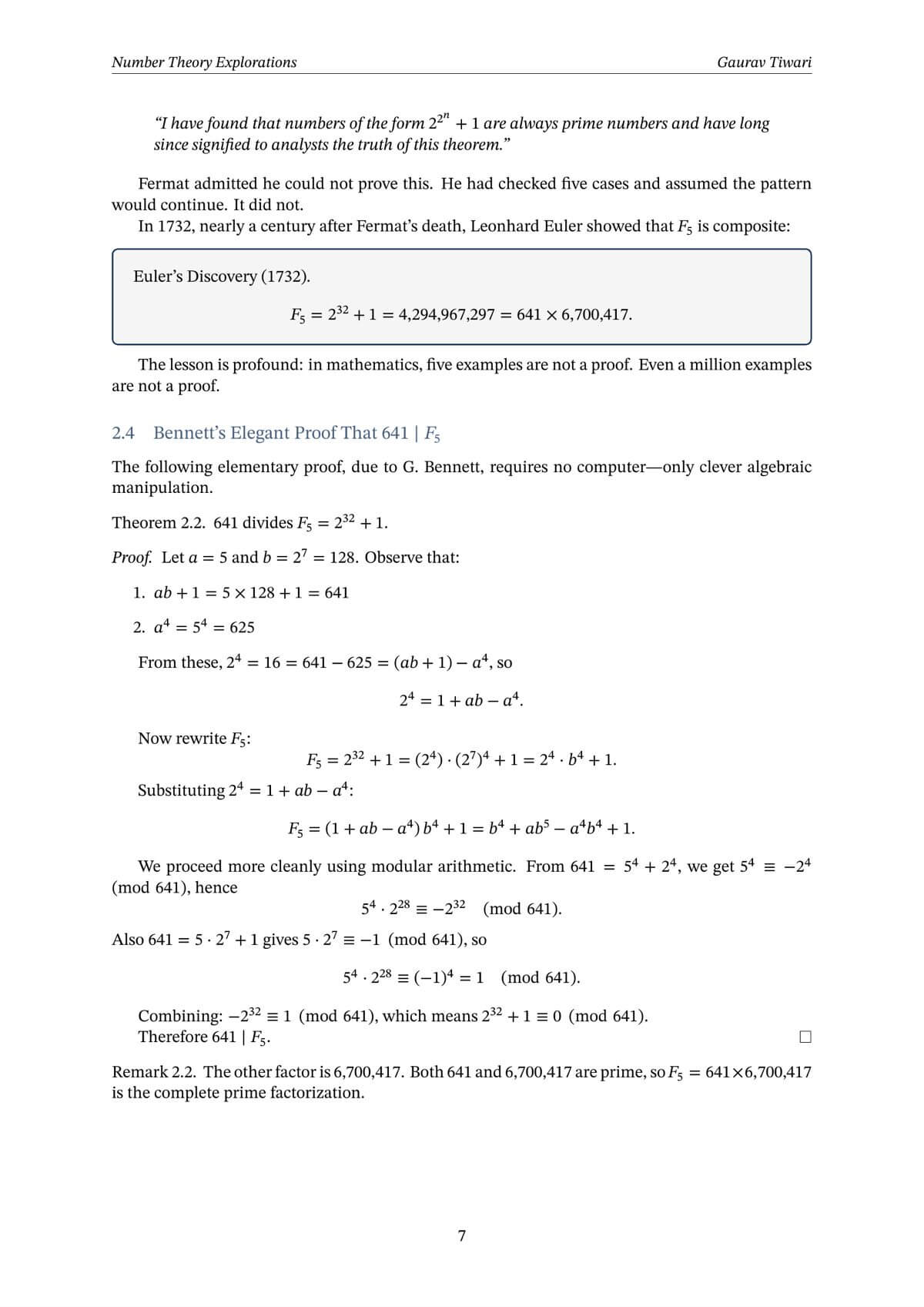
- Euler’s factorization of F5, plus Bennett’s elegant proof that 641 divides it.
- Mutual coprimality and the Euler-Lucas factoring theorem.
- Pepin’s primality test and the connection to constructible polygons.
Euler’s prime polynomial
- n² + n + 41 generates primes for n = 0 to 39, then fails at n = 40. The book explains why.
- Heegner numbers and the Lucky Numbers of Euler.
- Proof that no polynomial can generate all primes.
- The Ulam spiral connection, adding a visual dimension.
The Collatz conjecture
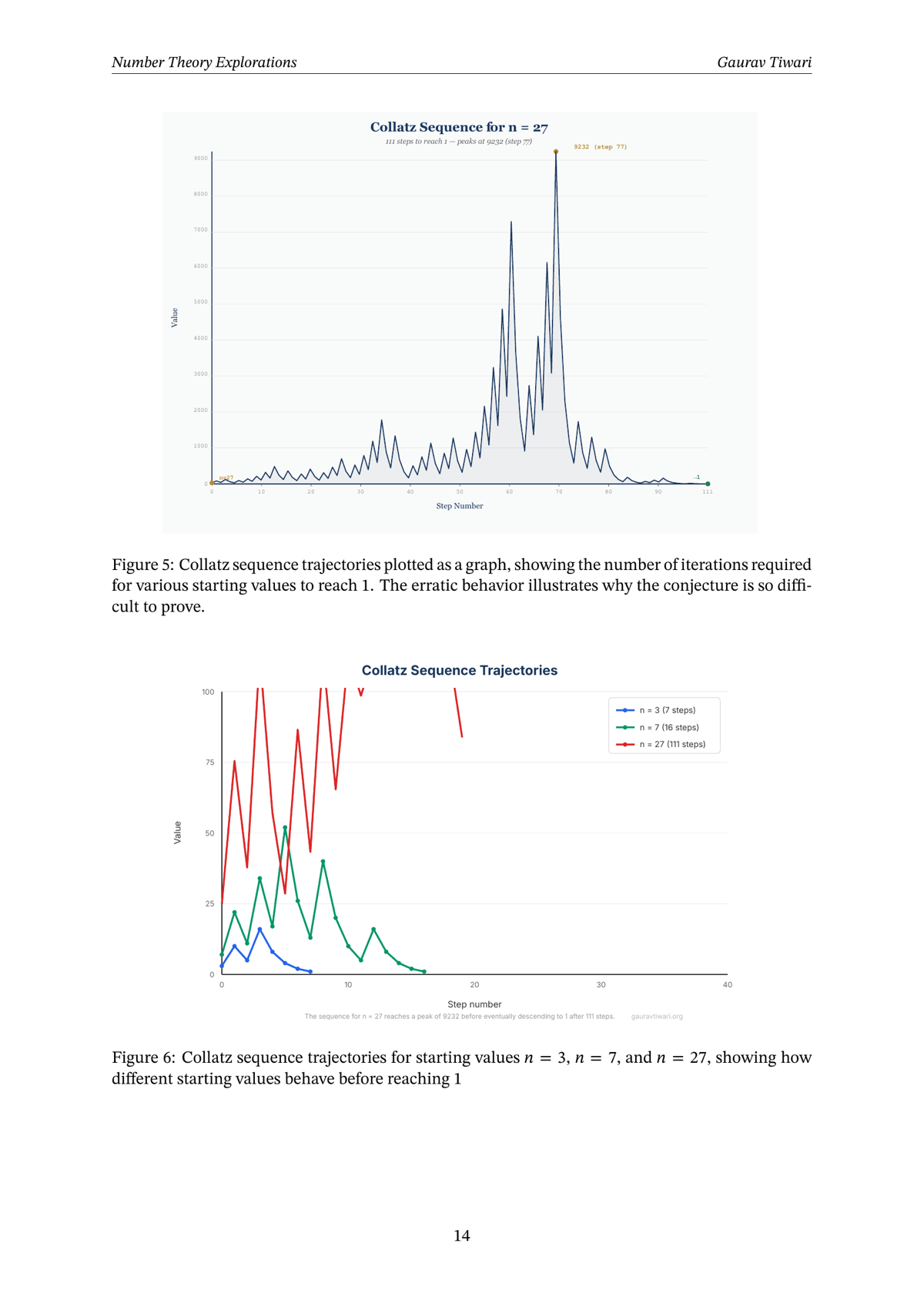
- A sieve-based argument, presented and then systematically critiqued.
- Computational verification and the partial results so far.
- Possible failure modes, taken seriously rather than waved away.
- Why the problem remains so hard, stated honestly.
Quadratic residues run through all three corners, and the book makes those connections explicit.
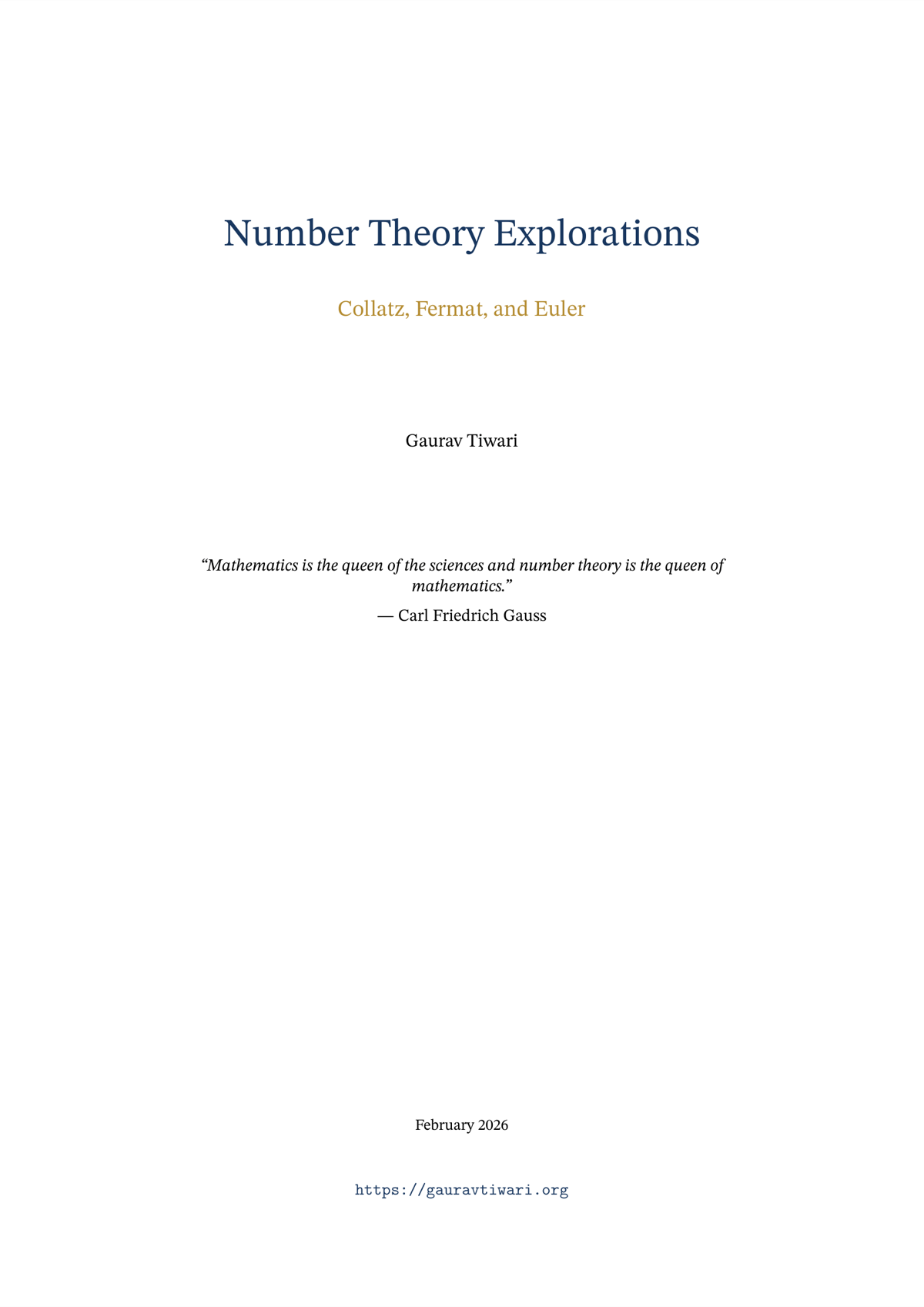
Look inside the book.
Preview the writing, structure, and page layout before you decide.
Get the book
Number Theory Explorations
Free
Free ebook · instant download · no payment step
- Test Fermat numbers for primality and follow their factorizations
- See why 641 divides F5, through Bennett’s elegant proof
- Understand why n² + n + 41 works forty times and then stops
- Follow the Collatz sieve argument and see exactly where it falls short
- Trace quadratic residues through all three topics
- Use the complete tables of Fermat factorizations and Euler formula values
No payment. Checkout creates your download link instantly.
Questions readers ask
Asked before downloading, answered straight.
Is it actually free?
Yes. There’s no payment step and no email gate. The checkout exists only to create your download link, and it does that instantly.
Does it prove the Collatz conjecture?
No, and it doesn’t pretend to. It presents a sieve-based argument, then systematically critiques why that argument is insufficient for a proof. You get the computational verification, the partial results, the possible failure modes, and an honest account of why the problem stays open.
Do I need heavy prerequisites?
The three objects are elementary: Fermat numbers, a quadratic polynomial, and a rule you can run on any integer by hand. The proofs go deeper from there, Pepin’s test and the Heegner number connection among them, but each chapter builds up from the definitions.
Why these three topics?
Because they connect. Quadratic residues run through all three, and the book makes those connections explicit. You also get complete tables of Fermat factorizations and Euler formula values, plus the open problems and computational frontiers at each edge.
What I’m not going to claim
The Collatz chapter does not solve the Collatz conjecture. Nobody has. What it does is show you a plausible attack, a sieve-based argument, and then take it apart honestly, which teaches you more about the problem than a tidy summary would.
This is an exploration of three corners, not a complete number theory course. It goes deep on Fermat numbers, Euler’s polynomial, and Collatz, and it stays there.
It’s a free download with no ratings to show, so there’s no rating band on this page. I’d rather skip the section than dress one up.

Hey, I’m Gaurav 👋
I taught mathematics before the web work, and my M.Sc. is in mathematics. Number theory is what I reach for when someone asks why anyone falls in love with this subject: the questions fit in one line, and some of the answers have held out for centuries.
The numbers, since you probably won’t read a full bio:
- 18 years building on the web, and a WordPress core contributor
- 2,000+ articles published since 2008
- 850+ clients
Free download
Spend an evening with problems that fight back.
Fermat numbers, a polynomial that almost works, and a conjecture nobody can close. All three, free.
Free ebook · download link issued instantly at checkout